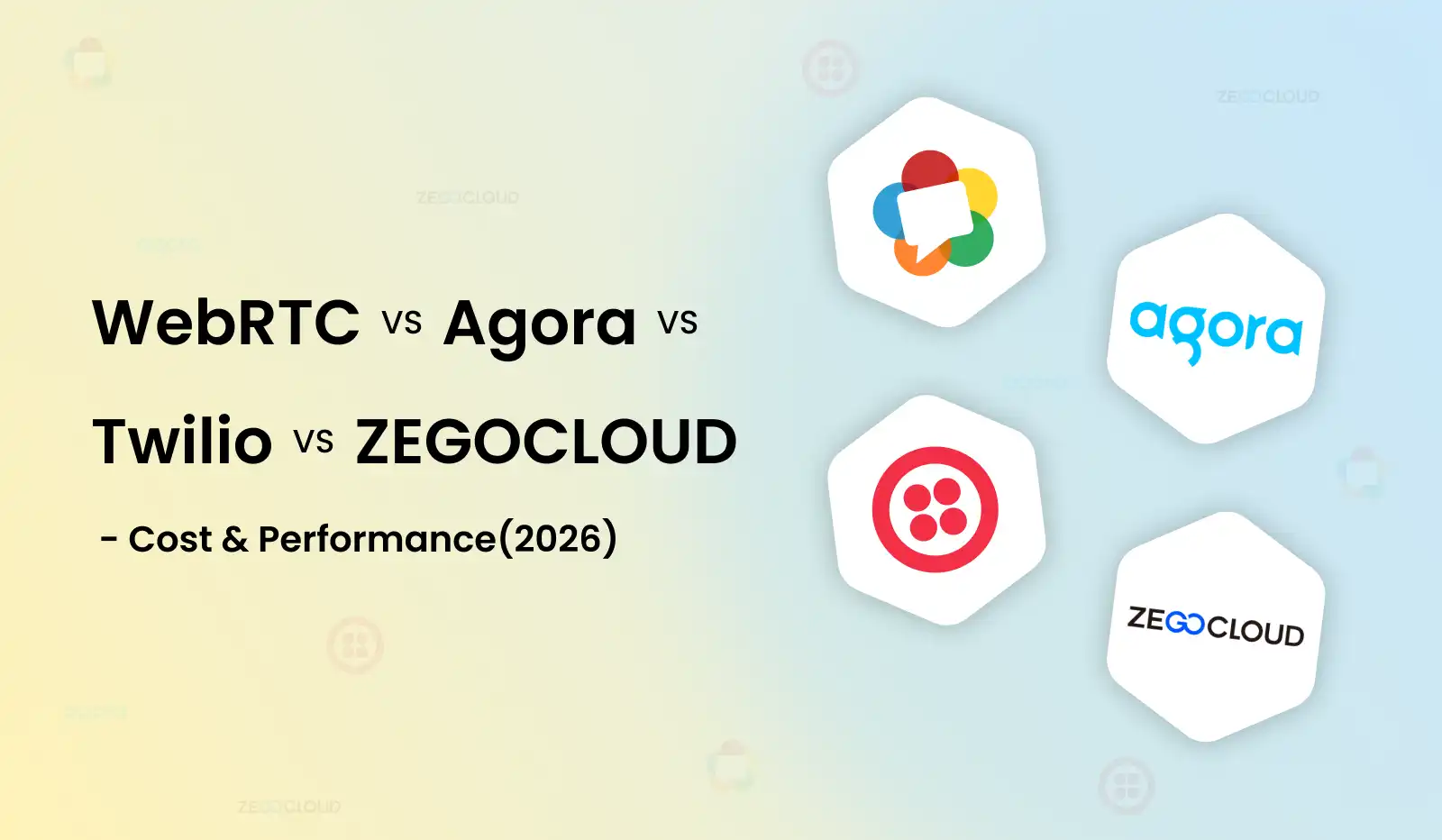
PeerJS vs Agora vs Twilio vs ZEGOCLOUD: Cost & Performance Comparison (2026)
Date
20 Apr, 2026
Share:
When you start building a mobile app or web platform that needs real-time video calling — whether through a peerjs video call setup or a fully managed API — you face an immediate choice: pay for a managed API like Agora, Twilio, or Zegocloud — or build your own real-time communication layer using WebRTC. At Primocys, we deliver self-hosted WebRTC for both mobile apps (Flutter & React Native on iOS and Android) and web applications (React, Next.js, Vue) — same open standard, same cost advantage, same data ownership. This guide gives you the honest numbers, the architecture differences, and the decision framework we use when we build video calling into apps like Corex Messenger and Vemenne.
What Is WebRTC & How Does PeerJS Simplify It?
WebRTC (Web Real-Time Communication) is an open-source standard — built into every major browser and available natively on Android and iOS — that enables peer-to-peer audio, video, and data transmission directly between devices. It is the same technology underlying Google Meet, Facebook Messenger’s video calls, and Discord.
The challenge with raw WebRTC is complexity. You need to manage ICE (Interactive Connectivity Establishment) candidates, SDP (Session Description Protocol) negotiation, STUN servers (for NAT discovery), TURN servers (for relay when direct P2P fails), and your own signalling layer. It is powerful but verbose.
PeerJS is an open-source JavaScript library that wraps WebRTC’s complexity behind a clean API. Instead of managing ICE candidates and SDP offers yourself, PeerJS handles the handshake, NAT traversal, and connection setup — letting you focus on your application logic.
⚡ The key insight: Agora, Twilio, and Zegocloud are essentially “WebRTC-as-a-service” — they host the signalling servers, STUN/TURN infrastructure, and media relay on your behalf and charge per minute for the privilege. PeerJS gives you the same WebRTC standard but you host the infrastructure yourself, paying only for server costs instead of per-minute usage fees.
WebRTC for Mobile App vs Web — How Primocys Delivers Both
One of the most common misconceptions we hear: “WebRTC is for browsers only.” That hasn’t been true for years. At Primocys, we implement self-hosted WebRTC across every platform — and the same infrastructure (your TURN server + signalling server) powers all of them simultaneously.
Mobile App (Flutter & React Native)
WebRTC runs natively on both Android and iOS via official platform APIs. For Flutter projects (our primary mobile stack), we use the flutter_webrtc package — a mature, production-tested binding to the native WebRTC engine on both platforms. For React Native, the equivalent is react-native-webrtc. Both connect to the same PeerJS signalling server your web users use — one backend, all platforms.
Flutter + flutter_webrtc — production-ready, used in Vemenne (iOS & Android)
React Native + react-native-webrtc — compatible with the same signalling server
Works on both Android (API 21+) and iOS (13+)
Same TURN server handles NAT traversal for mobile and cellular users
No Agora SDK, no proprietary binary — just WebRTC native APIs
Web Application (React, Next.js, Vue, Vanilla JS)
In web browsers, WebRTC is a first-class native API — available in Chrome, Firefox, Safari, and Edge without any plugin. PeerJS wraps the browser’s RTCPeerConnection API, meaning the exact same JavaScript calling code works across all major browsers. For React / Next.js projects, we integrate PeerJS into a custom hook or context so call state is managed cleanly alongside your application state.
Native browser support — Chrome, Firefox, Safari, Edge (no plugins)
Works in React, Next.js, Vue, Angular, and plain JavaScript
Same PeerJS signalling server serves both mobile and web users
Screen sharing, file transfer via Data Channel, and group calls all supported
✅The architecture advantage: Because WebRTC is an open standard implemented at the OS and browser level, a single backend deployment — one Node.js PeerJS signalling server + one Coturn TURN server — serves your Flutter mobile app, your iOS app, your Android app, and your web application simultaneously. You are not paying Agora per-minute for each platform separately.
How Each Platform Actually Works
ARCHITECTURE: SELF-HOSTED WEBRTC VS MANAGED API (AGORA / TWILIO / ZEGOCLOUD)
✅ PeerJS Self-Hosted WebRTC
User A (Browser)Your App
P2P Direct
↔
User B (Mobile)Your App
TURN relay(~15-20% of calls)
Your TURN ServerCoturn · AWS · $5-20/mo
Total: $30-$45/month (fixed, 100 users)
Your Node.js SignallingWebSocket + PeerJS ServerIncluded in your backend
❌ Agora / Twilio / Zegocloud
User AYour App
User BYour App
All trafficroutes viatheir servers
THEIR Cloud ServersAgora / Twilio / Zegocloud data centres
💳 Per-Minute BillingEvery call · Every user · Every minuteScales directly with your growth
The architecture difference is fundamental. With third-party APIs, all your call data flows through their infrastructure — every packet, every audio frame, every video frame. With self-hosted WebRTC, direct peer-to-peer connections handle approximately 80–85% of calls, and your own TURN server handles the remaining 15–20% where direct connection is blocked by NAT or firewalls. Your data never leaves your infrastructure.
Real 2026 Cost Breakdown — All Four Platforms
Let’s use a consistent scenario for fair comparison: 100 daily active users, each making an average of 60 minutes of HD video calls per day, 30 days per month. That’s 180,000 call-minutes per month.
Scenario
Agora
Twilio
Zegocloud
PeerJS WebRTC (Self-Hosted)
Pricing model
Per minute/user
Per minute/user
Per minute/user
Fixed server cost
HD video rate
$8.99/1,000 min
$4.00/1,000 min
$0.99/1,000 min
$0 per minute
10 users, 1hr/day
$16.18/mo
$7.20/mo
$1.78/mo
$15–$25/mo
100 users, 1hr/day
$718.20/mo
$720.00/mo
$108.00/mo
$30–$45/mo
1,000 users, 1hr/day
$7,182/mo
$7,200/mo
$1,080/mo
$80–$150/mo
10,000 users, 1hr/day
$71,820/mo
$72,000/mo
$10,800/mo
$300–$600/mo
Data ownership
❌ Their servers
❌ Their servers
❌ Their servers
✅ Your servers
Vendor lock-in
❌ High
❌ High
❌ High
✅ None
Year-1 saving (vs Agora, 100 users)
—
Similar to Agora
$7,320 saving
~$8,200 saving
⚠️Important note on Zegocloud: Zegocloud appears significantly cheaper than Agora and Twilio — and for small-scale apps with 10–50 users, it can be cheaper than self-hosted WebRTC (which has a fixed baseline cost). However, at 1,000+ users, the per-minute model still results in $1,080/month vs $80–$150/month for self-hosted. Additionally, your data still routes through their servers — an issue for enterprise, healthcare, or compliance-sensitive applications.
Interactive Cost Calculator — See Your Numbers
💰 WebRTC Cost Calculator
Enter your expected usage and see the monthly cost difference across all four platforms.
Agora—per month
Twilio—per month
Zegocloud—per month
PeerJS WebRTC—per month (fixed)
You Save vs Agora—per year
Full Feature Comparison Table
Feature
PeerJS WebRTC
(Self-Hosted)
Agora
Twilio
Zegocloud
1:1 Video Calls
✅
✅
✅
✅
Group Video Calls
⚡ SFU needed
✅
✅
✅
Audio Calls
✅
✅
✅
✅
Screen Sharing
✅
✅
✅
✅
Data Channels (P2P file share)
✅
❌
❌
❌
Self-hosted option
✅ Full
❌ None
❌ None
⚡ Limited
Data stays on your server
✅
❌
❌
❌
GDPR / HIPAA / PDSK ready
✅ Full control
⚡ Partial
⚡ Partial
⚡ Partial
No vendor lock-in
✅
❌
❌
❌
Predictable monthly cost
✅ Fixed
❌ Usage-based
❌ Usage-based
❌ Usage-based
Per-minute fees
$0
$3.99–$8.99/1k min
$4.00/1k min
$0.59–$0.99/1k min
Setup complexity
Medium
Low
Low
Low
Works in China (requires relay)
✅ TURN relay
✅ Built-in
⚡ Limited
✅ Built-in
Custom UI/UX freedom
✅ Complete
⚡ SDK-limited
⚡ SDK-limited
⚡ SDK-limited
When to Use Each Platform — The Decision Framework
Choose Self-Hosted PeerJS WebRTC When:
Your app will have 50+ daily active users making video calls — the fixed server cost becomes cheaper than per-minute APIs from this point
Your application handles sensitive data — healthcare (HIPAA), finance, enterprise (GDPR), or any regulated industry where routing calls through third-party servers creates compliance risk
You are building for Indonesia, India, or any region with data residency laws — PDSK, DPDP, and similar regulations are easier to comply with when data stays on your servers
You want zero vendor lock-in — if Agora doubles their prices (they have done this before), you have no leverage. With self-hosted WebRTC, you own the infrastructure
You need full UI/UX control — third-party SDKs impose UI patterns; WebRTC gives you complete freedom over the interface design
li>You are building a long-term product — the infrastructure investment pays back within the first 3–6 months of real usage
Choose Agora / Twilio / Zegocloud When:
You are building a prototype or MVP with fewer than 20 daily users — the managed service requires zero infrastructure setup
You need a working demo in 48 hours for a pitch or investor presentation
Your team has no backend or DevOps experience — running a TURN server requires server administration knowledge
Your app serves users in China — Agora and Zegocloud have strong built-in China infrastructure; WebRTC through a TURN server in Hong Kong can work but requires more configuration
The video calling feature is a minor add-on with very low usage — for truly minimal usage, a managed service can be cheaper than your minimum server costs
🚀 We Build with Self-Hosted WebRTC as Standard
Every video calling app Primocys delivers uses self-hosted WebRTC — zero per-minute fees, full data ownership. See it running live in a demo.
Here is the minimum viable implementation of a 1:1 video call using PeerJS — the same foundation we use in production
chat applications like Corex Messenger and Vemenne, built with our Node.js backend.
Step 1 — Install PeerJS
bash
# For Node.js server (PeerJS signalling server)npminstallpeer# For your web clientnpminstallpeerjs# Or include via CDN<script src="https://unpkg.com/[email protected]/dist/peerjs.min.js"></script>
Step 2 — PeerJS Signalling Server (Node.js)
javascript
const { PeerServer } = require('peer');
const express = require('express');
const app = express();
// Mount PeerJS signalling serverconst peerServer = PeerServer({
port: 9000,
path: '/peerjs',
// Add your own TURN server config for production
config: {
iceServers: [
{ urls: 'stun:stun.l.google.com:19302' }, // Free STUN
{
urls: 'turn:your-turn-server.com:3478', // Your TURN
username: 'your_username',
credential: 'your_password'
}
]
}
});
peerServer.on('connection', (client) => {
console.log(`Peer connected: ${client.getId()}`);
});
app.listen(3000);
Step 3 — Client-Side Call Initiation
javascript
import Peer from'peerjs';
// Connect to your own PeerJS signalling serverconst peer = new Peer('my-unique-peer-id', {
host: 'your-server.com',
port: 9000,
path: '/peerjs',
secure: true
});
// Get user camera + microphoneconst localStream = await navigator.mediaDevices.getUserMedia({
video: true,
audio: true
});
// Initiate call to another peerconst call = peer.call('remote-peer-id', localStream);
// When remote stream arrives - display it
call.on('stream', (remoteStream) => {
remoteVideoElement.srcObject = remoteStream;
});
// Handle incoming calls
peer.on('call', (incomingCall) => {
incomingCall.answer(localStream); // Answer with local stream
incomingCall.on('stream', (remoteStream) => {
remoteVideoElement.srcObject = remoteStream;
});
});
✅That is genuinely the core of a 1:1 video call. Three files, ~60 lines of code. The rest of your implementation effort goes into UI design, call state management (ringing, connected, ended), and TURN server configuration for production reliability — not the call technology itself.
Scaling Beyond 1:1 — Group Calls with SFU Architecture
Standard PeerJS uses a mesh network architecture where each participant connects directly to every other participant. This works well for 2–4 users in a call, but becomes bandwidth-intensive beyond that. For a call with 6 participants in a mesh, each person is sending 5 streams simultaneously — which can overwhelm mobile connections.
The SFU Solution
For group calls with 5+ participants, Primocys implements a Selective Forwarding Unit (SFU) — a WebRTC media server where each participant sends one stream to the SFU, and the SFU forwards the appropriate streams to each participant. This dramatically reduces per-user bandwidth requirements.
Each user sends 1 stream to SFU — receives selected streams back
A
B
C
D
E
MediaSoup / JanusSFU Server (open-source)
✅ MediaSoup or Janus — open source, self-hosted
The open-source SFU options Primocys uses — MediaSoup and Janus — are the same category of technology Agora uses internally. The difference: Agora hosts it and charges per-minute; you host it on your own server and pay only for compute.
What We Actually Use in Production at Primocys
This is not a theoretical comparison. Here is exactly what we implemented in two live applications:
Corex Messenger — Enterprise B2B Chat
Built for Orbis Elite, Inc
1:1 calls: PeerJS WebRTC with direct P2P connections for ~83% of calls
NAT fallback: Coturn TURN server deployed on AWS EC2 — handles the remaining ~17% of calls blocked by corporate firewalls
Signalling: Custom Node.js signalling server integrated with the main chat WebSocket infrastructure
Data: All call metadata and media stay on the client's own server — no third-party access
Cost vs Agora: With ~50 enterprise users making calls regularly, we estimate saving $3,500–$4,200/year vs Agora HD pricing
Vemenne — Student Community App
Student & University Messenger
1:1 calls: PeerJS WebRTC — same P2P architecture
Group study calls: MediaSoup SFU for calls with 3–8 participants — deployed on the same server cluster as the application
Regional performance: TURN server deployed in Singapore region — lowest latency for Indonesian users across Telkomsel, Indosat, and XL mobile networks
Mobile SDK: Flutter with native WebRTC bindings via flutter_webrtc package
✅Our standard architecture for all Primocys video calling projects: PeerJS + Coturn TURN server (for 1:1 and small groups) + MediaSoup SFU (for groups of 5+). This stack scales from 10 users to 100,000+ users with only infrastructure scaling — no change to the calling architecture, no change to per-minute pricing, and no change to data ownership.
STEP 1 OF 3 · BUDGET RANGE
What's Your Approximate Budget for This Project?
Every Instagram clone is unique — the investment depends on your feature set, platform choices, AI requirements, and
target scale. Tell us about your project and we'll send a precise, no-obligation estimate within 24 hours.
Under $10,000
$10,000 – $25,000
$25,000 – $50,000
$50,000 – $100,000
$100,000+
Not Sure Yet
Help me decide
STEP 2 OF 3 · KEY FEATURES
Which features matter most to you?
Select all that apply — this helps us scope your estimate accurately.
STEP 3 OF 3 · GET YOUR ESTIMATE
How would you like to receive your estimate?
Choose whichever feels comfortable — both work great.
✉️
Get estimate via Email
We'll send a detailed breakdown to your inbox within 24 hours
⚠️ Please enter your name.
⚠️ Please enter a valid email.
🔒 No spam ever. Only your project estimate, nothing else.
✅
Check your inbox soon!
We've received your project details. Our team will send a tailored estimate to
your
email within 24 hours — check your spam folder just in case.
See self-hosted WebRTC running in a React / Next.js web application — browser-native 1:1 video, group calls, and screen sharing with full data ownership.
Choosing the right real-time video platform in 2026 comes down to one question: do you want convenience or control?
Agora, Twilio, and Zegocloud deliver fast setup and managed infrastructure — but you pay per minute, per user, forever. Costs scale brutally as your app grows.
A peerjs video call implementation or a fully self-hosted WebRTC solution gives you complete data ownership, zero per-minute fees, and full architectural control — exactly what we build at Primocys for production apps like Corex Messenger and Vemenne.
Our honest verdict:
PeerJS / Self-Hosted WebRTC — Best for scale, cost & privacy
Agora — Best for fastest MVP launch
Zegocloud — Best for budget managed API
Twilio — Most expensive at scale
If you are building a Flutter, React Native, React, or Next.js app and want real-time video without the recurring API bill — Primocys can build it for you.
Frequently Asked Questions
Is PeerJS WebRTC better than Agora for video calling apps?
For apps with 50+ daily active users making video calls, PeerJS WebRTC is significantly more cost-effective — the fixed server cost of $30–$45/month vs Agora's usage-based pricing of $718/month (100 users, 1hr/day HD) represents an 80–95% cost reduction. PeerJS also gives you full data ownership and no vendor lock-in. Agora's advantages are faster initial setup and no server administration required — making it suitable for prototypes and very low-usage applications.
What are the actual 2026 costs of Agora, Twilio, and Zegocloud?
In 2026: Agora charges $3.99/1,000 minutes (SD video) and $8.99/1,000 minutes (HD video) per user. Twilio charges approximately $4.00/1,000 minutes for video. Zegocloud charges $0.59–$0.99/1,000 minutes. All three use per-minute pricing that scales directly with your user activity. At 1,000 users making 1 hour of HD calls daily, Agora costs $7,182/month — compared to $80–$150/month for self-hosted WebRTC.
What is a TURN server and do I need one for PeerJS WebRTC?
A TURN server is a relay server used when a direct peer-to-peer WebRTC connection cannot be established — typically when users are behind strict corporate firewalls or mobile carrier NAT. Approximately 15–20% of WebRTC connections require a TURN relay. You need one for production. Coturn is the most popular open-source TURN server — it runs on any Linux server (AWS, DigitalOcean, Hetzner) and costs $5–$20/month depending on traffic volume. Primocys sets up Coturn as part of every WebRTC integration we deliver.
Can PeerJS WebRTC handle group video calls?
Standard PeerJS uses a mesh architecture — works well for 2–4 participants. For groups of 5+, Primocys implements a Selective Forwarding Unit (SFU) using MediaSoup or Janus — open-source WebRTC media servers that enable scalable group calls. This is the same architecture category Agora uses internally, just self-hosted. The SFU runs on your own server, adding approximately $20–$50/month to infrastructure costs regardless of call volume.
Does Primocys use PeerJS WebRTC in production apps?
Yes. Every video calling app Primocys delivers — including Corex Messenger (enterprise B2B) and Vemenne (student community app) — uses self-hosted WebRTC. We do not use Agora, Twilio, or Zegocloud in any production application. The reasons are the same as described in this article: predictable costs, full data ownership, and compliance with GDPR, HIPAA, and Indonesia's PDSK data privacy law. Book a demo to see it running →.
Can Primocys implement WebRTC in a Flutter mobile app?
Yes — Flutter is our primary mobile stack for WebRTC delivery. We use the flutter_webrtc package, which provides production-ready native WebRTC bindings for both iOS and Android. Your Flutter app connects to the same PeerJS signalling server as any web users — one backend, all platforms. We've deployed this in Vemenne (student community app for Indonesian users) where the TURN server is hosted in Singapore for low-latency mobile connections. Book a Flutter WebRTC demo →
Can Primocys add WebRTC video calling to an existing web application?
Yes. For existing React, Next.js, Vue, or any web application, we integrate PeerJS WebRTC as a self-contained calling layer — typically a custom React hook or context that manages call state and connects to your Node.js PeerJS signalling server. No Agora SDK, no third-party dependency in your bundle, no per-minute costs. The integration can be added to an existing web app without changing your existing architecture. You can see a live example at whoxachat.com — our full-stack chat and video demo. Contact us to discuss your web app →
Arpan Sagar
Arpan leads product and engineering at Primocys, a Top-Rated Clutch app development company based in Ahmedabad, India. With over 10+ years of experience, he has successfully delivered real-time communication platforms for 1,200+ clients worldwide.
He is directly involved in overseeing the development of chat and messaging applications, ensuring high performance, scalability, and seamless user experience in every project.
📧 Email: [email protected]
📱 WhatsApp: Chat on WhatsApp
Trusted by Global Businesses for AI, Mobile, SaaS & Custom Software Development. Your Vision, Our Expertise.Trusted by Global Businesses for AI, Mobile, SaaS & Custom Software Development. Your Vision, Our Expertise.Trusted by Global Businesses for AI, Mobile, SaaS & Custom Software Development. Your Vision, Our Expertise.Trusted by Global Businesses for AI, Mobile, SaaS & Custom Software Development. Your Vision, Our Expertise.Trusted by Global Businesses for AI, Mobile, SaaS & Custom Software Development. Your Vision, Our Expertise.Trusted by Global Businesses for AI, Mobile, SaaS & Custom Software Development. Your Vision, Our Expertise.
Hear from our clients and why 1200+ businesses trust Primocys
"Our B2B and B2C platform helps Nigerian manufacturers sell at wholesale
prices and suppliers offer competitive retail pricing, with a strong focus on Made in Africa products
and easy local and international distribution.
The app has received excellent user reviews for its design and unique features. Communication with the
Primocys team was smooth in an agile setup, even beyond office hours when needed. Their mobile app
development expertise is excellent—highly professional and reliable."
Adegbuyi OduguwaCEO & Co-Founder
"The dating app was delivered successfully and approved by both Apple App
Store and Google Play. Our users are highly impressed with the design, UI, and overall functionality.
The project was well planned with clear milestones, and all modules were delivered on time.
The team is talented, patient, and flexible, accommodating multiple scope revisions as requirements
evolved. Their 24/7 development and support availability made the entire process smooth and reliable."
Revanth KExecutive
" We hired Primocys to develop a highly complex and specialized mobile
application, and they delivered outstanding results. The app includes advanced features such as
timeline mixers, classifieds, payments, advertisements, GPS functionality, and more. Their technical
skills, timely delivery, availability, and the personal attention Arpan Sagar brings to each project
truly stand out. The team stays focused and committed from start to finish—an excellent experience
overall."
Gregor Skerl Founder PROHUNTER
" Great team with excellent communication and a strong commitment to on-time
delivery. They developed a fully customized mobile app for both Android and iOS, perfectly matching
our requirements. The entire process was smooth and professional, with clear updates at every stage.
They are reliable, skilled, and very easy to work with. We’re continuing our partnership on more
projects, and choosing them has been one of the best business decisions I’ve made."