








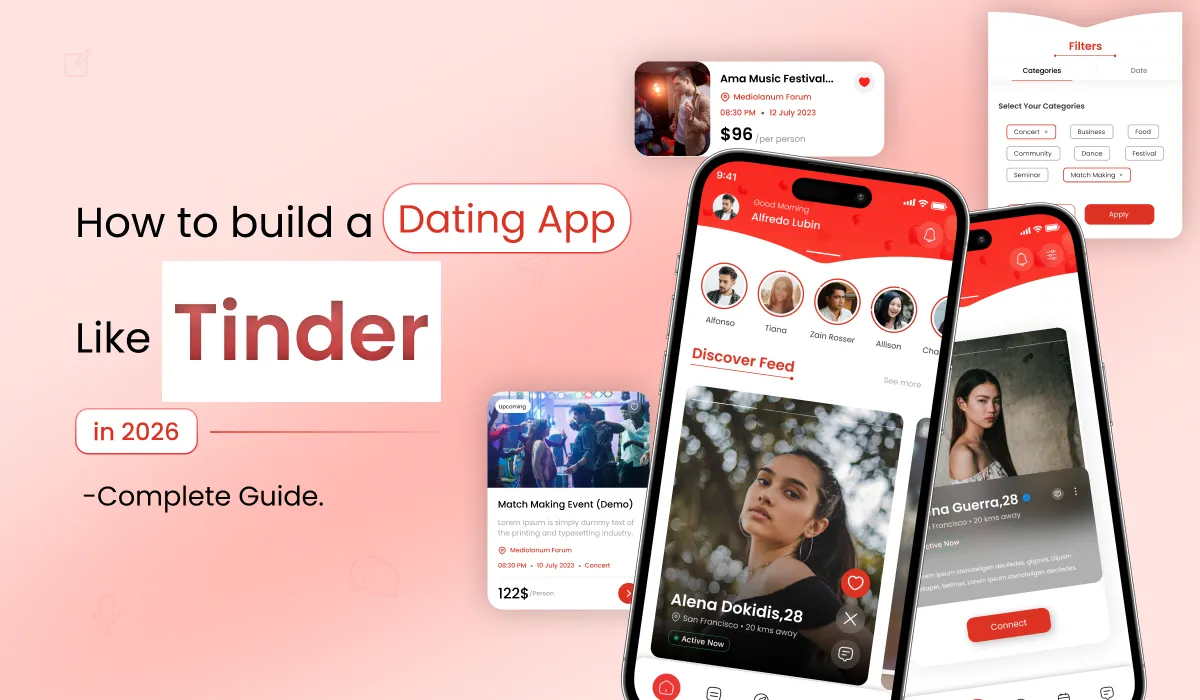
A dating app like Tinder — but one Tinder can’t build — is the real opportunity in 2026. It’s about serving a specific niche, integrating AI matching from day one, building safety into the architecture, and monetising through subscriptions before it ever shows an ad. This guide walks through every step — from market positioning and core features to tech stack, cost, and go-to-market strategy.
The global online dating market hit $9.8 billion in 2026 and is forecast to reach $15 billion by 2035. Southeast Asia alone — Indonesia, Malaysia, Vietnam, Philippines — is growing at 11% CAGR, driven by a young, smartphone-first population increasingly comfortable with digital matchmaking. Tinder has 75 million registered users. Bumble IPO’d at a $13 billion valuation. Hinge grew revenue 200% in a single year.
The numbers look intimidating. They shouldn’t. Because the incumbents all share a common problem: they were built on architectures from 2012–2016. They are slow to ship features, weak on AI personalisation, and largely indifferent to niche communities. That is precisely where new entrants win consistently — and where the real opportunity in dating app development lives in 2026.
Global dating app market value in 2026
SEA dating market annual growth rate (CAGR)
Global dating app users in 2024, growing year-on-year
This guide covers everything you need to build a competitive dating app in 2026 — not a Tinder clone, but a product with a specific purpose, a real audience, and the technical foundation to keep users coming back.
WHAT THIS GUIDE COVERS
Planning to add dating features into a messaging platform? See our WhatsApp clone app development contact page → for the real-time chat and WebRTC calling infrastructure that underpins both products. Ready to start building? Explore our dating app development services → for a detailed overview of what we build at Primocys.
Before You Build: The Strategic Decision That Determines Everything
The single most important question in dating app development is not “what features should we build?” It is: are you building for everyone, or for someone specific?
Tinder is for everyone. That also means it is optimised for no one in particular. The apps that have succeeded in Tinder’s shadow — Hinge for relationship-seekers, Grindr for gay men, Bumble for women who want conversational control, Feeld for non-monogamous users — all won by going narrower, not broader. Each picked a specific underserved audience and built something genuinely better for that audience than Tinder offered.
| Niche | Why It’s Underserved by Tinder | Revenue Potential |
|---|---|---|
| Faith-based matching (Muslim, Christian, Hindu) | Tinder’s casual framing alienates religious users | High — strong willingness to pay for values-aligned matches |
| Professional / career-focused | LinkedIn demographic wants relationships, not hookups | High — premium subscription tolerance |
| LGBTQ+ regional (SEA / Middle East) | Safety features mainstream apps don’t provide | Strong — loyal, high-retention user base |
| Language / expat communities | Shared language is a stronger match signal than location alone | Medium — underserved in specific geographies |
| Senior dating (50+) | Fastest-growing demographic, worst-served by existing apps | High — High ARPU, lower churn than younger cohorts |
| Sober / wellness-focused | Identity-based — users leave Tinder specifically for this | Strong — community monetisation potential |
The chicken-and-egg network effect problem is magnified in dating apps. An app needs critical mass in a specific geography and a specific demographic before matches feel meaningful. A general-purpose app must solve this everywhere simultaneously. A niche app needs to solve it for one audience in one city — a far more tractable problem.
Step-by-Step: How to Build a Dating App Like Tinder
Building a dating app is a six-phase process. Each phase builds on the last. Skipping phases — particularly the research and design phases — is the most reliable way to waste development budget and launch a product no one uses.
Define Your Niche, UVP, and Target Market
Document your target persona (age range, geography, relationship goal, what they hate about existing apps). Write a one-sentence unique value proposition: “The only dating app for [X] in [Y] that does [Z] differently.” Map your competitive landscape. Validate with 20–30 user interviews before any design work begins.
Map Your Feature Set — MVP vs. Full Build
Draw a clear line between what ships in the MVP and what waits for Phase 2. The MVP rule: users must be able to create a profile, browse, match, and message. Nothing more. Every additional feature in the MVP is a risk to launch timeline and budget.
Design the UX/UI
Dating app UX lives and dies on two flows: onboarding (signup to first swipe in under 90 seconds) and Match → Message (zero friction). Prototype in Figma and test with 10 real target users before development begins. Key principles: large fast-loading photos, single-thumb usability, and gamified micro-interactions that drive return visits.
Choose Your Tech Stack
The critical decision: Flutter (cross-platform, recommended for SEA and most markets) vs. native Swift + Kotlin (maximum performance for premium Western markets). See the full tech stack breakdown below. Decide before development starts — migration is expensive.
Build the MVP — Backend First
Sprint structure: 2-week sprints, backend first (auth, profile, matching engine) then frontend. Start with rule-based matching — do not build ML until you have 10,000+ active users for training data. Conduct a closed beta with 50–200 users in your target city before App Store submission.
Dating App Features: 10 Core Things to Build in a Dating App Like Tinder
Each feature is covered at engineering depth — what to build, why it matters in 2026, and the implementation decisions that separate apps that retain users from apps that lose them at day 7.
Smart Onboarding and Profile Creation
60–70% of dating app churn happens during onboarding. Every extra step loses users. The goal is completing profile creation in under 90 seconds while capturing enough data to power meaningful first matches — a balance that requires progressive disclosure, not an exhaustive signup form.
WHAT TO BUILD
- WebSocket-based persistent connection (Socket.io or native WebSocket)
- Message queue (Redis or RabbitMQ) for guaranteed delivery
- Delivery state machine: sent → delivered → read with timestamps
- Typing indicators via lightweight WebSocket event, debounced to avoid channel flooding
- Threaded replies with original message quoted inline
- Message reactions — emoji picker plus custom reactions
- Starred/bookmarked messages accessible from a dedicated inbox
- Disappearing messages (24h / 7d / 90d timer), enforced server-side with TTL
Location-Based Discovery and Geofencing
Proximity is the #1 matching signal for casual and relationship-oriented dating alike. Users who can meet within 24 hours of matching have 3× the message conversion rate of long-distance matches. Getting GPS right — fast, accurate, and battery-efficient — is harder than it sounds.
WHAT TO BUILD
- Background GPS with adaptive polling rate — frequent when open, sparse when backgrounded
- Configurable radius: 1km / 5km / 25km / anywhere (radius “anywhere” = premium feature)
- Location privacy: show approximate distance (“2km away”), never exact coordinates
- Ghost mode (premium): browse without appearing in others’ discovery feeds
- Travel/Passport mode (premium): set location to another city before visiting
- Geofence-triggered match pool refresh on significant location change (100m+ movement threshold)
Battery note: Location polling is the fastest way to earn a one-star review. Use the Haversine formula for distance calculation server-side and only re-poll GPS on significant movement — not on a timer.
Swipe Mechanic and Match Engine
Tinder’s swipe mechanic made dating apps addictive. But the swipe is just the UI — the real product is the order in which profiles are presented. Get that wrong, and users swipe exhaustively with no matches, get bored, and uninstall. The match engine is the actual product.
Swipe interface
- Card stack UI with physics-based spring animation — smooth and satisfying to use
- Super Like (limited per day on free tier) — notifies the recipient distinctly
- Undo last swipe (premium feature)
- Profile expand: tap photo → full profile, voice prompt, all photos before deciding
Matching engine — rule-based MVP
- Filter pool by: proximity radius, age range, gender preference, relationship goal
- Score by: mutual interest tag overlap, recency (active users ranked higher), profile completeness
- Exclude previously seen profiles and unmatched profiles (with cooldown period)
- Queue management: curated stack of 20–30 profiles per session, refreshed on demand
AI-Powered Matching Algorithm
The matching algorithm is the actual product of a dating app. In 2026, any app without an ML matching layer is immediately outcompeted by Tinder, Hinge, and Bumble — all of which have been training their models for a decade. The good news: you don’t need their scale to start.
Build in three layers, introduced progressively as data accumulates:
Rule-Based Filtering
Hard filters: location, age, gender. Soft filters: relationship goal match, interest tag overlap score. Fast, interpretable, works from user one.
Collaborative Filtering
“Users with similar swipe patterns to you also liked these profiles.” Netflix-style recommendation. Predicts mutual like probability for both parties.
Reinforcement Learning
Trains on message length, response time, date conversion, unmatch rate. Adjusts match scores in real time. Optimises for conversations, not just swipes.
Real-Time Chat and Conversation Tools
Matches who don’t message within 24 hours almost never message at all. The moment of first message is the highest-friction point in the dating app funnel — and anything that reduces that friction directly improves DAU and subscription conversion.
WHAT TO BUILD
- WebSocket-based real-time messaging (see our WhatsApp clone features guide → for architecture)
- Match-gated access: messaging only opens on mutual like
- AI conversation starters: icebreaker suggestions based on shared interests
- Photo sharing in chat with opt-in moderation to prevent unsolicited inappropriate images
- Voice notes (30-second limit)
- GIF search integration (Giphy or Tenor API)
- Unmatch and report — one tap from within the chat thread, no friction
- Read receipts (premium feature)
Video Dating and Voice Calls (Self-Hosted WebRTC)
Video dating is now a permanent user expectation — not a pandemic-era feature. Users who video-call before meeting have lower ghosting rates and higher date conversion. In 2026, an app without in-app video is perceived as unsafe by a meaningful portion of users, particularly women.
WHAT TO BUILD
- Self-hosted WebRTC (LiveKit or mediasoup) — no per-minute API fees, full data control
- 1:1 video calls between matched users only — no cold calling
- Video date scheduling with dual reminder notifications
- Speed date mode: optional 15/30-minute timer with countdown — reduces “how long should this call be?” anxiety
- Blur background option for users in shared spaces
- In-call report button — one tap safety exit
Safety and Trust Infrastructure
Safety is the #1 reason women stop using dating apps. This is not a social responsibility statement — it’s a retention strategy. Apps that solve the safety problem better than Tinder retain female users at higher rates, which improves the gender ratio, which improves match rates for everyone, which drives subscriptions.
Identity and verification
- Real-time selfie verification at registration (AWS Rekognition or comparable)
- Verified badge prominently displayed — filter to verified-only (premium option)
- Phone number required — prevents disposable-account harassment at scale
Blocking, reporting, and moderation
- Block: removes from match pool immediately and permanently
- Report: 5 categories in-chat and in-profile (inappropriate / harassment / fake / underage / other)
- AI photo moderation at upload (AWS Rekognition or Google Vision) for nudity, violence, minors
- First-message keyword filtering: flag common harassment patterns for human review
- Automated high-report-rate suspension with configurable threshold
Proactive safety tools
- Date check-in: share location with trusted contact, auto-alert if no check-in response
- Incognito mode (premium): browse without appearing in discovery feeds
- Photo permissions: control who can view which photos
Push Notifications and Re-engagement
Dating apps have among the highest Day-7 churn rates of any app category. Notifications are the primary re-engagement mechanism — but poorly timed or excessive notifications are the second most cited reason (after “no matches”) for uninstalls. The balance is precision, not volume.
What to build
- FCM (Android) + APNs (iOS) — platform-native delivery
- Smart daily cap: no more than 3 notifications per day unless user opts in to more
- Time-of-day suppression: 11pm–8am unless user has been active at those times (inferred preference)
- “It’s a Match!” deep link directly into the new chat thread — zero friction to first message
- Weekly digest: “You have X new likes this week” — re-engagement for inactive users
- Notification preference centre: granular per-category controls
Premium Features and Subscription Tiers
Dating apps are one of the highest-converting freemium categories in mobile. Subscription revenue accounts for approximately 70% of total dating app revenue. Users are emotionally invested — and emotionally invested users pay. Design your premium tiers to feel like meaningful upgrades, not paywalls on basic functionality.
Free Tier — The Hook
15–30 swipes per day · messaging all matches · basic location radius · basic age/gender filter
Standard — The Core Revenue Driver
Unlimited swipes · 1 Super Like/day · see who liked you (blurred) · Passport mode · 1 monthly profile boost
Premium — Full Experience
All Standard + 5 Super Likes/day · read receipts · incognito mode · advanced filters (height, education, religion) · see exactly who liked you · ad-free
Admin Panel and Analytics Dashboard
Without a robust admin panel, your moderation team works blind and your product team flies without instruments. The admin panel is not a user-facing feature, but it is a product-survival requirement — particularly for safety management and A/B testing at scale.
What to build
- User management: search, filter, review profiles, suspend/ban/restore with audit log
- Content moderation queue: AI pre-scored reports, human review for borderline cases, appeal workflow
- Analytics: DAU/MAU, retention curves (Day 1 / Day 7 / Day 30), match rate, message conversion rate
- Subscription funnel: free → trial → paid → renewal — with drop-off visibility at each step
- A/B testing framework: feature flags for controlled rollouts by cohort and geography
AI Dating App: How the Matching Algorithm Actually Works in 2026
Most “AI matching” in dating apps is not as sophisticated as the marketing suggests. Here is what the three layers actually look like under the hood — and what this means for your build timeline and data strategy.
Tinder’s original Elo score — a chess-rating system adapted for attractiveness — is deprecated. It created feedback loops that penalised less conventionally attractive users. Modern systems optimise for mutual engagement, not just “likes received.”
The most important architectural insight: capture the right behavioural signals from day one, even before your ML models exist. Swipe direction, time spent viewing a profile, message length, response time — these signals must be logged from launch so that when you hit 10,000 users and add collaborative filtering, you have months of training data already waiting.
Swipe App Development: Best Tech Stack to Build a Dating App in 2026
Every component below is chosen specifically for the markets where dating app growth is happening: Southeast Asia, South Asia, and globally-competitive Western markets, where mid-range Android devices and variable mobile networks define the user experience.
Single iOS + Android codebase. Skia/Impeller renderer delivers smooth card animations on mid-range Android. Recommended for SEA and most markets.
Maximum platform performance. Preferred for premium Western markets where Face ID, Live Activities, and native platform features matter.
Battle-tested WebSocket architecture at scale. Battle-tested WebSocket architecture at scale. Same foundation as WhatsApp clone stack →
Python preferred when ML matching logic is significant — cleaner ecosystem for TensorFlow/PyTorch integration than Node.js.
PostgreSQL for user, match, and chat data. Redis for presence, swipe queue, and session state — sub-millisecond reads for real-time matching.
Global CDN for fast photo delivery. Rekognition for AI nudity/violence detection at upload. Singapore edge nodes for SEA performance.
No per-minute fees. Full data sovereignty. GDPR and PDP compliant without third-party DPA review. Pays back within 3–6 months.
Selfie-to-profile-photo comparison for identity verification at registration. Reduces fake profiles and increases match trust.
Collaborative filtering once 10,000+ active users are reached. Architecture the data pipeline from Day 1 so training data is ready.
Retention tracking, funnel analysis, and controlled feature rollouts. Essential for data-driven iteration post-launch.
How Much Does It Cost to Build a Dating App Like Tinder in 2026?
Cost varies significantly based on scope, platform choice, and development approach. Here is the honest breakdown — including the cost most guides omit.
$5K–$10K
6–10 weeks
Concept validation, early market testing, fastest path to launch
$10K–$15K
14–22 weeks
Funded niche apps with specific UVP and custom matching requirements
$15K–$20K
16–24 weeks
Serious launch, investor-ready, scalable architecture from day one
$20K–$30K+
28–40 weeks
Series A / enterprise social platform with AI matching and full safety stack
Onboarding + profile creation
Swipe mechanic + rule-based matching
Real-time chat (WebSocket)
AI photo verification + moderation
Video / voice calling (self-hosted WebRTC)
Safety tools (block, report, date check-in)
Subscription + in-app purchase engine
Admin panel + moderation queue
AI matching layer (Phase 2, collaborative filtering)
Marketing / user acquisition (Year 1)
Monetisation Strategy: How Dating Apps Make Money in 2026
Dating apps are one of the most efficiently monetised categories in mobile. The average paying user spends approximately $240 per year on dating app subscriptions. The model is proven: freemium with tiered subscriptions generates the vast majority of revenue, with à la carte purchases filling in the gaps.
A niche app with 50,000 highly engaged users will almost always out-monetise a general app with 500,000 disengaged users. Users who feel the app is built for them pay more willingly, churn less, and refer more. Niche focus is not just a product strategy — it’s a revenue strategy.
Go-To-Market Strategy: How to Get Your First 10,000 Users
Building the app is 40% of the work. Getting users is 60%. Dating apps suffer from a particularly acute version of the chicken-and-egg problem — and every successful dating app has solved it with a specific launch strategy, not paid acquisition alone.
Pick one city. Focus all marketing and community efforts there until 500+ DAU. Then expand. Tinder launched at USC. Hinge in Washington DC. Bumble in Austin. City-first works. National launches don’t.
Partner with offline communities that already serve your niche — a mosque network, a sober events circuit, a professional association. Pre-validated users who already trust the community you’re entering.
Dating apps succeed or fail on gender ratio. Too many men, too few women → women leave → men leave → app dies. Prioritise female acquisition first, even if it means free premium access early on.
Channel recommendations: Campus ambassador programs (fastest CAC for sub-30 demographic), TikTok and Instagram content showing real matches (not stock photos), micro-influencers in your target niche, and App Store Optimisation targeting “dating app [city]” rather than generic “dating app” keywords.
Building for Southeast Asia: What Makes the SEA Dating Market Different
Indonesia, Malaysia, Vietnam, Philippines, and Thailand represent one of the fastest-growing dating app markets globally — 11% CAGR versus the global average of 4.8%. But the SEA market has specific requirements that global-default builds consistently miss.
Mid-range Android devices dominate — Redmi Note, OPPO A-series, Samsung Galaxy A. Low-latency photo loading, offline-resilient design, and data-light mode are non-negotiable, not nice-to-haves.
In markets like Indonesia, positioning around “meeting new people” rather than explicitly “dating” achieves higher organic adoption. The stigma is declining fast, but framing matters for early user acquisition.
GoPay, OVO, and QRIS for Indonesia. Touch ‘n Go and DuitNow for Malaysia. Stripe-only apps convert 40–60% fewer subscribers in SEA. Local payment integration is a revenue decision, not a localisation detail.
Paktor (Singapore, 15M users across SEA), TanTan (popular in Indonesia), and Bumble’s growing SEA presence. The opportunity is niche depth, not head-to-head competition with these platforms.
Common Mistakes to Avoid When Building a Dating App
Building for everyone instead of someone specific
The most expensive mistake in dating app development is building a general-purpose Tinder clone and hoping differentiation emerges later. It doesn’t. Pick your niche before you write one line of code.
Launching without critical mass in a specific geography
A dating app with 1,000 users spread across 50 cities has no density anywhere and delivers no value. A dating app with 1,000 users in one neighbourhood is a viable product. Launch small and dense, not wide and thin.
Ignoring the gender ratio from day one
If your app is 80% male at launch, it will very likely never recover. Design your early acquisition strategy specifically around attracting female users, even if it means free premium access in the early months.
Underinvesting in safety infrastructure
Safety features are not optional polish — they are retention infrastructure for the demographic (women) whose presence determines whether your app succeeds. Photo verification, content moderation, and in-app blocking must ship before launch, not in the next update.
Underestimating user acquisition costs
Most dating app post-mortems cite the same cause: ran out of money before achieving critical mass. The development costs what it costs. The marketing costs as much as the development — often more. Plan for both from day one.
AI Dating App in 2026: How Artificial Intelligence Is Transforming Online Dating
If you want to build a dating app like Tinder that can actually compete in 2026, you cannot ignore AI. Artificial intelligence is no longer an advanced feature reserved for Phase 3 — it is the core competitive differentiator separating apps that users love from apps they delete after a week. Every serious dating app development project today is, fundamentally, an AI dating app project.
Here is a comprehensive breakdown of how AI is being used across the six most impactful areas of modern dating apps — and what you need to build from day one.
AI-Powered Smart Matching
Traditional matching filters (age, location, interests) are static. They reflect what a user says they want — not what they actually engage with. AI matching learns from real behaviour: which profiles a user lingers on, who they message first, how long conversations last, and whether matches lead to dates.
Three layers of AI matching
- Collaborative filtering: “Users with similar swipe patterns to you also liked these profiles.” Works from ~10,000 active users.
- Content-based filtering: Profile attribute similarity — interests, education, lifestyle signals — weighted by engagement patterns.
- Reinforcement learning: The model optimises for actual conversations and dates, not just mutual swipes. Every interaction updates the recommendation engine in real time.
AI Photo Verification & Deepfake Detection
Fake profiles and catfishing are the #1 trust destroyer in dating apps. In 2026, with AI-generated faces and deepfake photos now trivially easy to produce, photo verification is a non-negotiable MVP requirement — not a Phase 2 nice-to-have.
How to build it
- Real-time selfie capture at registration compared against uploaded profile photos using facial embedding models (FaceNet, ArcFace, or AWS Rekognition)
- Deepfake detection layer using CNN-based classifiers (Microsoft’s VideoAuthenticare API or open-source alternatives)
- Verified badge prominently displayed — filter to verified-only as a premium feature
- Ongoing periodic re-verification challenges to prevent profile swapping post-registration
AI-Generated Icebreakers & Conversation Starters
The most common reason a match goes nowhere: neither user knows what to say first. AI icebreakers solve the blank-message problem by generating personalised conversation starters based on both users’ profiles, interests, and past successful conversation patterns within the app.
Hinge pioneered this with “Most Compatible” prompts. In 2026, fine-tuned LLMs can generate contextual, natural-sounding openers — “I see you’ve hiked Hampta Pass — how was the altitude?” — that achieve measurably higher response rates than generic greetings. Integrate via OpenAI’s API or a fine-tuned open-source model (Mistral, LLaMA 3) for cost control at scale.
AI Content Moderation & Safety Monitoring
Manual moderation does not scale. At 50,000 users, your team cannot read every chat or review every photo upload. AI moderation handles the volume, flags borderline cases for human review, and enforces safety standards 24/7 without a growing headcount.
What to automate from day one
- Photo upload moderation: nudity, violence, minors (AWS Rekognition or Google Cloud Vision)
- Message toxicity scoring: NLP models flag harassment, threats, explicit content before delivery
- Behavioural signals: unusual message volume, repeated block/reports — auto-flag for human review
- Automated suspension on high-confidence violations; human review queue for borderline cases
AI Profile Optimisation Assistant
Most users write weak dating profiles — not because they are uninteresting, but because they do not know what information drives match rates. AI can close this gap. By analysing which profile elements correlate with higher right-swipe rates and more conversations in your specific user base, an AI assistant can give personalised, data-backed recommendations to help every user present themselves better.
This features delivers two compounding benefits: better profiles create better matches, and better matches increase retention. It is one of the highest-leverage AI features you can ship in Phase 2. Surface it as a “Profile Score” with specific improvement suggestions — not a generic checklist, but personalised recommendations based on your platform’s real engagement data.
Want to explore our full dating app development services including AI-powered matching and profile optimisation? Our team at Primocys has delivered production-grade AI dating apps for clients across South Asia, Southeast Asia, and international markets.
AI Relationship Coach & Re-engagement Engine
The frontier of AI dating apps in 2026 is moving beyond matchmaking into relationship coaching. AI can detect when a conversation has stalled, suggest re-engagement prompts, identify matches who have gone quiet, and surface “second chance” profiles of users who liked the current user but were never seen. Some platforms are integrating lightweight conversational AI coaches that help users reflect on past matches, improve their communication style, and set healthier dating intentions.
This is Phase 3 territory — it requires a meaningful user base and a mature matching data set — but architecting your platform to support it from the start ensures you can ship it without a full rebuild when the time comes.
Want to explore our full dating app development services including AI-powered matching and profile optimisation? Our team at Primocys has delivered production-grade AI dating apps for clients across South Asia, Southeast Asia, and international markets.
Conclusion
If you’ve read this far, you understand that the question is never “should I build a dating app?” — the market at $9.8 billion in 2026 answers that. The real questions are: who are you building for, what problem are you solving better than the incumbents, and how do you execute with a technical foundation that can actually scale?
Let’s recap the critical decisions that separate successful dating apps from the 95% that fail:
✅ Your 2026 dating app success checklist
Niche first:
Pick a specific underserved audience. “Dating app like Tinder but better” is not a niche. “Dating app for South Asian professionals in the UK” is.
AI from day one:
Log all behavioural signals from launch. Your AI dating app matching engine needs training data before it can train.
Safety as strategy:
Photo verification, content moderation, and block/report must ship in your MVP — not in the next update. Safety retains women. Women improve gender ratios. Improved ratios drive subscriptions.
Swipe app development with density:
Launch in one city, not fifty. 1,000 users in one neighbourhood is a product. 1,000 users across a country is a ghost town.
Tinder clone app thinking vs. original thinking:
Copy Tinder’s swipe UX (it works). Do not copy Tinder’s positioning. Your differentiation is your niche, your community, your safety record, and your AI personalisation — not a feature list.
Monetise early:
Dating app development cost is only half the budget. Subscriptions from month one — even at lower price points — signal product-market fit and extend your runway.
Build for your market:
Use Flutter for cross-platform efficiency, optimise for mid-range Android in SEA and South Asia, and implement local currency pricing from launch.
The dating app market is not winner-take-all at the niche level. Grindr didn’t lose to Tinder. Hinge didn’t lose to Bumble. Each found its audience and served it deeply. Your opportunity is the same: pick your community, earn their trust, and build the app that Tinder — a general-purpose platform optimised for mass appeal — simply cannot build for them.
Primocys has built production-grade dating apps for clients across South Asia, Southeast Asia, and international markets — from MVPs to full AI-powered platforms. If you’re serious about how to create a dating app that actually ships and scales, we’d love to talk.
The next big dating app won’t look like Tinder. It’ll look like yours. Let’s build it — get in touch today .
Frequently Asked Questions
How much does it cost to build a dating app like Tinder in 2026?
How long does it take to build a dating app like Tinder?
What features does a dating app MVP need?
How does the Tinder matching algorithm work?
Is it legal to build a dating app like Tinder?
What is the best tech stack for a dating app in 2026?
What makes an AI dating app different from a regular dating app?
What is a Tinder clone app and should I build one?
How does swipe app development work technically?
Can Primocys help me build a dating app like Tinder?

Build your scalable apps today.
Contact UsLeaving Already?
Hear from our clients and why 1200+ businesses trust Primocys

"Our B2B and B2C platform helps Nigerian manufacturers sell at wholesale prices and suppliers offer competitive retail pricing, with a strong focus on Made in Africa products and easy local and international distribution. The app has received excellent user reviews for its design and unique features. Communication with the Primocys team was smooth in an agile setup, even beyond office hours when needed. Their mobile app development expertise is excellent—highly professional and reliable."

"The dating app was delivered successfully and approved by both Apple App Store and Google Play. Our users are highly impressed with the design, UI, and overall functionality. The project was well planned with clear milestones, and all modules were delivered on time. The team is talented, patient, and flexible, accommodating multiple scope revisions as requirements evolved. Their 24/7 development and support availability made the entire process smooth and reliable."

" We hired Primocys to develop a highly complex and specialized mobile application, and they delivered outstanding results. The app includes advanced features such as timeline mixers, classifieds, payments, advertisements, GPS functionality, and more. Their technical skills, timely delivery, availability, and the personal attention Arpan Sagar brings to each project truly stand out. The team stays focused and committed from start to finish—an excellent experience overall."

" Great team with excellent communication and a strong commitment to on-time delivery. They developed a fully customized mobile app for both Android and iOS, perfectly matching our requirements. The entire process was smooth and professional, with clear updates at every stage. They are reliable, skilled, and very easy to work with. We’re continuing our partnership on more projects, and choosing them has been one of the best business decisions I’ve made."

AWARDS


Share Your Requirements
TRUSTED BY GLOBAL BRANDS