
Simple App Development Cost
$3K – $6K
₹₹2.5L – ₹5L
- 1-2 core features
- Basic login & profile
- Single platform
- No backend complexity
- Template-based UI
 DapkeSocial video app with live streaming and PK battles.
 Lika Real EstateProperty discovery platform for listings and leads.
 BurpoutSocial fitness challenges that keep people moving.
 ChatLivoConnected customer communication SaaS workspace.
 EmoTalesAI storytelling adventures designed for children.
 EarnifyTrack Income from Multiple Sources with Analytics & Tax Planning.
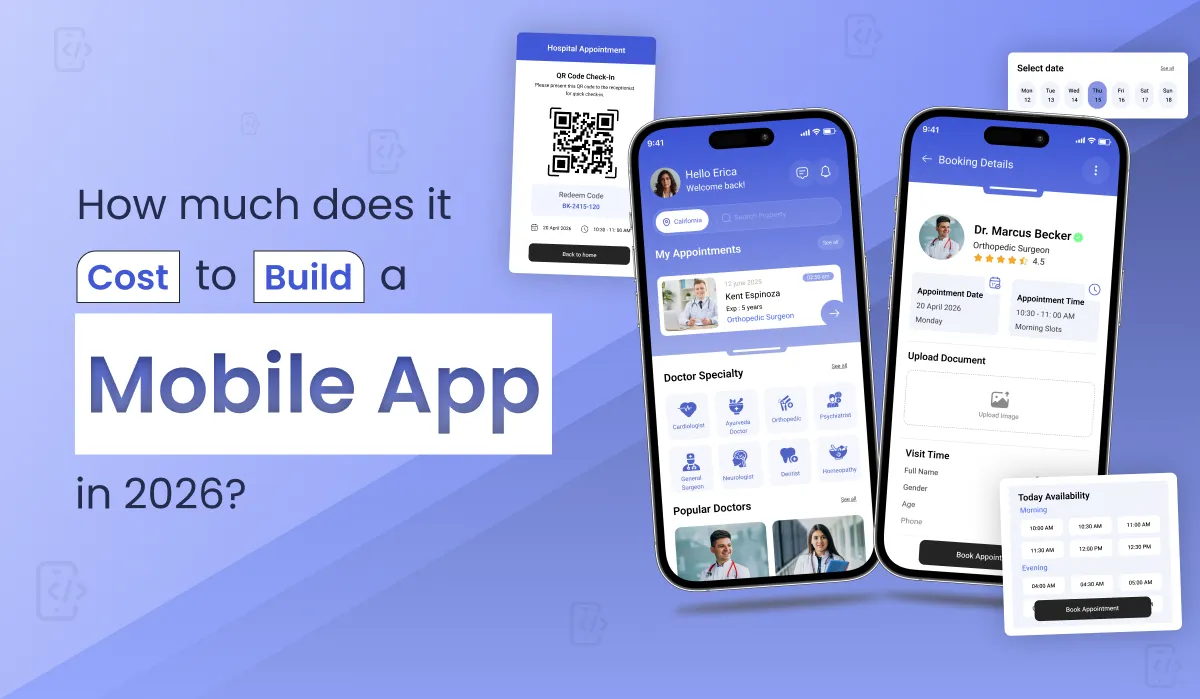
Quick Summary: Mobile app development cost in 2026 ranges from $1,500 for a simple MVP to $10,000+ for a complex enterprise platform. India-based development delivers 60–70% cost savings vs US agencies. making India the top destination for global businesses. Use our free cost calculator to get your estimate in 2 minutes →
Mobile app development cost is the output of five interacting variables:
Here’s the real pricing across all four complexity tiers, with both USD and INR ranges for 2026. Understanding the average app development cost upfront helps you set realistic expectations and avoid budget overruns:
The Hidden Truth About Cheap Quotes: A quote for $5,000 that becomes $30,000 mid-project is more expensive than a $25,000 honest quote. Always ask for a fixed-price contract with a clear scope — and watch out for agencies that price low to win the project, then charge for every change.
Before diving into costs, it’s important to understand what you’re actually paying for. The total cost to develop a mobile app is spread across 6 defined stages — each with its own timeline, deliverables, and cost. Here’s the full picture:
This is the most overlooked stage — and skipping it is the #1 reason apps fail. Before a single line of code is written, you need to answer: Who is your user? What problem does the app solve better than what exists? What does a successful launch actually look like?
our Discovery phase covers competitor analysis, user persona mapping, feature prioritisation, technical feasibility, and a formal project scope document. This document becomes the source of truth that prevents costly mid-project changes.
Design is not just about how your app looks — it determines how users feel, what they do, and whether they come back. App design costs typically make up 15–25% of the total budget, yet a well-designed app can improve retention by 40%. This stage produces wireframes (black-and-white screen layouts), interactive prototypes, and final high-fidelity designs approved before development begins.
Investing in good UX early is one of the highest-ROI decisions in mobile app development. Changes at the design stage cost 10× less than changes during development.
The technology decisions made at this stage shape your entire project — cost, timeline, scalability, and future maintenance. The biggest choice is whether to go native (separate iOS and Android apps), cross-platform (one codebase for both), or web-based (PWA).
For most startups and businesses in 2026, Flutter is the answer. It delivers native-quality performance on iOS, Android, and web simultaneously — from a single codebase — saving 30–40% in development cost and time. Clutch-recognised Flutter development company with 6+ years of Flutter expertise.
Why We Recommend Flutter for Most Projects Flutter is primary mobile framework — and for good reason. One codebase, iOS + Android + web, 30–40% faster to build, and performance comparable to native for 95% of business apps. See our Flutter development services →
This is the largest stage — where your app actually gets built. It runs in parallel workstreams: frontend developers build the screens and user interactions, backend engineers build the server, database, and business logic, and integration specialists connect third-party services (payments, maps, SMS, video, etc.).
agile 2-week sprints with milestone deliveries, so you’re never waiting months to see progress. You get a working build after each sprint and can provide feedback continuously.
QA (Quality Assurance) is not optional — it’s what stands between you and a 1-star App Store review on launch day. Your app needs to be tested on multiple real devices, OS versions, screen sizes, network conditions, and edge cases. Bugs caught in QA cost $50 to fix. Bugs caught by users in production cost $500+ (in lost users, reviews, and rework).
QA process includes functional testing, performance testing, security testing, and device-specific testing across the top 20 most-used Android and iOS devices globally.
Submitting to the App Store and Google Play is not as simple as clicking “upload.” Apple’s review process is strict — apps get rejected for technical, design, or policy reasons, which can delay launch by weeks if not handled correctly. the full submission process including metadata optimisation, screenshots, descriptions, and responding to Apple/Google review feedback.
the full submission process including metadata optimisation, screenshots, descriptions, and responding to Apple/Google review feedback.
Your app is a living product — not a one-time delivery. Apple and Google release new OS versions every year, third-party APIs change, user feedback requires feature additions, and security vulnerabilities need patching. Skipping maintenance is the fastest way to kill an app’s ratings and user base.
Our dedicated maintenance packages that cover OS compatibility updates, bug fixes, performance monitoring, security patches, and minor feature additions — ensuring your app stays competitive after launch.
Pro Tip: Bundle Maintenance in Your Initial Contract Negotiate a 6–12 month maintenance package as part of your development agreement. It’s almost always cheaper than paying for it separately post-launch, and it keeps the same team familiar with your codebase.
This is one of the biggest budget decisions you’ll make. Your platform choice alone can change the cost for application development by 30–60%. Here’s how each path affects cost and timeline:
| Platform | Cost Impact | Timeline | Best For |
|---|---|---|---|
| iOS Only (Swift) | Base cost | 2–6 months | Premium products, USA/EU market |
| Android Only (Kotlin) | 5–10% cheaper | 2–6 months | India, South Asia, emerging markets |
| Native Both (iOS + Android) | +40–60% more | Doubles timeline | Large enterprises, performance-critical apps |
| Flutter (Cross-platform) | Save 30–40% | 25–35% faster | Startups, MVPs, most business apps ✓ Recommended |
| React Native | Save 25–35% | Similar to Flutter | JS-heavy teams, web-to-mobile |
| PWA (Web App) | Lowest cost | 1–3 months | Proof-of-concept, content apps |
Why Most Startups in 2026 Choose Flutter: Flutter lets you write one codebase that runs on iOS, Android, and web simultaneously. Clutch Top Flutter Developers 2024 & 2026 award winner. Explore our Flutter development services →
One of the most common questions we get is: how much does it cost to develop an app feature-by-feature? Every feature adds time and cost. Here’s what you’re actually paying for at Indian agency rates in 2026:
Where your team is based changes your budget dramatically. Here’s the real hourly rate comparison for mobile app developers in 2026:
Baseline
~30% cheaper than US
~50% cheaper than US
✅ 60-70% cheaper than US — same quality with the right agency partner
Why Ahmedabad is India’s Rising Tech Hub: India’s two dominant tech cities — Bangalore and Mumbai — come with a premium. Talent costs run 15–20% higher than in Ahmedabad, where a growing pool of senior engineers serves clients across the USA, UAE, UK, and Southeast Asia. For businesses comparing development partners, Ahmedabad represents a practical middle ground: lower overhead than metro hubs, with no measurable difference in output quality for the vast majority of mobile app projects.
Here are real cost breakdowns for apps built by our team — so you know what to expect for your project type:
iOS + Android via Flutter · Similar to: WasaaChat, EcoFon projects
The number of features, user roles, and screens is the single biggest cost driver. Every additional feature adds 1–4 weeks of work.
Building for both iOS and Android natively doubles your cost. Flutter gives you both for 60–70% of native cost.
Design accounts for 15–25% of total cost. Custom animations and bespoke components cost more than template-based design.
Real-time features, large databases, and complex APIs can make the backend as expensive as the app itself.
AI-curated explore page, hashtag search, trending topics, and geotagged content discovery.
Live video broadcasts with real-time comments, reactions, co-hosts, and tip/donation features for creators.
Senior Indian developers cost $35–$60/hr vs $150–$250/hr in the US. Junior-heavy teams increase cost through rework.
Budget 15–25% of your initial cost annually for maintenance, OS updates, bug fixes, and new feature additions.
Your development quote is just the beginning. Here’s what to budget for beyond the build:
| Hidden Cost | Estimated Annual Cost | Notes |
|---|---|---|
| Cloud Hosting (AWS / GCP) | $500–$5,000/year | Scales with users; starts low |
| App Store Developer Accounts | $125/year | Apple $99 + Google $25 (one-time |
| Third-party API Costs | $200–$3,000/year | SMS, maps, payment fees, video calling |
| App Maintenance | 15–25% of build cost/year | OS updates, bug fixes, security patches |
| SSL Certificates & Security | $100–$500/year | Essential for any app handling user data |
| Push Notification Service | Free–$500/year | Firebase free tier covers most startups |
| App Store Optimisation (ASO) | $500–$3,000/year | If you want organic downloads |
Before you finalize how much it will cost to develop your app, explore these five proven strategies used by clients to slash budgets without compromising quality:
Build only your core 2–3 features first. Launch, validate with real users, then add features based on what they actually use. This can cut your initial budget by 40–60% — and prevents you from building features nobody wants.
One codebase for iOS, Android, and web saves 30–40% vs building two separate native apps. Top Flutter Developers 2024 & 2026 award winner. Explore our Flutter services →
Indian agencies charge $25–$60/hr vs $100–$250/hr in the US — a 60–70% saving with equivalent quality. See our mobile app development services →
Don’t build payment processing, video calling, or SMS from scratch. Use Razorpay/Stripe, Agora/Twilio, and Firebase — saving weeks of development time and thousands of dollars.
Time-and-materials contracts can spiral out of control. Always negotiate a fixed-price contract with milestone-based payments and a clear change management process for new requirements.
We cover the full spectrum of mobile, web, and AI development — all under one roof. Here’s what we build:
Core Service
Framework
Platform
Platform
AI Center
Web
Backend
Solutions
Custom
Clone
Custom
Hire
| Option | Cost Impact | Timeline | Best For |
|---|---|---|---|
| Freelancer | Lowest ($15–$40/hr) | Very small projects, single features | High — no PM, accountability, or scalability |
| Indian Dev Agency | Best value ($25–$60/hr) | Startups, SMBs, funded products | Low — full team, PM, QA, support included |
| US / European Agency | Highest ($100–$250/hr) | Fortune 500, highly regulated industries | Medium — quality high, but overkill for most |
| In-house Team | $120K–$300K+/year | Mobile-first businesses needing full control | High upfront, recruiting takes months |
If there’s one thing this guide makes clear, it’s that mobile app development cost is not a fixed number — it’s a reflection of what you choose to build, how you choose to build it, and who you choose to build it with.
For most businesses and startups, the average app development cost in 2026 starts from $5,000 (₹4L) for a basic MVP and goes up to $30,000 (₹25L) for a full-featured product built using Flutter for iOS and Android. Simple MVPs start from $2,000–$5,000 (₹1.5L–₹4L), while enterprise-grade platforms are custom quoted based on requirements. Get a FREE custom quote for your project today!
The smartest approach is to start lean. Build an MVP with 2–3 core features, validate it with real users, then scale based on feedback. This reduces your initial cost by 40–60% and dramatically increases the chance of building something people actually want to use. Pair this with Flutter development and an experienced Indian agency, and you’ll get global-quality delivery at a fraction of US or European prices.
First-time founder? Start from just $2,000 for a functional MVP with real user data. Established business? Our full-cycle team delivers enterprise solutions custom quoted for your requirements. Whatever your budget - has a solution for you.
The cost for application development is an investment — not just an expense. A well-built app generates revenue, retains customers, and compounds over time. The companies that treat it as a one-time cost find themselves rebuilding in 18 months. The ones that invest in quality, maintainability, and scalability from day one win in the long run.
Ready to Get Your Real Number? delivered 650+ apps across fintech, healthcare, e-commerce, social, and enterprise categories. Use our free cost calculator or talk to our team for a fixed-price estimate within 24 hours — no obligation, no sales pitch.

Hear from our clients and why 1200+ businesses trust Primocys

"Our B2B and B2C platform helps Nigerian manufacturers sell at wholesale prices and suppliers offer competitive retail pricing, with a strong focus on Made in Africa products and easy local and international distribution. The app has received excellent user reviews for its design and unique features. Communication with the Primocys team was smooth in an agile setup, even beyond office hours when needed. Their mobile app development expertise is excellent—highly professional and reliable."

"The dating app was delivered successfully and approved by both Apple App Store and Google Play. Our users are highly impressed with the design, UI, and overall functionality. The project was well planned with clear milestones, and all modules were delivered on time. The team is talented, patient, and flexible, accommodating multiple scope revisions as requirements evolved. Their 24/7 development and support availability made the entire process smooth and reliable."

" We hired Primocys to develop a highly complex and specialized mobile application, and they delivered outstanding results. The app includes advanced features such as timeline mixers, classifieds, payments, advertisements, GPS functionality, and more. Their technical skills, timely delivery, availability, and the personal attention Arpan Sagar brings to each project truly stand out. The team stays focused and committed from start to finish—an excellent experience overall."

" Great team with excellent communication and a strong commitment to on-time delivery. They developed a fully customized mobile app for both Android and iOS, perfectly matching our requirements. The entire process was smooth and professional, with clear updates at every stage. They are reliable, skilled, and very easy to work with. We’re continuing our partnership on more projects, and choosing them has been one of the best business decisions I’ve made."

AWARDS

TRUSTED BY GLOBAL BRANDS