
They give you a price quote in the first call
A serious company asks deep discovery questions before pricing. A quote on a first call means they’re quoting low to win — then charging more through scope changes later.
 DapkeSocial video app with live streaming and PK battles.
 Lika Real EstateProperty discovery platform for listings and leads.
 BurpoutSocial fitness challenges that keep people moving.
 ChatLivoConnected customer communication SaaS workspace.
 EmoTalesAI storytelling adventures designed for children.
 EarnifyTrack Income from Multiple Sources with Analytics & Tax Planning.
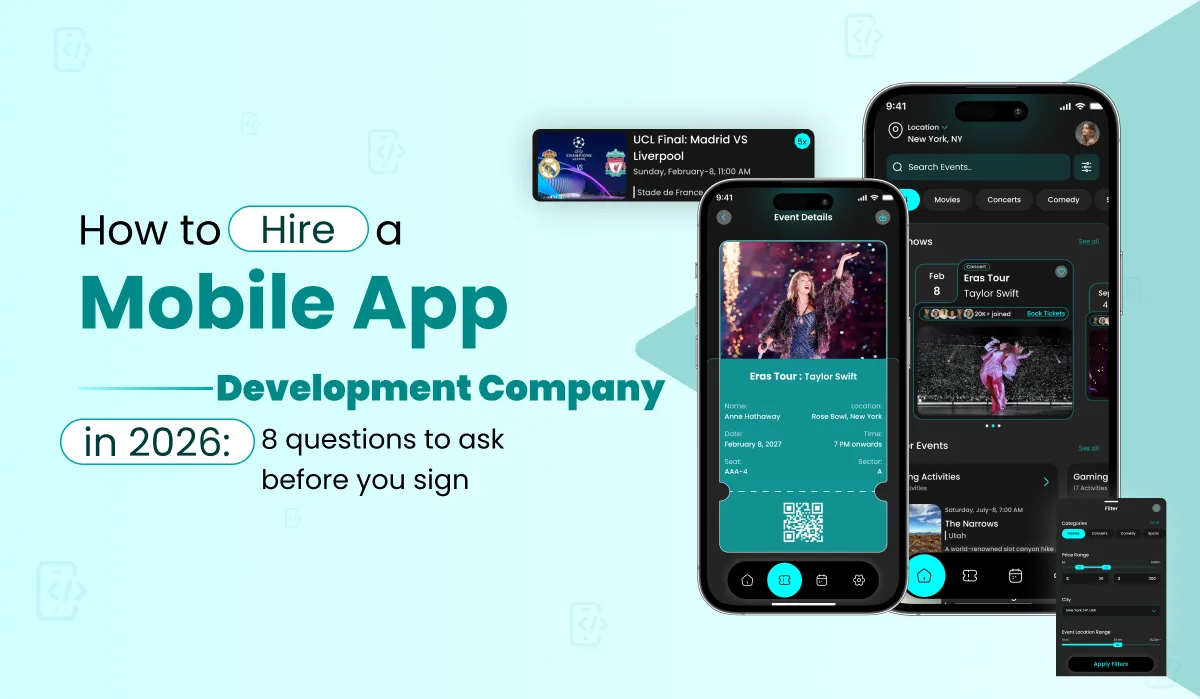
Most founders hire the wrong company — not because of budget, but because they didn’t ask the right questions. Here are the 8 questions that separate great app development teams from expensive mistakes.
That’s what businesses lose, on average, when they hire the wrong mobile app development company. Sunk development costs. Missed market timing. Starting from scratch — again. This guide gives you the 8 critical questions to ask before you sign any contract — so you don’t become that statistic.
App projects go over budget
Poor Vendor Choice Failure
Questions that prevent both
When businesses decide to hire a mobile app development company, the stakes are high — and the risks are real. Every week, startups and businesses reach out to us after a bad experience with another development company. The story is almost always the same: they got a low quote, the company seemed professional on the first call, the contract was signed — and six months later they have a half-built app, missed deadlines, and a team that’s stopped responding.
The painful truth: most vetting mistakes happen before the contract is signed. Founders ask the wrong questions — or none at all — during the sales process. The 8 questions below are what a CTO at a funded startup would ask before committing. Every founder hiring an app company in 2026 should ask all of them.
The Most Expensive Mistake in App Development It’s not a bad tech choice. The most expensive mistake is starting development with a company that can’t finish — forcing a rebuild. Average rebuild cost: $40,000–$80,000 plus 6–12 months of lost time. The 8 questions below exist to prevent exactly this.
A serious company asks deep discovery questions before pricing. A quote on a first call means they’re quoting low to win — then charging more through scope changes later.
Anyone can show a logo grid. You need live App Store links — apps you can actually download, test, and verify exist right now.
If they can’t tell you who your PM is before you sign, you’ll be managing developers yourself — which is a full-time job you’re not equipped or paid to do.
A contract with no deliverables, no milestone payments, and no IP assignment clause is a red flag. You could lose your code and your investment simultaneously.
If they never mention QA during the sales process, they likely don’t have a dedicated QA team — meaning bugs will reach your users, not a test environment.
These aren’t generic “how long have you been in business” questions. Each one is designed to reveal how a company actually operates — not how they present themselves on a sales call. Send these in advance so the company has time to prepare. How they respond tells you as much as the answers themselves.
A logo grid is marketing. A real case study is evidence. Every reputable mobile app development company should show live App Store or Play Store links — apps you can download, test, and verify exist. Case studies should describe the problem, the solution, the tech stack used, and measurable outcomes — not just design screenshots.
If an agency can’t provide at least 3–5 live app references, that is a significant warning sign. Either their work didn’t survive in production, they lack production-quality experience, or the projects shown aren’t actually theirs.
Primocys Portfolio: Our portfolio includes WasaaChat (messaging app), Only Singles (dating platform), ZIBA Driver (ride-hailing), Burpout (fitness), ZIO Gram (social), and 200+ more across 15+ categories and 30+ countries. All available for client reference calls. Request our full portfolio →
Communication breakdown is the #1 reason app projects fail — not technical incompetence. You need to know exactly how you’ll be updated, how often, through which channels, and what happens when something goes wrong or falls behind.
A well-run agency has a clear, documented answer: a dedicated project manager, sprint reviews every two weeks, a shared PM tool (Jira, ClickUp), and a defined escalation path for issues. If their answer is “we’ll email you when there’s an update” — that’s not a process, it’s a prayer.
How Primocys Handles Communication: Every Primocys project gets a named dedicated PM, a private Slack workspace, bi-weekly sprint demo calls with recorded video, and a shared Jira board with full sprint visibility. You can see exactly what’s being built at any moment — no guessing, no chasing updates.
In 2026, cross-platform frameworks — especially Flutter — are the standard for most business apps. A company that only builds native iOS and Android will charge you 40–60% more and take twice as long to ship. But there’s a catch many founders miss: agencies claim Flutter expertise while quietly outsourcing it to junior freelancers.
Ask for Flutter-specific portfolio apps you can download and test. Ask how many dedicated Flutter developers they employ full-time in-house. Ask about state management experience (Bloc, Riverpod, Provider) — a team that can’t answer this clearly doesn’t have senior Flutter engineers.
Primocys: Clutch Top Flutter Developer — 2024 & 2026: Flutter is our primary mobile framework — not an afterthought. We have a dedicated in-house Flutter team with 6+ years of Dart and Flutter expertise, specialising in complex state management, custom animations, and high-performance cross-platform apps. Explore our Flutter development services →
Most companies sell the build. The best companies think beyond it. Apps require ongoing care — Apple and Google release new OS versions every year, third-party APIs change without warning, bugs surface in production that never appeared in testing, and users request features that keep your app competitive.
If the company you hire disappears after launch day, you’re left managing a codebase you don’t understand with a team you haven’t vetted. Get all post-launch terms in writing before you sign. A serious agency will have a defined maintenance package with response SLAs, scope of coverage, pricing, and confirmation it’s the same team that built the app.
Budget for maintenance before you sign: Plan to spend 15–25% of your build cost per year on maintenance. A $30,000 app = $4,500–$7,500/year to keep it healthy, secure, and compatible. Companies that don’t mention this haven’t thought the full project lifecycle through. See our full mobile app cost breakdown →
Testimonials on a company’s own website are self-selected and meaningless. Clutch.co and GoodFirms conduct independent client interviews, verify that the work was actually done, and publish reviews that the company cannot edit or remove. This is the gold standard for vetting any development agency globally.
When reading Clutch reviews, look at: overall rating, total number of reviews, recency (reviews from the last 12 months), and the specificity of each review. A generic “5-star great team!” is worth nothing. A detailed review describing the actual project, challenges, and outcomes is high-signal evidence.
Primocys on Clutch: We hold 7 Clutch Top Company awards including: Top Flutter Developers 2024 & 2026, Top App Development Company — Financial Services, Real Estate, Legal Cannabis, and Music & Entertainment. Our Clutch profile shows 4.9-star verified reviews from clients across the USA, UAE, UK, and Australia.
Every app category has unique technical complexity. A food delivery app requires real-time GPS, multi-vendor management, and split payment flows. A dating app needs matching algorithms, video calling, and trust & safety features. A chat app requires WebSocket infrastructure and end-to-end encryption. If a company has never built in your category, they will be solving your domain’s hardest problems for the first time — on your budget and timeline.
Don’t accept “we’ve built something similar.” Ask for a directly comparable app. Apps with the same core architecture. If they’ve solved those specific problems before, they have pre-tested solutions — which can cut your development time by 30% or more.
Primocys Portfolio by App Category: Chat: WhatsApp Clone · Social: Instagram Clone · Short video: TikTok Clone · Dating: Dating App · Food delivery: Food Delivery App · Fitness: Fitness App · eCommerce: eCommerce App · Classified: Classified App · AI apps: AI Development
Most companies sell the build. The best companies think beyond it. Apps require ongoing care — Apple and Google release new OS versions every year, third-party APIs change without warning, bugs surface in production that never appeared in testing, and users request features that keep your app competitive.
If the company you hire disappears after launch day, you’re left managing a codebase you don’t understand with a team you haven’t vetted. Get all post-launch terms in writing before you sign. A serious agency will have a defined maintenance package with response SLAs, scope of coverage, pricing, and confirmation it’s the same team that built the app.
| Pricing Model | Best For | Budget Certainty | Client Risk |
|---|---|---|---|
| Fixed Price | Clear scope, MVP, defined features | High — agreed upfront | Low |
| Time & Materials | Evolving scope, retainers, iterations | Low — open-ended | Higher (scope creep) |
| Milestone-based Fixed | Long projects with phased releases | High — per phase | Best of both worlds |
| Dedicated Team (retainer) | Ongoing product development | Medium — monthly rate | Medium |
Always Negotiate Milestone-Based Payments: Never pay 100% upfront. Pay by milestone: 20–30% on contract signing, then per sprint delivery against agreed deliverables. This protects your budget and creates natural accountability checkpoints. Use our free cost calculator to plan your budget →
Many agencies win a project and quietly outsource pieces — design to a freelancer network, QA to an offshore team they’ve never worked with, backend to a subcontractor. This fragmentation destroys quality, accountability, and communication. You end up with a project that has no single owner responsible for the outcome.
A truly integrated agency has UI/UX designers, frontend developers, backend engineers, QA testers, and a project manager all under one roof — working together daily, sharing context, and holding each other accountable. Ask specifically about each function and insist on meeting the actual team (not just the sales contact) before signing any contract.
Primocys: Fully In-house, End-to-End: Our 50+ person in-house team in Ahmedabad includes UI/UX designers, Flutter and React Native developers, Node.js and Python backend engineers, dedicated QA testers, and experienced project managers — nothing outsourced, everything accountable. Hire dedicated developers from our team →
Use this on every vendor call before you sign. A company that can’t check at least 12 of these 16 boxes is not ready to take your project seriously.
Beyond the 8 questions, here is the full hiring process used by experienced founders and tech leads — from the first call to contract signing:
Document your target users, core features, platform preference, budget range, and timeline expectations. Companies that receive a clear brief give better quotes. Companies that quote without asking for one are worth filtering out immediately.
Never evaluate one company in isolation — comparison is how you develop calibration for what good looks like. Aim for a mix of sizes and price points. Don’t shortlist based on website design alone.
Send the 8 questions in advance. Evaluate not just the answers but the process: did they ask smart questions back? Did they challenge unrealistic expectations? Good agencies will push back on things that can’t be built as described — that’s a sign of competence, not conflict.
A real proposal includes: proposed tech stack, architecture overview, team composition, timeline with milestones, assumptions, risks, and a payment schedule. A one-page PDF with a number is not a proposal.
Specifically ask: “What went wrong on this project and how did they handle it?” Great vendors are transparent about challenges. Perfect project stories with no issues are red flags — every real project has at least one challenge worth discussing.
India is the world’s #1 outsourcing destination for mobile app development — and it’s not close. Here’s a direct comparison across the factors that matter most:
| Factor | 🇮🇳 India (Top Agency) | 🇺🇸 US Agency | 🇬🇧 UK/Europe | Freelancer |
|---|---|---|---|---|
| Hourly rate | $25–$60/hr | $100–$250/hr | $80–$150/hr | $15–$40/hr |
| Full-stack team | ✓ In-house | ✓ In-house | ✓ In-house | ✗ Solo developer |
| Flutter expertise depth | Very strong (primary focus) | Variable | Variable | Hit or miss |
| Post-launch support | Included, defined SLAs | Included | Usually included | Rarely available |
| Clutch verified presence | Top agencies: yes | Yes | Yes | No |
| IP ownership clarity | Standard in contract | Standard | Standard | Often ambiguous |
| Equivalent $50K US build | ~$18–28K in India | $80–120K | $60–90K | Unpredictable |
The “India Quality” Myth — Debunked in 2026: The concern that Indian developers deliver lower quality is outdated and factually wrong for top-tier agencies. India produces 1.5 million engineering graduates per year. Top Indian agencies serve Silicon Valley startups, NASDAQ-listed companies, and Fortune 500 enterprises. The difference between a great Indian agency and a mediocre one is the same gap that exists in any country — which is exactly why the 8 questions above matter regardless of location. See why 650+ global clients chose Primocys →
We didn’t just answer these 8 questions — we built our entire operation around them. Here’s how Primocys answers each one, specifically:
App Store links across 15+ categories. Named clients and reference contacts — not a logo grid.
Named PM, bi-weekly sprint demos, private Slack workspace, Jira board — from the day we sign.
Dedicated in-house Flutter team, 6+ years Dart expertise, Clutch-awarded two consecutive years.
Clear SLAs, same team post-launch, monthly retainer options. OS updates and bug fixes included.
7 Clutch Top Company awards. Verified reviews from USA, UAE, UK, Australia clients.
Chat, social, dating, food delivery, fitness, eCommerce, classified, on-demand — all in production.
Transparent fixed-price contracts, milestone-based payments, no hidden fees, formal change process.
Design, development, QA — all full-time in-house. Nothing outsourced. One team owns the outcome.
We cover the full spectrum of mobile, web, and AI development — all under one roof. Here’s what we build:
Core Service
Framework
Platform
Platform
AI Center
Web
Backend
Solutions
Custom
Clone
Custom
Hire
Hiring a mobile app development company in 2026 is one of the most consequential decisions you’ll make for your product. The difference between a great outcome and a $50,000+ mistake almost always comes down to one thing: how well you vetted the company before you signed.
The 8 questions in this guide aren’t designed to make the process harder — they’re designed to protect you. A great mobile app developer company will answer every single one clearly, specifically, and confidently. A company that deflects, gets vague, or can’t back up claims with evidence is one that will cost you later.
Here’s the short version of everything you’ve read:
Ask for live App Store links — not logo grids. Any company serious about their work will have downloadable, verifiable production apps to show you.
A company with a repeatable, documented communication and delivery process will outperform a company relying on talent alone — every time.
Fragmented teams destroy accountability. Ensure design, development, and QA are all under one roof before you commit.
Never start a project on Time & Materials without a cap. Protect your budget with milestone-based payment structures from day one.
The best mobile app development company for startups and growing businesses is one that thinks beyond the build — with maintenance plans, SLAs, and a team that stays with you.
The best mobile app development company for your project isn’t necessarily the biggest, the most expensive, or the one with the slickest website. It’s the one that answers all 8 questions honestly, has a track record you can verify, and treats your project with the same accountability they’d apply to their own product.
Use the 16-point checklist above on every vendor call. Run through the 5-step hiring process before you sign anything. And if you’re looking for a team that checks all 8 boxes — talk to Primocys. We’ll give you an honest assessment of your project within 24 hours, no sales pressure.
Ready to hire a mobile app development company that actually delivers?: Primocys has helped 650+ founders and businesses across the USA, UAE, UK, and Australia build apps that ship on time, on budget, and on quality. Start the conversation today →

Hear from our clients and why 1200+ businesses trust Primocys

"Our B2B and B2C platform helps Nigerian manufacturers sell at wholesale prices and suppliers offer competitive retail pricing, with a strong focus on Made in Africa products and easy local and international distribution. The app has received excellent user reviews for its design and unique features. Communication with the Primocys team was smooth in an agile setup, even beyond office hours when needed. Their mobile app development expertise is excellent—highly professional and reliable."
"The dating app was delivered successfully and approved by both Apple App Store and Google Play. Our users are highly impressed with the design, UI, and overall functionality. The project was well planned with clear milestones, and all modules were delivered on time. The team is talented, patient, and flexible, accommodating multiple scope revisions as requirements evolved. Their 24/7 development and support availability made the entire process smooth and reliable."

" We hired Primocys to develop a highly complex and specialized mobile application, and they delivered outstanding results. The app includes advanced features such as timeline mixers, classifieds, payments, advertisements, GPS functionality, and more. Their technical skills, timely delivery, availability, and the personal attention Arpan Sagar brings to each project truly stand out. The team stays focused and committed from start to finish—an excellent experience overall."

" Great team with excellent communication and a strong commitment to on-time delivery. They developed a fully customized mobile app for both Android and iOS, perfectly matching our requirements. The entire process was smooth and professional, with clear updates at every stage. They are reliable, skilled, and very easy to work with. We’re continuing our partnership on more projects, and choosing them has been one of the best business decisions I’ve made."

AWARDS
TRUSTED BY GLOBAL BRANDS