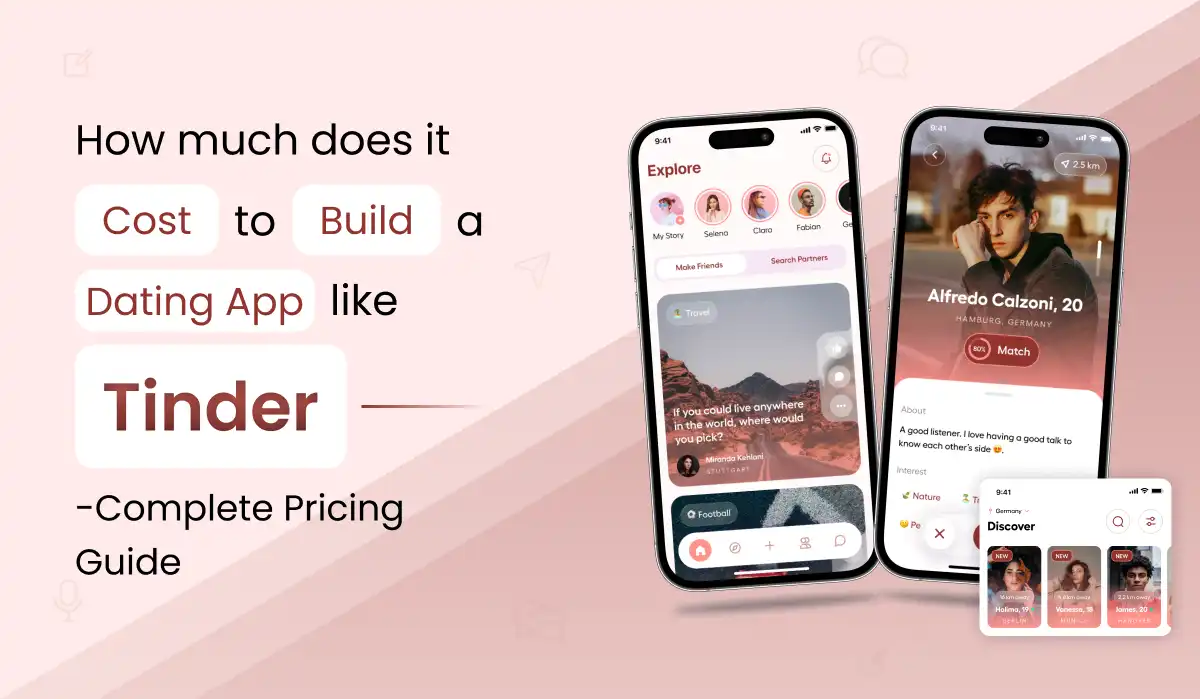
How Much Does It Cost to Build a Dating App Like Tinder in 2026? (Complete Pricing Guide)
Date
16 Jun, 2026
Share:
Every agency you’ve Googled quoted $50,000–$300,000. That’s what US developers charge. The same dating app, built by a Clutch-verified Indian team with live apps on both stores, costs $9,000–$38,000. Here’s the honest, feature-by-feature breakdown.
Quick Summary:
A dating app like Tinder costs $9,000–$18,000 for a basic MVP (swipe, match, chat, profiles), $20,000–$38,000 for a mid-tier app with video calls, AI matching, and subscription billing, and $40,000–$75,000 for a full AI-powered platform with advanced safety features and dynamic pricing — all at India development rates. US agencies quote $50,000–$300,000 for the same apps because their developers charge $100–$250 per hour instead of $25–$60. The dating app market hit $9.8 billion in 2026 and is heading to $15 billion by 2035 — the opportunity is real. The question is whether you spend three times more than you need to to chase it. See our dating app service →
Tinder didn’t start as Tinder. It started as a college campus experiment that spread through fraternities and sororities at USC before anyone called it a dating app. The point is: you don’t need to build Tinder to compete with Tinder. You need to build something that a specific group of people prefers over Tinder — and that’s a dramatically different, and dramatically cheaper, problem to solve.
The founders who come to Primocys asking for a “dating app like Tinder” usually don’t mean they want to clone Tinder feature-for-feature. They mean they want the core mechanic — discover people nearby, swipe to express interest, match when mutual, chat when connected — applied to their specific niche, audience, or geography. And that is absolutely achievable for a budget that doesn’t require a Series A round to fund.
Here’s the part none of the $150,000 quotes tell you: the swipe mechanic costs about $2,500 to build. The matching algorithm costs $1,500–$3,000. The real-time chat costs $3,000–$5,000. What makes dating app budgets spiral is not the core features — it’s the safety infrastructure, the identity verification, the AI matching that actually works at scale, and the premium subscription billing system that makes the business model viable. This guide breaks all of it down, feature by feature, with honest prices.
$9.8B
Dating app market 2026
$9K
Basic MVP starting cost (India)
60–70%
Cost saving vs US/UK agencies
$25–$60
India Devs vs US $100–$250
$1.9B
Tinder 2023 Revenue: Mostly Subs
Niche Dating Apps: The Lower-Cost Strategy for 2026
Before we get into costs, there’s something worth saying plainly: building a general dating app that competes with Tinder, Bumble, and Hinge for the same audience is a bad business idea in 2026. Not because it’s technically impossible — it isn’t — but because those platforms have hundreds of millions of profiles. The cold-start problem, where new users see few matches and leave before getting value, is nearly impossible to solve in a general market.
The dating apps actually succeeding in 2026 are niche platforms. They serve a specific community so well that the network effect question becomes manageable — you don’t need 10 million profiles if your 50,000 profiles are exactly the right 50,000 for your audience.
Regional / Cultural
South Asian diaspora, Middle Eastern professionals, Latin American communities. Apps serving cultural marriage preferences or language-specific audiences where Tinder’s algorithm fails.
→ Aisle proved this works in India
Professional Niche
Doctors, lawyers, engineers, creatives, entrepreneurs. Verified professional credentials as a trust signal. Higher willingness to pay for premium features.
Grindr proved that a focused platform for a specific identity community creates stronger network effects than a general app trying to serve everyone.
→ Strong subscription conversion rates
Age-Specific
Dating apps for 40+, 50+, or seniors. Tinder’s UX and culture actively puts off this demographic. Massive underserved market with high purchasing power.
→ OurTime charges $30/month with ease
Student / Campus
University-verified profiles, campus events, study-date features. Geographic density solves the cold-start problem naturally. How Tinder itself started.
→ Built-in geographic density advantage
The decision that determines your budget more than any feature: A general dating app needs enough profiles in every geography to generate matches — which requires expensive marketing before the app delivers value to anyone. A niche dating app only needs enough profiles within one specific community — which you can reach through targeted community marketing for a fraction of the cost. The niche choice is not just a product decision. It’s the decision that most determines whether your launch budget runs out before you hit product-market fit.
Dating App Development Cost by Complexity — 4 Tiers
All prices below are at India development rates using Flutter for iOS and Android. These ranges are based on real project scopes — not theoretical estimates built around inflated hourly rates.
Tier 1
Basic Swipe MVP
$9K–$18K
US/UK equiv: $40,000–$80,000
User registration + social login
Profile creation (photos, bio, age)
Location-based discovery
Swipe right/left interface
Mutual match system
Basic text chat on match
Push notifications
Admin panel + moderation tools
Most PopularTier 2 — Most Popular
Full-Featured Dating App
$20K–$38K
US/UK equiv: $80,000–$160,000
All MVP features
Premium subscription (Stripe/RevenueCat)
AI-powered matching algorithm
ID verification + selfie check
Video calls (WebRTC or Agora)
Advanced filters (lifestyle, religion, intent)
Profile boost + super like mechanics
Reporting + block + unmatch flows
Tier 3
AI-Powered Platform
$40K–$75K
US/UK equiv: $160,000–$300,000+
All Tier 2 features
ML compatibility scoring
AI-generated icebreakers
Dynamic pricing engine
Background check integration
Voice notes in chat
Virtual date features
Advanced analytics dashboard
Tier 4
Enterprise / SaaS Platform
$80K+
US/UK equiv: $300,000+
All Tier 3 features
Multi-region / multi-language
White-label licensing
Custom ML pipeline
Regulatory compliance (GDPR, COPPA)
Dedicated moderation team tools
SaaS infrastructure + DevOps
Dating App Development Cost Breakdown 2026
Add up what you actually need — this table breaks down dating app development cost per feature, line by line, and it’s the most useful pricing reference in this guide before your first conversation with any developer.
Feature
India Cost
US Cost
Timeline
Must-Have?
User registration + social login
$800–$1,400
$2,500–$6,000
4–6 days
MVP
Profile creation (photos, bio, preferences)
$800–$1,800
$3,200–$7,500
5–7 days
MVP
Location-based discovery (GPS + radius)
$900–$2,000
$3,600–$8,000
1 week
MVP
Swipe right/left + animation
$1,200–$2,500
$5,000–$10,000
1 week
MVP
Mutual match system + notification
$800–$1,800
$3,200–$7,200
4–6 days
MVP
Real-time chat (text + emoji)
$2,500–$5,500
$10,000–$22,000
2–3 weeks
MVP
Push notifications (FCM)
$500–$1,000
$2,000–$4,000
3–4 days
MVP
Admin panel + moderation
$2,000–$4,500
$8,000–$18,000
2–3 weeks
MVP
Freemium subscription billing
$1,500–$3,500
$6,000–$14,000
1–2 weeks
V2
AI/ML matching algorithm
$5,000–$14,000
$20,000–$55,000
4–8 weeks
V2
ID verification + selfie match
$2,000–$5,000
$8,000–$20,000
1–2 weeks
V2
Video calls (WebRTC self-hosted)
$4,000–$9,000
$16,000–$36,000
3–5 weeks
V2
Advanced filters (religion, lifestyle, intent)
$1,000–$2,500
$4,000–$10,000
1 week
V2
Super like + profile boost mechanics
$800–$2,000
$3,200–$8,000
4–6 days
V2
AI icebreaker suggestions
$1,500–$3,500
$6,000–$14,000
1–2 weeks
V3
Background check API integration
$1,500–$4,000
$6,000–$16,000
1–2 weeks
V3
Voice notes in chat
$800–$2,000
$3,200–$8,000
4–6 days
V3
How to use this table to estimate your real budget: Add up the MVP features: registration ($1,400) + profile ($1,800) + location ($2,000) + swipe ($2,500) + match system ($1,800) + chat ($5,500) + notifications ($1,000) + admin ($4,500) = approximately $20,500 before design, QA, backend, and project management. Add 35–40% for those overhead items and you land at $27,000–$28,500 for a complete MVP at India rates. The table matches what’s in Tier 1 at the bottom of that range. Any quote significantly below this from an Indian agency should raise quality questions. Any quote significantly above from a reputable Indian agency needs justification. Use our free cost calculator →
Dating App Development Cost: Global Rate Comparison
The most common concern we hear from founders who’ve only worked with Western agencies is some version of: “Is it actually as good?” The honest answer is that the code quality, the architecture decisions, and the apps you get are identical — because the programming languages, frameworks, tools, and architectural patterns are all global. What varies is the cost of living in the city where your developer works.
🇮🇳
India
$25–$60/hr
Senior Flutter / Dart dev
60–70% cheaper
🇵🇱
Eastern Europe
$45–$85/hr
Senior mobile developer
🇬🇧
UK
$90–$160/hr
Senior mobile developer
🇦🇺
Australia
$100–$175/hr
Senior mobile developer
🇺🇸
United States
$120–$250/hr
Senior mobile developer
A dating app MVP requiring 500 hours of development costs $12,500–$30,000 in India versus $60,000–$125,000 in the US. Same hours. Same architecture. Same Flutter code. The quality verification for India-based agencies comes from independent platforms — Clutch, GoodFirms, and Upwork — where real clients leave real reviews. Primocys’s 4.9★ verified rating on Clutch from global clients across the US, UK, UAE, and Australia is the independent evidence that the quality gap is a myth. Whether you hire dating app developers in India directly or go through a dating app development agency, total agency cost in India still lands 60–70% below an equivalent US or UK quote for the same scope.
The 3 Features That Push Dating App Budgets Highest
Most founders budget for the visible features — the swipe, the profile, the chat. The features that actually move the budget are the ones in the infrastructure layer: how the app keeps users safe, how it learns their preferences, and how it makes money. Here’s an honest breakdown of where the real cost goes on dating apps specifically.
1. AI Dating App Development Cost
Proximity-based matching — showing you people within 5km who are between 25 and 35 — is not a matching algorithm. It’s a filter. A real matching algorithm analyses engagement patterns: which profiles you spend more time on, which conversations you let die, which matches you unmatch quickly, and what the successful matches have in common. Building that costs $5,000–$14,000 and requires real user data to train on — which means it gets meaningfully better after you have your first 5,000 active users, not before.
The honest advice here: launch with a smart filter system, not a full ML model. Build the data pipeline correctly from day one so the ML model can be trained once you have real signal. Adding a half-trained AI algorithm to an MVP with 200 users produces worse recommendations than a well-designed filter. We’ve seen founders spend $12,000 on AI matching that actively hurt retention on small user bases because there wasn’t enough data to learn from.
2. ID Verification Feature Cost — Not Optional in 2026
App Store and Google Play both have specific policies around dating apps in 2026. Apple requires dating apps to have mechanisms for reporting profiles and a clear process for handling those reports. Both stores increasingly expect some form of identity verification for apps that facilitate real-world meetups. Beyond platform requirements, real users in 2026 are choosing dating apps partly on safety signals — identity verification badges, in-app reporting workflows, and AI-powered message filtering are increasingly table stakes rather than premium features.
ID verification via a selfie-plus-government-ID flow costs $2,000–$5,000 to implement using Onfido or Jumio APIs. The API cost itself is typically $1–$2 per verification — negligible at launch, manageable at scale. This is one of the features we recommend including in V2 rather than MVP, but planning for it architecturally from day one is important.
3. Video Calling Feature Cost — Increasingly Expected
Post-2020, video dates have become a standard part of the dating app experience for a large portion of users — both as a way to connect before meeting in person and as a safety filter for screening matches. The cost difference between self-hosted WebRTC ($4,000–$9,000 one-time) and Agora/Twilio (approximately $0.0099 per minute per participant ongoing) adds up fast. At 1,000 users averaging 10 minutes of video calls per day, Agora costs approximately $2,970 per month. Self-hosted WebRTC costs $40–$80 per month in server fees for the same volume. Build self-hosted from day one. See our WebRTC vs Agora comparison →
“The three features that determine whether a dating app survives its first year are not the swipe, the matching, or the chat. They’re the moderation that keeps bad actors out, the AI that learns fast enough to give good matches before users give up, and the subscription billing that turns retention into revenue.”
How Dating Apps Actually Make Money — and What to Build First
Tinder generated over $1.9 billion in 2023. Not from ads. Not from user data. Almost entirely from subscriptions and in-app purchases. Understanding how the revenue model works is just as important as understanding the feature costs — because the revenue architecture directly affects what you need to build and how you prioritise your budget.
Subscription Billing Integration Cost
Whichever model you pick, you’ll need RevenueCat or native StoreKit/Play Billing wired in before launch. Subscription billing integration cost typically runs $1,500–$3,500 at India rates — covering Apple/Google IAP compliance, webhook handling, and the V2 milestone already listed in the feature table above.
Freemium Subscription
Free tier with limited swipes. Premium tier ($10–$30/month) unlocks unlimited swipes, see who liked you, profile boosts, and read receipts. Tinder’s primary revenue driver.
→ Build this in V2 — highest LTV model
In-App Credits
One-time purchases for Super Likes, Profile Boosts (appear at top of discovery for 30 mins), and Spotlights. Lower commitment than subscriptions, higher ARPU from power users.
→ Add alongside subscription in V2
Verified Profile Badge
Paid identity verification gives users a badge showing their profile is real. Premium trust signal. Increasingly attractive to users tired of bots and catfishers.
→ Growing fast in 2026 market
Message Before Matching
Premium-only feature — send a message to someone you haven’t matched with yet. Hinge Rose feature. High perceived value. Premium subscribers love it.
→ Good retention and upgrade driver
Targeted Discovery
Filter by very specific criteria (height, education level, wants kids, relationship type) — free app shows basic filters, premium unlocks granular ones. High upgrade motivation.
→ Best feature to put behind paywall at launch
The monetisation mistake that kills most new dating apps: Putting the subscription paywall up before users have experienced genuine value from the app. If a user creates a profile, swipes a few times, doesn’t get any matches, and then hits a paywall — they don’t pay. They delete. The sequence that works: free swipes (limited), first match is free, first conversation is free, then the paywall appears naturally as the user has experienced value and wants more. Subscription billing that appears after demonstrated value converts at 3–5× the rate of paywalls that appear before it.
Flutter vs Native Swift/Kotlin — The Right Choice for Dating Apps
For a dating app that needs both iOS and Android — which is every dating app, because your users are on both — Flutter is the correct technical choice in 2026. The swipe animations, the card stack UI, the real-time chat interface, the map-based discovery — all of this works at native quality in Flutter. Primocys’s live apps (Snaptaig, InstaClone, WasaaChat, Emoji Tale) all demonstrate the same Flutter performance characteristics a dating app needs.
Factor
Flutter (iOS + Android)
Native Swift + Kotlin
Verdict
Build cost (both platforms)
$9K–$38K
$18K–$70K+
Flutter saves 35–40%
Swipe animation quality
Native-quality, 60fps
Native, 60fps
Equal
Real-time chat (WebSocket)
Full support
Full support
Equal
Camera + media upload
Flutter plugins
Direct platform API
Equal for dating apps
Push notifications
Firebase FCM — full
Full
Equal
Subscription billing
RevenueCat Flutter SDK
StoreKit / Google Play Billing
Equal
Maintenance (ongoing)
One codebase
Two codebases (Swift + Kotlin)
Flutter saves 50% ongoing
Developer availability
Large pool
Fragmented by platform
Flutter easier to hire
Best for
95% of dating apps
AR-heavy, Apple Watch integration
Flutter for most
Primocys · Dating App Development
Build Your Dating App With a Team That Has Live Apps on Both Stores
Primocys builds dating apps at India rates — fixed price, full source code, Flutter iOS and Android. Not theoretical capability — we have live consumer apps on App Store and Google Play right now that prove what we build performs in production for real users.
Swipe + match built correctly
Card stack animation, swipe physics, mutual match detection — all native-quality in Flutter. No jank, no lag, no compromise.
AI matching — when the data supports it
We build the data pipeline from day one. ML model added when you have real training data. Honest advice on timing.
Safety infrastructure built in
Report + block + unmatch flows, ID verification architecture, content moderation — App Store compliant from day one.
Subscription billing via RevenueCat
Freemium tiers, in-app credits, Super Like mechanics. Full App Store and Google Play subscription compliance.
Self-hosted WebRTC — $0/min
No Agora monthly bill at scale. Self-hosted saves $3,000–$10,000/month vs usage-based APIs once your user base grows.
Fixed price from $9,000
Cost agreed before development starts. Milestone payments. Full source code. No recurring licence fees.
Conclusion: What Your Dating App Will Actually Cost
There’s no single answer to dating app development cost — it depends on your niche, your feature tier, and whether you build in-house or outsource dating app development to a fixed-price India team. If you’re scoping a dating app like Hinge, cost to build sits close to our Tier 2 number ($20,000–$38,000), since Hinge’s core differentiator — prompts and compatibility scoring — maps directly onto the AI matching line in our table.
The cost of building a dating app like Bumble in India follows similar math, with a small premium for the women-message-first gating logic. Whatever niche you pick, run your own numbers with our free dating app development cost calculator , and budget separately for dating app maintenance cost after launch — typically 15–20% of your build cost every year for servers, OS updates, and the bug fixes no initial quote ever mentions.
Niche dating app development cost will almost always beat a general Tinder clone, simply because you’re shipping fewer features built only for the audience that actually needs them.
Questions We Get About Dating App Costs
How much does it cost to build a dating app like Tinder in 2026?
A dating app MVP (swipe, match, chat) costs $9K–$18K in India. Full-featured with video calls and AI matching: $20K–$38K. US/UK agencies quote $50K–$300K+ for identical scope — the difference is developer rates ($25–$60/hr vs $120–$250/hr), not code quality. Get a personalised estimate →
What features make a dating app cost more?
Five features push costs highest: AI/ML matching ($5K–$14K), video calls via WebRTC ($4K–$9K), ID verification + selfie match ($2K–$5K), real-time chat ($2.5K–$5.5K), and freemium subscription billing ($1.5K–$3.5K). A basic swipe + chat MVP costs $9K–$18K. Add all five and you’re at $35K–$55K.
Should I build my dating app with Flutter or native?
Flutter saves 35–40% vs separate Swift + Kotlin builds — without sacrificing swipe animations, real-time chat, or subscription billing. Native only makes sense for deep ARKit or Apple Watch features, which 95% of dating apps don’t need. Flutter is the right and cheaper choice for almost every dating app. See our Flutter service →
How do dating apps like Tinder make money?
Three proven models: (1) Freemium subscriptions ($10–$30/month) — unlimited swipes, see who liked you, profile boosts. (2) In-app credits — one-time purchases for Super Likes and Spotlights, high ARPU from power users. (3) Verified badges — paid identity verification. Tinder hit $1.9B in 2023, mostly through subscriptions. Start freemium — it scales at any user count.
How long does it take to build a dating app in 2026?
A basic dating app MVP (swipe, match, chat) takes 8–12 weeks with Flutter. A mid-tier app with video calls and subscription billing takes 14–20 weeks. A complex AI-powered platform takes 20–30 weeks. The longest part isn’t core mechanics — it’s safety infrastructure, billing, and ID verification that slow timelines down.
Build Your Dating App for What It Actually Costs
Tell us your niche, your target audience, and the features you need. We’ll give you a feature-by-feature fixed-price estimate within 48 hours — no vague ranges, no inflated US rates.
Arpan leads product and engineering at Primocys, a Top-Rated Clutch app development company based in Ahmedabad, India. With over 10+ years of experience, he has successfully delivered real-time communication platforms for 1,200+ clients worldwide.
He is directly involved in overseeing the development of chat and messaging applications, ensuring high performance, scalability, and seamless user experience in every project.
📧 Email: [email protected]
📱 WhatsApp: Chat on WhatsApp
Trusted by Global Businesses for AI, Mobile, SaaS & Custom Software Development. Your Vision, Our Expertise.Trusted by Global Businesses for AI, Mobile, SaaS & Custom Software Development. Your Vision, Our Expertise.Trusted by Global Businesses for AI, Mobile, SaaS & Custom Software Development. Your Vision, Our Expertise.Trusted by Global Businesses for AI, Mobile, SaaS & Custom Software Development. Your Vision, Our Expertise.Trusted by Global Businesses for AI, Mobile, SaaS & Custom Software Development. Your Vision, Our Expertise.Trusted by Global Businesses for AI, Mobile, SaaS & Custom Software Development. Your Vision, Our Expertise.
Hear from our clients and why 1200+ businesses trust Primocys
"Our B2B and B2C platform helps Nigerian manufacturers sell at wholesale
prices and suppliers offer competitive retail pricing, with a strong focus on Made in Africa products
and easy local and international distribution.
The app has received excellent user reviews for its design and unique features. Communication with the
Primocys team was smooth in an agile setup, even beyond office hours when needed. Their mobile app
development expertise is excellent—highly professional and reliable."
Adegbuyi OduguwaCEO & Co-Founder
"The dating app was delivered successfully and approved by both Apple App
Store and Google Play. Our users are highly impressed with the design, UI, and overall functionality.
The project was well planned with clear milestones, and all modules were delivered on time.
The team is talented, patient, and flexible, accommodating multiple scope revisions as requirements
evolved. Their 24/7 development and support availability made the entire process smooth and reliable."
Revanth KExecutive
" We hired Primocys to develop a highly complex and specialized mobile
application, and they delivered outstanding results. The app includes advanced features such as
timeline mixers, classifieds, payments, advertisements, GPS functionality, and more. Their technical
skills, timely delivery, availability, and the personal attention Arpan Sagar brings to each project
truly stand out. The team stays focused and committed from start to finish—an excellent experience
overall."
Gregor Skerl Founder PROHUNTER
" Great team with excellent communication and a strong commitment to on-time
delivery. They developed a fully customized mobile app for both Android and iOS, perfectly matching
our requirements. The entire process was smooth and professional, with clear updates at every stage.
They are reliable, skilled, and very easy to work with. We’re continuing our partnership on more
projects, and choosing them has been one of the best business decisions I’ve made."