








Hiring a developer is easy to describe and surprisingly difficult to get right. Here is how to budget for a dedicated developer, choose the right dedicated developer hiring model, and protect your project before signing a contract.
Quick answer: If you want to hire dedicated developers in 2026, budget for more than the hourly rate. As an illustrative planning range, an offshore agency developer might cost around $20–$60/hour, or roughly $3,200–$9,600 for 160 billable hours. Senior specialists, US/UK-based talent, and managed teams can cost significantly more. A good hiring decision depends on ownership, oversight, continuity and delivery quality—not simply the lowest quote.
Imagine you have an app that works for your first 200 customers. Now you need payment improvements, an admin dashboard and a faster release cycle. You could hire a permanent employee, commission a fixed-price project, or bring in a dedicated developer who works alongside your team. Each route can work. The mistake is choosing one before you know what you actually need.
This guide is written for founders, CTOs and business owners who want realistic cost expectations and a hiring process they can use, whether they are adding one Flutter developer or assembling a small dedicated development team.
What does it mean to hire a dedicated developer?
When you hire dedicated developers, you get a software professional assigned to your project for an agreed time, often full-time or part-time over several months. They may work through a development company, while your team sets priorities, reviews the work and joins sprint planning.
Dedicated vs Fixed Fee
A fixed fee buys a finished feature. A dedicated developer gives you ongoing engineering capacity that you can steer as priorities change.
Best Fit
Ongoing product development, changing backlogs, long-term maintenance and teams that need extra specialist capacity.
Less Suitable
Small, fully specified one-off tasks, where a fixed-scope contract gives clearer cost control.
When should you hire dedicated developers?
Dedicated hiring works best when the work is continuous and the roadmap will keep changing. It is usually worth considering if:
- You have a live product and a backlog that keeps growing.
- You need specialist skills, such as Flutter, Node.js or AI, faster than permanent hiring allows.
- You want to build a dedicated development team without setting up recruitment and HR first.
Our team has built Chatlivo, a live chat and AI chatbot SaaS with visitor tracking and WhatsApp integration, live on the web, Android and iOS. When you hire dedicated developers from Primocys, you work with engineers who have shipped and maintained a real product.
If your task is small and fully specified, a fixed-scope contract is usually simpler and gives clearer cost control. Not sure which model fits your product? Share your brief and our team will suggest a suitable approach.
Hire dedicated developer cost: hourly rates in 2026
The dedicated developer hourly rate depends mostly on location, experience and what the provider includes. As a planning guide, most offshore developers fall between $20 and $60 per hour, while senior specialists and local-market contractors cost more. Use the table below to compare scenarios before you request proposals.
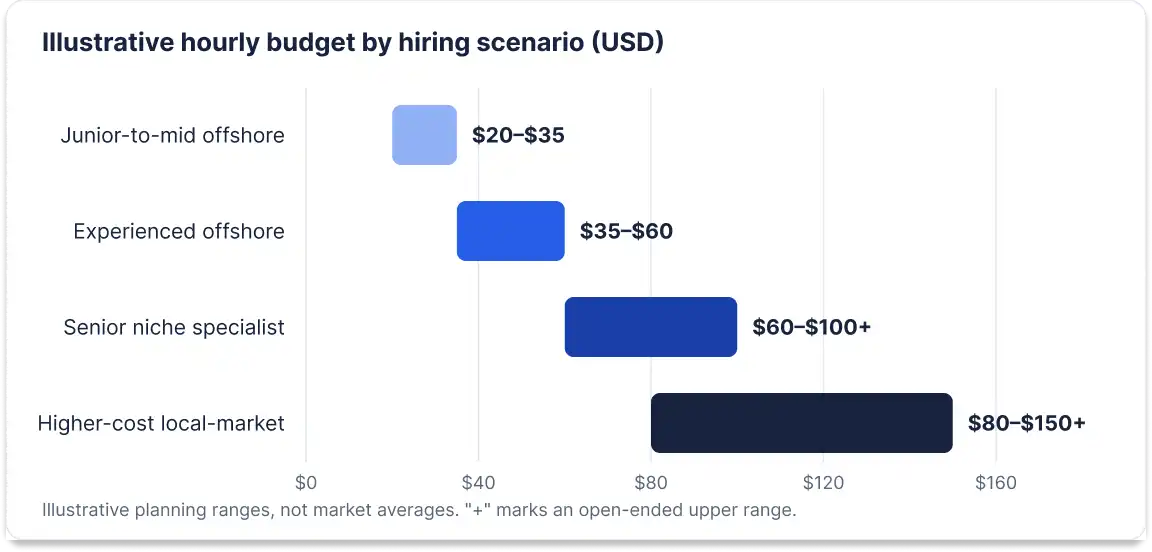
| Hiring scenario | Illustrative hourly budget (USD) | 160-hour month | What to check |
|---|---|---|---|
| Junior-to-mid offshore developer | $20–$35 | $3,200–$5,600 | Mentorship, code review, autonomy |
| Experienced offshore developer | $35–$60 | $5,600–$9,600 | Architecture, delivery ownership, domain expertise |
| Senior niche specialist / technical lead | $60–$100+ | $9,600–$16,000+ | Scarce skills, technical leadership, security requirements |
| Higher-cost local-market contractor | $80–$150+ | $12,800–$24,000+ | Location, availability, compliance and contracting |
The hourly rate is only part of your budget. QA, UI/UX, project management and cloud costs can add to the monthly total. Share your requirements and we will give you a scope-based estimate instead of a generic rate.
A sample three-month budget
Suppose you hire one experienced developer at an illustrative $40/hour for 120 billable hours per month:
120 hours × $40 × 3 months = $14,400 in development fees. You may still need QA, UI/UX, product management, cloud hosting, security testing and third-party services. Ask whether those are included before treating a monthly quote as the full project budget. For wider project budgets, see our mobile app development cost guide.
Why the cheapest developer can cost more
A lower rate does not save money if the work repeatedly needs rewriting. Ask what the developer has shipped, who reviews their code, how bugs are handled and whether documentation is part of the work. The goal is a predictable cost per useful outcome—not the smallest number on a proposal.
Dedicated developers vs freelancers vs agencies
Choosing the wrong hiring model costs more than choosing the wrong developer. Your dedicated developer hiring model decides how much control you keep, how predictable your budget is, and who owns delivery. Here is how the main options compare, so you can match the model to your product.
| Model | Best when | Main advantage | Potential drawback |
|---|---|---|---|
| Dedicated developer / team | Your roadmap evolves and you need steady capacity | Continuity, flexible prioritization and growing product knowledge | Needs active product oversight from your side |
| Staff augmentation | You manage delivery and need extra engineers | Fast capacity added to your own team | Less delivery ownership from the provider |
| Independent freelancer | Tasks are small and clearly defined | Direct, flexible engagement | Availability and continuity can vary |
| Fixed-price agency project | Scope and acceptance criteria are stable | Clearer deliverable-based pricing | Changes may require new estimates |
| In-house employee | You need long-term ownership of a core product | Deep organizational knowledge | Recruitment, benefits and management overhead |
A quick way to choose: if your backlog keeps changing, a dedicated developer or team usually fits best. If the scope is fixed and fully documented, a fixed-price project is simpler. For a one-off task, a freelancer may be enough.
If you already have a product manager and senior engineer, one dedicated developer can add valuable capacity. If nobody on your side can review technical decisions, a managed dedicated development team or a fixed-scope engagement may be safer. Not sure which fits your product? Share your brief and we will recommend a model.
Which developers should you hire?
The right dedicated developers depend on your outcome, not a job title. A mobile app with real-time messaging and an admin dashboard, for example, usually needs more than one skill set. Use this list to decide which roles to hire first.
DEVELOPER ROLES TO CONSIDER
- Flutter developer: One codebase for iOS and Android features, app architecture and release support.
- React / Next.js developer: Web applications, customer dashboards and frontend performance.
- Node.js / NestJS developer: APIs, authentication, integrations and backend services.
- AI / ML developer: AI integrations, retrieval workflows, evaluation and model-powered features.
- QA engineer: Regression coverage, device testing and release confidence.
- DevOps engineer: Deployment pipelines, monitoring, infrastructure and security controls.
For a complex project, pairing a developer with part-time QA and senior technical review can be more effective than hiring two developers with no quality process. Primocys can staff this mix across Flutter app development for cross-platform apps and Node.js development for APIs and backends. Not sure which roles you need? Share your brief and we will suggest the right team.
How to hire a dedicated developer: 7 practical steps
Follow these seven steps to hire a dedicated developer with confidence, from a clear project brief to a paid trial that protects your budget, code and timeline.
Write a one-page project brief
Explain the product, users, current stack, biggest problem, near-term milestones and expected time commitment.
Choose an engagement model
Decide whether you need a dedicated individual, a managed pod or a defined fixed-price delivery.
Review relevant work
Ask for similar apps, technical decisions and a clear explanation of the candidate’s personal contribution.
Interview for judgment
Ask how they would diagnose a slow API, handle a breaking release or resolve ambiguous requirements, not only syntax questions.
Run a paid, bounded trial
Use a real but low-risk task with documented acceptance criteria and a code review.
Agree on working rules
Define time-zone overlap, meetings, pull requests, issue tracking, security and reporting cadence.
Start with a milestone
Review delivery quality after the first sprint before committing to a long engagement.
Interview questions for dedicated developers
- What is the most similar product you worked on, and what did you personally build?
- How do you estimate a feature when the requirements are incomplete?
- Who reviews your code, and what tests do you normally write?
- How will you report blockers and changes to the estimate?
- What happens to code, credentials and documentation if the engagement ends?
- How do you use AI coding tools, and how do you verify the code they generate?
How fast can you hire dedicated developers?
Hiring dedicated developers is usually faster than recruiting in-house, but the exact timeline depends on your skills, stack and how quickly you give feedback. A typical process runs in four stages: shortlist profiles, interview the candidates, run a paid trial of one to two weeks, then start the engagement. Ask any provider for its actual onboarding timeline in writing, along with its replacement terms if the first match is not right.
You can save days before the first call. Prepare a one-page brief, plan repository and tool access, and choose a small trial task in advance. Share your stack and skills with us, and we will tell you what a realistic start date looks like for your project.
Seven risks when you hire remote developers—and fixes
| Risk | Practical protection |
|---|---|
| Unclear developer allocation | Specify hours, availability, holidays and replacement policy. |
| Code quality problems | Require pull requests, reviews, testing and coding standards. |
| Unexpected costs | Define billable work, approval thresholds and change requests. |
| Vendor lock-in | Keep repositories, domains, cloud accounts and licenses under your control. |
| Security or privacy exposure | Use least-privilege access, NDAs, access logs and secure secret handling. |
| Communication gaps | Set overlap hours, weekly demos and a written decision log. |
| Difficult handover | Require deployment notes, architecture documentation and an exit checklist. |
One small but important detail: decide who owns the source code and intellectual property before development starts. Contract terms differ across jurisdictions, so have qualified legal counsel review any agreement that matters to your business.
What should be included in a dedicated developer agreement?
A clear dedicated developer agreement protects your budget, your code and your timeline. Before you sign, make sure it covers these seven points, so there are no surprises once the work starts.
DEDICATED DEVELOPER AGREEMENT CHECKLIST
- Roles and capacity: Named roles, seniority expectations and allocated capacity.
- Fees and invoicing: Hourly or monthly fees, invoicing terms, overtime rules and payment currency.
- Scope ownership: Who sets priorities and who approves completed work.
- IP and security: Intellectual property, confidentiality, data handling and security obligations.
- Code ownership: Repository ownership, access permissions and use of third-party libraries.
- Exit terms: Replacement terms, notice period, termination and knowledge transfer.
- Quality standards: Definition of done, acceptance process and bug-fix expectations.
Also ask whether your team can interview the assigned developer before the engagement begins. An agency’s portfolio is useful, but you should know who will actually work on your code. Have qualified legal counsel review the final agreement.
Our Product Experience: Real-Time Chat App
Cost tables are easier to trust when you can see the work behind them. Whoxa Chat is a Primocys-built messaging app published on Google Play, shown here as delivery experience rather than an independently verified client ROI case study.
Whoxa Chat: real-time messaging app
- What buyers need: A messaging product needs more than a chat screen. Messages must sync across devices in real time, groups need admin controls, and voice and video calling has to behave well on real networks.
- What the app includes: Phone-number sign-up with OTP, single and group chat, reply, forward, search and archive, clear and delete chat, block and report user, and audio and video calls.
- What sits behind the screens: A Flutter mobile frontend with a Node.js backend and real-time communication components. The Whoxa site also lists push notifications, end-to-end encryption, multi-language support and an admin panel for user management and analytics.
- Proof you can check: Whoxa Chat is published on Google Play under the Primocys developer account, with 1K+ downloads and a last update on 30 October 2026. View Whoxa Chat on Google Play or visit the Whoxa website.
- What it means for your budget: Real-time sync, group management, calling and an admin panel are the features that move a chat app from lean MVP towards growth-stage pricing, so scope them early. UK businesses can use this as a reference when scoping chat features, or explore our chat app development service.
Chatlivo: live chat and lead capture SaaS
- What buyers need: A business chat platform must connect a website widget, agent workflows, visitor interactions and integrations, and keep all of them reliable while customers are waiting for a reply.
- What the product includes: A customisable website chat widget with pre-chat forms and offline messages, chatbot flows for lead capture, live visitor tracking, a shared inbox for WhatsApp, email, Messenger and Instagram, chat assignments for agents, auto translation, AI-assisted support features, chat and visitor analytics, and web, iPhone and Android apps. Visit Chatlivo.
- Proof you can check: Chatlivo runs as a live subscription product with a public pricing page, a free plan and a 7-day free trial of paid plans without a credit card. View Chatlivo plans.
- What it means for your budget: A multi-channel inbox, agent assignments, translation, analytics and mobile apps are the features that move a SaaS product from lean MVP towards growth-stage pricing. Scope each one separately and plan for ongoing support.
Hire dedicated developers India: what UK buyers should know
India can be a practical option for UK businesses that want remote development capacity at a lower hourly cost, particularly when the provider has experience working across time zones. But location alone does not determine quality. Compare partners on engineering judgement, communication, portfolio relevance, security practices and contract clarity.
| Option | Illustrative hourly budget (GBP) | Main consideration |
|---|---|---|
| Offshore specialist agency (for example, India) | £20–£60 equivalent | Time-zone overlap, communication, vendor vetting and contract protections |
| UK independent developer | £40–£100+ | Flexible for narrow work; confirm backup, design and QA coverage |
| UK app development agency | £70–£140+ | Local workshops and easier overlap; often higher delivery cost |
Illustrative planning ranges consistent with the cost tables above, not market averages or a Primocys rate card.
For UK clients, a few practical points matter. India is 4.5 to 5.5 hours ahead of the UK depending on the season, so agree an overlap window for calls and demos. Confirm in writing who owns the source code, and check data hosting and transfer arrangements under UK GDPR. Start with a paid trial sprint or a first milestone before committing to a longer engagement.
Comparing providers? Read our guide to the best mobile app development companies in India, or explore how to hire dedicated developers for your product.
Why choose Primocys for your UK app project?
Primocys is a full-cycle software development company founded in 2019 and based in Ahmedabad, India, working with B2B and B2C clients across mobile app, AI, SaaS and web development. For UK clients, we agree the following before any engagement starts:
- A written agreement covering IP ownership, confidentiality and repository access.
- An agreed overlap window for UK working hours, so calls and demos fit your day.
- Short milestones and regular demos, so you see working software early.
- Developers matched to your stack, such as Flutter, React, Node.js or AI.
- A phased scope and project estimate based on your actual feature list.
Independent client reviews: Primocys is rated 5.0 on Clutch from 16 client reviews. View our Clutch profile.
Ready to talk it through? Share your brief and we will suggest a suitable team, engagement model and project estimate, or explore our UK mobile app development services.
How to request an accurate developer quote
Send every prospective partner the same brief, so you can compare quotes like for like. A one-page brief should cover your existing codebase or technology stack, the skills you need, expected weekly hours, target start date, time-zone and UK-hours requirements, QA expectations and who will manage the backlog.
Ask each provider to separate developer capacity from project deliverables, and to state what is included: discovery, design, QA, DevOps, project management, hosting and post-launch support. If a quote promises both unlimited changes and a guaranteed deadline, ask for the exact conditions behind that promise.
Then compare the things a price alone will not show: who will actually work on your code, how often you will see a tested build, and what happens if you need to replace a developer or end the engagement. A clear proposal with named roles, milestones and exclusions is usually better value than a lower number with a vague scope.
Conclusion: hire dedicated developers with confidence
The best developer is not always the least expensive, the most senior or the person who can start tomorrow. The right hire is someone whose skills match your current bottleneck, who communicates clearly, and whose work your business can maintain after the engagement ends.
To get there, start with a small, measurable commitment such as a paid trial or a first milestone. Keep control of your code repositories and cloud accounts. Judge progress by working software, not hours logged. These habits protect your budget far more than chasing the lowest hourly rate.
Whether you need one specialist or a full dedicated development team, the right engagement model depends on your stack, scope and timeline. Explore our hire dedicated developers service to see how we work, then send your brief when you are ready to compare estimates.
Hire Dedicated Developers: FAQs
How much does it cost to hire a dedicated developer in 2026?
Dedicated developers vs freelancers: what is the difference?
What should a dedicated development contract include?
Can I hire one developer instead of a complete team?
How do I reduce the risk when I hire remote developers?
How do I hire a dedicated developer for my startup, and how long does it take?
Should I hire dedicated developers in India or locally?
Related Guides & Services

Build your scalable apps today.
Contact UsLeaving Already?
Hear from our clients and why 1200+ businesses trust Primocys

"Our B2B and B2C platform helps Nigerian manufacturers sell at wholesale prices and suppliers offer competitive retail pricing, with a strong focus on Made in Africa products and easy local and international distribution. The app has received excellent user reviews for its design and unique features. Communication with the Primocys team was smooth in an agile setup, even beyond office hours when needed. Their mobile app development expertise is excellent—highly professional and reliable."

"The dating app was delivered successfully and approved by both Apple App Store and Google Play. Our users are highly impressed with the design, UI, and overall functionality. The project was well planned with clear milestones, and all modules were delivered on time. The team is talented, patient, and flexible, accommodating multiple scope revisions as requirements evolved. Their 24/7 development and support availability made the entire process smooth and reliable."

" We hired Primocys to develop a highly complex and specialized mobile application, and they delivered outstanding results. The app includes advanced features such as timeline mixers, classifieds, payments, advertisements, GPS functionality, and more. Their technical skills, timely delivery, availability, and the personal attention Arpan Sagar brings to each project truly stand out. The team stays focused and committed from start to finish—an excellent experience overall."

" Great team with excellent communication and a strong commitment to on-time delivery. They developed a fully customized mobile app for both Android and iOS, perfectly matching our requirements. The entire process was smooth and professional, with clear updates at every stage. They are reliable, skilled, and very easy to work with. We’re continuing our partnership on more projects, and choosing them has been one of the best business decisions I’ve made."

AWARDS




Share Your Requirements
TRUSTED BY GLOBAL BRANDS