






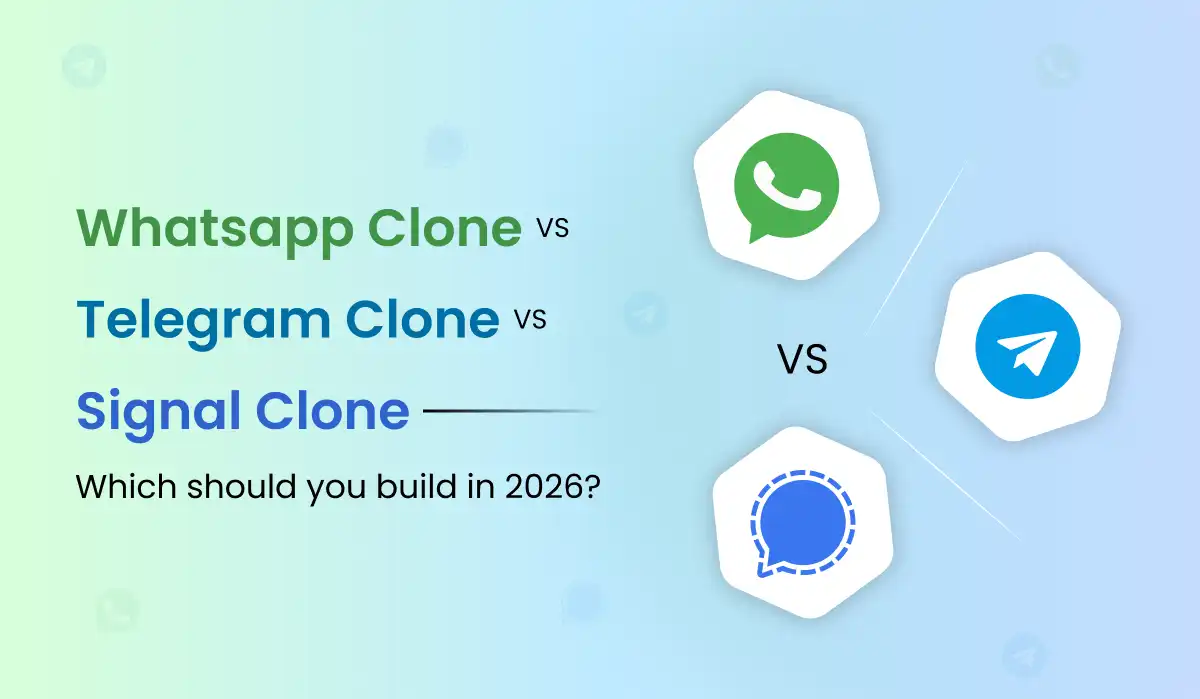
Every comparison online ranks these three as a consumer picking which app to use. None of them help a founder decide which architecture to build a business on. That’s a completely different question — and the right answer depends entirely on your business model, not on which app has the strongest privacy reputation.
The honest answer, before anything else This isn’t really “which app is most secure” — it’s “what does my business actually need a messaging product to do?” Build WhatsApp-style if you need general consumer or business messaging with broad commercial flexibility. Build Telegram-style if your product is communities, channels, or bot-driven automation rather than private conversation. Build Signal-style only if privacy itself is your core product — not a feature you’d like to have, but the entire reason the product exists. The architecture you pick shapes your entire backend, your monetisation options, and how hard certain features are to add later. See our WhatsApp clone service →
Every founder who comes to us with “I want to build something like Telegram” or “I want a Signal-level secure app” is actually describing a feeling, not an architecture. They’ve used these apps, they like something specific about how each one works, and they’re reaching for the closest familiar reference point.
That’s a completely reasonable place to start — but it’s worth unpacking what you’re actually asking for, because WhatsApp clone vs Telegram clone vs Signal clone development involves fundamentally different architectures. Picking the wrong one means rebuilding core infrastructure six months in. This guide breaks down each messaging app clone option so you can choose with confidence.
Each app’s personality comes directly from its founder’s priorities, and understanding that history makes the technical decision much clearer. WhatsApp was built by engineers who hated ads and tracking, then became a Meta product optimised for broad reach. Signal was created by a cryptographer who cared more about privacy than profit, and it shows in every architectural choice — minimal data retention, no ads, nonprofit funding. Telegram was built by a founder who prioritised features, scale, and community tools, with end-to-end encryption available but not the default. None of these are “better” in the abstract. They’re optimised for different things.
WhatsApp vs Telegram vs Signal Clone: 3 Architectures Explained
The single most important technical distinction across all three architectures isn’t the logo or the colour scheme — it’s where messages live and how encryption is applied by default. Get this one decision right and almost everything else follows naturally from it. The architecture you choose defines your entire backend, your feature roadmap, and which monetisation paths stay open to you.
WhatsApp-Style
- Signal Protocol on every chat, no exceptions
- Minimal server-side message storage
- Phone-number-based identity
- Strong 1:1 and small-group focus
- Business API model proven at scale
Telegram-Style
- Regular chats stored server-side (not E2E by default)
- E2E only in opt-in “Secret Chats” mode
- Large file sharing, generous size limits
- Powerful bot API, public channels at scale
- Multi-device sync without re-sending messages
Signal-Style
- Signal Protocol E2E on everything, always
- No cloud backup of messages by default
- Minimal metadata retention — by design
- No ads, no data monetisation model
- Smaller feature surface, deliberately
Why Telegram Clone Default Encryption Surprises Founders: Telegram’s brand association with privacy-conscious communities leads many founders to assume its architecture is as private as Signal’s by default. It isn’t. Regular Telegram chats use server-side encryption — Telegram’s servers can technically access message content — while only the opt-in Secret Chats mode uses true end-to-end encryption. This isn’t a flaw; it’s a deliberate trade-off that enables features Signal doesn’t have, like seamless multi-device sync and searchable cloud message history. If you’re building a Telegram-style clone, decide explicitly whether default-encrypted or cloud-synced is the right trade-off for your users — don’t assume “Telegram-like” automatically means “as private as Signal.”
Which Messaging App Clone Fits Your Business Model
You’re building general consumer or business messaging — customer support, internal team chat, community-specific social messaging, or a white-label platform for other businesses. The broadest commercial use case by far.
Your product centers on one-to-many broadcasting, large public or semi-public communities, or bot-driven automation — content distribution, trading signal groups, customer notification channels, or community management tools.
Privacy and provable confidentiality is the entire product, not a feature — healthcare communication (HIPAA), legal client conversations, journalism source protection, or any regulated industry where “can you prove this was private?” is the question that matters most.
WhatsApp Clone vs Telegram Clone vs Signal: Cost & Features
| Factor | WhatsApp-Style | Telegram-Style | Signal-Style |
|---|---|---|---|
| Default encryption | E2E always on | Server-side (opt-in E2E) | E2E always on |
| Multi-device sync | Moderate complexity | Easiest — cloud-native | Hardest — by design |
| Large group / channels | Limited (1,024 members) | Excellent — 200K+ supported | Limited, deliberately |
| Bot / automation API | Business API only | Mature, powerful bot platform | Minimal |
| File sharing limits | Moderate (2GB typical) | Generous (4GB+) | Conservative |
| Monetisation clarity | Strong — Business API model | Strong — subscriptions, channels | Weakest — privacy vs revenue |
| MVP build cost (Flutter, India) | $5,000–$12,000 | $8,000–$18,000 | $6,000–$14,000 |
| Full platform cost | $15,000–$35,000 | $20,000–$45,000 | $15,000–$30,000 |
| Engineering discipline required | Standard | Higher — bot infra, scale | Different — minimal retention discipline |
Why Telegram Clone App Development Often Costs More Than Expected: The bot API and large-group infrastructure are the parts that quietly add cost. Supporting 200,000-member channels with smooth message delivery requires a fundamentally different backend architecture than 1:1 and small-group chat — message fanout at that scale needs careful queue design, not just a bigger server. If “channels and bots” are core to your product vision rather than a nice-to-have, budget for that complexity from day one rather than discovering it mid-project.
Messaging App Monetisation: Which Clone Model Makes Money
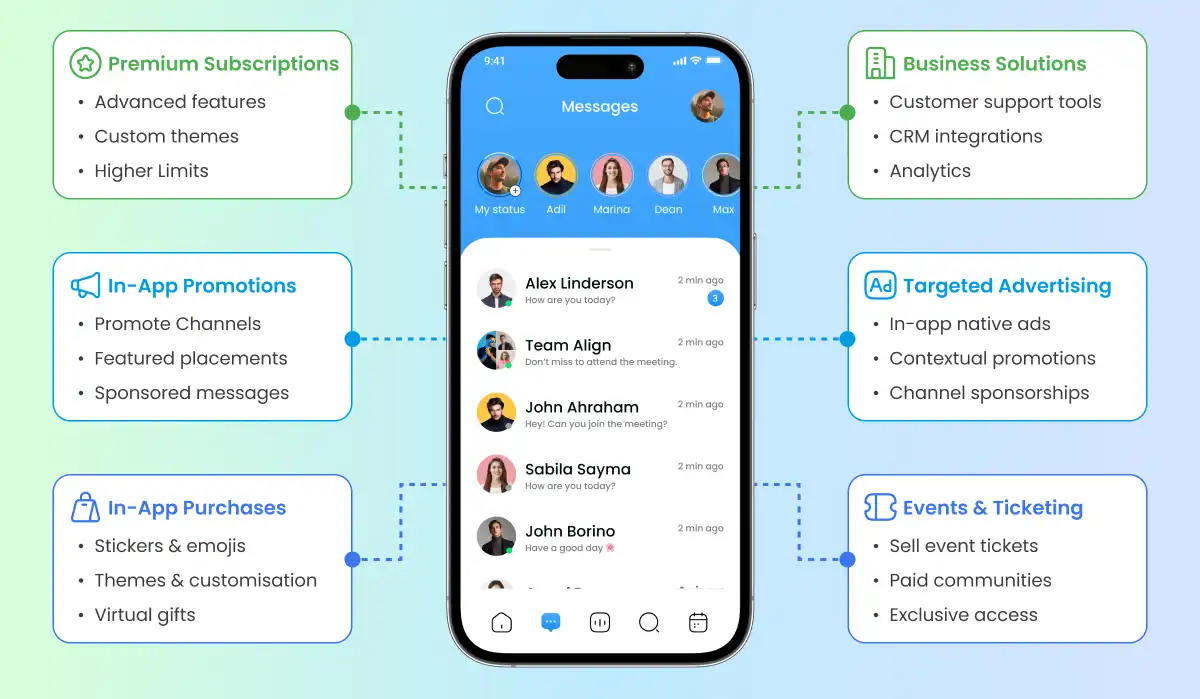
This is the part most comparison articles skip entirely, and it’s often the deciding factor for a founder building a commercial product rather than a personal project. The encryption model you choose has direct downstream effects on which messaging app monetisation model options are even available to you. Understanding this is key before you finalize your WhatsApp clone cost vs Telegram clone cost budget.
WhatsApp Clone App Development: Clearest Commercial Path: The WhatsApp Business API model — paid per-conversation messaging for businesses to reach customers — is a proven, substantial revenue driver for Meta. For a clone, this translates into B2B licensing (selling your messaging platform to other businesses under their brand), premium subscription tiers, or a verified business account model. This is the architecture with the most commercial precedent.
Telegram Clone App Development: Subscriptions & Channel Monetisation: Telegram itself reports roughly $1 billion in annual revenue through Telegram Premium subscriptions and channel/bot monetisation tools that let content creators and businesses charge for premium channel access. A Telegram-style clone has a genuine path to revenue through similar subscription and creator-monetisation mechanics, particularly if your product serves content creators or community organisers.
Signal Clone App Development: The Honest Truth About Monetisation: Signal itself runs on nonprofit donations specifically because its founders concluded that any data-driven or ad-driven revenue model would compromise the privacy promise that defines the product. If you’re building a Signal-style clone as a commercial venture, your realistic paths are B2B licensing to regulated industries (healthcare, legal) who will pay specifically for compliance-grade privacy, or a straightforward paid-subscription model with no data monetisation whatsoever. This is the architecture where “free, ad-supported, privacy-focused” is a genuine contradiction — don’t try to have it both ways.
“The architecture decision isn’t really about which app you admire most. It’s about which revenue model your business actually needs — and Signal’s own funding structure is the clearest proof that privacy-first and ad-revenue-first are fundamentally incompatible goals.”
Hybrid Messaging App Architecture: Best of All Three
You don’t have to pick exactly one of these three models in their pure form. The most commercially successful messaging app clone development projects in 2026 often borrow deliberately from more than one architecture. A WhatsApp-style core (E2E encrypted 1:1 and group chat) with Telegram-style channel and bot features layered on top serves both private conversation and public broadcasting needs in one product — useful for community platforms that need both DMs and announcement channels. This hybrid approach is especially popular among messaging app development companies in India building for global markets.
Similarly, a primarily Signal-style privacy posture with an optional, clearly-labelled “cloud backup” feature (opt-in, not default) gives privacy-conscious users the option without compromising the core promise for everyone else. The key discipline is being explicit about which parts of your product inherit which architecture’s trade-offs — murky half-measures, where users assume Signal-level privacy on a feature that’s actually server-side encrypted, are how trust gets broken later.
We Build All Three Architectures — and We’ll Tell You Honestly Which One Fits
Primocys has shipped WhatsApp-style messaging products in production — WasaaChat and ChatWave, both live on the App Store and Google Play, Flutter-built with Signal Protocol encryption and self-hosted WebRTC. We scope every messaging project around your actual business model, not the app you happen to like.
2 live WhatsApp-style apps
WasaaChat and ChatWave — download and test before committing to anything.
Signal Protocol expertise
Same E2E encryption standard across all three architectures — we implement it correctly every time.
Bot & channel infrastructure
Built the message fanout and queue architecture that large-group, Telegram-style products need.
Honest architecture scoping
We’ll tell you which model fits your actual revenue plan — even when that means a smaller invoice.
Flutter, one codebase
iOS + Android from one build, any of the three architectures. Clutch Top Flutter Developer 2024 & 2026.
Fixed price from $5,000
Cost agreed before development starts. Full source code. No vendor lock-in.
Conclusion: Which Messaging App Clone Should You Build in 2026?
Choosing between WhatsApp, Telegram, and Signal clone development comes down to one honest question: what does your business actually need messaging to do?
If you need broad consumer or business messaging with a proven monetisation path, a WhatsApp-style build is your answer — it has the most commercial precedent, the clearest B2B revenue model, and the widest market fit. If your product centers on communities, channels, or bot-driven automation, a Telegram-style architecture gives you the infrastructure for large-group broadcasting and a powerful bot platform. And if privacy is your entire product — not just a feature — a Signal-style build is the right choice, particularly for healthcare, legal, and regulated industries.
For most commercial projects in 2026, WhatsApp-style architecture offers the best balance of features, cost, and monetisation clarity. Building with Flutter lets you ship iOS and Android from one codebase, cutting your development cost significantly compared to separate native builds — especially with an India-based team.
Not sure yet? That’s exactly what we scope for free. Talk to the Primocys team → and we’ll give you an honest recommendation — WhatsApp-style, Telegram-style, Signal-style, or a hybrid — before any contract is signed.
Questions About Choosing Between These Architectures
Should I build a WhatsApp clone, a Telegram clone, or a Signal clone?
What is the main architectural difference between a Telegram clone and a WhatsApp clone?
Is a Signal clone harder to build than a WhatsApp clone?
Which messaging clone makes the most money — WhatsApp, Telegram, or Signal style?
Related Articles

Build your scalable apps today.
Contact UsLeaving Already?
Hear from our clients and why 1200+ businesses trust Primocys

"Our B2B and B2C platform helps Nigerian manufacturers sell at wholesale prices and suppliers offer competitive retail pricing, with a strong focus on Made in Africa products and easy local and international distribution. The app has received excellent user reviews for its design and unique features. Communication with the Primocys team was smooth in an agile setup, even beyond office hours when needed. Their mobile app development expertise is excellent—highly professional and reliable."

"The dating app was delivered successfully and approved by both Apple App Store and Google Play. Our users are highly impressed with the design, UI, and overall functionality. The project was well planned with clear milestones, and all modules were delivered on time. The team is talented, patient, and flexible, accommodating multiple scope revisions as requirements evolved. Their 24/7 development and support availability made the entire process smooth and reliable."

" We hired Primocys to develop a highly complex and specialized mobile application, and they delivered outstanding results. The app includes advanced features such as timeline mixers, classifieds, payments, advertisements, GPS functionality, and more. Their technical skills, timely delivery, availability, and the personal attention Arpan Sagar brings to each project truly stand out. The team stays focused and committed from start to finish—an excellent experience overall."

" Great team with excellent communication and a strong commitment to on-time delivery. They developed a fully customized mobile app for both Android and iOS, perfectly matching our requirements. The entire process was smooth and professional, with clear updates at every stage. They are reliable, skilled, and very easy to work with. We’re continuing our partnership on more projects, and choosing them has been one of the best business decisions I’ve made."

AWARDS


Share Your Requirements
TRUSTED BY GLOBAL BRANDS