
MVP — Validate the Core
$18K–$50K
US/EE equiv: $50,000–$150,000
- Core feature set + UI/UX design
- Multi-tenant authentication
- Stripe billing (2–3 tiers)
- Basic admin dashboard
- Transactional email
- Basic DevOps / cloud setup
 DapkeSocial video app with live streaming and PK battles.
 Lika Real EstateProperty discovery platform for listings and leads.
 BurpoutSocial fitness challenges that keep people moving.
 ChatLivoConnected customer communication SaaS workspace.
 EmoTalesAI storytelling adventures designed for children.
 EarnifyTrack Income from Multiple Sources with Analytics & Tax Planning.
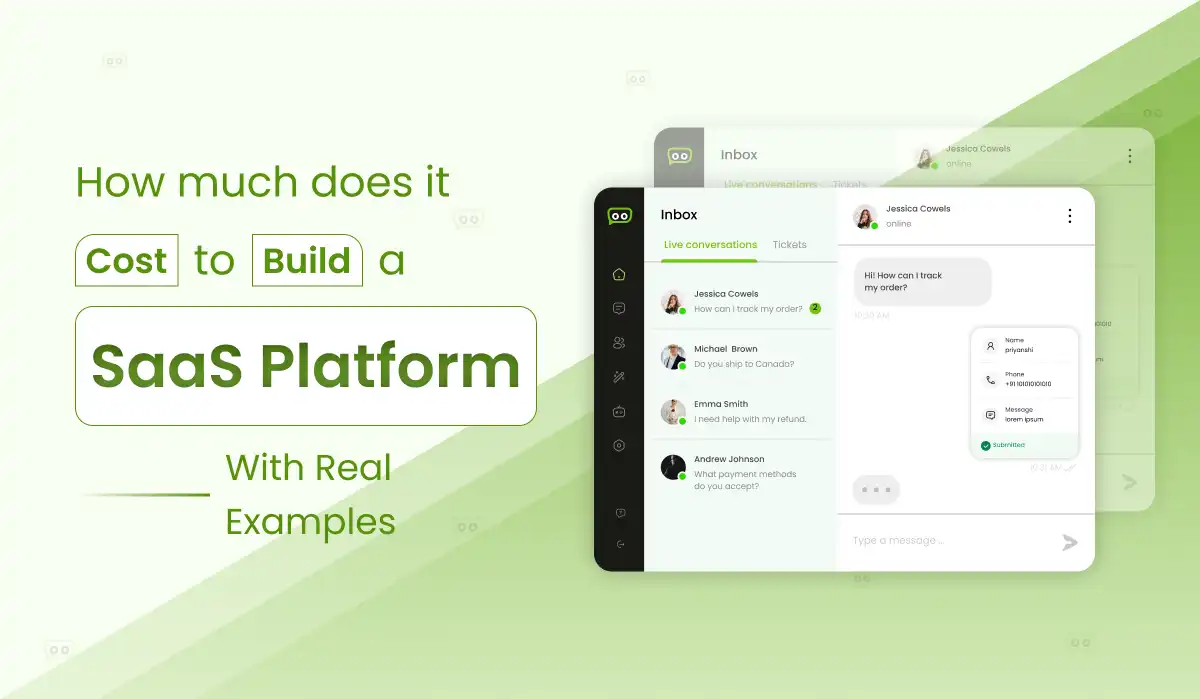
Every guide quotes $5,000 to $1,000,000+ and calls it a day. We’re breaking it down by SaaS type, by component, and by real-world experience — including Chatlivo, a live chat SaaS we built and run ourselves, with AI and chatbot features currently in development.
The number you came here for SaaS platform development costs $18,000–$50,000 for an MVP (core feature set, multi-tenant architecture, Stripe billing, admin dashboard) at India development rates. A mid-tier platform with integrations, role-based access, and API-based AI features costs $55,000–$150,000. A full enterprise SaaS with SOC 2 compliance, SSO, custom analytics, and proprietary AI models costs $150,000–$300,000+. Industry guides quote $25,000–$500,000+ — all at US or Eastern European rates, zero India-rate options cited anywhere. Annual maintenance adds 15–25% of your original build cost every year — a number that blindsides most founders after launch. See our SaaS development service →
The “$5,000 to $1,000,000+” cost range that appears in every SaaS platform development cost guide isn’t wrong — it’s just useless. A simple subscription tool for solo founders and a multi-tenant operations platform for enterprise clients are both “SaaS” and they cost completely different amounts to build. The range is wide precisely because SaaS is a business model, not an application type. Before SaaS platform development cost can be meaningful, the type of SaaS you’re building has to be defined — and that’s the question most guides skip.
We’re in a different position from most agencies writing this guide: we’ve been here. Chatlivo , our own B2B SaaS development project for SMBs, is live, priced, and running — with a WordPress plugin submitted, WhatsApp integration built, a chatbot on the product roadmap, and an AI module coming in Phase 2. We know what SaaS platform development actually costs because we’ve built one, and we know which parts cost more than expected because we’ve paid for those surprises ourselves.
Most agencies writing SaaS cost guides have built SaaS products for clients. We’ve done that too — but we’ve also built one for ourselves, which is a different kind of education. When it’s your own revenue on the line, every infrastructure decision and feature scope debate has real consequence.
Pricing tiers (Free, Pro, Business)
Live chat + WhatsApp integration
Plugin submitted to WordPress.org
AI chatbot + reply assist in roadmap
Chatlivo is Primocys’s own B2B SaaS product — not a client project. We built it, we run it, and we’re building the AI roadmap right now. When we talk about what SaaS development costs, we’re describing what we’ve actually spent.
What building Chatlivo taught us that no cost guide mentions: The infrastructure we built on day one — multi-tenant data isolation, per-account billing logic, real-time agent websocket connections, GDPR-compliant data handling — wasn’t visible to any user. It was foundational plumbing that had to be right before we could ship a single customer-facing feature. The most consistent underestimation in SaaS budgeting is treating this invisible layer as a small part of the build. It isn’t. For Chatlivo, multi-tenancy, billing, and compliance-aware data architecture together consumed roughly a third of Phase 1 engineering time — before a single chat widget rendered in a browser.
Treating “SaaS” as a single product category when scoping cost is the most reliable path to a budget that’s wrong before development starts. These are the genuinely different types, each with different architecture requirements and cost drivers:
Serves any industry — Slack, Stripe, Notion. Large potential market, fierce competition with well-funded incumbents.
Solves a problem specific to one industry. Less competition from horizontal giants, deeper product-market fit, often premium pricing.
Installed inside an existing platform — a chat widget, review tool, or analytics snippet. Lower friction adoption, distribution via plugin ecosystem.
AI as the core product, not a feature added to a conventional tool. Requires real model integration or fine-tuning, not just an API wrapper.
Sold to organizations, not individuals. Requires SSO, advanced role-based permissions, audit logs, SOC 2 compliance, and enterprise contract workflows.
Product-led growth — users sign up themselves and upgrade when they outgrow the free tier. Requires frictionless onboarding and feature gating infrastructure.
These are the two most consistently underestimated cost centres in SaaS platform development — not because they’re complex to describe, but because they’re invisible to users. Nobody opens Chatlivo and thinks “impressive row-level security and prorated billing engine.” They think “the chat works.” But the chat only works reliably at scale because the invisible layer was built correctly first. Multi-tenant SaaS development cost surprises more founders than any other single line item.
Multi-tenancy means a single codebase serving thousands of separate business customers, each with their data completely isolated. Getting this wrong means one tenant can theoretically access another tenant’s data — an existential security and trust failure. Building it correctly from day one means choosing a data isolation strategy (shared database with row-level tenant filtering using a tenant_id column on every table, or a separate database schema per tenant), designing every query with tenant isolation enforced at the application layer, and building admin tooling that can view and manage the platform across all tenants without breaching any of them.
“We’ll use Stripe” is the beginning of the billing conversation, not the end of it. A real SaaS billing engine needs tiered plan management with feature gating (free users get X agents, Pro users get Y, Business gets Z), prorated billing when users upgrade mid-cycle, trial-to-paid conversion with automatic plan locking when payment fails, seat-based or usage-based billing if your model calls for it, automated invoice generation, and tax calculation across jurisdictions if you serve international customers. Chatlivo has three tiers (Free, Pro at $19/month, Business at $32/month) plus annual discount pricing — each with its own feature set, agent limits, and channel access. That billing logic is real engineering, not a Stripe documentation tutorial.
The most common SaaS budget surprise: design, QA, and DevOps aren’t in the quote Most SaaS development quotes cover only engineering hours. In practice, UI/UX design, QA testing, and DevOps setup (CI/CD pipeline, environment management, monitoring, staging and production infrastructure) together add 40–60% on top of the base engineering quote. A project quoted at $80,000 can land at $130,000–$150,000 once these are properly accounted for. The companies worth hiring are the ones who include these in the initial scope, not the ones who quote engineering-only and surface the rest later.
| SaaS Component | India Rates (Primocys) | US / EE Rates | Notes |
|---|---|---|---|
| UI/UX Design | $3,000–$12,000 | $10,000–$40,000 | Dashboard, onboarding, settings, mobile-responsive |
| Auth + Multi-Tenancy | $4,000–$10,000 | $15,000–$35,000 | SSO adds $8K–$18K on top for enterprise |
| Core Feature Set | $8,000–$35,000 | $25,000–$100,000 | Your product’s unique value proposition |
| Billing Engine (Stripe) | $3,000–$8,000 | $10,000–$25,000 | Tiers, proration, trials, invoicing, tax |
| Admin Dashboard | $3,000–$10,000 | $8,000–$30,000 | User management, metrics, support tooling |
| API + Webhooks | $3,000–$8,000 | $10,000–$25,000 | Required for integrations and partner ecosystem |
| Third-party Integrations | $2,000–$6,000 each | $5,000–$15,000 each | Each integration is its own project scope |
| AI Features (API-based) | $5,000–$20,000 | $15,000–$60,000 | + $500–$5,000/month in ongoing API usage |
| AI Features (Custom ML) | $40,000–$100,000 | $80,000–$200,000+ | Only after product-market fit and real data |
| DevOps / CI/CD / Infra | $4,000–$12,000 | $12,000–$35,000 | Often missing from initial quotes |
| Compliance (SOC 2, HIPAA) | $20,000–$60,000 | $30,000–$80,000 | Certification cost largely fixed regardless of team location |
Gartner projects that 80% of enterprises will have deployed GenAI-enabled applications by end of 2026. In practice, that means AI SaaS development cost is now a standard budget question — users expect intelligent features even in early-stage SaaS products. “Is this AI-powered?” is now a standard evaluation question for B2B buyers.
The right sequencing for AI in a SaaS product, based on what we’re building right now with Chatlivo:
Chatlivo launched with human-agent live chat, WhatsApp integration, and conversation management. No AI features, because we needed to prove that the core workflow — a support agent handling real customer conversations — was valuable before adding automation on top of it.
Reply Assist (suggested responses based on conversation context) and an AI chatbot for handling common queries are in active development right now. Both use third-party LLM APIs rather than custom-trained models, because we don’t yet have enough conversation data to justify training proprietary models.
Custom intent classification, churn prediction, and advanced automation workflows, trained on Chatlivo’s own conversation dataset. A Stage 3 decision that makes sense only once Stage 2 has shipped to real users.
Why “start with APIs, build custom models later” is the financially correct sequence Building custom ML models before you have real user data from your own platform produces models that are less accurate than a third-party API — at significantly higher cost. OpenAI, Anthropic, and Google Gemini APIs give you immediately useful AI capability for $500–$5,000 per month, while a custom model adds $50,000–$150,000 to your upfront build cost before you have the data to make it meaningfully better. The financially correct sequence is validated by what the most efficient AI-native SaaS companies do: ship API-based features first, accumulate proprietary data, fine-tune models later when the improvement is measurable and worth the investment.
Why boring tech choices are the right tech choices for SaaS platform development Choosing a proven, well-documented stack — Next.js, Node.js, PostgreSQL, AWS — rather than the newest framework or database keeps your hiring pool wide, your debugging cycles short, and your long-term maintenance costs predictable. The goal of SaaS development is shipping product that earns revenue, not demonstrating technical sophistication through framework selection. The companies that rebuild their stack 18 months after launch because they chose something exotic almost always trace the decision to “it seemed interesting” rather than “it solved a real constraint we had.” We use the same stack in Chatlivo that we recommend to clients — not because it’s exciting, but because it works and we can maintain it.
“The most expensive SaaS mistake isn’t spending too much — it’s spending on the wrong architecture, the wrong team, or the wrong features before you know whether anyone wants what you’re building. The Chatlivo playbook: launch lean, prove demand, then invest in AI and automation on top of something users are already paying for.”
Primocys builds B2B SaaS products the same way we built Chatlivo — multi-tenancy scoped correctly from day one, billing engine built for real complexity, AI roadmapped honestly rather than bolted on as a marketing claim. Fixed price from $18,000, full source code.
Row-level isolation, tenant-scoped queries, admin tooling — not retrofitted after 1,000 customers.
Tiers, proration, trials, invoicing, seat management — the complexity your business model actually needs.
API-based AI at MVP, custom models when your data justifies it. No AI hype, real sequencing.
We’ve built and submitted WordPress + Shopify plugins for Chatlivo. Your SaaS can use the same playbook.
Chatlivo is live. We’ve paid for the surprises. That experience is part of your project scoping.
Cost agreed before development starts — design, QA, DevOps included. Full source code ownership.
SaaS platform development cost is the most honest indicator of scope complexity — and the most reliably misquoted number in the software industry. The founders who ship SaaS products that survive past year one aren’t the ones who found the cheapest quote; they’re the ones who made the multi-tenancy decision correctly before writing a line of code, budgeted the billing engine as a real engineering project rather than a Stripe tutorial, and chose a B2B SaaS development company that has shipped production SaaS products before — not one learning the architecture on their budget.
India-based SaaS platform development delivers the same Next.js, Node.js, PostgreSQL, and Stripe architecture at 60–70% lower engineering cost than US or Eastern European agencies. The infrastructure costs — AWS, Stripe fees, SendGrid — are identical globally. What changes is the engineering cost to wire them together correctly and build multi-tenancy, billing, and DevOps right from day one. That gap is where the real saving is, and for a $55,000–$150,000 Stage 2 SaaS platform, it’s the difference between a project that ships and one that runs out of budget before the first enterprise customer signs up.
The single most important question before you hire a SaaS development company: Ask any shortlisted company to walk you through how they handle multi-tenancy data isolation and billing proration in their SaaS builds — not just describe the features. That one question separates companies who’ve actually built production multi-tenant SaaS from companies quoting based on a single-tenant web app. Get a free SaaS scope call from Primocys →

Hear from our clients and why 1200+ businesses trust Primocys

"Our B2B and B2C platform helps Nigerian manufacturers sell at wholesale prices and suppliers offer competitive retail pricing, with a strong focus on Made in Africa products and easy local and international distribution. The app has received excellent user reviews for its design and unique features. Communication with the Primocys team was smooth in an agile setup, even beyond office hours when needed. Their mobile app development expertise is excellent—highly professional and reliable."

"The dating app was delivered successfully and approved by both Apple App Store and Google Play. Our users are highly impressed with the design, UI, and overall functionality. The project was well planned with clear milestones, and all modules were delivered on time. The team is talented, patient, and flexible, accommodating multiple scope revisions as requirements evolved. Their 24/7 development and support availability made the entire process smooth and reliable."

" We hired Primocys to develop a highly complex and specialized mobile application, and they delivered outstanding results. The app includes advanced features such as timeline mixers, classifieds, payments, advertisements, GPS functionality, and more. Their technical skills, timely delivery, availability, and the personal attention Arpan Sagar brings to each project truly stand out. The team stays focused and committed from start to finish—an excellent experience overall."

" Great team with excellent communication and a strong commitment to on-time delivery. They developed a fully customized mobile app for both Android and iOS, perfectly matching our requirements. The entire process was smooth and professional, with clear updates at every stage. They are reliable, skilled, and very easy to work with. We’re continuing our partnership on more projects, and choosing them has been one of the best business decisions I’ve made."

AWARDS


TRUSTED BY GLOBAL BRANDS