How to Build a Fintech App Like PayPal or Cash App in 2026: Features, Cost & Compliance
Date
26 Jun, 2026
Share:
Every fintech cost guide quotes $50,000–$500,000 — all at US or Eastern European rates, none mentioning India. The architecture decision that matters more than any feature: Banking-as-a-Service, or your own money transmitter license. Here’s the honest version of both.
The number you came here for
Fintech app development like PayPal or Cash App costs $18,000–$40,000 for an MVP (digital wallet, peer-to-peer transfers, KYC via a third-party provider, single payment processor) at India development rates using a Banking-as-a-Service partner. A mid-tier platform with multi-currency support and AI fraud detection costs $45,000–$100,000. A full banking-style platform with its own licensing costs $120,000–$350,000+. US and Eastern European agencies quote $50,000–$500,000+ for the same scope — and none of them mention India rates as an option. Compliance work alone typically accounts for 20–40% of any fintech app’s budget, regardless of who builds it. Get a free fintech app estimate →
Fintech app development is the one app category where the architecture decision genuinely outweighs every feature decision combined. You can scope a beautiful wallet UI, a slick transfer flow, and a clean transaction history screen — and none of it matters if you haven’t decided, before any of that, whether you’re operating under someone else’s banking license or pursuing your own. That single choice determines your timeline, your regulatory exposure, and a meaningful share of your total budget, and it’s the part every generic “fintech app cost” article either skips or buries under a wall of compliance acronyms.
We’re also going to say something plainly that every competitor quote in this category avoids: India rates apply to fintech app development the same way they apply to every other app category. The compliance work itself — PCI-DSS scoping, KYC integration, AML monitoring — costs roughly the same in absolute terms wherever you build, because it’s largely third-party vendor fees and audit costs. But the engineering hours to implement it correctly cost 60–70% less at India rates than at US or Eastern European rates, and that gap compounds across a project where compliance alone can be 20–40% of the total.
$324B
Global fintech market by 2026
70%
Compliance & Security Risks
$18K
BaaS MVP Cost (India)
20–40%
Share of compliance budget
60–80%
BaaS avoids licensing
Banking as a Service vs Own License: The #1 Fintech App Decision
This is the conversation that should happen before a single screen gets designed for your payment app development project. Get this wrong and you either burn six to twelve months waiting on state-by-state licensing approval before you can legally launch, or you over-invest in licensing infrastructure for a product that hasn’t yet proven anyone wants it.
Banking-as-a-Service
Operate under a BaaS partner’s existing license (Unit, Synapse, Treasury Prime )
Cuts regulatory cost by 60–80% vs self-licensing
Live in months, not years
BaaS provider charges per-transaction or monthly platform fees
Right choice for nearly every new fintech app at launch
Locks your financial architecture to their constraints — choose carefully
Your Own Money Transmitter License
State-by-state Money Transmitter Licenses (MTLs) in the US
$50,000–$500,000 total cost across states
6–12 months approval time, per state
Only makes sense at meaningful proven transaction volume
Removes per-transaction BaaS fees at scale
A Stage 2/3 decision, not a launch decision
Why this decision locks in for years, not months: Choosing a Banking-as-a-Service partner isn’t just a vendor selection — it determines your financial network architecture for as long as you’re built on top of it. Different BaaS providers have different constraints around supported transaction types, geographic coverage, and integration depth. Evaluate this the way you’d evaluate a co-founder, not a software subscription, because migrating BaaS providers after launch is a genuinely painful, months-long project. Most founders should still choose BaaS over self-licensing at launch — the point is choosing the right BaaS partner deliberately, not skipping the decision.
PCI DSS, KYC & AML Fintech App Compliance — Cost & What You Need
PCI DSS compliant app development isn’t a feature you add — it’s structural engineering that has to be designed in from the architecture stage, not retrofitted later. Retrofitting PCI-DSS compliance after launch costs three to four times more than designing for it upfront, because by then it’s woven through code that wasn’t written with audit trails and data isolation in mind.
PCI-DSS
Required for handling card data. Scope drops dramatically if you never store raw card numbers — route through Stripe or a tokenizing processor instead.
→ Tokenized: low scope · Self-hosted: $50K+
KYC (Know Your Customer)
Identity verification via a provider like Persona, Jumio, or Onfido. Connect via API — don’t build identity verification from scratch.
→ $0.50–$3 per verification
AML Monitoring
Transaction monitoring to flag suspicious activity. Managed platforms (Flagright, Unit21) are cheaper than building reporting in-house.
→ $500–$5,000+/month
GDPR
Mandatory if you handle EU user data — data residency, processing agreements, and user data rights built into the architecture.
→ Architecture cost, ongoing
Penetration Testing
Required by most payment processors and banking partners before onboarding. Annual, from an accredited firm.
→ $15,000–$40,000 per audit
AI Fraud Detection
Increasingly standard, not optional. Real-time anomaly detection on transaction patterns — a meaningful build investment at any real volume.
→ $30,000–$50,000
The compliance budgeting mistake that kills fintech projects mid-build: Treating compliance as the last 10% of the project rather than baking it into the architecture from the start is the single most common — and most expensive — mistake fintech founders make. A founder who scopes a beautiful feature list, then discovers mid-build that the data model doesn’t support proper audit logging, ends up rebuilding core infrastructure rather than adding a feature. Scope compliance architecture in week one, alongside your first wireframe, not after.
Digital Wallet App Features That Actually Matter in 2026
Core Payment App Features (Must-Have)
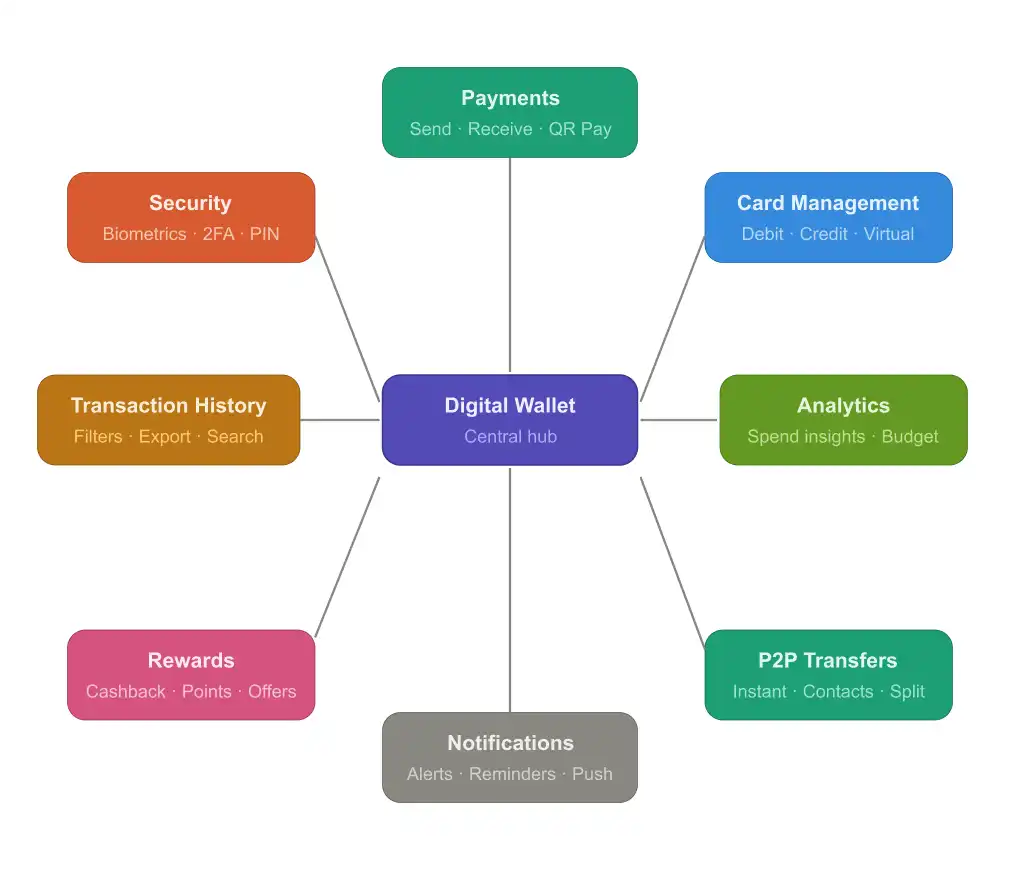
Digital wallet with real-time balance and transaction history. Peer-to-peer transfers with phone number or username-based recipient lookup. Bank account linking (via Plaid or a regional equivalent) for funding and withdrawal. QR code payments for in-person transactions. Biometric authentication (Face ID/Touch ID) as the default login method, not an optional add-on. Push notifications for every transaction, in real time, with no exceptions — this is a trust feature, not a convenience one.
KYC AML Compliance Features
KYC onboarding flow integrated at signup, not bolted on later. Transaction limits tied to verification tier (unverified users get lower limits, fully verified users get higher ones — a standard pattern across PayPal, Cash App, and Venmo). Dispute and refund request flow with clear status tracking. Account freeze/lock capability for the admin team when fraud is suspected, with a fast unlock path for false positives.
Admin Dashboard & Operations
Real-time transaction monitoring dashboard. KYC review queue for manual escalations the automated provider couldn’t resolve. AML alert management with case notes and resolution tracking. Compliance reporting exports formatted for regulatory submission. Customer support tools with full transaction history visibility for resolving disputes quickly.
Why transaction limits tied to verification tier matter more than they look like they should: This single pattern — unverified users capped at low transfer amounts, fully KYC-verified users unlocked for higher limits — is simultaneously a compliance control, a fraud mitigation tool, and a genuine growth lever. It lets you onboard users instantly without requiring full KYC at signup (reducing friction and drop-off), while still satisfying regulatory requirements before meaningful money moves. Get the tier thresholds right and you improve both your compliance posture and your activation rate at the same time — get them wrong and you either create unnecessary friction or unacceptable regulatory exposure.
Fintech App Development Cost 2026 — 3 Tiers at India Rates
Fintech app development costs in 2026 vary by complexity. At India-based development rates, MVPs start around $25,000, while advanced fintech platforms with compliance, AI, and payments can exceed $150,000.
Tier 1
MVP via Banking-as-a-Service
$18K–$40K
US/EE equiv: $50,000–$150,000
Digital wallet + P2P transfers
KYC via third-party provider integration
Single payment processor (Stripe/tokenized)
BaaS partner handles core banking license
Basic admin dashboard
Single market launch
Most CommonTier 2
Full Platform + AI Fraud Detection
$45K–$100K
US/EE equiv: $150,000–$300,000
All Tier 1 features
Multi-currency support
Card issuing (via BIN sponsor)
AI-powered fraud detection
AML transaction monitoring platform integration
Advanced compliance reporting dashboard
Tier 3
Full Licensed Banking Platform
$120K–$350K+
US/EE equiv: $400,000+
All Tier 2 features
Own money transmitter licensing
Multi-region regulatory architecture
Dedicated MLRO compliance reporting
Open banking (PSD2/PSD3) integration
Enterprise-grade high-availability infrastructure
Confused Between BaaS And Your Own Banking License?
Most fintech founders overspend by choosing the wrong path. Tell us your business model and we’ll tell you honestly whether BaaS or a full license makes sense for you — no bias, no upsell.
Flutter Fintech App Tech Stack — Built for Audit Trails
Mobile App
Flutter
Admin Dashboard
React.js / Next.js
Backend
Node.js / Go
Database
PostgreSQL
Payments / Tokenization
Stripe / Adyen
Banking-as-a-Service
Unit / Synapse
KYC Provider
Persona / Jumio
Cloud Infra
AWS (compliance regions)
Why Flutter is a genuine fintech consideration, not just a general preference: Flutter’s compiled Dart code and Skia rendering engine give it a smaller attack surface than frameworks that lean on platform web views for parts of the UI, which matters for a category where every screen potentially touches sensitive financial data. The trade-off worth knowing: because Flutter draws every pixel itself, a developer building a card-entry field must explicitly ensure that content never passes through the rendering canvas in plaintext — a non-obvious PCI requirement that an inexperienced team can miss. This is exactly the kind of detail where fintech-specific development experience prevents an expensive mistake rather than just a generic engineering preference.
Best Niche Fintech App Strategy — What to Build Instead of PayPal
PayPal and Cash App have hundreds of millions of users, established banking relationships built over decades, and a level of regulatory trust a new fintech app development entrant cannot replicate quickly. A general-purpose consumer payment app trying to compete head-on is fighting a battle with no realistic path to winning the trust and scale these platforms already have.
Vertical Payment Products
Freelancer payouts, gig-economy earnings, or B2B invoicing for a specific industry — narrower trust requirements and clearer go-to-market.
→ Clearer banking partnership path
Embedded Finance
Add payment capability inside an existing platform with a built-in audience — you inherit trust and distribution instead of building both from zero.
→ Lower CAC, existing user base
Regional / Remittance Products
Cross-border payment products for underbanked populations or specific immigrant communities — a real, underserved need with less direct competition.
→ Genuine underserved demand
“The founders who succeed in fintech in 2026 aren’t trying to out-PayPal PayPal. They’re solving a payment problem for a specific group of people that PayPal has no commercial reason to solve well — and that’s a fundamentally cheaper, faster path to a real banking partnership.”
Primocys · Fintech App Development
We Build Compliance In From Day One — Not Retrofitted Later
Primocys has shipped fintech products with HIPAA, PCI-DSS, GDPR, RBI, and SOC 2 compliance requirements built into the architecture from the first sprint, not added afterward. Flutter mobile apps, fixed price from $18,000, full source code.
Honest BaaS vs licensing scoping
We’ll recommend the right architecture for your stage — not the most expensive one.
KYC/AML integration done right
Persona, Jumio, or regional equivalents wired in correctly from the first sprint, not bolted on.
PCI-DSS scope minimised by design
Tokenized payment flows that never touch raw card data — the right architecture from day one.
Niche-first strategy advice
We’ll help you scope a vertical or embedded model with a real path to a banking partnership.
Conclusion: How to Choose the Best Fintech App Development Company India
Building a fintech app like PayPal or Cash App in 2026 is entirely achievable — but only if compliance is treated as architecture, not an afterthought. The founders who succeed aren’t the ones with the longest feature lists; they’re the ones who made the BaaS vs licensing decision correctly before writing a line of code, scoped KYC/AML into the first sprint, and chose a payment app development company that has shipped compliant fintech products before — not one learning compliance on your budget.
India-based fintech app development delivers the same PCI-DSS, KYC, and AML compliance architecture at 60–70% lower engineering cost than US or Eastern European agencies. The compliance vendor fees — Persona, Stripe, Flagright — are identical globally. What changes is the engineering cost to wire them in correctly. That gap is where the real saving is, and for a $45,000–$100,000 Tier 2 platform, it’s the difference between a fundable MVP and a budget that ran out before launch.
The single most important step before you hire a fintech app development company: Tell us your target market, your business model, and your compliance requirements. We’ll give you an honest BaaS vs licensing recommendation and a fixed-price estimate broken down by feature and compliance component — within 48 hours, no commitment required. Get your free fintech app estimate →
FAQs: Fintech App Development Like PayPal & Cash App
How much does it cost to build a fintech app like PayPal or Cash App in 2026?
Building a fintech app in 2026 costs $18,000–$40,000 for an MVP at India rates, including a digital wallet, P2P transfers, basic KYC, and BaaS integration. Mid-tier apps with multi-currency, card issuing, and AI fraud detection cost $45,000–$100,000, while enterprise banking platforms with custom licensing and compliance range from $120,000 to $350,000+. Get your free fintech app cost estimate →
Should I use Banking-as-a-Service or get my own money transmitter license?
Use a Banking-as-a-Service provider (such as Unit, Synapse, or Treasury Prime) for nearly every new fintech app, because it lets you operate under their existing regulatory licensing instead of obtaining your own state-by-state Money Transmitter Licenses, which typically cost $50,000 to $500,000 in total and take 6–12 months per state to approve. A BaaS partnership can cut regulatory costs by 60–80% and get you to market in months instead of years. Only pursue your own licensing once you have proven product-market fit and meaningful transaction volume. Ask us which is right for your project →
What compliance does a fintech app actually need before launch?
A fintech payment app typically requires PCI DSS compliance, KYC identity verification, AML transaction monitoring, and GDPR compliance if operating in the EU. Most payment providers also require an independent penetration test before onboarding. Compliance engineering, security, and audits usually account for 20–40% of the total fintech app development cost. Get compliance scoped into your free estimate →
Should I build a general payment app or a niche fintech product?
Build a niche or vertical-specific fintech product, not a general consumer payment app competing with PayPal or Cash App directly. The opportunities that work in 2026 are vertical payment apps for a specific industry (freelancer payouts, gig-economy earnings, B2B invoicing), embedded finance for an existing platform with a built-in audience, or regional payment products serving underbanked populations with cross-border remittance needs. These niches have clearer paths to a banking partnership and lower customer acquisition costs than a general-purpose wallet.
Why choose a Flutter fintech app development company?
Yes. Flutter is a strong choice for fintech app development, delivering iOS and Android apps from one codebase, reducing development costs by up to 35% and speeding delivery. It offers near-native performance, strong security, and smooth biometric authentication. For PCI compliance, sensitive card-entry fields must be implemented securely, making experienced Flutter fintech developers essential. See our Flutter fintech portfolio →
How long does it take to build a fintech app like Cash App or Venmo?
A Tier 1 fintech MVP with a digital wallet, KYC, P2P transfers, and BaaS payments typically takes 16–22 weeks. A Tier 2 app with multi-currency support, AI fraud detection, and AML monitoring requires 26–36 weeks. A Tier 3 digital banking platform usually takes 12+ months. Early compliance planning for KYC, AML, and licensing is essential to avoid delays and extra development costs. Get your timeline estimate free →
Ready to Build Your Fintech App — Compliance Done Right From Day One
Tell us your target market and your business model. We’ll give you an honest BaaS vs licensing recommendation and a fixed-price estimate within 48 hours.
Arpan leads product and engineering at Primocys, a Top-Rated Clutch app development company based in Ahmedabad, India. With over 10+ years of experience, he has successfully delivered real-time communication platforms for 1,200+ clients worldwide.
He is directly involved in overseeing the development of chat and messaging applications, ensuring high performance, scalability, and seamless user experience in every project.
📧 Email: [email protected]
📱 WhatsApp: Chat on WhatsApp
Trusted by Global Businesses for AI, Mobile, SaaS & Custom Software Development. Your Vision, Our Expertise.Trusted by Global Businesses for AI, Mobile, SaaS & Custom Software Development. Your Vision, Our Expertise.Trusted by Global Businesses for AI, Mobile, SaaS & Custom Software Development. Your Vision, Our Expertise.Trusted by Global Businesses for AI, Mobile, SaaS & Custom Software Development. Your Vision, Our Expertise.Trusted by Global Businesses for AI, Mobile, SaaS & Custom Software Development. Your Vision, Our Expertise.Trusted by Global Businesses for AI, Mobile, SaaS & Custom Software Development. Your Vision, Our Expertise.
Hear from our clients and why 1200+ businesses trust Primocys
"Our B2B and B2C platform helps Nigerian manufacturers sell at wholesale
prices and suppliers offer competitive retail pricing, with a strong focus on Made in Africa products
and easy local and international distribution.
The app has received excellent user reviews for its design and unique features. Communication with the
Primocys team was smooth in an agile setup, even beyond office hours when needed. Their mobile app
development expertise is excellent—highly professional and reliable."
Adegbuyi OduguwaCEO & Co-Founder
"The dating app was delivered successfully and approved by both Apple App
Store and Google Play. Our users are highly impressed with the design, UI, and overall functionality.
The project was well planned with clear milestones, and all modules were delivered on time.
The team is talented, patient, and flexible, accommodating multiple scope revisions as requirements
evolved. Their 24/7 development and support availability made the entire process smooth and reliable."
Revanth KExecutive
" We hired Primocys to develop a highly complex and specialized mobile
application, and they delivered outstanding results. The app includes advanced features such as
timeline mixers, classifieds, payments, advertisements, GPS functionality, and more. Their technical
skills, timely delivery, availability, and the personal attention Arpan Sagar brings to each project
truly stand out. The team stays focused and committed from start to finish—an excellent experience
overall."
Gregor Skerl Founder PROHUNTER
" Great team with excellent communication and a strong commitment to on-time
delivery. They developed a fully customized mobile app for both Android and iOS, perfectly matching
our requirements. The entire process was smooth and professional, with clear updates at every stage.
They are reliable, skilled, and very easy to work with. We’re continuing our partnership on more
projects, and choosing them has been one of the best business decisions I’ve made."