How to Build an eCommerce App Like Amazon in 2026: Features, Cost & Tech Stack
Date
22 Jun, 2026
Share:
One competitor quotes $200,000–$500,000+ for “an Amazon-style marketplace” with no breakdown of what that actually includes. Here’s the honest version — feature by feature, with the architecture decision that determines 40–60% of your real cost before a single screen gets designed.
The number you came here for
An eCommerce app like Amazon costs $15,000–$35,000 for an MVP (customer app, catalog, cart, checkout, basic admin) at India development rates. A mid-tier multi-vendor marketplace with vendor onboarding and commission management costs $40,000–$90,000. A complex enterprise marketplace with AI recommendations and logistics integration costs $100,000–$250,000+. US agencies quote $80,000–$500,000+ for the same scope — one quoted an “Amazon-style marketplace” at $200,000–$500,000+ with zero breakdown of what’s actually included. The single decision that most determines your real cost: are you building single-vendor (you sell your own products) or multi-vendor (Amazon’s actual model — other sellers list through you)? See our eCommerce app service →
Amazon didn’t start as a marketplace. It started as an online bookstore selling its own inventory — single-vendor, simple, focused. The marketplace model — letting third-party sellers list and sell through Amazon’s platform — launched in 2000, two years after Amazon had already proven the core retail experience worked. That sequencing matters more than most guides on amazon clone app development acknowledge, because almost every founder asking for “an app like Amazon” is actually asking for the marketplace model from day one, when the smarter path is often closer to what Amazon itself did.
The architecture, feature complexity, and cost of a single-vendor eCommerce app versus a multi-vendor marketplace are genuinely different builds, not the same app with a different skin. This guide is built around that distinction, because getting it wrong is the single most common way founders end up either overpaying for complexity they don’t need yet, or underscoping a marketplace that needs vendor management from the start.
65%
DoorDash’s US market share, 2026
15–30%
Platform Commission Range
$0.49–$7.99
Uber Eats Delivery Fee
$12K
4-App MVP Cost (India)
2026
Uber Eats Lite: 15%→20%
Single-Vendor vs Multi-Vendor: The Decision That Drives 40–60% of Your Cost
This is the question that should come before features, before tech stack, before anything else — because the answer changes the entire architecture you’re building, not just the feature list on top of it.
Single-vendor means you sell your own products — one inventory system, one party receiving payment, simpler logistics. This is what Amazon actually was for its first two years, and it’s still the right model for most businesses building “an app like Amazon” who actually mean “a really good online store.”
Multi-vendor marketplace means independent third-party sellers list and sell through your platform — Amazon’s current model. This requires vendor onboarding and verification workflows, separate vendor dashboards for inventory and order management, split payment processing where your platform takes a commission and the vendor receives the remainder, and a meaningfully more complex admin system to handle disputes, vendor performance, and payout schedules across potentially thousands of sellers.
The architecture decision most founders get wrong: A founder building a single-brand online store often asks for “multi-vendor” because that’s the word associated with Amazon, when what they actually need is a well-built single-vendor app with room to add vendor functionality later if the business model genuinely calls for it. Building multi-vendor architecture you don’t need yet adds 40–60% to your budget and timeline for capability that sits unused. Scope this honestly before writing a single line of code — it’s the cheapest mistake to avoid and one of the most expensive to fix after launch.
Multi-Vendor Marketplace Architecture: 3 Products, One Backend
If multi-vendor genuinely is your model, here’s what you’re actually building — three coordinated products sharing one backend, each serving a completely different user.
Customer App
Product discovery, search, cart, checkout, order tracking, reviews. The largest surface area for design polish, the smallest share of total engineering complexity.
Vendor Dashboard
Product listing, inventory management, order fulfillment, sales analytics, payout history. Usually a web dashboard — sellers manage stock from a desktop, not a phone screen.
Admin Panel
Vendor approval, commission configuration, dispute resolution, platform-wide analytics, category and catalog management. The control centre holding the marketplace together.
eCommerce App Features List — By Role
Customer App Features — Mobile Commerce Must-Haves
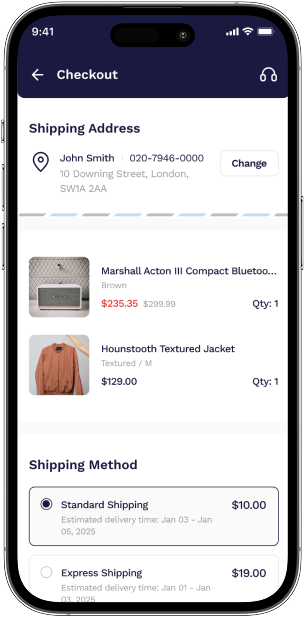
Product browsing with category navigation and filters (price, rating, brand, availability). Search with autocomplete and typo tolerance — this is one of the highest-leverage features in the entire app, since a search that returns poor results loses the sale before the customer ever sees the product. Product detail pages with multiple images, descriptions, specifications, and reviews. Cart and checkout with saved addresses and multiple payment methods. Order tracking from confirmation to delivery. Wishlist and recently-viewed products. Ratings and reviews with verified-purchase indicators.
Vendor Dashboard Features — Multi-Vendor Marketplace
Product listing creation with bulk upload support (vendors managing hundreds of SKUs need CSV import, not one-by-one manual entry). Inventory management with low-stock alerts. Order management with status updates (processing, shipped, delivered). Sales analytics — daily/weekly revenue, best-selling products, return rate. Payout history and commission breakdown. Promotional tools for running discounts on their own listings.
Admin Panel Features — Amazon Clone App Control Centre
Vendor onboarding and verification workflow, including document checks for business legitimacy. Commission rate configuration — flat-rate or category-specific tiers. Automated payout processing on a defined schedule. Dispute and refund management between customers and vendors. Category and catalog taxonomy management. Platform-wide analytics across all vendors and categories.
The feature every guide mentions briefly but deserves real engineering attention: search: At marketplace scale — thousands or tens of thousands of SKUs across multiple vendors — a basic database query for product search breaks down quickly. It can’t handle typo tolerance, can’t rank by relevance combined with rating and availability, and gets meaningfully slower as your catalog grows. Elasticsearch (or a managed equivalent like Algolia) solves this properly from day one. This is a genuinely worthwhile investment even in an MVP — retrofitting proper search after launch, once you have real catalog volume and real customer frustration data, is a significantly harder and more disruptive project than building it correctly the first time.
eCommerce App Development Cost — 3 Tiers at India Rates
eCommerce app development cost varies by complexity. Flutter MVP from $15,000. Multi-vendor marketplace from $40,000. Enterprise with AI and logistics from $100,000. India rates — fixed price, full source code.
Tier 1
MVP — Single or Limited Multi-Vendor
$15K–$35K
US/UK equiv: $80,000–$180,000
Customer app: browse, search, cart, checkout
Single-vendor or limited multi-vendor (≤50 sellers)
Basic admin dashboard
Single payment gateway
Order tracking & notifications
Ratings and reviews
Most CommonTier 2
Full Multi-Vendor Marketplace
$40K–$90K
US/UK equiv: $180,000–$350,000
All MVP features
Full vendor onboarding + dashboard
Elasticsearch product search
Commission engine + automated payouts
Multiple payment gateways
Promotional/coupon system
Tier 3
Enterprise AI-Powered Platform
$100K–$250K+
US/UK equiv: $350,000+
All Tier 2 features
AI-powered recommendations
Multi-warehouse inventory routing
Logistics/shipping API integration
Multi-currency, multi-language
Advanced fraud detection
eCommerce App Tech Stack — What Works at Marketplace Scale
Flutter for mobile, React.js for vendor and admin dashboards, Node.js backend, PostgreSQL database, Elasticsearch for product search, Redis caching, and Stripe or Razorpay for payments.
Customer App
Flutter
Vendor & Admin
React.js / Next.js
Backend / API
Node.js / Python
Database
PostgreSQL
Product Search
Elasticsearch
Caching
Redis
Payments
Stripe / Razorpay
Cloud Infra
AWS / GCP
Why Flutter for the customer app, even at marketplace scale: A marketplace’s customer app lives or dies on browsing and checkout feeling fast — image-heavy product grids, smooth scrolling, quick add-to-cart. Flutter’s rendering engine handles this consistently across the wide device range a general marketplace audience actually uses, and one codebase covers iOS and Android without the native-module overhead some frameworks need for camera-based features like barcode scanning or visual search. The 30–40% cost saving over separate native builds compounds meaningfully at this scope, where the app itself is one of several major cost centres alongside the vendor and admin systems.
Niche Online Marketplace App Development: What to Build Instead of “Amazon”
Amazon’s advantage isn’t its app. It’s decades of logistics infrastructure, warehousing, supplier relationships, and a fulfillment network that took tens of billions of dollars to build. A new entrant cannot replicate that, and trying to build a general marketplace that competes with Amazon on selection and price is close to certain to fail — not because the app would be bad, but because the underlying business has no path to the scale economics Amazon already has. The verticals that actually win in 2026 are niche-specific: B2B marketplace app development, regional commerce, and category-focused platforms where curation beats selection.
Vertical-Specific Marketplace
One product category served better than Amazon’s generic listing — specialty tools, handmade goods, sustainable products, a specific hobby community.
→ Curation beats selection at this scale
Regional Marketplace
A geography or market Amazon serves poorly — local sellers, regional products, faster local delivery than a national logistics network can match.
→ Local trust + local speed
B2B Wholesale Marketplace
Bulk ordering for a specific industry — restaurant supplies, construction materials, medical equipment. Higher order values, less price-war competition.
→ Higher margins, less commoditised
Resale / Circular Marketplace
Pre-owned or refurbished goods in a specific category — electronics, fashion, furniture. Different trust and verification needs than new-goods retail.
→ Strong sustainability-driven demand
Maker / Artisan Marketplace
Independent makers and small brands underserved by Amazon’s mass-market positioning — the Etsy model applied to a specific niche.
→ Brand story sells, not just price
Subscription Commerce
Recurring product delivery — consumables, curated boxes, replenishment subscriptions. Different retention dynamic than one-off purchases.
→ Predictable recurring revenue
How Mobile Commerce Apps Actually Make Money
From vendor commission to featured ads — real revenue models used by mobile commerce apps in 2026. We’ll tell you which one fits your stage before you build a single screen.
Vendor Commission
A percentage of each sale, typically 8–20% depending on category. The primary revenue driver for most multi-vendor marketplaces.
→ Core revenue stream from day one
Vendor Subscriptions
Monthly fee for listing access, advanced analytics, or reduced commission rates — recurring B2B revenue layered on top of commission.
→ Strong once you have an active vendor base
Featured Listings / Ads
Vendors pay for top placement in search and category pages — a high-margin revenue stream once you have meaningful order volume.
→ V2 feature, needs catalog density first
Delivery / Fulfillment Fees
Charge for logistics if your platform handles shipping rather than leaving it to individual vendors — relevant if you operate centralised fulfillment.
→ Depends entirely on your operating model
“A marketplace that tries to out-select Amazon loses before it launches. A marketplace that out-curates, out-trusts, or out-serves Amazon in one specific category has a real shot — and costs a fraction of what ‘build me an Amazon competitor’ actually requires.”
Primocys · eCommerce App Development
We Scope the Right Architecture First — Then Build It Properly
Primocys builds eCommerce apps with the single-vendor vs multi-vendor decision made honestly upfront, not assumed. Flutter customer apps, React.js vendor and admin dashboards, fixed price from $15,000, full source code.
Right architecture, scoped honestly
We’ll tell you if you need single-vendor or multi-vendor — not just build whatever sounds bigger.
Elasticsearch from day one
Proper product search built in at MVP stage — not a costly retrofit after launch.
Stripe + Razorpay built in
Global and regional payment coverage. Automatic commission split for marketplace builds.
Niche-first strategy advice
We’ll help you scope the right vertical or region, not just build a generic catalog app.
Flutter — 35% cheaper than native
Clutch Top Flutter Developer 2024 & 2026. One codebase for the customer app.
Fixed price from $15,000
Cost agreed before development starts. Milestone payments. Full source code ownership.
Conclusion: Build the Right eCommerce App, Not the Biggest One
Building an eCommerce app like Amazon is a well-defined engineering problem in 2026 — the architecture is understood, the tech stack is proven, and the cost at India rates is a fraction of what US or UK agencies quote. The harder question is never “can we build it?” It’s “which version do you actually need right now?”
Start with the vendor model. Single-vendor keeps costs in the $15K–$35K range and gets you to market in 12–16 weeks. Full multi-vendor marketplace app development with commission engine, vendor onboarding, and Elasticsearch search sits in the $40K–$90K range and takes 20–28 weeks. Enterprise AI-powered platforms are $100K+ and 30+ weeks.
The founders who get the best outcomes from eCommerce app development aren’t the ones who try to build everything — they’re the ones who scope the right thing for where their business actually is, launch it well, and add complexity only when the market pulls them toward it. That’s what Primocys helps you figure out before a single screen gets designed. Ready to scope your eCommerce app the right way? Get in touch — get a feature-by-feature fixed-price estimate in 48 hours.
FAQ — eCommerce App Development Like Amazon
How much does it cost to build an eCommerce app like Amazon in 2026?
Building an eCommerce app like Amazon costs $15,000–$35,000 for an MVP with customer app, product catalog, cart, checkout, and admin panel. A multi-vendor marketplace with vendor onboarding, commissions, and advanced search usually ranges from $40,000–$90,000. Enterprise-grade platforms with AI recommendations, warehouse management, and logistics integrations can cost $100,000–$250,000+, depending on complexity and scale. Get a personalised estimate →
What is the difference between a single-vendor and multi-vendor eCommerce app?
A single-vendor eCommerce app sells products from one business, making management simpler with one catalog, inventory system, and payment flow. A multi-vendor marketplace, like Amazon, allows multiple sellers to list products, requiring vendor onboarding, separate seller dashboards, commission-based payouts, and advanced admin controls. Because of these added features and complexity, multi-vendor marketplace apps typically cost 40–60% more to build than comparable single-vendor apps.
Should I build a general marketplace like Amazon or a niche eCommerce app?
Don’t build a general marketplace to compete with Amazon. Amazon’s strength comes from decades of investment in logistics, warehouses, and supplier networks—not just its app. In 2026, the best opportunities are niche eCommerce platforms focused on a specific product category, underserved region, or B2B industry. These models require lower marketing spend, face less competition, and can win through better curation, expertise, and customer service rather than massive scale.
What is the right tech stack for an eCommerce app in 2026?
Flutter is the best choice for a customer-facing eCommerce app in 2026 because a single codebase supports both iOS and Android, reducing development costs by 30–40% compared to separate native apps. A modern stack typically includes Node.js or Python for APIs, PostgreSQL for orders and products, Elasticsearch for fast product search, and Redis for cart caching. Stripe or Razorpay handles payments, while React.js or Next.js powers vendor and admin dashboards for efficient desktop-based inventory and order management. See our Flutter development service →
How long does it take to build a multi-vendor marketplace app?
A Flutter eCommerce MVP (single or limited multi-vendor) takes 12–16 weeks at India rates. A full multi-vendor marketplace with vendor onboarding, commission engine, and Elasticsearch product search takes 20–28 weeks. Enterprise-tier platforms with AI recommendations and logistics integrations take 30+ weeks. Timeline depends heavily on the feature scope agreed before development starts — Primocys provides a milestone-based fixed-price contract so you know both cost and delivery schedule upfront. Get a timeline estimate →
Why hire an eCommerce app development company in India vs a US agency?
India-based eCommerce app development companies like Primocys deliver the same Flutter, Node.js, and Elasticsearch stack at 60–70% lower cost than equivalent US or UK agencies — without sacrificing engineering quality. A full multi-vendor marketplace that a US agency quotes at $200,000–$350,000 costs $40,000–$90,000 at India rates. The difference isn’t the tech or the quality — it’s labour cost arbitrage. Primocys works on fixed-price contracts with full source code ownership, so there’s no cost ambiguity and no lock-in after delivery. See our eCommerce app service →
Get Your eCommerce App Scoped & Priced in 48 Hours
Tell us your product category, vendor model, and target market. As a leading eCommerce app development company in India, Primocys will give you an honest architecture recommendation and a feature-by-feature fixed-price estimate — no sales call required.
Arpan leads product and engineering at Primocys, a Top-Rated Clutch app development company based in Ahmedabad, India. With over 10+ years of experience, he has successfully delivered real-time communication platforms for 1,200+ clients worldwide.
He is directly involved in overseeing the development of chat and messaging applications, ensuring high performance, scalability, and seamless user experience in every project.
📧 Email: [email protected]
📱 WhatsApp: Chat on WhatsApp
Trusted by Global Businesses for AI, Mobile, SaaS & Custom Software Development. Your Vision, Our Expertise.Trusted by Global Businesses for AI, Mobile, SaaS & Custom Software Development. Your Vision, Our Expertise.Trusted by Global Businesses for AI, Mobile, SaaS & Custom Software Development. Your Vision, Our Expertise.Trusted by Global Businesses for AI, Mobile, SaaS & Custom Software Development. Your Vision, Our Expertise.Trusted by Global Businesses for AI, Mobile, SaaS & Custom Software Development. Your Vision, Our Expertise.Trusted by Global Businesses for AI, Mobile, SaaS & Custom Software Development. Your Vision, Our Expertise.
Hear from our clients and why 1200+ businesses trust Primocys
"Our B2B and B2C platform helps Nigerian manufacturers sell at wholesale
prices and suppliers offer competitive retail pricing, with a strong focus on Made in Africa products
and easy local and international distribution.
The app has received excellent user reviews for its design and unique features. Communication with the
Primocys team was smooth in an agile setup, even beyond office hours when needed. Their mobile app
development expertise is excellent—highly professional and reliable."
Adegbuyi OduguwaCEO & Co-Founder
"The dating app was delivered successfully and approved by both Apple App
Store and Google Play. Our users are highly impressed with the design, UI, and overall functionality.
The project was well planned with clear milestones, and all modules were delivered on time.
The team is talented, patient, and flexible, accommodating multiple scope revisions as requirements
evolved. Their 24/7 development and support availability made the entire process smooth and reliable."
Revanth KExecutive
" We hired Primocys to develop a highly complex and specialized mobile
application, and they delivered outstanding results. The app includes advanced features such as
timeline mixers, classifieds, payments, advertisements, GPS functionality, and more. Their technical
skills, timely delivery, availability, and the personal attention Arpan Sagar brings to each project
truly stand out. The team stays focused and committed from start to finish—an excellent experience
overall."
Gregor Skerl Founder PROHUNTER
" Great team with excellent communication and a strong commitment to on-time
delivery. They developed a fully customized mobile app for both Android and iOS, perfectly matching
our requirements. The entire process was smooth and professional, with clear updates at every stage.
They are reliable, skilled, and very easy to work with. We’re continuing our partnership on more
projects, and choosing them has been one of the best business decisions I’ve made."