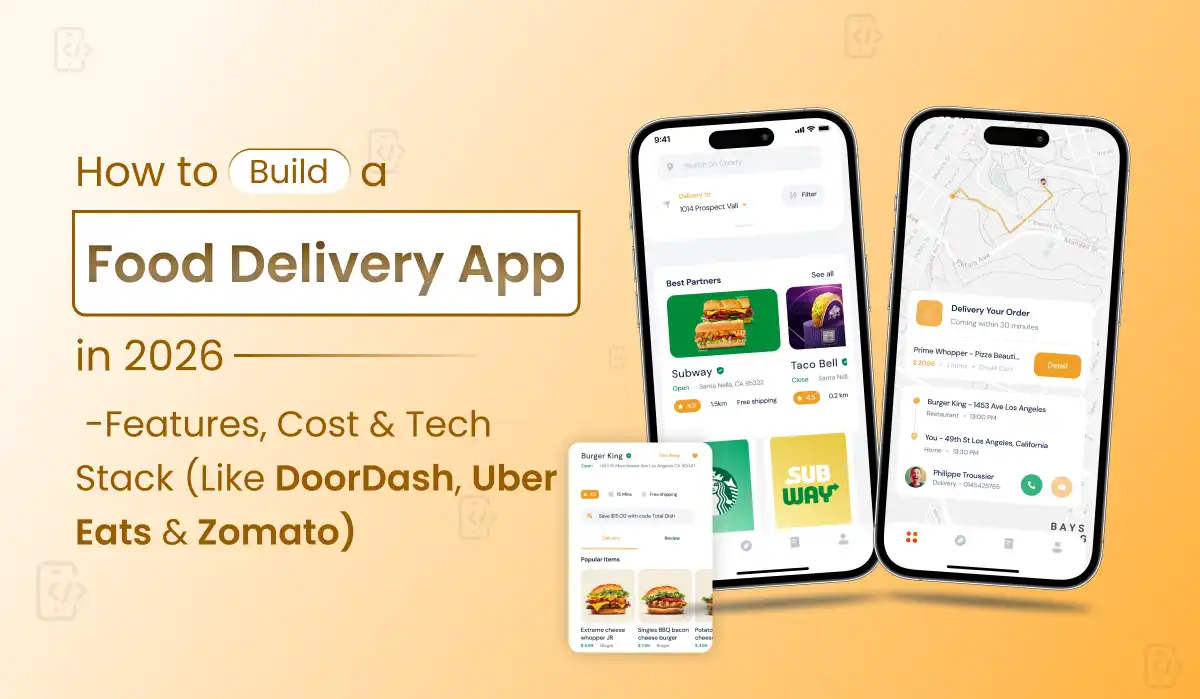
How to Build a Food Delivery App in 2026: Features, Cost & Tech Stack (Like DoorDash, Uber Eats, Zomato)
Date
22 Jun, 2026
Share:
Uber Eats raised its commission tiers again in March 2026. DoorDash holds steady at 15–30%. If you’re building for the US or global market specifically, the numbers and the playbook differ from an India-focused build — here’s the version built around that.
The number you came here for
A food delivery app like DoorDash or Uber Eats costs $12,000–$25,000 for an MVP (customer app, restaurant panel, driver app, admin dashboard) at India development rates. A mid-tier platform with real-time tracking and a tiered commission engine costs $28,000–$60,000. A complex multi-market platform costs $65,000–$150,000+. US agencies quote $40,000–$200,000+ for the same scope. The architecture is identical to building for the India market — what genuinely differs is the commission model, the payment stack, and the per-order fee structure your specific market expects. See our food delivery app service →
If you’ve read guides on building a food delivery app for the India market — Zomato and Swiggy style — the architecture you’ll find there is correct for a US or global launch too: four interconnected apps, the same core features, broadly the same tech stack. What changes when you’re building a food delivery app like DoorDash or Uber Eats for the US specifically is the business model layer sitting on top of that architecture — and that’s where this guide picks up. If you haven’t read our India-market build guide yet, Read our India market guide →
This guide focuses on what’s genuinely different for a US or global food delivery app development project: real, current DoorDash and Uber Eats commission data, US-specific payment infrastructure, and the fee structures American consumers and restaurants actually expect in 2026 — because copying an India-market commission strategy onto a US launch (or vice versa) is one of the more common, avoidable mistakes we see founders make.
65%
DoorDash’s US market share, 2026
15–30%
Platform Commission Range
$0.49–$7.99
Uber Eats Delivery Fee
$12K
4-App MVP Cost (India)
2026
Uber Eats Lite: 15%→20%
DoorDash & Uber Eats Commission Rates in 2026 — What Your Build Must Account For
This is the data every founder planning on-demand food delivery app development for the US market needs before scoping their own commission model, because copying a number you saw in an old blog post is a fast way to mis-price your platform. As of 2026, both major platforms run tiered commission structures, and both have moved those tiers upward this year.
Platform
Tier
Commission Rate
2026 Change
DoorDash
Pickup only
6%
Unchanged
DoorDash
Basic
15%
Unchanged
DoorDash
Plus
25%
Unchanged
DoorDash
Premier
30%
Unchanged
Uber Eats
Lite
20%
↑ from 15% (Mar 2026)
Uber Eats
Plus (standard order)
25%
Unchanged
Uber Eats
Plus (Uber One order)
30%
New +5% surcharge added
Uber Eats
Premium
30%
Unchanged
What this rate creep means if you’re building a new platform: Restaurants are increasingly fee-fatigued — operators report effective platform costs, once promotions and ad placement are included, often run closer to 30–40% of order value rather than the headline commission rate. This is your opening as a new entrant: a transparently lower, simpler commission structure is a genuinely compelling pitch to restaurants who’ve watched the incumbents’ rates climb every year. Don’t undercut to the point of unsustainable unit economics, but a clean 15–20% flat rate with no surprise surcharges is a real differentiator in 2026, not just a marketing line.
Subscription Layer: DashPass & Uber One as a Revenue Model
Both platforms have built substantial recurring revenue and retention on subscription programs — DashPass and Uber One — that waive delivery fees for members in exchange for a monthly or annual fee, while simultaneously increasing the commission restaurants pay on those exact orders. If you’re building a US-market food delivery app at any meaningful scale, a subscription program belongs on your roadmap by V2: it dramatically improves order frequency and customer lifetime value, the same pattern Uber Eats One has demonstrated clearly at scale.
US vs India Food Delivery App Development: Key Differences
The four-app architecture, the core features, and most of the tech stack are identical regardless of target market. These are the specific places where a US/global food delivery app development project and an India-market build diverge in ways that actually affect your scope and cost.
🇺🇸 US / Global Market Build
Stripe as primary payment processor
Higher per-order delivery fees ($0.49–$7.99)
Subscription (DashPass/Uber One style) is core to monetisation
Lower order density per city — wider delivery radii needed
Driver pay regulation varies significantly by state (e.g. Prop 22 in California)
Tipping culture affects driver earnings model design
🇮🇳 India-Market Build
UPI integration essential alongside cards
Lower per-order delivery fees, higher order density
Restaurant commission is the dominant revenue lever
Higher order density per city — tighter delivery radii viable
Cash on delivery still meaningfully used in many markets
Lower average order value, higher order frequency
The mistake we see most often when founders copy the wrong market’s playbook: A founder building for a US city sets up UPI integration they’ll never use and skips the subscription program that actually drives US retention. Or a founder building for an Indian city builds a Stripe-only payment flow and wonders why conversion is low because UPI wasn’t an option at checkout. The architecture transfers cleanly between markets — the payment stack and monetisation sequencing absolutely do not. Scope this explicitly with whoever builds your platform, not as an afterthought.
On-Demand Food Delivery App Architecture: The 4-App Structure
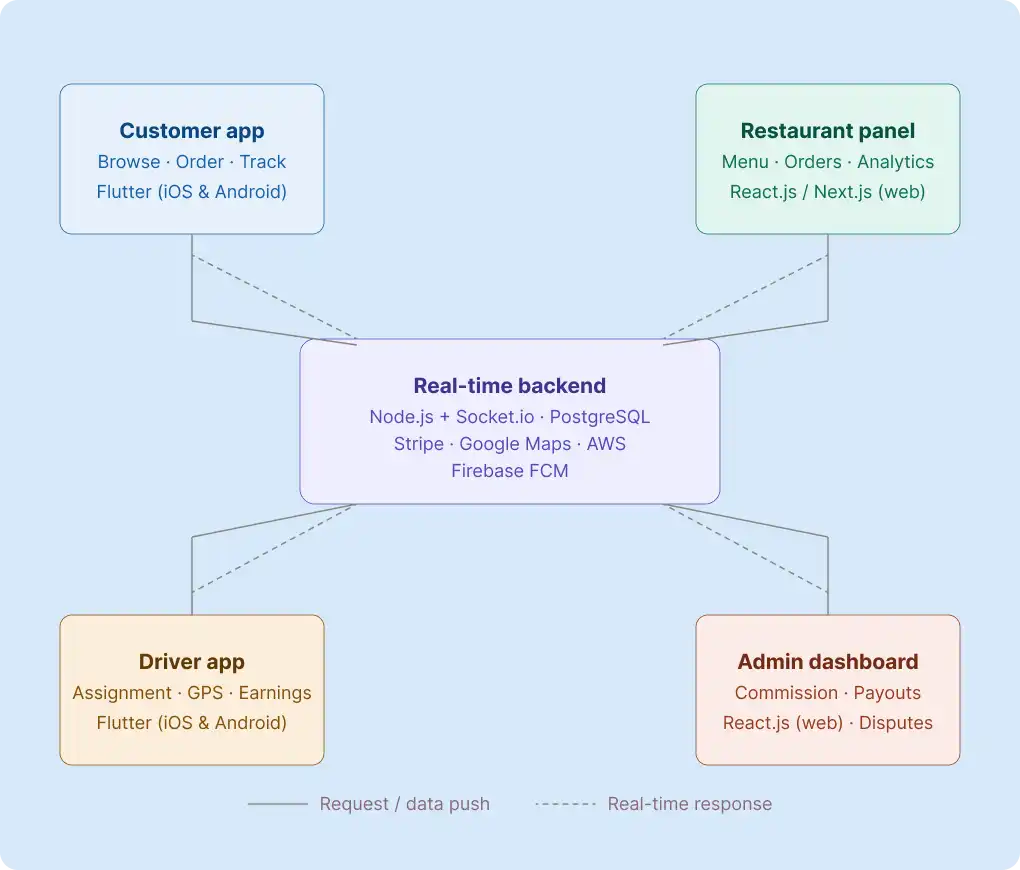
We’ve covered this in full depth in our India-market build guide, and the architecture doesn’t change for a US or global launch — it’s still four coordinated apps sharing one real-time backend: the customer app (browse, order, track), the restaurant panel (menu and order management, typically a web dashboard), the delivery driver app (assignment, navigation, earnings), and the admin dashboard (commission configuration, payouts, dispute resolution). See full feature breakdown →
Food Delivery App Development Cost: US/Global Market, India Rates
Tier 1
MVP — 4 Apps, US Payment Stack
$12K–$25K
US/UK equiv: $45,000–$100,000
Customer, restaurant, driver, admin apps
Stripe payment integration
Distance-based delivery fee calculation
Real-time GPS order tracking
Basic push notifications
Single-city launch ready
Most CommonTier 2
Full Platform + Subscription Layer
$28K–$60K
US/UK equiv: $100,000–$220,000
All MVP features
Subscription program (DashPass/Uber One style)
Tiered commission engine for restaurants
Promo codes, loyalty points
Multi-city support
Advanced restaurant analytics dashboard
Tier 3
Multi-Market AI Platform
$65K–$150K+
US/UK equiv: $220,000+
All Tier 2 features
AI-powered recommendations
Dynamic surge pricing engine
Multi-country, multi-currency support
Advanced driver route optimisation (ML)
Dedicated fraud detection layer
Get a Cost Breakdown Built Around Your Market
Share your target market and features — we’ll scope the right cost, compliance, and payment stack, and deliver a fixed-price quote fast.
Food Delivery App Tech Stack for US & Global Platforms
The core tech stack for food delivery app development is the same Flutter/Node.js/PostgreSQL foundation we recommend for any food delivery build — the differences for a US/global launch are concentrated almost entirely in the payments and notifications layer.
Customer & Driver App
Flutter
Restaurant & Admin
React.js / Next.js
Backend / Real-Time
Node.js + Socket.io
Database
PostgreSQL
Payments (US/Global)
Stripe
Maps & GPS
Google Maps SDK
Push Notifications
Firebase FCM
Cloud Infra
AWS
“Building for the US market means budgeting real engineering time for the subscription billing layer from the start — DashPass and Uber One both prove that recurring revenue, not just per-order commission, is what makes US food delivery unit economics work long-term.”
Best Niche Strategy for a New Food Delivery App in the US Market
The same honest advice applies here as it does for any market: competing with DoorDash’s 65% US market share or Uber Eats’ global footprint head-on is not a realistic path for a new platform. The real opportunity in food delivery app development in 2026 isn’t slowing — it’s fragmenting into niches the aggregators serve poorly. Hyper-local platforms for specific cities, vertical-specific apps (halal, vegan, diet-plan-based), B2B corporate catering, and subscription meal services built around local chefs or dark kitchens all have lower customer acquisition costs and far more defensible unit economics than trying to out-compete the giants on their own turf.
The restaurant fee-fatigue opportunity, specifically for the US market in 2026: With Uber Eats’ March 2026 fee increase fresh in restaurant owners’ minds, this is a genuinely good moment to approach independent restaurants with a transparent, lower-commission alternative — particularly in a specific city or niche where you can offer real density without needing national scale. Restaurants doing $20,000+ in monthly delivery orders are currently handing over $3,000–$6,000 a month in commissions; even a modest, honest improvement on that math is a compelling pitch when delivered with real local density behind it.
Primocys · Food Delivery App Development
We Build for Any Market — US, India, or Global — With the Right Payment Stack From Day One
Primocys builds food delivery platforms scoped correctly for your actual target market — Stripe and US-style subscription billing for a US launch, UPI and India-specific commission structures for an India launch, or both if you’re going multi-market. Same proven 4-app architecture, fixed price from $12,000.
Right payment stack, right market
Stripe for US/global, UPI + Razorpay for India — we scope this correctly from the first conversation.
All 4 apps, one coordinated build
Customer, restaurant, driver, admin — built together, real-time synced, properly tested under load.
Commission engine built in
Tiered restaurant commission, subscription billing, payout automation — configured to your model.
Niche-first strategy advice
We’ll help you scope the right city, vertical, or model — not just build whatever you ask for.
Flutter — 35% cheaper than native
Clutch Top Flutter Developer 2024 & 2026. One codebase for customer and driver apps.
Fixed price from $12,000
Cost agreed before development starts. Milestone payments. Full source code ownership.
Conclusion: Is 2026 the Right Time to Build a Food Delivery App?
Yes — but only if you build smart. The US food delivery app development market is not wide open the way it was in 2018, but it’s actively fragmenting in ways that favour focused, well-scoped entrants. DoorDash and Uber Eats continue raising fees, restaurant owners are genuinely looking for alternatives, and the infrastructure to build a production-ready DoorDash clone or Uber Eats clone at a fraction of US agency rates exists right now.
The businesses that will win aren’t the ones trying to build the next national aggregator from day one. They’re the ones who pick a specific city, vertical, or customer type — corporate catering, halal delivery, hyperlocal dark kitchen — and build a tightly scoped MVP that solves that specific problem well. A well-built food delivery MVP at $12,000–$25,000, launched in the right niche with real restaurant density, can reach profitability faster than a $150,000 platform that tries to compete everywhere at once.
The single most important decision before you start building: Define your target city and niche before you write a single line of code. A food delivery app for corporate lunch delivery in Austin has a completely different commission model, driver requirement, and restaurant acquisition strategy than a consumer-facing multi-restaurant marketplace in Chicago. Get this right first — everything else follows from it. If you’re not sure, talk to us before you scope — it’s a conversation we have with every founder, at no charge.
Questions About Building a Food Delivery App for the US/Global Market
How long does it take to build a food delivery app like DoorDash?
An MVP food delivery app (customer app, restaurant panel, driver app, admin dashboard) built on Flutter typically takes 11–15 weeks at India development rates. A mid-tier platform with subscription billing, tiered commission engine, and multi-city support takes 18–26 weeks. A full multi-market platform with AI recommendations and surge pricing takes 28+ weeks. Timeline depends heavily on scope clarity at the start — a well-defined project runs on schedule; a vaguely scoped one rarely does. Get a timeline estimate for your specific scope →
What features are must-have in a food delivery app in 2026?
For a US food delivery app in 2026, essential features include real-time GPS order tracking, Stripe payments, delivery fee calculation, push notifications, restaurant menu management, driver assignment, tiered commissions, and an admin dashboard for payouts and disputes. In V2, add subscriptions, promo codes, loyalty rewards, and analytics. AI recommendations and dynamic pricing are best added later, once enough order data is available.
What is the best tech stack for a food delivery app like Uber Eats?
The best tech stack for a food delivery app like Uber Eats in 2026 is Flutter for customer and driver apps, React.js/Next.js for restaurant and admin panels, Node.js with Socket.io for real-time order tracking, and PostgreSQL for data storage. Add Stripe for payments, Google Maps SDK for GPS and routing, Firebase FCM for push notifications, and AWS
for cloud hosting. This combination supports iOS and Android from one codebase while remaining scalable and cost-efficient.
Can I build a food delivery app for a specific city or niche?
Yes. For most startups, a city-specific or niche delivery app is the smarter approach. Competing nationally with DoorDash’s dominant market position is costly and difficult. Focusing on a specific city, audience, or delivery model—such as corporate catering, halal food, vegan meals, dark kitchens, or subscriptions—reduces customer acquisition costs, strengthens restaurant partnerships, and improves profitability. The same four-app architecture still applies, but with a focused launch strategy.
Why build with an India-based development company instead of a US agency?
India-based food delivery app development companies typically deliver the same Flutter/Node.js/PostgreSQL architecture at 60–75% lower cost than US or UK agencies — not because of code quality differences, but because of hourly rate differences. A US agency quoting $100,000–$220,000 for a Tier 2 platform is building the same product a Primocys team delivers at $28,000–$60,000. The key is choosing a company with a proven portfolio of production food delivery apps, fixed-price contracts, and a clear milestone payment structure. See our food delivery app service →
Ready to Build for Your Specific Market?
Tell us your target city, market, and business model. We’ll scope the right payment stack, commission structure, and feature set — and give you a fixed-price estimate within 48 hours.
Arpan leads product and engineering at Primocys, a Top-Rated Clutch app development company based in Ahmedabad, India. With over 10+ years of experience, he has successfully delivered real-time communication platforms for 1,200+ clients worldwide.
He is directly involved in overseeing the development of chat and messaging applications, ensuring high performance, scalability, and seamless user experience in every project.
📧 Email: [email protected]
📱 WhatsApp: Chat on WhatsApp
Trusted by Global Businesses for AI, Mobile, SaaS & Custom Software Development. Your Vision, Our Expertise.Trusted by Global Businesses for AI, Mobile, SaaS & Custom Software Development. Your Vision, Our Expertise.Trusted by Global Businesses for AI, Mobile, SaaS & Custom Software Development. Your Vision, Our Expertise.Trusted by Global Businesses for AI, Mobile, SaaS & Custom Software Development. Your Vision, Our Expertise.Trusted by Global Businesses for AI, Mobile, SaaS & Custom Software Development. Your Vision, Our Expertise.Trusted by Global Businesses for AI, Mobile, SaaS & Custom Software Development. Your Vision, Our Expertise.
Hear from our clients and why 1200+ businesses trust Primocys
"Our B2B and B2C platform helps Nigerian manufacturers sell at wholesale
prices and suppliers offer competitive retail pricing, with a strong focus on Made in Africa products
and easy local and international distribution.
The app has received excellent user reviews for its design and unique features. Communication with the
Primocys team was smooth in an agile setup, even beyond office hours when needed. Their mobile app
development expertise is excellent—highly professional and reliable."
Adegbuyi OduguwaCEO & Co-Founder
"The dating app was delivered successfully and approved by both Apple App
Store and Google Play. Our users are highly impressed with the design, UI, and overall functionality.
The project was well planned with clear milestones, and all modules were delivered on time.
The team is talented, patient, and flexible, accommodating multiple scope revisions as requirements
evolved. Their 24/7 development and support availability made the entire process smooth and reliable."
Revanth KExecutive
" We hired Primocys to develop a highly complex and specialized mobile
application, and they delivered outstanding results. The app includes advanced features such as
timeline mixers, classifieds, payments, advertisements, GPS functionality, and more. Their technical
skills, timely delivery, availability, and the personal attention Arpan Sagar brings to each project
truly stand out. The team stays focused and committed from start to finish—an excellent experience
overall."
Gregor Skerl Founder PROHUNTER
" Great team with excellent communication and a strong commitment to on-time
delivery. They developed a fully customized mobile app for both Android and iOS, perfectly matching
our requirements. The entire process was smooth and professional, with clear updates at every stage.
They are reliable, skilled, and very easy to work with. We’re continuing our partnership on more
projects, and choosing them has been one of the best business decisions I’ve made."