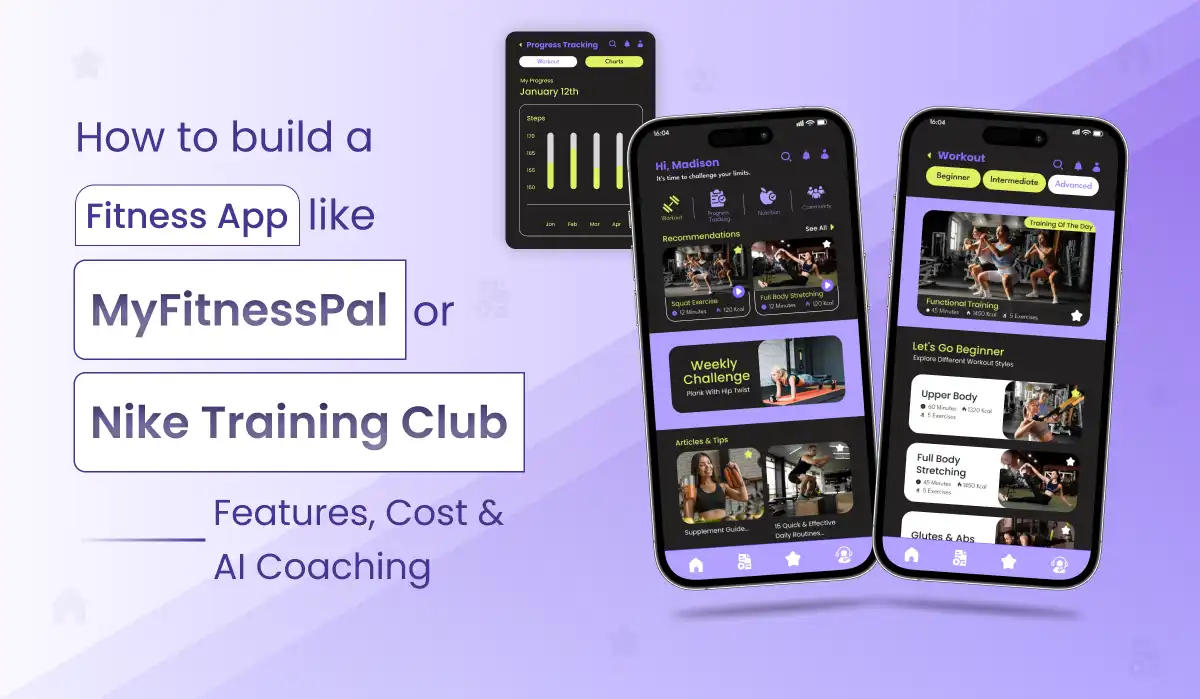
How to Build a Fitness App Like MyFitnessPal or Nike Training Club in 2026: Features, Cost & AI Coaching
Date
06 Jul, 2026
Share:
Nobody should be building another generic app like MyFitnessPal in 2026. MyFitnessPal has 14 million foods in its database. NTC has Nike’s entire content machine behind it. The real opportunity is narrower — and far more profitable. Here’s the honest guide to both the niche strategy and the actual cost.
The number you came here for
A fitness app like MyFitnessPal costs $12,000–$30,000 for an MVP (workout logging, nutrition tracking via third-party food API, goal setting, Apple Health + Google Health Connect integration, basic progress dashboard) at India development rates. A mid-tier platform with AI coaching, custom workout video library, and wearable device integration costs $35,000–$80,000. A full platform with computer vision form correction, community features, and proprietary food database costs $90,000–$200,000+. US agencies quote $25,000–$160,000 for equivalent scope, all at US hourly rates — zero India-rate options mentioned across competitor guides. The fitness app market hits $30 billion by 2030 — but 75% of revenue comes from subscriptions, not downloads. See our fitness app development service →
Building an app like MyFitnessPal means competing with a food database of over 14 million entries, built over years of user contributions and editorial curation. Nike Training Club has Nike’s global athlete network creating content, Nike’s brand driving downloads, and Nike’s marketing budget sustaining retention. A new fitness app trying to replicate either of these at general-audience scale is competing with an asset base that took a decade and hundreds of millions in investment to build.
That’s not pessimism — it’s the useful framing. Because the apps actually winning market share in 2026 are not trying to out-MyFitnessPal MyFitnessPal. They’re solving a specific fitness problem for a defined audience better than any generic platform ever will: a strength training app calibrated specifically for women over 40, a prenatal fitness platform with trimester-aware programming, a marathon training app that also adjusts nutrition based on weekly mileage. Niche fitness apps consistently outperform generic ones for retention, and retention is everything in a category where 75% of revenue comes from subscriptions.
$30B
Global fitness app market by 2030
75%
Subscriptions, Not Downloads
$12K
MVP starting cost (India rates)
+40%
AI vs Static Retention
858M
2023 Fitness App Downloads
Fitness App Development Cost — Which Type Are You Actually Building?
The fitness app development cost and feature decisions depend almost entirely on which category you’re building in. These categories have genuinely different data models, different wearable integration requirements, and different AI features that matter.
Workout & Training
Structured workout programs with video, progress tracking, and adaptive AI plans. High video infrastructure cost.
Nike Training Club, Freeletics, Fitbod
Nutrition & Calorie Tracking
Food database, barcode scanning, macro tracking. Food database is the primary cost and differentiation — use a third-party API at launch.
MyFitnessPal, Cronometer, Lose It!
Activity & Route Tracking
GPS tracking, wearable-first, performance analytics. Strava’s social layer is the real differentiator — features alone don’t win here.
Strava, MapMyRun, Runkeeper
Wellness & Mindfulness
Meditation, sleep tracking, stress management. Audio content is the core asset — a big production cost if done properly.
Calm, Headspace, Insight Timer
Personal Training Platform
Connects coaches with clients for remote programming. B2B/B2C hybrid, high LTV per user ($50–$200/mo). Small user base, high retention.
Trainerize, TrueCoach, My PT Hub
Medical Fitness Tracking
Rehabilitation, chronic condition management, post-surgical recovery. Requires clinical validation — a real regulatory consideration.
Fastest growing: 43% YoY in 2024
Fitness App Food Database API Integration — The Trap Most Founders Fall Into
If your fitness app development project includes any nutrition tracking, the food database is your single biggest source of underestimated cost and overestimated scope at launch. MyFitnessPal’s 14-million-item database wasn’t bought or licensed — it was accumulated over years through user contributions, brand partnerships, and editorial verification. It’s a competitive moat that took time, not money alone, to build.
What you should actually do at MVP stage — and when to build proprietary later: Use a third-party food database API from day one. Nutritionix covers over 1.2 million branded and restaurant foods with a well-documented API used by hundreds of fitness apps. Open Food Facts is an open-source, community-contributed alternative with strong international coverage. Neither requires years of editorial work before launch. Add barcode scanning using a mobile library (ML Kit on Android, Vision on iOS) that reads the barcode and sends it to your food API — that covers 90% of packaged food queries. Build proprietary food entries, AI-powered meal recognition, and curated database categories only after you have an active user base contributing data and telling you where gaps exist. Building a food database before you have users is building a product for a customer you haven’t met yet.
Best Niche Fitness App Development Strategy — Women’s Health, Corporate & More
The fitness app development market is dominated by platforms with tens of millions of users, years of engagement data, and content libraries that took years to produce. The apps actually winning against them in 2026 are niche fitness app development projects designed for an audience that general apps treat as a secondary use case rather than the primary one.
Women’s Health & Fitness
Strength training for women over 40, prenatal and postnatal fitness (Baby2Body is proof), menopause-aware programming. GenericFit never gets this right.
→ High subscription LTV, word-of-mouth driven
Sport-Specific Training
Marathon training + nutrition, tennis performance, basketball conditioning — vertical deep enough that a specialist app wins against a generalist every time.
→ Coach communities drive organic distribution
Corporate Wellness
Employee wellness programs for remote/hybrid teams — B2B pricing ($5–$15/employee/mo), predictable contract revenue, IT-friendly integration requirements.
→ B2B contracts, low churn once embedded
Recovery & Rehab
Post-surgical, injury rehabilitation, mobility. Medical fitness is growing 43% YoY — the fastest fitness category in 2024.
→ Healthcare partnerships as distribution
Regional & Language-Specific
A fitness app built for a specific market — Indian regional languages, Arabic-speaking users, Japanese-specific wellness culture — where global platforms’ content feels generic.
→ Low competition, culturally relevant content
Metabolic & Data-Driven
WHOOP-inspired platforms combining wearable data (HRV, sleep, readiness score) with training load recommendations — the power-user niche willing to pay premium.
→ $30–$40/mo subscription, high LTV
“MyFitnessPal’s 2018 security breach compromised 150 million accounts. That’s the scale of the liability that comes with being the dominant general-purpose fitness platform. A niche app with 50,000 deeply engaged users in one vertical has a smaller liability surface, a more defensible market position, and a clearer path to subscription revenue than a generalist app trying to compete with that scale.”
Know Your Fitness Niche? Let’s Scope Your App.
Tell us your target audience — women’s health, corporate wellness, sport-specific, or another vertical. We’ll scope a fitness app development plan with AI coaching and wearable integration included, fixed-price estimate in 48 hours.
AI Fitness App Development — What Belongs at MVP and What Requires Real Data
Fitness apps with personalised AI coaching see 30–40% higher 90-day retention compared to apps with static, fixed plans. In 2026, that’s not a differentiator for AI fitness app development — it’s the baseline expectation. The question for a founder isn’t whether to include AI; it’s which type of AI to build at which stage.
Adaptive Workout Plans
AI adjusts exercise selection, sets, and reps based on previous session performance and recovery data. Use LLM API at MVP.
✅ MVP — API-based, launch day
AI Meal Recommendations
Macro-aware meal suggestions calibrated to training load, goals, and logged food history. GPT-4o or Gemini API handles this well at MVP.
✅ MVP — API-based, launch day
Performance Insights
Natural language summaries of weekly trends — “Your recovery metrics suggest taking a lighter session Thursday.” Immediate user value.
✅ MVP — API-based, launch day
Food Photo Recognition
Snap a meal photo, AI estimates macros. Requires image classification model. Google Cloud Vision or LogMeal API at MVP; proprietary model later.
⏱ Stage 2 — integrate existing API first
Computer Vision Form Correction
Real-time exercise form analysis using device camera — MediaPipe Pose is the 2026 default for implementation. High engineering cost, high retention value.
⏱ Stage 2–3 — after core product is validated
Proprietary Coaching Model
Custom ML trained on your platform’s user data — more accurate than generic API for your specific audience. Only possible once you have real training data.
➡ Stage 3 — after product-market fit
The AI coaching inference cost you need to budget from day one: API-based AI coaching has an ongoing cost that varies with usage. If your app generates 100,000 AI coaching responses per month averaging 800 input tokens and 300 output tokens using a mainstream LLM API, your monthly inference cost runs roughly $100–$500 depending on provider and model tier — very manageable at early scale. The cost compounds as users grow, which is the signal that investing in a custom fine-tuned model makes financial sense. At MVP stage, the right answer is API-based AI and budgeting 5–15% of your ARPU for inference costs. Plan for it as a line item from month one, not a surprise you discover at 10,000 active users.
Wearable Integration Fitness App Development — Non-Negotiable in 2026
Apple Health and Google Health Connect are the two integrations that make every other wearable brand work automatically for wearable integration fitness app development. Build those two connections and you immediately have access to data from Apple Watch, Fitbit, Garmin, Samsung Health, Oura Ring, WHOOP, and most other wearable platforms. Don’t build individual wearable SDK integrations for your MVP — build the health aggregator connections and let the ecosystem do the work.
Apple HealthKit
50%+ smartwatch market share in NA
Google Health Connect
Android aggregator, covers all brands
Apple Watch
Via HealthKit — auto if you build HealthKit
Fitbit / Google Fit
19% US wearable market, Health Connect
Garmin
Running/cycling community, Connect API
Oura Ring
HRV, sleep, readiness — premium users
Why wearable data transforms your AI coaching from generic to genuinely personal: A fitness app without wearable data generates adaptive plans based on what users tell it. A fitness app with wearable data generates plans based on what users actually did — their sleep quality last night, their resting heart rate trend this week, their actual calorie burn from their Apple Watch during the workout they logged. The difference in output quality is significant. A user who slept five hours and has an elevated HRV trend should not get the same Tuesday workout recommendation as someone who slept eight hours and is showing peak recovery metrics. Wearable integration at MVP isn’t a premium feature — it’s the data source that makes your AI coaching honest rather than generic.
Fitness App Development Cost 2026 — 3 Tiers at India Rates
Tier 1
MVP — Core Fitness Tracker
$12K–$30K
US equiv: $25,000–$80,000
Workout logging + progress dashboard
Nutrition tracking via food API (Nutritionix)
Barcode scanner for packaged food
Apple Health + Google Health Connect
Goal setting + streaks
Basic API-based AI coaching
Most CommonTier 2
Full Platform + AI + Video
$35K–$80K
US equiv: $80,000–$160,000
All Tier 1 features
Custom workout video library
Advanced adaptive AI coaching
Wearable deep integration (Garmin, Oura)
Gamification (streaks, badges, leaderboards)
Social challenges + community
Tier 3
Enterprise + CV Form Correction
$90K–$200K+
US equiv: $160,000+
All Tier 2 features
Computer vision form correction (MediaPipe)
Proprietary food database
Live coach booking + video sessions
Corporate wellness B2B tier
Proprietary AI model (post PMF)
Flutter Fitness App Tech Stack — Built for Wearables & AI Coaching
Mobile App
Flutter
Backend
Node.js
Database
PostgreSQL
Food Database
Nutritionix API
AI Coaching
OpenAI / Gemini API
Wearables
HealthKit + Health Connect
Video (Workouts)
Cloudflare Stream / Mux
Subscriptions
RevenueCat
Why RevenueCat instead of direct App Store / Play Store billing: RevenueCat sits between your app and both the App Store and Google Play, giving you a single API for subscription management, trial handling, grace periods, refund processing, and cross-platform analytics — without building separate billing logic for iOS and Android. The difference in implementation time is significant: a custom IAP implementation for both platforms typically takes 3–6 weeks of careful engineering to get right (particularly around receipt validation and grace period handling). RevenueCat gets you to the same result in a few days at a reasonable monthly fee that starts at free and scales with revenue. For any fitness app where subscriptions are the primary revenue model, this is the correct choice at MVP stage. See our RevenueCat integration guide →
How Fitness Apps Make Money — RevenueCat Subscriptions & Beyond
Freemium Subscriptions
Free tier with basic logging, paid tier with AI coaching, advanced analytics, and premium content. The dominant model — 75% of fitness app revenue comes from subscriptions.
→ $8–$20/month, $40–$80/yr (annual discount)
Coach Marketplace
Book 1:1 sessions with certified coaches through the app. Platform takes 20–30% commission. High LTV if coach-client relationships form.
→ $50–$200/session, recurring clients
Corporate Wellness B2B
Per-employee monthly licensing to companies for team wellness programs. Predictable contract revenue, low churn once HR buys in.
→ $5–$15/employee/month, annual contracts
Affiliate & Supplement
Commission on relevant supplement and equipment recommendations. Works best when contextual — recommending creatine in a strength training context, not generic ads.
→ 5–15% affiliate commission
Primocys · Fitness App Development
We Build Fitness Apps With Niche Strategy, Wearable Integration, and AI Coaching From Day One
Primocys builds fitness apps at our dedicated fitness app development service, with Apple Health and Google Health Connect integrated from the first sprint, Nutritionix or Open Food Facts for food tracking, RevenueCat for subscriptions, and API-based AI coaching built before you have the data for proprietary models. Fixed price from $12,000, full source code.
Niche-first scoping
We’ll help you define the specific audience your app serves — not “build me a MyFitnessPal clone.”
Wearable from day one
Apple HealthKit + Google Health Connect integrated in sprint one. Data-driven coaching from launch.
API-based AI coaching first
Adaptive plans and nutrition recommendations via LLM API — proprietary models when your data justifies it.
Food database scoped honestly
Nutritionix API at launch — no multi-year database build before you have a single user.
RevenueCat subscriptions
Cross-platform subscription management done correctly — not a custom IAP implementation that takes 6 weeks.
Fixed price from $12,000
Cost agreed before development starts. Milestone payments. Full source code ownership.
Conclusion: How to Choose the Best Fitness App Development Company
Fitness app development in 2026 is not about building a better MyFitnessPal — it’s about building the best possible fitness experience for one specific audience that general platforms treat as a secondary use case. The founders who ship fitness apps with real retention aren’t the ones who built the most features; they’re the ones who defined a specific niche before writing a line of code, integrated wearable data from the first sprint, added API-based AI coaching at launch rather than waiting for proprietary models, and chose a fitness app development company that understands the RevenueCat subscription model as well as the Flutter architecture.
India-based fitness app development delivers the same Flutter architecture, Apple HealthKit, Google Health Connect, Nutritionix food API, and RevenueCat subscription integration at 60–70% lower engineering cost than US agencies. The third-party API costs — Nutritionix, OpenAI, RevenueCat — are identical globally. What changes is the engineering cost to wire them together correctly and build the AI coaching loop, gamification system, and wearable data pipeline that makes a fitness app genuinely sticky. That gap is where the real saving is, and for a $35,000–$80,000 Tier 2 flutter fitness app, it’s the difference between a project that launches with real AI coaching and one that launches with a static workout list and a promise to add AI later.
The single most important step before you hire a fitness app development company: Define your niche audience specifically enough that you could name 10 real people who fit it. “People who want to get fit” is not a niche. “Women over 40 who want to maintain muscle mass while managing perimenopause symptoms” is a niche — and it defines your AI coaching tone, your wearable data priorities, your content strategy, and your subscription price point before you build a single screen. Get a free fitness app scope call from Primocys →
FAQs: Fitness App Development Cost, AI Coaching & Wearables
How much does it cost to build a fitness app like MyFitnessPal in 2026?
Building a fitness app like MyFitnessPal costs $12,000–$30,000 for an MVP (workout logging, nutrition tracking via third-party food API, goal setting, Apple Health and Google Health Connect integration, basic progress dashboard) at India development rates using Flutter. A mid-tier platform with AI-powered coaching, custom workout library with video, wearable device integration, and gamification costs $35,000–$80,000. A full platform with computer vision form correction, proprietary food database, and social community features costs $90,000–$200,000+. US agencies quote $25,000–$160,000 for equivalent scope, all at US hourly rates. Get a personalised estimate →
Should I build my own food database or use a third-party API?
For an MVP, use a third-party food database API instead of building your own. MyFitnessPal’s 14M+ food database took years to develop. APIs like Nutritionix or Open Food Facts provide reliable nutrition data from day one at a fraction of the cost. As your app grows, add proprietary foods, user contributions, and AI meal recognition on top of that foundation.
Should I add AI coaching to my fitness app from launch?
If AI personalization is central to your product, add API-based coaching from MVP using LLMs like OpenAI or Gemini. They can generate adaptive workout and nutrition plans without the cost of custom AI development. Build proprietary models, such as computer vision for form correction, only after you have enough user data to train models that outperform general-purpose APIs.
Should I build a general fitness app or focus on a specific niche?
Niche fitness app development outperforms general apps because it serves a specific audience with tailored workouts, coaching, and community. Strong opportunities include women’s strength training, prenatal fitness, marathon coaching, and corporate wellness. Higher user retention drives subscription revenue, making niche-focused fitness apps a more sustainable business model in 2026. Tell us your niche — free scope call →
How long does it take to build a fitness app like MyFitnessPal?
A Tier 1 flutter fitness app MVP (workout logging, Nutritionix food API, Apple Health + Google Health Connect, basic AI coaching, RevenueCat subscriptions) takes 12–18 weeks at India development rates. A Tier 2 platform with custom workout video library, advanced adaptive AI coaching, wearable deep integration, and gamification takes 22–34 weeks. A full Tier 3 enterprise fitness platform with computer vision form correction and proprietary food database is a 9+ month phased build. Get your free timeline estimate →
What is corporate wellness app development and is it a viable niche?
Corporate wellness app development creates employee wellness platforms sold to businesses, typically earning $5–$15 per employee monthly on annual contracts. In 2026, it’s a strong B2B niche thanks to recurring revenue, low churn, and clear buyers. Essential features include step challenges, team leaderboards, calendar integrations, and privacy-focused manager dashboards. Get a free corporate wellness app estimate →
Ready to Build Your Fitness App — Niche Strategy, AI Coaching, Real Cost
Tell us your target fitness audience, your core feature set, and whether AI coaching is in your launch scope. We’ll give you an honest estimate within 48 hours — wearable integration, food API, and RevenueCat included.
Arpan leads product and engineering at Primocys, a Top-Rated Clutch app development company based in Ahmedabad, India. With over 10+ years of experience, he has successfully delivered real-time communication platforms for 1,200+ clients worldwide.
He is directly involved in overseeing the development of chat and messaging applications, ensuring high performance, scalability, and seamless user experience in every project.
📧 Email: [email protected]
📱 WhatsApp: Chat on WhatsApp
Trusted by Global Businesses for AI, Mobile, SaaS & Custom Software Development. Your Vision, Our Expertise.Trusted by Global Businesses for AI, Mobile, SaaS & Custom Software Development. Your Vision, Our Expertise.Trusted by Global Businesses for AI, Mobile, SaaS & Custom Software Development. Your Vision, Our Expertise.Trusted by Global Businesses for AI, Mobile, SaaS & Custom Software Development. Your Vision, Our Expertise.Trusted by Global Businesses for AI, Mobile, SaaS & Custom Software Development. Your Vision, Our Expertise.Trusted by Global Businesses for AI, Mobile, SaaS & Custom Software Development. Your Vision, Our Expertise.
Hear from our clients and why 1200+ businesses trust Primocys
"Our B2B and B2C platform helps Nigerian manufacturers sell at wholesale
prices and suppliers offer competitive retail pricing, with a strong focus on Made in Africa products
and easy local and international distribution.
The app has received excellent user reviews for its design and unique features. Communication with the
Primocys team was smooth in an agile setup, even beyond office hours when needed. Their mobile app
development expertise is excellent—highly professional and reliable."
Adegbuyi OduguwaCEO & Co-Founder
"The dating app was delivered successfully and approved by both Apple App
Store and Google Play. Our users are highly impressed with the design, UI, and overall functionality.
The project was well planned with clear milestones, and all modules were delivered on time.
The team is talented, patient, and flexible, accommodating multiple scope revisions as requirements
evolved. Their 24/7 development and support availability made the entire process smooth and reliable."
Revanth KExecutive
" We hired Primocys to develop a highly complex and specialized mobile
application, and they delivered outstanding results. The app includes advanced features such as
timeline mixers, classifieds, payments, advertisements, GPS functionality, and more. Their technical
skills, timely delivery, availability, and the personal attention Arpan Sagar brings to each project
truly stand out. The team stays focused and committed from start to finish—an excellent experience
overall."
Gregor Skerl Founder PROHUNTER
" Great team with excellent communication and a strong commitment to on-time
delivery. They developed a fully customized mobile app for both Android and iOS, perfectly matching
our requirements. The entire process was smooth and professional, with clear updates at every stage.
They are reliable, skilled, and very easy to work with. We’re continuing our partnership on more
projects, and choosing them has been one of the best business decisions I’ve made."