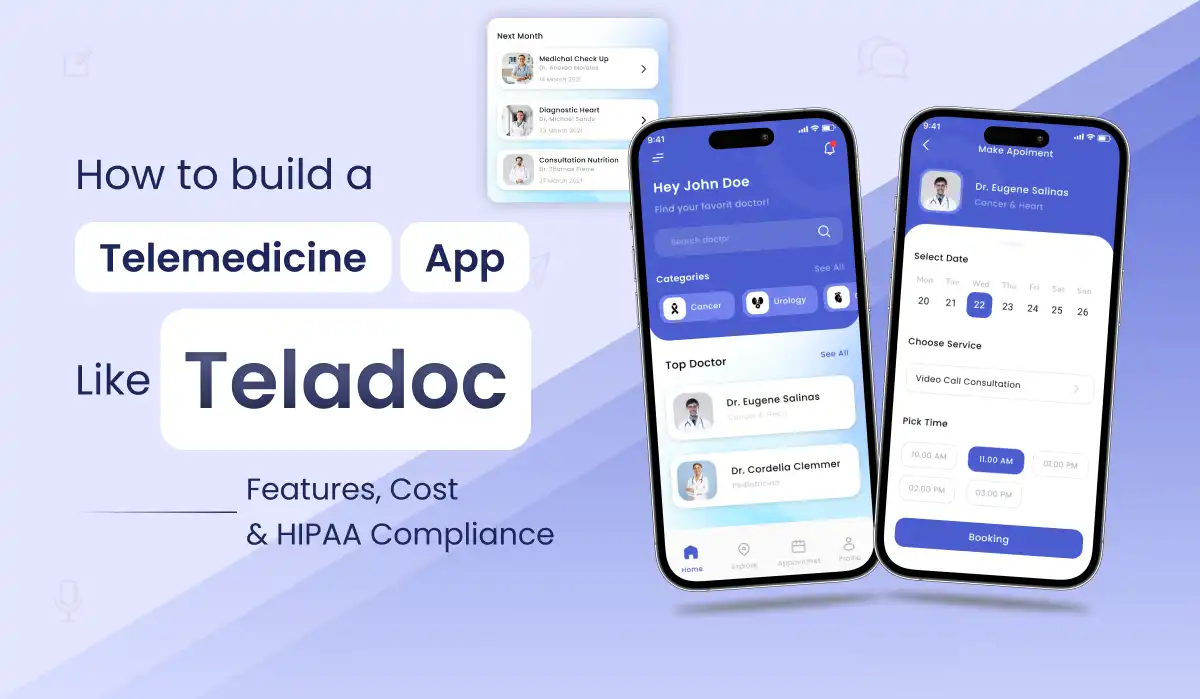
How to Build a Telemedicine App Like Teladoc in 2026: Features, Cost & HIPAA Compliance
Date
29 Jun, 2026
Share:
Every cost guide quotes $40,000 to over $1,000,000 — all at US or Eastern European rates, none mentioning India. Teladoc and Amwell already own broad primary care. The real opportunity is narrower than that, and the real cost is lower than every quote you’ve seen.
The number you came here for
A telemedicine app like Teladoc costs $22,000–$45,000 for an MVP (secure video consultations, patient registration, scheduling, HIPAA-compliant infrastructure) at India development rates using Flutter. A mid-tier platform with EHR/FHIR integration and e-prescribing costs $50,000–$120,000. A full enterprise platform with AI triage and remote patient monitoring costs $130,000–$300,000+. US and Eastern European agencies quote $40,000–$1,000,000+ for the same scope — and not one mentions India rates as an option. HIPAA compliance work alone typically accounts for 20–30% of any telemedicine app’s budget, regardless of who builds it. See our healthcare app development service →
When Medicare’s telehealth flexibilities briefly lapsed in September 2025, fee-for-service telemedicine visits dropped 24% almost overnight. That single data point tells you something more useful than any growth projection: telehealth isn’t an emerging trend anymore — it’s infrastructure that patients and providers have built clinical workflows around. The question for a founder in 2026 isn’t whether telemedicine works. It’s whether your telemedicine app development approach has compliance architecture that doesn’t unravel the moment a regulator looks closely.
We’re going to say plainly what every generic “build a telemedicine app” guide either buries or skips: India development rates apply to telemedicine app development exactly the way they apply to every other app category. The HIPAA compliance work itself — BAAs, encryption architecture, audit logging — costs roughly the same in absolute vendor and infrastructure terms wherever you build. But the engineering hours to implement that architecture correctly cost 60–70% less at India rates than at US rates, and across a project where compliance can be 20–30% of total spend, that gap is the difference between a $300,000 quote and a $50,000 one for genuinely comparable work.
$244B
Global telehealth market, 2026
24%
2025 Medicare Visit Drop
$22K
MVP starting cost (India rates)
20–30%
HIPAA Compliance Spend
86,000
US physician shortage by 2036
HIPAA Compliant Telemedicine App Development — What It Actually Requires
HIPAA compliant telemedicine app development isn’t a feature you add — it’s the floor everything else stands on, and it has to be designed into the architecture before the first screen gets built. Using a generic video tool like Zoom without a signed Business Associate Agreement is a HIPAA violation regardless of how encrypted the connection is, because the agreement, not the encryption alone, is what makes a vendor relationship compliant.
Business Associate Agreements
Signed BAAs with every vendor touching PHI — cloud provider, video infrastructure, analytics, support tools. No exceptions, no informal arrangements.
Foundational, non-negotiable
Encryption In Transit & At Rest
AES-256 or equivalent for all PHI, including video streams and session logs. Encryption in transit has no noticeable performance cost.
Architecture cost, built in
Role-Based Access Control
Providers see full records; patients see only their own. Multi-factor authentication is now standard, not optional.
Core architecture decision
Audit Trails
Log every access or modification to PHI — who, what, when, where. HHS guidance requires retention for at least six years.
Retrofit cost is far higher
Penetration Testing
Annual vulnerability assessment and pen testing from an accredited firm — required before launch and on an ongoing basis.
Required, recurring
Breach Risk
Healthcare data breaches averaged $7.42M in cost in 2025. Non-compliance fines reach $50,000 per violation under current enforcement.
The cost of getting it wrong
Why retrofitting compliance costs more than building it correctly the first time: A founder who scopes a beautiful feature list first and treats compliance as a final pass before launch almost always discovers, mid-build, that the data model doesn’t support proper audit logging or that role-based permissions weren’t designed into the original schema. Fixing that means rebuilding core data architecture, not adding a feature. Design the matrix of access rights, the audit logging approach, and the PHI data flow in week one, alongside your first wireframe — not as a compliance review before launch.
EHR FHIR Integration for Telemedicine — When You Need It & When You Don’t
EHR FHIR integration for telemedicine, connecting to systems like Epic or Cerner via HL7 FHIR, is essential if you’re building for established health systems or clinic groups that already run on those platforms — providers will not re-key patient data into a second system, and without bidirectional sync your product becomes a workflow burden rather than a workflow improvement. This single integration point is one of the largest sources of underestimated cost and timeline in telemedicine app development projects.
If you’re building for independent providers, telehealth-only practices, or a niche like mental health where standalone operation is common, you can launch a focused MVP without EHR integration at all — scheduling, video, and secure messaging cover the core workflow, and EHR integration gets added later once you have providers who specifically require it. Building EHR integration before you know which system your actual provider base runs on is one of the more common, avoidable ways founders overspend.
The DEA prescribing detail almost no generic guide mentions: The DEA’s temporary telemedicine flexibilities — including prescribing Schedule II-V controlled substances via audio-video telehealth without a prior in-person visit — have been extended through 2026, with permanent rules still under development. Over 7 million controlled substance prescriptions were issued through telemedicine in 2024 alone. If your platform supports e-prescribing for controlled substances, it needs EPCS (Electronic Prescriptions for Controlled Substances) with two-factor authentication and compliance with both federal and state requirements — and the rules genuinely could tighten when the temporary extension eventually lapses. Architect for this explicitly if controlled substance prescribing is part of your product, and stay close to the regulatory calendar rather than assuming current flexibility is permanent.
Telemedicine App Features That Actually Matter in 2026
Patient-Facing Telehealth Features
Secure registration and identity verification — not just email and password, but government ID verification for prescription-eligible platforms. Provider search and appointment scheduling with real-time availability, specialty filters, and insurance acceptance checks. HD video and audio consultations (WebRTC-based) with automatic failover on poor connections, because a dropped call mid-consultation is a clinical and trust problem, not just a technical one. Secure in-app messaging for non-urgent follow-ups that keeps all communication within your HIPAA-compliant environment rather than routing through the patient’s personal email. Prescription history and refill requests with notification alerts when a refill is ready. Payment and insurance processing integrated directly into the booking flow — not a separate step that creates drop-off. Health record access showing visit history, provider notes, and lab results in a format patients can actually read.
Provider Dashboard Features
Clinical documentation tools integrated directly into the consultation flow — not a separate system providers have to switch into mid-appointment, because switching context during a consultation is the fastest way to make a provider hate your product. Structured note templates that pre-populate from patient intake forms and prior visit history. E-prescribing with EPCS (Electronic Prescriptions for Controlled Substances) support if controlled substances are in scope, built to the DEA’s two-factor authentication standard. Patient chart access pulled from EHR integration where applicable, with bidirectional sync so notes written in your app appear in the provider’s primary EHR system without re-keying. Schedule and availability management with buffer time controls and no-show handling. Billing and claims submission tools with CPT code suggestions based on documentation. License verification against state medical board APIs, important for multi-state telehealth platforms where a provider’s license scope determines which patients they can legally treat.
Admin & HIPAA Compliance Features
Provider credentialing and onboarding workflow with document collection, license verification, and malpractice insurance tracking — the operational layer that determines how fast you can grow your provider network. Audit log dashboard for compliance review, giving your compliance officer a searchable record of every PHI access event without needing to query the database directly. BAA tracking across all connected vendors, because your HIPAA compliance is only as strong as your weakest vendor agreement. Session recording and retention policy management where used, with explicit patient consent flows built into the booking process. Platform analytics showing visit volume, no-show rates, consultation duration averages, and provider utilization — the data your operations team needs to run the platform efficiently. Incident response tooling: the ability to quickly identify which patients were affected by a data event and generate the breach notification reports required under HIPAA’s 60-day notification rule.
Why the video infrastructure decision matters more than it looks like it should: Three real options exist for video: a managed service like Twilio Video API that handles security, scalability, and HIPAA compliance for you; open-source WebRTC, which is free but requires building your own encryption, NAT traversal, and scalability infrastructure; or Vonage, broadly similar to Twilio with different pricing. For most telemedicine apps, a managed HIPAA-compliant video service is the right choice — it costs more per-minute than DIY WebRTC but saves months of engineering and includes handling for the edge cases (dropped connections, poor networks, device handoff) that matter enormously when a patient is mid-consultation with their doctor.
Remote Patient Monitoring App Development — The Underserved Niche
Remote patient monitoring app development sits at the intersection of telemedicine and IoT — and it’s one of the most genuinely underserved categories in healthcare technology in 2026. Most general telehealth platforms treat remote monitoring as a secondary feature rather than a core product, which means well-scoped, purpose-built remote patient monitoring apps are competing against platforms that don’t actually prioritize the use case.
A remote patient monitoring platform connects wearable devices — continuous glucose monitors, blood pressure cuffs, pulse oximeters, cardiac event monitors — to a clinical dashboard where providers can track patient vitals between visits rather than waiting for the next scheduled consultation. For chronic conditions like diabetes, hypertension, and congestive heart failure, this between-visit data is often more clinically valuable than the visit itself, because it shows patterns across days and weeks rather than a single snapshot.
What makes remote patient monitoring app development different from standard telemedicine: Standard telemedicine apps are event-driven — a patient books an appointment, has a consultation, and the interaction ends. Remote patient monitoring is continuous — the app is always receiving data, always running alert logic, and always maintaining a live connection to patient health status. That changes the architecture significantly: you need real-time data pipelines, threshold-based alerting, device integration APIs for multiple manufacturers, and a clinical dashboard designed for monitoring dozens or hundreds of patients simultaneously rather than one at a time. The HIPAA compliance requirements are the same, but the data volume and real-time requirements are substantially higher.
The commercial model also differs. Remote patient monitoring qualifies for CMS reimbursement under CPT codes 99453, 99454, 99457, and 99458, which means platforms built around reimbursable RPM services can generate recurring revenue through insurance billing rather than direct-to-patient subscription fees. For a telemedicine app development company building in this space, understanding the billing codes is as important as understanding the technical architecture — because the reimbursement structure shapes the feature set and the provider workflow.
Mental Health Telemedicine App Development — 2026’s Biggest Opportunity
Mental health telemedicine app development is the single most active niche in telehealth right now, and for reasons that go beyond the well-documented demand increase. The clinical workflow for mental health is genuinely different from general primary care in ways that create real product differentiation opportunities for a focused platform.
Behavioral health consultations are longer — typically 45 to 60 minutes versus 10 to 15 minutes for primary care. They happen on a recurring cadence rather than episodically. The provider-patient relationship is more central to outcomes than in most other specialties, which means platform switching costs are higher once a patient and provider have established a therapeutic relationship. And the compliance considerations, while still HIPAA-governed, have additional sensitivity layers around psychotherapy notes under 45 CFR § 164.508 — notes from therapy sessions receive stronger protection than general medical records and require explicit patient authorization to disclose, separate from standard HIPAA authorizations.
Why mental health telemedicine doesn’t need EHR integration at launch: The majority of mental health providers in private practice and telehealth-only settings don’t run on Epic or Cerner — they use behavioral health-specific EHR systems like SimplePractice, TherapyNotes, or ICANotes, or they run entirely within a telemedicine platform’s own documentation tools. This means a mental health telemedicine app can launch a clinically complete MVP with scheduling, HIPAA-compliant video, secure messaging, and structured session notes — without the $15,000–$40,000 HL7 FHIR integration work that a general health system platform requires. It’s one of the few telemedicine categories where a well-scoped Tier 1 build genuinely covers the full provider workflow at launch. Get a free mental health telemedicine app estimate →
The other structural advantage of mental health telemedicine app development: the addressable market is enormous and fragmented. Unlike general primary care where a handful of large platforms dominate, mental health telehealth is served by a mix of large consumer platforms (BetterHelp, Talkspace), employer-sponsored programs, and a massive number of independent providers and small practices who need a platform but aren’t being well-served by either the consumer giants or by general telemedicine tools not designed for their workflow. A focused, well-designed mental health telemedicine platform built around the specific needs of therapists, psychologists, or psychiatrists has a clear differentiation story and a provider acquisition path that doesn’t require competing with Teladoc’s marketing budget.
Telemedicine App Development Cost 2026 — 3 Tiers at India Rates
Tier 1
MVP — Core Telehealth Loop
$22K–$45K
US/EE equiv: $40,000–$150,000
Patient + provider apps
Secure video consultations (managed service)
Scheduling and registration
HIPAA-compliant infrastructure (BAA-backed)
Basic admin dashboard
No EHR integration required
Most CommonTier 2
Full Platform + EHR Integration
$50K–$120K
US/EE equiv: $150,000–$400,000
All Tier 1 features
HL7 FHIR EHR integration (Epic/Cerner)
E-prescribing, EPCS-ready
Clinical documentation tools
Insurance and billing integration
Advanced compliance reporting
Tier 3
Enterprise Multi-Specialty Platform
$130K–$300K+
US/EE equiv: $400,000+
All Tier 2 features
AI-powered symptom triage
Remote patient monitoring (wearables)
Multi-EHR interoperability
Multi-state licensing workflow
White-label for health systems
Ready to Estimate Your Telemedicine App Cost?
Get a detailed cost breakdown, timeline, recommended features, and technology stack tailored to your healthcare startup or clinic.
Flutter Telemedicine App Tech Stack — Built for HIPAA Audit Trails
Mobile App
Flutter
Provider Dashboard
React.js / Next.js
Backend
Node.js / Python
Database
PostgreSQL (encrypted)
Video Infrastructure
Twilio / Vonage
EHR Integration
HL7 FHIR
Cloud Infra
AWS (HIPAA-eligible)
E-Prescribing
DoseSpot / Surescripts
Why we recommend Flutter even for a HIPAA-sensitive product: Flutter’s single codebase delivers iOS and Android simultaneously for telemedicine app development, which matters in healthcare because maintaining two separate native codebases doubles the surface area for security review and compliance auditing — every screen that touches PHI needs to be reviewed on both platforms, and a shared codebase halves that burden compared to native Swift and Kotlin builds. The performance gap that mattered years ago has narrowed to the point where most patients and providers can’t tell the difference, while the compliance and maintenance savings remain real and compounding.
Best Telemedicine App Niche Strategy — Mental Health, Dermatology & More
Teladoc Health and Amwell already own broad virtual primary care at massive scale, with EHR partnerships and provider networks built over years. A new telemedicine app development entrant trying to compete head-on for general primary care is fighting a battle with no realistic path to the trust, scale, or provider relationships these platforms already have.
Behavioral & Mental Health
Genuine white space even as broad telehealth platforms expand. Different session length, follow-up cadence, and provider relationship than general primary care.
→ Standalone operation often viable, no EHR needed
Dermatology
Asynchronous store-and-forward care (photo-based consults) works well for many dermatology cases, reducing the need for live video infrastructure entirely.
→ Lower infrastructure cost, async-friendly
Chronic-Condition Management
Diabetes, hypertension, and similar long-term conditions benefit from recurring check-ins and remote monitoring rather than one-off consultations.
→ Recurring revenue, higher patient retention
Remote Patient Monitoring
Wearable integration for vitals tracking between visits — a genuinely underserved category most general telehealth platforms treat as secondary.
→ Differentiated, sticky product
White-Label for Health Systems
Regional health systems and clinic groups want their own branded telehealth product, not routing patients to a third-party platform’s brand.
→ B2B, predictable contract revenue
Controlled Substance Specialty Care
ADHD, addiction medicine, and pain management telehealth — narrow, compliance-heavy, but currently underserved given DEA flexibility through 2026.
→ High regulatory bar, high differentiation
“The defining competitive edge in telemedicine in 2026 isn’t features. It’s compliance and interoperability done right from day one — a platform that handles HIPAA architecture and EHR data exchange correctly will beat a feature-richer one that gets either wrong.”
Primocys · Healthcare App Development
We Build HIPAA Compliance In From Day One — Not Bolted On at the End
Primocys has shipped products with HIPAA, PCI-DSS, GDPR, and SOC 2 compliance requirements built into the architecture from the first sprint. Flutter mobile apps, fixed price from $22,000, full source code.
BAA-backed infrastructure from day one
HIPAA-eligible cloud hosting, audit logging, and access controls designed in, not retrofitted.
Real WebRTC expertise
We’ve built self-hosted and managed video infrastructure in production — WasaaChat and ChatWave prove it.
HL7 FHIR integration done right
Bidirectional EHR sync scoped honestly — only when your provider base genuinely needs it.
Niche-first strategy advice
We’ll help you scope a specialty or B2B model with a real path to provider adoption.
Flutter — compliance-aware build
One codebase halves the security review surface vs separate native iOS and Android builds.
Fixed price from $22,000
Cost agreed before development starts. Milestone payments. Full source code ownership.
Conclusion: How to Choose the Best Telemedicine App Development Company
Building a telemedicine app like Teladoc or Amwell in 2026 is entirely achievable — but only if HIPAA compliance is treated as architecture, not an afterthought. The founders who succeed aren’t the ones with the longest feature lists; they’re the ones who made the BAA and data flow decisions correctly before writing a line of code, scoped EHR FHIR integration only when their actual provider base needed it, and chose a telehealth app development company that has shipped HIPAA compliant products before — not one learning healthcare compliance on your budget.
India-based telemedicine app development delivers the same HIPAA-compliant Flutter architecture, HL7 FHIR integration, and video consultation infrastructure at 60–70% lower engineering cost than US agencies. The compliance vendor fees — Twilio, DoseSpot, AWS HIPAA-eligible hosting — are identical globally. What changes is the engineering cost to wire them in correctly. That gap is where the real saving is, and for a $50,000–$120,000 Tier 2 telemedicine platform, it’s the difference between a fundable MVP and a budget that ran out before launch.
The single most important step before you hire a telemedicine app development company: Tell us your target specialty, your provider base, and whether EHR integration is in scope from day one. We’ll give you an honest HIPAA compliance recommendation and a fixed-price estimate broken down by feature and compliance component — within 48 hours, no commitment required. Get your free telemedicine app estimate →
FAQs: Telemedicine App Development Like Teladoc & Amwell
How much does it cost to build a telemedicine app like Teladoc in 2026?
A HIPAA-compliant telemedicine app like Teladoc costs $22,000–$45,000 for an MVP with video consultations, scheduling, and secure patient management at India development rates. Mid-tier platforms cost $50,000–$120,000, while enterprise solutions with AI, remote monitoring, and EHR integration range from $130,000–$300,000+. HIPAA compliance adds about 20–30% to the budget. Get a personalised telemedicine app estimate →
What does HIPAA compliance actually require for a telemedicine app?
HIPAA-compliant telemedicine apps require signed Business Associate Agreements (BAAs) with every vendor handling Protected Health Information (PHI), including cloud, video, and support providers. They also need encryption, role-based access, MFA, and audit logs. Using services like Zoom without a HIPAA BAA can violate HIPAA, even if the connection is encrypted.
Should I build a general telemedicine app or focus on a specific specialty?
Focus on a specific specialty or care vertical rather than competing with Teladoc and Amwell for broad primary care. Those platforms already own general virtual primary care at massive scale. The genuine white space in 2026 is mental health telemedicine app development, dermatology, chronic-condition management, and remote patient monitoring, along with white-label telemedicine platforms built for regional health systems and clinic groups. Tell us your niche — free scope call →
Do I need EHR FHIR integration for my telemedicine app from day one?
Not always. EHR/FHIR integration with platforms like Epic or Cerner is essential when building for hospitals or large clinic networks. For independent providers, telehealth startups, or mental health practices, an MVP can launch with scheduling, video consultations, and secure messaging. Add EHR integration later based on the systems your paying providers actually use, avoiding unnecessary development costs.
How long does it take to build a telemedicine app like Teladoc?
A Tier 1 telemedicine app MVP built in Flutter takes 16–22 weeks at India development rates. A Tier 2 platform with EHR FHIR integration, e-prescribing, and advanced compliance reporting takes 26–40 weeks. A full enterprise multi-specialty telemedicine platform is a 12+ month phased build. Timeline depends heavily on HIPAA compliance architecture decisions made in week one — compliance scoped correctly from the start runs on schedule; retrofitted compliance adds months and significant cost. Get your timeline estimate free →
What is the best tech stack for a telemedicine app in 2026?
The best flutter telemedicine app development tech stack in 2026: Flutter for iOS and Android apps (single codebase halves HIPAA security review surface), React.js/Next.js for the provider dashboard, Node.js or Python for the backend, PostgreSQL (encrypted) for the database, Twilio or Vonage for HIPAA-compliant video infrastructure, HL7 FHIR for EHR integration, AWS HIPAA-eligible hosting for cloud infrastructure, and DoseSpot or Surescripts for e-prescribing. Get a free tech stack review for your telemedicine project →
What is white label telemedicine app development?
White label telemedicine app development means building a fully branded telehealth platform for a regional health system, clinic group, or healthcare brand that wants their own patient-facing app — not routing patients to a third-party platform’s brand like Teladoc or Amwell. It typically includes custom branding, provider network management, HIPAA-compliant video consultations, scheduling, and EHR integration. This B2B model offers predictable contract revenue and is one of the strongest niche opportunities in telemedicine in 2026.
Why choose an India-based telehealth app development company?
India-based telehealth app development companies typically deliver the same HIPAA-compliant Flutter architecture, HL7 FHIR integration, and video consultation infrastructure at 60–70% lower cost than US agencies. The compliance vendor fees — Twilio, DoseSpot, AWS HIPAA-eligible hosting — are identical globally. What changes is the engineering cost to wire them in correctly. For a $50,000–$120,000 Tier 2 telemedicine platform, that gap is the difference between a project that ships on budget and one that runs out of money before launch. Get your free telemedicine app estimate from Primocys →
Ready to Build Your Telemedicine App — Compliance Done Right
Tell us your specialty, your target provider base, and whether EHR integration is in scope. We’ll give you an honest recommendation and a fixed-price estimate within 48 hours.
Arpan leads product and engineering at Primocys, a Top-Rated Clutch app development company based in Ahmedabad, India. With over 10+ years of experience, he has successfully delivered real-time communication platforms for 1,200+ clients worldwide.
He is directly involved in overseeing the development of chat and messaging applications, ensuring high performance, scalability, and seamless user experience in every project.
📧 Email: [email protected]
📱 WhatsApp: Chat on WhatsApp
Trusted by Global Businesses for AI, Mobile, SaaS & Custom Software Development. Your Vision, Our Expertise.Trusted by Global Businesses for AI, Mobile, SaaS & Custom Software Development. Your Vision, Our Expertise.Trusted by Global Businesses for AI, Mobile, SaaS & Custom Software Development. Your Vision, Our Expertise.Trusted by Global Businesses for AI, Mobile, SaaS & Custom Software Development. Your Vision, Our Expertise.Trusted by Global Businesses for AI, Mobile, SaaS & Custom Software Development. Your Vision, Our Expertise.Trusted by Global Businesses for AI, Mobile, SaaS & Custom Software Development. Your Vision, Our Expertise.
Hear from our clients and why 1200+ businesses trust Primocys
"Our B2B and B2C platform helps Nigerian manufacturers sell at wholesale
prices and suppliers offer competitive retail pricing, with a strong focus on Made in Africa products
and easy local and international distribution.
The app has received excellent user reviews for its design and unique features. Communication with the
Primocys team was smooth in an agile setup, even beyond office hours when needed. Their mobile app
development expertise is excellent—highly professional and reliable."
Adegbuyi OduguwaCEO & Co-Founder
"The dating app was delivered successfully and approved by both Apple App
Store and Google Play. Our users are highly impressed with the design, UI, and overall functionality.
The project was well planned with clear milestones, and all modules were delivered on time.
The team is talented, patient, and flexible, accommodating multiple scope revisions as requirements
evolved. Their 24/7 development and support availability made the entire process smooth and reliable."
Revanth KExecutive
" We hired Primocys to develop a highly complex and specialized mobile
application, and they delivered outstanding results. The app includes advanced features such as
timeline mixers, classifieds, payments, advertisements, GPS functionality, and more. Their technical
skills, timely delivery, availability, and the personal attention Arpan Sagar brings to each project
truly stand out. The team stays focused and committed from start to finish—an excellent experience
overall."
Gregor Skerl Founder PROHUNTER
" Great team with excellent communication and a strong commitment to on-time
delivery. They developed a fully customized mobile app for both Android and iOS, perfectly matching
our requirements. The entire process was smooth and professional, with clear updates at every stage.
They are reliable, skilled, and very easy to work with. We’re continuing our partnership on more
projects, and choosing them has been one of the best business decisions I’ve made."