
$0/month
$0
No credit card required
- 1 agent
- Up to 50 conversations/month
- WhatsApp + live chat channels
- 3 chatbot flow templates
- 14-day chat history
- Multiple agents
- Advanced analytics
 DapkeSocial video app with live streaming and PK battles.
 Lika Real EstateProperty discovery platform for listings and leads.
 BurpoutSocial fitness challenges that keep people moving.
 ChatLivoConnected customer communication SaaS workspace.
 EmoTalesAI storytelling adventures designed for children.
 EarnifyTrack Income from Multiple Sources with Analytics & Tax Planning.
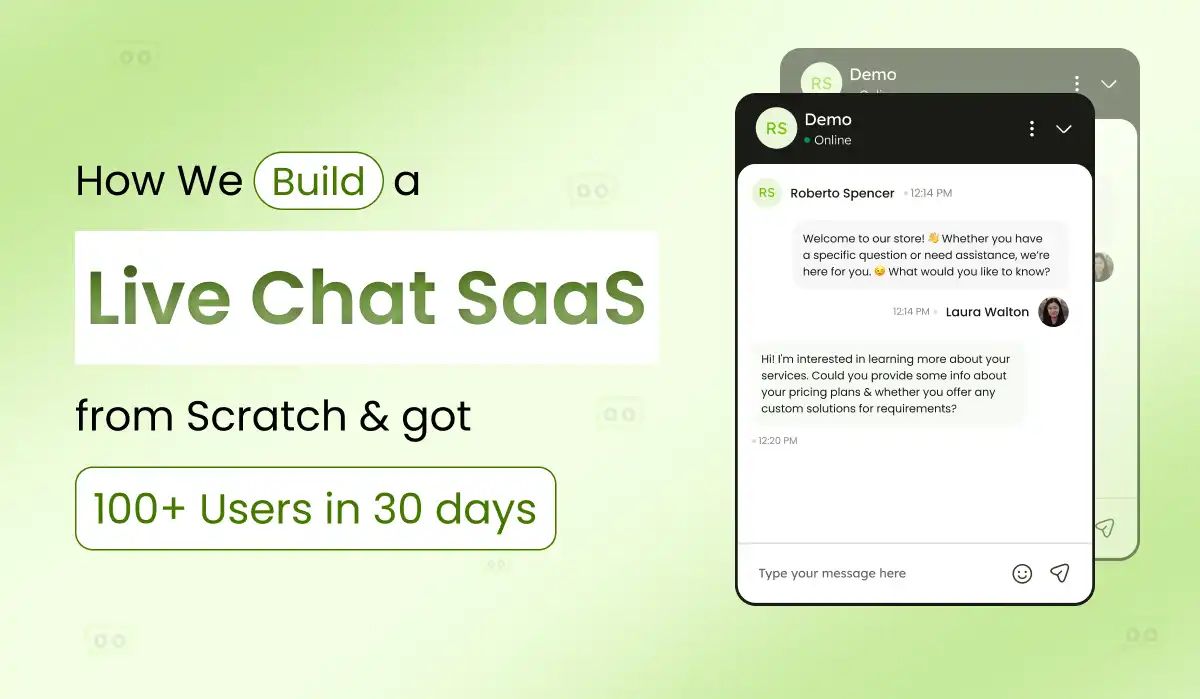
This is the unfiltered story of how Primocys built a live chat SaaS — Chatlivo — that competes with Tidio, Tawk.to, and Smartsupp, growing from zero to 100+ users in the first month. The architecture decisions, the pricing mistakes, the WordPress plugin, and the three things we’d do differently if we started again today.
Chatlivo is Primocys’s own live chat SaaS — a Tidio and Tawk.to alternative we built and launched ourselves, not for a client. We reached 100+ users in month one without paid advertising. The three things that drove early adoption: a free tier generous enough that users actually experienced the product’s value, an existing client base from Primocys’s development work who needed live chat, and a WordPress plugin that creates organic discovery on WordPress.org. The biggest lesson: the free tier converts when it removes friction for new users, not when it artificially limits what they can experience. Everything else in this guide is the architecture, pricing decisions, channel integrations, and mistakes that got us here. Try Chatlivo free →
Most articles about building SaaS products are written by people who’ve thought about building one, not people who’ve shipped one and watched real users sign up. This is the other kind. Chatlivo is a real product — live at chatlivo.com right now — that Primocys built, priced, shipped, and grew. The architecture described here is what’s running. The pricing tiers are the ones real users are on. The 100+ users in 30 days is the actual milestone, not a projection.
The honest framing: this is not a story about overnight success. It’s a story about a development company that already had real-time messaging infrastructure in production (WasaaChat and ChatWave), identified a gap in the live chat market (Tawk.to is free but dated, Tidio’s AI costs $32.50/month on top of an already $24/month plan), and built a focused product that addressed that gap at honest pricing. The lessons here apply whether you’re building a live chat SaaS or any SaaS product from scratch in 2026.
Primocys needed live chat for our own website. We evaluated Tidio, Tawk.to, and Smartsupp. What we found was a market with a clear pattern: the genuinely free option (Tawk.to) had a dated UI, no meaningful chatbot automation, and minimal AI. The modern options (Tidio, Smartsupp) were locking AI and automation behind separate paid add-ons that compounded on top of already expensive base plans — Tidio’s Lyro AI chatbot starts at $32.50/month on top of their $24/month Starter plan. For an SMB that just wants live chat, a chatbot, and WhatsApp integration without a spreadsheet of add-on costs, none of the obvious options were compelling.
We had something competitors didn’t: four years of production real-time WebSocket messaging infrastructure from building WasaaChat and ChatWave. The hardest part of live chat — reliable real-time message delivery, reconnection logic, offline queuing, read receipts across multiple agent sessions — was already solved in production. What we needed to build was the SaaS wrapper: a multi-tenant SaaS architecture, a clean widget, a WordPress plugin, and a subscription billing layer. That insight is what turned a client evaluation into a product decision.
The most important two weeks of the build. We chose row-level multi-tenancy in PostgreSQL (workspace_id foreign key on every table) over separate schemas or separate databases per tenant. This trades some isolation for dramatically simpler database management at early scale — the right call for month one. Node.js + Socket.io for real-time, Redis for presence and session caching, Vue.js for the frontend. We used our existing WasaaChat WebSocket infrastructure as the foundation.
The chat widget is a self-contained JavaScript bundle (under 20KB gzipped) injected via a single script tag — no iframe, no dependency on external frameworks. The agent dashboard handles conversation assignment, status (open/resolved/pending), multi-agent presence, and conversation history. Real-time message delivery via Socket.io with offline message queuing so messages sent while an agent is disconnected are delivered on reconnection.
WhatsApp Business API integration via Meta Cloud API — conversations from WhatsApp appear in the same agent dashboard as website live chats. Stripe for subscription billing with webhook handling for every subscription lifecycle event (new subscription, renewal, cancellation, payment failure). Server-side subscription validation on every API request gates premium features — no client-side subscription check that can be bypassed.
The WordPress plugin (slug: chatlivo-live-chat) is a PHP wrapper around the JavaScript widget that handles authentication from WordPress admin settings. Submitted to WordPress.org for organic discovery. Three chatbot flow templates shipped: Welcome + Lead Capture (collect name and email before connecting to agent), FAQ Auto-Reply (match keywords to predefined answers), and Off-Hours Message (capture visitor details when no agents are online). Built in a visual flow builder inside the dashboard.
Zero paid advertising. Three user acquisition channels: direct outreach to Primocys’s existing development client base (the fastest and most qualified source), community presence in WordPress and SaaS communities where we’d genuinely been helpful for months before mentioning Chatlivo, and organic discovery via the WordPress plugin on WordPress.org. The free tier — 1 agent, 50 conversations/month, WhatsApp + live chat channels — was the conversion mechanism that didn’t require a sales conversation.
Picking a freemium pricing model is the decision most founders agonise over and then get wrong anyway on the first version. Our first instinct was to gate WhatsApp integration behind the paid tier. We changed this before launch because it contradicted our core differentiation argument: Chatlivo gives you live chat and WhatsApp in one place at honest pricing. If WhatsApp wasn’t on the free tier, that argument didn’t land for the first 10 minutes of a user’s experience — which is when you convert or lose them.
The pricing lesson we learned from the first 50 sign-ups: Our original free tier limited the chatbot to one flow template. We changed it to three within the first week of launch because users weren’t experiencing the chatbot value — they were setting up one flow, seeing limited functionality, and not understanding why they’d need to upgrade. Once we gave free users three flow templates, they experienced the actual value, hit the custom-flow limit, and converted at a meaningfully higher rate. The lesson: limiting what users can experience before they pay is different from limiting scale once they’ve experienced it. The first kills conversion; the second drives it.
We’re not going to pretend we’re competing with Intercom at the enterprise level or that we have Tidio’s 300,000-website scale. Chatlivo is 12 months old. Here’s where we actually compete, and why, based on real pricing data from May 2026:
| Platform | Base Price | AI/Chatbot | WP Plugin | Honest verdict for SMBs | |
|---|---|---|---|---|---|
| Tawk.to | $0 (forever) | Add-on only, minimal | Not native | ✓ | Free but dated UI, no real automation. Fine for “I just need chat.” |
| Tidio | $24.17/mo | Lyro AI: +$32.50/mo extra | ✓ paid plans | ✓ | Great product but AI doubles the cost. Hidden pricing complexity. |
| Smartsupp | $20/mo | Mira AI: +$16/mo extra | Not native | ✓ | Visitor recording is unique. European-focused. AI add-on cost stacks. |
| Crisp | $45/mo workspace | Bundled at Mini | Paid plans | ✓ | Good multichannel. Expensive flat-rate workspace pricing for small teams. |
| Chatlivo ✓ | $0 → $19/mo | Flows free, AI Phase 2 | ✓ Free tier | ✓ | Honest pricing, WhatsApp on free plan, chatbot flows without add-on cost. AI is Phase 2 — not shipped but roadmapped honestly. |
The one thing we won’t do: ship AI before it’s ready and market it as a feature: Every competitor in the live chat space is rushing AI features to their marketing pages. Tidio’s Lyro AI is real and mature. Several others have labeled basic keyword-matching flows as “AI” to capture search traffic. Chatlivo’s Phase 2 AI chatbot and reply assist are actively in development using Python microservices with LangChain and OpenAI. We’re not shipping them to users until they’re genuinely better than existing chatbot flow automation — because shipping mediocre AI and calling it AI chatbot is the fastest way to train your users not to trust your product claims. We’d rather say “Phase 2 roadmap” honestly and ship something that works than say “AI-powered” and ship something that doesn’t.
Node.js + Socket.io
WebSocket connections for live message delivery, agent presence (online/away/offline), typing indicators, and read receipts. Node.js’s event-driven model handles thousands of simultaneous connections without thread overhead — the same architecture running WasaaChat in production.
PostgreSQL 16+ (row-level isolation)
workspace_id on every table. Row-level isolation vs schema isolation — simpler to manage at early scale, upgrade path to schema isolation when tenant count warrants it. Every query automatically scoped to the authenticated workspace via database middleware.
Redis
Agent online/offline presence state, session caching (subscription tier cached to avoid database hit on every API request), and rate limiting per workspace. Redis pub/sub will extend to support multi-server chat widget broadcast when we scale past single-server.
JavaScript (self-contained bundle)
Under 20KB gzipped. Single script tag install. No iframe, no framework dependencies. Connects via WebSocket for real-time messages, REST API for conversation history. Fully customisable colours, position, and greeting message from the dashboard.
PHP (slug: chatlivo-live-chat)
PHP wrapper around the JS widget. Handles API key configuration from WP admin settings, injects widget on all pages via wp_footer hook, includes shortcode support for page-specific placement. Submitted to WordPress.org for organic discovery.
Stripe + webhooks
Server-side subscription validation on every premium API request. Stripe webhooks handle lifecycle events: new subscription, renewal, cancellation, payment failure, grace period. No client-side subscription check that can be bypassed. Stripe Customer Portal for self-serve billing management.
If you’re weighing the best tech stack for a live chat SaaS in 2026, here’s the exact stack Chatlivo runs on in production — no theoretical picks.
Users who experience real value and hit a natural limit convert. Users who can’t experience the product’s core value don’t. We learned this in week one when changing from 1 to 3 chatbot flow templates on the free plan measurably improved conversion.
Zero paid advertising in month one. Chatlivo’s first 100+ users came from Primocys’s existing client relationships and community presence built before we mentioned the product. SEO and WordPress.org discovery is a medium-term growth channel — not a month-one channel.
WordPress powers 43% of all websites. A plugin on WordPress.org creates organic, zero-cost discovery from website owners searching for live chat solutions. We shipped a great plugin as a standalone investment in distribution, not as a feature checkbox.
Tidio’s $24/month base plan + $32.50/month AI add-on adds up to $56.50 before you have the full product. Users who’ve experienced that discover Chatlivo’s $19/month with chatbot flows included and don’t need a long sales conversation.
We could have shipped a basic keyword-matching system and marketed it as “AI chat.” We’re building real LLM-powered AI for Phase 2 instead. Being honest about the roadmap builds more trust than shipping mediocre AI and hoping users don’t notice.
Retrofitting multi-tenancy into a SaaS codebase that was built single-tenant is one of the most expensive engineering projects in SaaS. We designed workspace_id isolation into the database schema before writing the first API endpoint. This is always the right order.
Cancellation, billing failure, grace period, refund — if your server doesn’t handle these Stripe webhook events and update user access immediately, you’re either leaking premium access to cancelled users or breaking the experience for users in billing retry. We built all webhook handlers before taking the first subscription payment.
“The conventional wisdom about SaaS launches is to build in private, get 10 beta users, refine, then launch. We did the opposite — we shipped a working product with a real free tier and let early users tell us what to fix. The free tier removed the barrier to genuine feedback. People don’t give you honest product feedback on things they haven’t actually used. Make it free to use, make it easy to start, then listen to what people say when they hit the walls.”
Chatlivo is not a showcase project — it’s a live SaaS with real users and real revenue that we built for ourselves. The multi-tenant architecture, Stripe subscription integration, WordPress plugin, and WhatsApp channel described in this guide are available as a foundation for your SaaS product. We’ve already solved the hardest parts. You own the idea and the market. We build the product.
Row-level or schema-level isolation designed into the database before sprint one.
Free tier, paid tiers, annual discounts, webhook lifecycle handling — all shipped and tested.
WasaaChat, ChatWave, and Chatlivo all run on the same Node.js + Socket.io + Redis production pattern.
If your SaaS needs a WordPress plugin, we’ve built and submitted one to WordPress.org.
Python microservices for AI features, LangChain + OpenAI/Gemini, async job queue.
Scope, architecture, and cost agreed before development starts. Full source code ownership.
Building a live chat SaaS from scratch isn’t about copying Tidio or Tawk.to feature-for-feature — it’s about finding a genuine gap and pricing honestly against it. Chatlivo reached 100+ users in 30 days without paid ads because the free tier let people experience real value before we asked for a card, and because we’d already solved the hard part — real-time messaging infrastructure — in production. Whether you’re evaluating a live chat SaaS for your own site or planning to build a SaaS product of your own, the multi-tenant architecture, freemium pricing model, and lessons in this guide are the same playbook we’d use again.
If you’re scoping your own SaaS idea, get a free estimate from Primocys — or start with Chatlivo’s free plan to see the product this guide is built around.

Hear from our clients and why 1200+ businesses trust Primocys

"Our B2B and B2C platform helps Nigerian manufacturers sell at wholesale prices and suppliers offer competitive retail pricing, with a strong focus on Made in Africa products and easy local and international distribution. The app has received excellent user reviews for its design and unique features. Communication with the Primocys team was smooth in an agile setup, even beyond office hours when needed. Their mobile app development expertise is excellent—highly professional and reliable."

"The dating app was delivered successfully and approved by both Apple App Store and Google Play. Our users are highly impressed with the design, UI, and overall functionality. The project was well planned with clear milestones, and all modules were delivered on time. The team is talented, patient, and flexible, accommodating multiple scope revisions as requirements evolved. Their 24/7 development and support availability made the entire process smooth and reliable."

" We hired Primocys to develop a highly complex and specialized mobile application, and they delivered outstanding results. The app includes advanced features such as timeline mixers, classifieds, payments, advertisements, GPS functionality, and more. Their technical skills, timely delivery, availability, and the personal attention Arpan Sagar brings to each project truly stand out. The team stays focused and committed from start to finish—an excellent experience overall."

" Great team with excellent communication and a strong commitment to on-time delivery. They developed a fully customized mobile app for both Android and iOS, perfectly matching our requirements. The entire process was smooth and professional, with clear updates at every stage. They are reliable, skilled, and very easy to work with. We’re continuing our partnership on more projects, and choosing them has been one of the best business decisions I’ve made."

AWARDS




TRUSTED BY GLOBAL BRANDS