
Basic MVP
$8K–$18K
₹6.7L–₹15L
- Customer app (Flutter iOS + Android)
- Provider app (Flutter iOS + Android)
- Booking + scheduling
- In-app payments (Stripe)
- Basic GPS matching
- Ratings & reviews
- Push notifications
- Admin panel (web)/li>
 DapkeSocial video app with live streaming and PK battles.
 Lika Real EstateProperty discovery platform for listings and leads.
 BurpoutSocial fitness challenges that keep people moving.
 ChatLivoConnected customer communication SaaS workspace.
 EmoTalesAI storytelling adventures designed for children.
 EarnifyTrack Income from Multiple Sources with Analytics & Tax Planning.
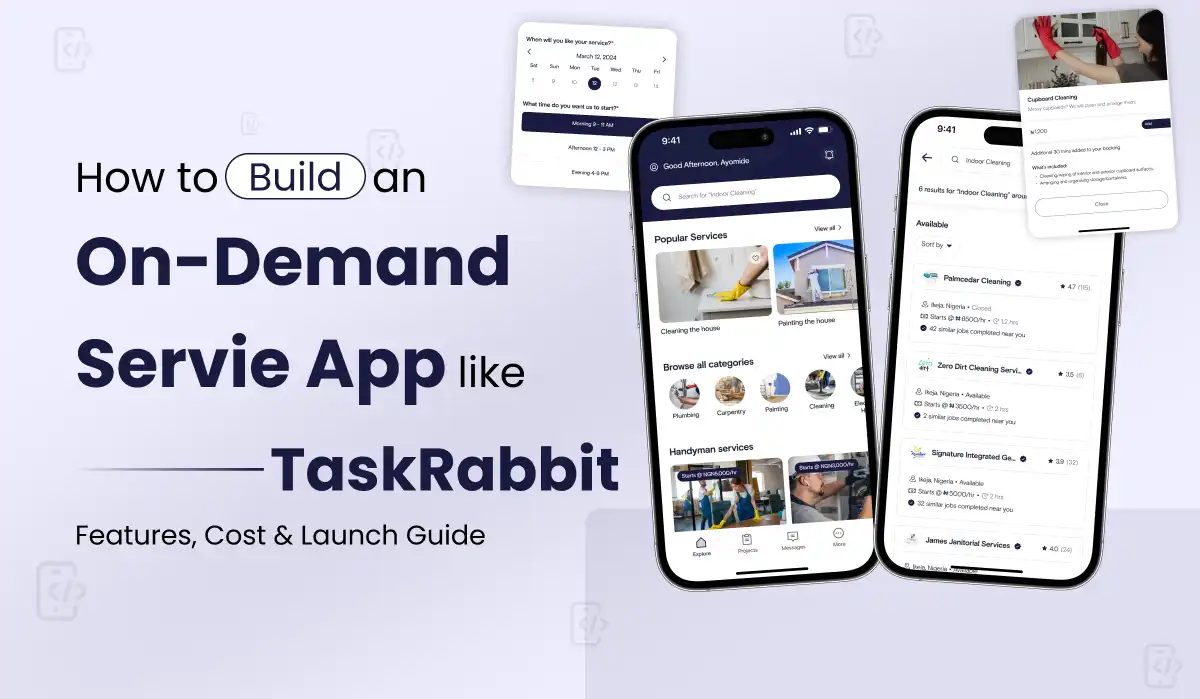
The on-demand home services market hits $1.2 trillion by 2030. Whether you want to build an app like TaskRabbit, Urban Company, or a niche handyman booking platform — this guide covers real features, actual costs from $8,000 MVP, and the launch strategy that works.
Quick Summary: An on-demand service app like TaskRabbit needs three separate products: a customer app, a service provider app, and an admin panel. The on-demand service app development cost starts at $8,000–$18,000 for an MVP at India development rates — Flutter iOS + Android, booking, payments, and reviews. The build takes 10–14 weeks. The hardest part isn’t the code — it’s solving the marketplace chicken-and-egg problem: customers won’t come without providers, providers won’t come without customers. Solve supply first. Launch with 20–30 vetted providers in one area before running a single customer ad. Looking for a handyman app development company or a TaskRabbit like app development company? See our on-demand app service →
TaskRabbit launched in 2008 as a simple errand-running app. By 2026, it’s owned by IKEA and operates across 9 countries. Urban Company launched in India in 2014 and became a $2 billion company by focusing on one geography, one service category at a time. The lesson from both: the winning on-demand home services app is never the most general one.
You win by picking one service vertical and one market, then building the experience that beats everything available there. The fitness trainer market in your city. The home cleaning niche for a specific demographic. The handyman booking market for a specific region. Niche platforms in the gig economy reach profitability 5× faster than general ones because they can build supply and demand density in the same location.
The technology stack for service marketplace app development is well-established in 2026. What takes real planning is the business model, the niche selection, the unit economics, and the launch sequence. This guide covers all of it — from MVP feature set to a fixed-price on-demand app development breakdown you can take to your co-founder or investor.
Most founders come to us asking to “build a TaskRabbit app.” What they’re actually asking for is three separate products working together as one platform. When you scope them incorrectly as a single app, you end up with wrong architecture, missed features, and expensive mid-build changes. Every two-sided marketplace app development project starts with understanding what each product actually does:
Why the provider app costs more than the customer app: FMost teams underestimate the provider app complexity. It has a more demanding workflow: job request handling with accept/decline timers, real-time navigation, job status progression with time tracking, earnings calculation with commission deduction, document upload and verification, and availability management. In any
service provider app development: project, the provider app typically adds 40–50% to the customer app build cost. Always budget for all three products from day one.
Before a single line of code, decide which model you’re building. The model determines your architecture, your unit economics, your provider acquisition approach, and how you control quality. These are not interchangeable after you’ve launched — and this is the most important strategic decision in any on-demand app development project.
Like: TaskRabbit, Thumbtack, Airtasker
Like: Urban Company, Amazon Home Services
Like: Handy Pro, HomeAdvisor Pro
Like: TaskRabbit (post-IKEA), Bark.com
“Urban Company didn’t start as a multi-service platform. It started as a home cleaning app in Delhi — one city, one service, one quality promise. Any handyman app development company or service marketplace will tell you: niche first, scale second.”
The most common mistake in on-demand service app development is choosing a niche that’s either too crowded or too thin to sustain a platform. The strongest home services marketplace app opportunities in 2026 are verticals with high ticket value, strong repeat frequency, and no dominant digital incumbent in emerging markets:
Plumbing, electrical, AC repair, furniture assembly. High ticket value ($80–$500/job), high repeat rate, no strong digital incumbent in most emerging markets.
Regular cleaning, deep cleaning, post-construction. Highest frequency of all home services — 2–4× per month. Subscription model works well here.
Haircut, massage, pedicure delivered at home. Post-COVID adoption accelerated dramatically. High customer lifetime value, strong referral loop.
Home tutoring, test prep, music lessons, coding classes. High average ticket ($30–$100/hr), parents pay reliably, digital adoption still has runway.
Dog walking, pet sitting, grooming. Pet owners pay premium for reliable care. Strong subscription conversion — daily dog walks create monthly recurring revenue.
Car washing, mechanic at home, tyre change, battery jump. High urgency = high willingness to pay. Currently underserved by on-demand platforms in most markets.
The technology stack for on-demand service app development is well-established in 2026. What takes real planning is the business model, the niche selection, the unit economics, and the launch sequence. Here are the six steps that determine whether your platform succeeds.
This decision drives everything else. Choose one service category, one launch city or neighbourhood, and one business model — marketplace or managed. If you’re uncertain, lean managed: it’s harder operationally but delivers higher trust, better reviews, and stronger repeat rates. TaskRabbit is marketplace. Urban Company is managed. Urban Company is more valuable. This is the strategic foundation of every gig economy app development project we scope.
Before writing code: spend one week on offline validation. Call 20 potential customers in your target area and ask if they’d pay for this service via an app. Call 20 potential providers and ask if they’d accept work through a platform at your commission rate. If you can’t get enthusiastic yes answers from both sides in a week of calling, change the niche or market before any development starts.
The most expensive mistake in on-demand app development is scoping and building the customer app first, then treating the provider app as a separate project. They share the same backend, the same booking data model, the same real-time infrastructure. Building them separately doubles backend work and creates integration problems that are painful and costly to fix.
Scope all three products — customer app, provider app, admin panel — in one project brief. Build them in parallel on a shared Node.js backend with Flutter on-demand app development for both mobile apps. The provider app takes longer (more complex workflow) but shares 60–70% of backend code with the customer app. As a specialist on-demand app development company , Primocys always scopes all three together as one project with a shared backend.
Customers on an on-demand service platform are letting strangers into their homes. The trust infrastructure — ID verification, background checks, ratings and reviews, insurance disclosure, service guarantee — is not a nice-to-have feature you add in V2. It is the fundamental reason customers choose your platform over calling someone themselves. Get this wrong and no amount of UI polish rescues you.
At MVP level: phone number verification for providers, photo ID upload (reviewed by admin), two-way rating system with text reviews visible publicly, and your service guarantee prominently displayed. In V2: automated background verification via a third-party API (Checkr for US, Onfido globally), tiered provider badges (verified, top-rated, elite), and insurance integration options. Build the manual admin review flow first — automate it when you have volume to justify the API cost.
The trust signal that increases conversions more than any feature
Platforms that display a “Service Guarantee” — a specific, committed refund or redo policy — consistently see higher conversion from browse to booking than platforms that don’t. The guarantee costs you almost nothing at MVP scale (very few claims) and signals to customers that you stand behind the quality. Urban Company’s growth in India was built partly on the strength of its service guarantee promise.
Standard commission rates in 2026: marketplace model 15–20%, managed model 25–35%. The commission rate determines whether providers find the platform worthwhile — price it too high and you can’t acquire supply, too low and your unit economics don’t work. Most platforms start at 15% and increase to 20–25% as the supply side grows and providers can’t easily leave.
For payments: Stripe for global markets (US, UK, EU, Australia), Razorpay for India, Xendit for Southeast Asia. In-app wallet with store credit is a V2 feature that dramatically increases repeat booking rates — customers with wallet balance return 3× more frequently. Build Stripe first, add wallet after you’ve validated that customers come back without it.
Provider payouts: weekly is standard. Daily payouts are a strong provider acquisition differentiator — Urban Company offers daily settlements in India, which is one reason providers prefer it to competitors. Daily payouts add implementation complexity (reconciliation, fraud checks) but are achievable with Razorpay’s instant payouts feature.
The Flutter on-demand app development stack is well-established. There’s no need to invent anything here — the interesting work is in product design and business model, not infrastructure choice. For every service marketplace app development project, this is the standard tech setup:
| Layer | Technology | Purpose | Cost |
|---|---|---|---|
| Mobile Apps | Flutter | Customer app + Provider app — iOS & Android from one codebase | Open source |
| Maps & GPS | Google Maps SDK | Provider tracking, address search, distance calculation, route display | $7/1,000 requests |
| Backend API | Node.js + Express | REST API for all operations, shared between customer + provider apps | Open source |
| Real-Time | Socket.io | Live job status updates, provider location to customer, chat messages | Open source |
| Database | PostgreSQL | Users, bookings, reviews, payments, provider profiles, service categories | Open source |
| Payments | Stripe + Razorpay | Customer payments, provider payouts, refunds, commission calculation | 2.9% per transaction |
| Push Notifications | Firebase FCM | Job alerts for providers, status updates for customers, reminders | Free at most scales |
| File Storage | AWS S3 | Provider photos, portfolio images, ID documents, service media | Pay-as-you-go |
| Admin Panel | React.js dashboard | Web-based admin for provider management, analytics, disputes, payouts | Open source |
The most common reason on-demand home services app launches fail isn’t the product — it’s launching customer acquisition before the supply side is ready. A customer downloads your app, searches for a plumber, finds zero providers available, and deletes the app. That customer never returns, no matter how good the product later becomes. You get one first impression.
The rule: do not run a single customer acquisition campaign until you have 20–30 verified, active providers in your launch area who have been briefed, completed test bookings, and are actively checking for jobs. This typically means 4–6 weeks of manual provider recruitment before your first customer ad. Every experienced on-demand app development company will tell you the same thing: solve supply before demand.
In the first week of customer launch, manually watch every booking. Call providers who miss jobs. Call customers after service completion. Every piece of feedback from the first 100 bookings is worth more than any A/B test you’ll run in the following six months.
The launch metric that predicts whether your platform survives
Measure “Time to First Booking” for new providers after they’re approved — how many days before they receive and complete their first job. If that number is above 7 days, your supply density is too low or your matching is broken. Providers who don’t get work in the first week have a dramatically higher churn rate. Fixing time-to-first-booking is your most important operational metric at launch.
As a specialist handyman app development company and on-demand app development company India, Primocys delivers all three apps — customer + provider + admin — in one Flutter project with shared Node.js backend, Google Maps real-time tracking, Stripe + Razorpay payments, and a service quality framework built to retain providers. Fixed price. Full source code yours. No lock-in.
Customer app, provider app, admin panel — scoped and built together. Shared backend. No double-charging.
Clutch Top Flutter Developer 2024 & 2026. 35% cheaper than dual native. Native GPS, camera, push notifications.
Google Maps SDK integration. Live provider location on customer screen. Route + ETA display.
Stripe + Razorpay. Automatic commission split. Provider payouts. Refunds. Wallet. All included.
ID verification, two-way ratings, service guarantee framework. Trust features, not afterthoughts.
Total cost agreed before development starts. Milestone payments. Full source code. No lock-in.
The on-demand services market is large enough that even a well-executed niche platform can build a valuable, defensible business. The mistake most founders make is trying to be general from day one — building a platform for every service category in every city simultaneously, acquiring users who have no density of providers around them, and wondering why the platform doesn’t work.
The formula is consistent across every successful platform in this space: one service category, one launch city, supply-first launch sequence, then expand. The technology — Flutter on-demand app development, Node.js backend, Google Maps, Stripe — is well-understood and well-priced in 2026. The platform risk is not technical. It’s strategic and operational.
If you’re planning to build an app like TaskRabbit or build an app like Urban Company, the most important thing you can do before writing a line of code is validate your niche and your commission rate with real potential providers and customers in your target market. The business model validation takes two weeks. Changing it after six months of development takes much longer.
Primocys has delivered 650+ apps as a specialist on-demand app development company India. We scope all three products — customer app, provider app, admin panel — together as one fixed-price project, so there are no surprises mid-build. If you know your niche and your market, we can give you a transparent estimate within 48 hours.
Ready to scope your on-demand service app?: Tell us your service niche, your launch market, and your business model. We’ll scope all three apps and give you a fixed-price estimate within 48 hours — no obligation. Get your free estimate →

Hear from our clients and why 1200+ businesses trust Primocys

"Our B2B and B2C platform helps Nigerian manufacturers sell at wholesale prices and suppliers offer competitive retail pricing, with a strong focus on Made in Africa products and easy local and international distribution. The app has received excellent user reviews for its design and unique features. Communication with the Primocys team was smooth in an agile setup, even beyond office hours when needed. Their mobile app development expertise is excellent—highly professional and reliable."

"The dating app was delivered successfully and approved by both Apple App Store and Google Play. Our users are highly impressed with the design, UI, and overall functionality. The project was well planned with clear milestones, and all modules were delivered on time. The team is talented, patient, and flexible, accommodating multiple scope revisions as requirements evolved. Their 24/7 development and support availability made the entire process smooth and reliable."

" We hired Primocys to develop a highly complex and specialized mobile application, and they delivered outstanding results. The app includes advanced features such as timeline mixers, classifieds, payments, advertisements, GPS functionality, and more. Their technical skills, timely delivery, availability, and the personal attention Arpan Sagar brings to each project truly stand out. The team stays focused and committed from start to finish—an excellent experience overall."

" Great team with excellent communication and a strong commitment to on-time delivery. They developed a fully customized mobile app for both Android and iOS, perfectly matching our requirements. The entire process was smooth and professional, with clear updates at every stage. They are reliable, skilled, and very easy to work with. We’re continuing our partnership on more projects, and choosing them has been one of the best business decisions I’ve made."

AWARDS


TRUSTED BY GLOBAL BRANDS