








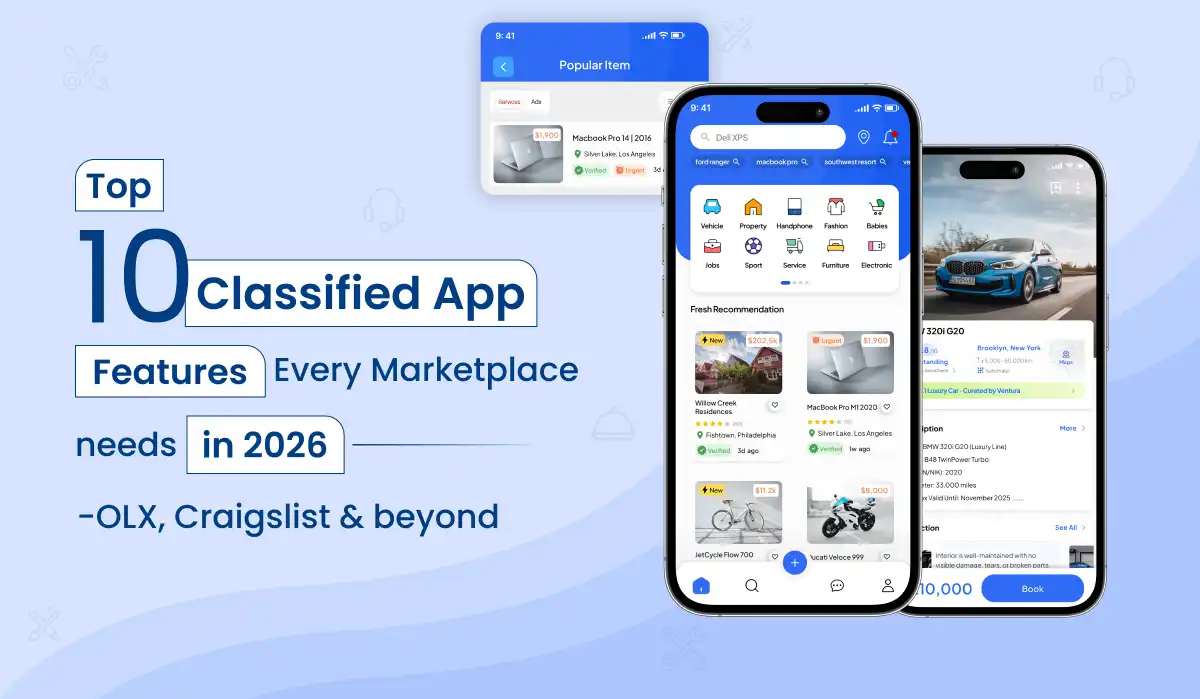
Most articles on classified app features describe what users see when they open OLX. This guide is written for the person building the marketplace — what each feature does for trust, transaction volume, and why getting them wrong kills new platforms in the first six months.
Before the features — the question that determines all 10 A classified app is fundamentally a trust machine. Every feature exists to answer one of two questions for a stranger about to transact with another stranger: “Is this listing real?” and “Is this person safe to deal with?” Search and discovery features get someone to a listing. Trust and safety features are what actually get them to message the seller. If you build great search and weak trust signals, you’ll have a beautiful app that nobody uses to actually transact. See our classified app service →
Craigslist generates over $1 billion in annual revenue with a website design that has barely changed since 2000. That fact alone tells you something critical about classified app features: marketplaces don’t succeed because of beautiful UI. They succeed because of enough real listings and enough trust that a stranger will hand over money to another stranger they met through your app.
Every marketplace app feature in this guide is filtered through that lens. We’re not listing classified app features because OLX has them. We’re explaining what each feature does for the trust equation, what happens when you get it wrong, and where the genuinely interesting product decisions are — because most guides treat this category as a solved problem with a fixed checklist, when the differences between a thriving niche marketplace and a dead one come down to a handful of specific decisions.
10 Classified App Features — Why Each One Matters
The right features turn a basic classifieds app into a trusted marketplace. From secure user profiles and smart search to in-app chat and payments, each feature improves user experience, builds trust, and increases successful buying and selling.
Listing Creation — Core Classified App Feature for Supply Growth
Every classified marketplace begins as a chicken-and-egg problem: buyers won’t come without listings, sellers won’t post without buyers. The listing creation flow is the single most important conversion point in your entire app for the supply side — if it’s slow, confusing, or demands too much information upfront, sellers abandon and your marketplace stays empty. The flow needs to be faster to use than texting a photo to a friend, because that’s the actual competing behaviour you’re up against.
Category-specific attributes matter more than most founders expect. A car listing needs mileage, year, and transmission type. A furniture listing needs dimensions and material. A job listing needs salary range and remote/onsite status. Generic listing forms that don’t adapt to category produce weak, unsearchable listings — which is exactly the kind of low-quality content that makes users distrust a marketplace.
// WHAT TO BUILD Multi-image upload (5–10 photos) with client-side compression before upload — uncompressed photos from modern phone cameras are 8–15MB and will frustrate users on slower connections. Dynamic form fields that change based on selected category (a Flutter dropdown triggering conditional form sections). Auto-save draft listings every 10 seconds — sellers frequently get interrupted mid-listing and shouldn’t lose their work. Image moderation via AWS Rekognition runs automatically on upload, before the listing goes live, not after.
Smart Search & Filters — Where Most Classified Marketplace Apps Quietly Fail
Most teams build search as an afterthought — a simple SQL LIKE query against listing titles — and then wonder why users complain they “can’t find anything” even when relevant listings exist. Search quality is not a nice-to-have polish item in a classified app; it is the core product experience for every buyer who isn’t browsing aimlessly.
The search bar should include filters for categories, price ranges, location, and other relevant criteria based on the marketplace — and crucially, the filter set needs to change per category the same way the listing form does. Filtering car listings by mileage makes sense. Filtering furniture listings by mileage doesn’t exist as a concept. Generic filters that apply everywhere usually mean they apply nowhere usefully.
The search mistake that quietly kills classified app retention Users who search for something specific and get zero results — or results that feel irrelevant — don’t complain. They just don’t come back. This is the single hardest failure mode to detect because it produces silence, not negative feedback. Build search analytics from day one: log every search query and whether it returned zero results. A high zero-result rate on common queries tells you exactly where your category taxonomy or search relevance needs work, weeks before you’d otherwise notice the retention drop.
// WHAT TO BUILD Elasticsearch for full-text search with fuzzy matching and typo tolerance — a plain SQL LIKE query cannot handle “iphon” matching “iPhone” or partial word matches efficiently at scale. Category-specific filter sets stored as a JSON schema per category, rendered dynamically in the Flutter UI. Price range slider with sensible category-aware default ranges (don’t default a real estate price slider to $0–$1,000). Sort by: most recent, price low-high/high-low, distance — these three cover 90% of actual user intent.
Location-Based Discovery — The Feature That Makes “Near Me” Actually Mean Something
Classified marketplaces are fundamentally local commerce, even when the platform serves an entire country. Nobody drives four hours to buy a used sofa. GPS-based “near me” listings, radius search, map view with listing pins, and city/neighbourhood filters are the most used feature on mobile classified apps — more than search itself, in many cases, because users open the app expecting to browse what’s around them rather than search for something specific.
The map view deserves more design attention than most teams give it. A list view shows you listings; a map view shows you the actual geography of where things are relative to you, which matters enormously for categories like real estate, vehicles, and large furniture where transport logistics affect the buying decision as much as price.
// WHAT TO BUILD Store listing location as latitude/longitude. Calculate distance server-side using PostGIS (PostgreSQL geographic extension) rather than naïve Haversine calculations in application code — PostGIS handles this natively and scales better with spatial indexing. Google Maps SDK for the map view with marker clustering when listings are dense (don’t render 500 individual pins — cluster them). Default radius search to a sensible category-aware default: 5km for furniture, 50km for vehicles, unlimited for remote jobs.
Trust & Verification — The Classified App Feature You’re Actually Selling
Here’s the uncomfortable truth most classified app guides won’t say directly: nobody actually wants to use a classified app. They want to buy or sell something, and the app is a means to do that with the least amount of risk. Trust is your #1 product feature — not the listings, not the search, not the design. A platform with mediocre UI but strong trust signals (visible seller history, response rate, verified phone numbers) beats a beautifully designed platform where every transaction feels like a gamble.
Public seller profiles with rating, review count, response rate, listing history, and verification badges all serve the same underlying function — converting an anonymous stranger into someone with a track record. The response rate metric specifically is underused by most platforms but is one of the strongest trust signals available: a seller who responds to 90% of inquiries within an hour is dramatically more trustworthy-feeling than one with great ratings but a low response rate, because it signals an active, engaged human on the other end.
Phone verification mandatory. Seller badges for verified accounts. Listing history visible publicly — buyers can see a seller’s track record across all past listings.
Identity verification (government ID) optional but prominently promoted. Star ratings visible on every listing card, not buried in profile — trust signal visible before the click.
No formal verification system — relies entirely on user judgment and community norms. Works because of two decades of established culture, not replicable for a new platform.
// WHAT TO BUILD Phone number verification via OTP (Twilio or local SMS gateway) at account creation — mandatory, not optional. Seller profile showing: join date, total listings, response rate (calculated from message reply times), and a simple thumbs up/down rating from completed transactions. Verification badge for sellers who complete ID verification (Onfido/Jumio selfie + government ID match) — add this in V2, but design the profile UI to display it from day one so the upgrade path is visual, not architectural.
In-App Chat with Number Masking — Keeps Transactions On-Platform
Real-time chat isn’t a nice-to-have — it’s the core transaction engine of a classified marketplace. Buyers and sellers need to negotiate, ask clarifying questions, and arrange logistics, and they’ll abandon a platform that forces them off-app to do it. Every message that happens off your platform — over WhatsApp, SMS, or a phone call — is a transaction your app gets zero credit for, zero data from, and zero opportunity to monetise.
Phone number masking is the specific technical decision that determines whether conversations stay on-platform. Real-time buyer-seller chat with media sharing, message requests, and read receipts works because buyer and seller never need to share phone numbers — they can complete an entire negotiation and arrange a meetup without either party knowing the other’s actual contact details until they choose to share them.
“The moment a buyer and seller exchange phone numbers and move to WhatsApp, your platform becomes invisible to the actual transaction. Number masking isn’t a privacy feature — it’s a business model decision disguised as one.”
// WHAT TO BUILD WebSocket-based chat (Socket.io) for real-time delivery. “Make an offer” structured message type — distinct from free text, lets buyers propose a specific price that the seller can accept/reject/counter, which is a meaningfully better UX than negotiating price entirely in unstructured text. Photo sharing within chat (for showing additional angles of an item). For categories where phone contact is eventually necessary (services, jobs), build a “reveal number” action that’s explicit and logged — not automatic.
Fraud Detection & Content Moderation — The Feature That Determines If Your Platform Survives Scale
Scams in classified marketplaces follow recognisable patterns: prices too good to be true, sellers who refuse video calls or in-person viewing, requests to pay via untraceable methods, and listings using stock photos rather than real product images. The honest version of this section that most classified app guides skip: you do not need machine learning to catch most early fraud. A well-designed rule-based system catches the majority of scam patterns long before you have enough data to train a meaningful ML model.
The mistake we see repeatedly is founders investing $8,000–$15,000 in an AI fraud detection system before launch, when a $2,000 rule-based system would catch 80% of the same fraud with a fraction of the engineering complexity. Build the rule-based system first. Log every flagged listing and every user report. That data becomes your training set for an ML model later — once you actually have enough volume for it to learn meaningful patterns instead of overfitting to a handful of examples.
The rule-based checks that catch most scam listings without any ML
Reverse image search flagging (TinEye API or Google Vision API) catches listings using stock photos. Price-anomaly detection flags listings priced 70%+ below the category median for similar items. Account-age + posting-velocity rules flag brand-new accounts posting 10+ listings in their first hour. Duplicate listing detection (same images posted across multiple accounts) catches the most common scam pattern of all — the same fraudulent listing posted repeatedly under different names. None of this requires machine learning. All of it can be built for $2,000–$5,000 and catches the overwhelming majority of early-stage fraud.
// WHAT TO BUILD Report button on every listing and every chat conversation, accessible in 2 taps. Admin queue for reviewing reports with one-click action (remove listing, warn user, ban account). Automated rules engine (simple if-then logic, not ML) running on every new listing: reverse image check, price anomaly flag, account velocity check. Build the data logging for every flagged event from day one — this is the dataset that justifies an ML upgrade later, and collecting it costs nothing extra now.
Push Notifications — Bringing Buyers Back When the Right Listing Appears
The notification that matters most in a classified app is different from social or dating apps: it’s not “someone is interacting with you,” it’s “something you want just became available.” Saved search alerts — “notify me when a 2-bedroom apartment under $1,500 appears in this neighbourhood” — turn passive browsers into active buyers the moment the right listing exists, often before competing buyers even see it.
This is a genuinely powerful retention mechanic because it gives users a reason to keep the app installed even when they’re not actively browsing. A buyer searching for something specific and uncommon (a particular car model, a rare instrument) will keep your app for weeks waiting for a saved search alert to fire — which is a dramatically stickier relationship than a one-time browse session.
// WHAT TO BUILD Firebase Cloud Messaging for cross-platform push. Saved search feature: user saves their filter combination, a background job (cron or queue worker) checks new listings against all saved searches every few minutes and fires notifications on match. Message notifications deep-link directly to the conversation. New message and saved search alerts should be immediate; “your listing got 5 new views today” digest notifications should batch once daily, not fire in real time.
Favourites & Saved Searches — The Small Feature That Quietly Drives Return Visits
Wishlist enables users to bookmark their chosen postings for later viewing and get notifications regarding their favourite listings. This sounds like a minor convenience feature, but it solves a genuine behavioural problem in classified shopping: buyers rarely decide to purchase the first item they see. They browse five to ten listings, compare prices and conditions mentally, and then come back to the one or two they’re seriously considering. Without a favourites feature, that comparison happens entirely in the buyer’s memory — which means a meaningful percentage of “I’ll come back to that” listings are simply never found again.
// WHAT TO BUILD Heart/bookmark icon on every listing card and detail page. Dedicated “Saved” tab in the app showing all favourited listings with price-change indicators (flag if a saved item’s price dropped since favouriting — this is a strong conversion trigger). Notify users if a favourited listing is marked sold or removed, so they’re not left wondering. This is a low-cost feature relative to its retention impact — build it in the MVP, not as an afterthought.
Admin Panel — The Feature Early-Stage Teams Consistently Underbuild
The admin panel is often underbuilt by early-stage teams — it’s the feature that has zero visible impact on the user-facing product demo, so it’s the first thing cut when budgets get tight. This is a mistake that surfaces painfully a few months post-launch, when you have hundreds of reported listings, no efficient way to review them, and a support inbox that’s becoming unmanageable.
Effective user management capabilities help maintain platform quality and safety. Administrators need comprehensive tools to monitor user behaviour, verify accounts, and take action against policy violations — and crucially, they need to be able to do this fast. An admin panel that requires five clicks and two page loads to ban a clearly fraudulent account will not be used consistently, which means bad actors stay on your platform longer than they should.
// WHAT TO BUILD React.js web dashboard (separate from the Flutter mobile app — admins work from desktop). Moderation queue showing reported listings and users, sorted by report count and recency, with one-click actions (approve, remove, ban). Category and listing management — ability to add new categories and custom attribute fields without a code deploy. Basic analytics: daily active users, listings created per day, top categories, search-to-message conversion rate. This last metric specifically tells you whether your search and trust features are actually working together.
Monetisation Infrastructure — Featured Listings, Boosts & Subscriptions
OLX and similar classified marketplaces crossed $500 million in global revenue by 2026, proving the simple buy-sell classified model continues to be one of the most profitable digital platforms worldwide — through ads, boosts, subscriptions, and lead generation, not transaction fees. This is an important distinction from e-commerce: most classified platforms don’t handle the actual payment for goods (a sofa, a car, a job placement) — they monetise the visibility and reach of the listing itself.
A seller spending a small boost fee to get 5× more views on their listing is a transaction with near-zero platform cost and extremely high margin — the infrastructure cost of showing a listing higher in search results is negligible, but the perceived value to a seller eager to sell quickly is significant. This is why boost and featured-listing models scale so well: the cost structure rarely changes as volume grows, but revenue grows linearly with transaction volume.
Why monetisation belongs in V2, not the MVP Adding paid boosts and featured listings before you have meaningful organic traffic and trust on the platform sends the wrong signal — it looks like you’re trying to extract money before proving the marketplace works. Launch free, prove that listings get views and messages turn into transactions, and introduce monetisation once sellers are asking “how do I get more visibility for my listing?” That question is your signal that the boost feature will convert, rather than feel like a tax on early adopters.
// WHAT TO BUILD Stripe or Razorpay for boost and subscription payments. Boost mechanic: seller pays a small fee, listing gets a “featured” badge and appears higher in search results / in a dedicated featured carousel for a fixed time window (24–72 hours). Seller subscription tier for power sellers (dealers, agencies) offering unlimited listings, advanced analytics on their own listings, and bulk listing tools. Avoid transaction fees on the actual sale amount unless your platform directly facilitates payment — most classified marketplaces don’t, and trying to insert yourself into a cash or bank-transfer transaction creates friction without clear value.
Classified App MVP vs V2 — Which Features to Build First
MVP — 9 Core Features
- Listing creation — multi-photo, category-specific attributes, draft save
- Smart search — Elasticsearch, category filters, price range
- Location discovery — GPS radius, map view, distance sort
- Trust system — phone verification, ratings, response rate
- In-app chat — number masking, offer/counter-offer
- Fraud detection — rule-based, not ML, report workflow
- Push notifications — saved search alerts, message alerts
- Favourites — bookmark listings, price-drop alerts
- Admin panel — moderation queue, basic analytics
V2 — When You Have Real Volume
- Monetisation infrastructure — boosts, featured listings, subscriptions
- ML fraud detection — once you have enough flagged data to train on
- ID verification badges — Onfido/Jumio selfie + government ID
- Advanced seller tools — bulk listing, dealer dashboard
- In-app payment escrow — only if your model genuinely needs it
We Build Classified Apps With Trust as the Starting Point, Not an Afterthought
Primocys builds classified marketplace apps that prioritise the trust and safety features that actually drive transactions — not just a feature checklist copied from OLX. Flutter iOS and Android, fixed price from $3,000, full source code.
All 9 MVP features included
Listings, search, location, trust, chat, fraud detection, notifications, favourites, admin — properly built, not placeholder.
Rule-based fraud detection from day one
No wasted spend on premature ML. We build the data pipeline that justifies an AI upgrade once you have real volume.
Phone number masking built in
Keep negotiations on-platform. Buyer-seller chat with structured offers, never forcing users off-app.
Elasticsearch from the start
Category-aware filters, fuzzy search, typo tolerance. Not a basic SQL query that quietly fails your users.
Flutter — iOS + Android from one build
Clutch Top Flutter Developer 2024 & 2026. Native-quality performance, one codebase, lower long-term cost.
Fixed price from $3,000
Cost agreed before development starts. Milestone payments. Full source code ownership. No lock-in.
Conclusion: Build Classified App Features That Drive Transactions
The classified marketplace features that actually matter in 2026 are not the ones that look impressive in a demo — they are the ones that make a complete stranger trust another stranger enough to hand over money. That is the only metric worth optimising for when you build a classified app.
Start with the 9 MVP classified app features: listing creation, smart search, location discovery, trust and verification, in-app chat with number masking, rule-based fraud detection, push notifications, favourites, and an admin panel. These nine features, built correctly, are what OLX, Craigslist, and OfferUp all have in common — not their design, not their brand, but their ability to make transactions feel safe.
Add monetisation infrastructure in V2, once your marketplace has proven it can convert listings into conversations and conversations into completed transactions. The founders who get this sequencing right build platforms that grow. The ones who add premium features before proving the core works build platforms that stay empty.
If you are ready to build your classified marketplace app — whether a niche OLX clone, a Craigslist-like platform, or something entirely new — Primocys builds classified apps at India rates with fixed-price contracts , full source code, and Flutter iOS + Android from a single build. Get a free estimate within 48 hours .
Classified App Features — Common Questions From Founders
What features does a classified app need in 2026?
What is the most important trust feature for a classified app?
Do I need AI fraud detection in my classified app from day one?
What features should I build in the MVP vs V2 for a classified app?
How much does it cost to build a classified app with these features?
Related Articles

Build your scalable apps today.
Contact UsLeaving Already?
Hear from our clients and why 1200+ businesses trust Primocys

"Our B2B and B2C platform helps Nigerian manufacturers sell at wholesale prices and suppliers offer competitive retail pricing, with a strong focus on Made in Africa products and easy local and international distribution. The app has received excellent user reviews for its design and unique features. Communication with the Primocys team was smooth in an agile setup, even beyond office hours when needed. Their mobile app development expertise is excellent—highly professional and reliable."

"The dating app was delivered successfully and approved by both Apple App Store and Google Play. Our users are highly impressed with the design, UI, and overall functionality. The project was well planned with clear milestones, and all modules were delivered on time. The team is talented, patient, and flexible, accommodating multiple scope revisions as requirements evolved. Their 24/7 development and support availability made the entire process smooth and reliable."

" We hired Primocys to develop a highly complex and specialized mobile application, and they delivered outstanding results. The app includes advanced features such as timeline mixers, classifieds, payments, advertisements, GPS functionality, and more. Their technical skills, timely delivery, availability, and the personal attention Arpan Sagar brings to each project truly stand out. The team stays focused and committed from start to finish—an excellent experience overall."

" Great team with excellent communication and a strong commitment to on-time delivery. They developed a fully customized mobile app for both Android and iOS, perfectly matching our requirements. The entire process was smooth and professional, with clear updates at every stage. They are reliable, skilled, and very easy to work with. We’re continuing our partnership on more projects, and choosing them has been one of the best business decisions I’ve made."

AWARDS




Share Your Requirements
TRUSTED BY GLOBAL BRANDS