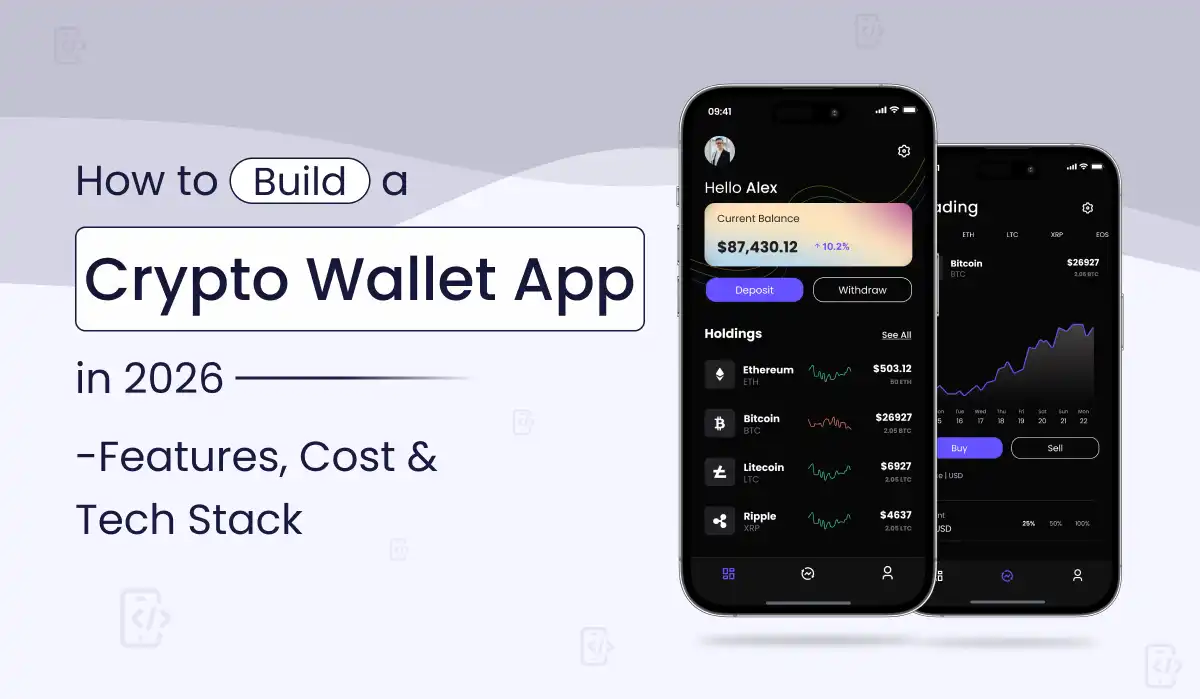
How to Build a Crypto Wallet App in 2026: Features, Cost & Security
Date
01 Jul, 2026
Share:
Crypto wallets don’t store coins. They store private keys — and that single architectural truth determines everything: your security model, your compliance obligations, your user recovery options, and where the majority of your development budget actually goes.
The number you came here for
A crypto wallet app costs $15,000–$35,000 for an MVP (non-custodial or custodial, 1–2 chains, send/receive, seed phrase backup, basic portfolio view) at India development rates. A mid-tier multi-chain platform with DeFi integration and token swaps costs $40,000–$100,000. An enterprise custody platform with MPC key management costs $120,000–$300,000+. Industry-wide quotes range from $25,000 to $500,000+ — all at US or Eastern European rates — with zero India-rate options cited across every competitor article in this space. Security audit adds $15,000–$40,000 on top of development, regardless of tier. That is not a line item you defer. See our fintech app development guide →
Most “how to build a crypto wallet” guides start with feature lists. This one starts with the thing every person asking about crypto wallet app development needs to understand first: a crypto wallet doesn’t store cryptocurrency. It stores the private cryptographic keys that prove ownership of assets living on a blockchain. The wallet is a key manager, not a bank account. That’s not a semantic distinction — it’s the architectural truth that determines whether your platform holds user keys (custodial) or the user holds their own (non-custodial), and that single decision shapes every security requirement, regulatory obligation, and recovery mechanism in your entire build.
The crypto wallet app development cost range is the widest of any app category — competitors quote from $25,000 to $500,000+ for what sounds like similar scope. The real drivers aren’t features, they’re the custodial model you choose, how many blockchains you support, and whether your security architecture holds up when a professional attacker looks at it. This guide is built around those decisions, in the order they actually matter.
$14.8B
Crypto wallet market, 2026
$98.6B
2034 Market (26.7% CAGR)
$15K
MVP starting cost (India rates)
20–30%
Security Spend Is Unavoidable
5.3B
Global Wallet Users 2026
Custodial vs Non-Custodial: The Core Decision
Before features, before tech stack, before a single screen gets designed — every crypto wallet app development project needs to decide who holds the private keys. This decision changes your regulatory exposure, your security architecture, your infrastructure costs, and your user experience in ways that can’t be changed after the fact without a near-complete rebuild.
Custodial Wallet (You Hold the Keys)
Your platform stores private keys on behalf of users — like a bank holding your cash
Simpler recovery: users who forget passwords can be restored
You bear legal responsibility for user funds
Mandatory KYC, AML monitoring, and regulatory licensing
Concentrated security risk — a breach of your key store is a breach of all users
Model used by: Coinbase, Binance, Kraken (exchange wallets)
Non-Custodial Wallet (User Holds the Keys)
Private keys generated and stored on the user’s device — Secure Enclave (iOS) or StrongBox (Android)
Your servers never see or store the private key, ever
User loses seed phrase = permanent loss of funds, no recovery path
No regulatory obligation to hold user funds — no money transmitter license needed
More complex client-side security architecture
Model used by: MetaMask, Trust Wallet, Phantom, Rainbow
Why this decision can’t be changed after launch without a near-complete rebuild: If you build custodial and later decide users should hold their own keys, you need to migrate every user’s key from server storage to their device — a genuinely complex cryptographic migration that requires every active user to take a manual action, and where a single step done wrong loses someone’s funds permanently. If you build non-custodial and later decide you want to offer recovery options, you have to introduce server-side components that fundamentally change your security model. Scope this honestly before writing a line of code — it’s the cheapest decision to get right and one of the most expensive to reverse.
Crypto wallet app development security isn’t a feature you add — it’s the substrate everything else is built on. A wallet breach is existential: funds drained, keys leaked, and no software patch will restore trust once users have lost money. The following aren’t nice-to-haves. They’re the minimum viable security architecture for any blockchain wallet app handling real assets.
Private Key Storage
iOS Secure Enclave and Android StrongBox for hardware-backed key storage in non-custodial wallets. Keys generated on-device, never transmitted.
Foundational — non-negotiable
HD Wallet (BIP-32/39/44)
Hierarchical Deterministic wallet spec. One seed phrase generates all keys across all accounts. Standard across every reputable wallet.
Required for seed phrase support
MPC Key Management
Multi-Party Computation — private key split across multiple parties, none holding the complete key alone. Enterprise and institutional standard in 2026.
Enterprise wallets, +$30K–$60K
Encryption At Rest
AES-256 encryption for any locally stored wallet data. Biometric authentication as the default unlock — not PIN only.
All wallet types
Security Audit
Professional penetration test and code audit from a blockchain security specialist. Required before launch — non-negotiable.
$15,000–$40,000
Smart Contract Audit
If your wallet interacts with DeFi protocols or custom smart contracts, a separate smart contract audit is mandatory before any contract goes live.
$10,000–$30,000 additional
Why the security audit is the line item you can’t cut, even for an MVP: The argument for deferring the security audit is always the same: “We’ll do it before we get real users.” But if you launch without it and even a small number of real users start depositing real funds — because they will, the moment the app is live and functional — you’ve accepted liability for assets under an unaudited security model. The cost of a security audit ($15,000–$40,000) is trivially small relative to the potential liability. A single critical vulnerability in a public wallet app that’s been running for two months with real user funds is a PR and legal catastrophe that no amount of post-fix engineering resolves.
Security Architecture First — Then Features
Tell us your custody model and target chain. We’ll scope your crypto wallet app development with the security audit budgeted in — fixed-price estimate within 48 hours.
Crypto Wallet App Features That Actually Matter in 2026
Core Crypto Wallet Features — Every Wallet Needs These
Wallet creation and import (from seed phrase or private key). Send and receive on supported chains with QR code support for addresses. Real-time balance display across all supported assets. Transaction history with status (pending, confirmed, failed) and block explorer links. Biometric authentication as the primary unlock method. Gas fee estimation with fast/standard/slow options before any transaction is signed. Push notifications for confirmed transactions.
Multi-Chain Crypto Wallet Development — The Complexity That Drives Cost
Each additional blockchain isn’t a simple data field — it’s a separate integration with its own node API, its own transaction format, its own fee model, and its own token standard. Supporting Ethereum, Bitcoin, Solana, and BNB Chain is four meaningfully different integrations that each require their own testing, their own library dependencies, and their own ongoing maintenance as those chains upgrade.
Ethereum
+ ERC-20 tokens, L2s
Bitcoin
UTXO model, SegWit
Solana
SPL tokens, fast finality
BNB Chain
BEP-20, EVM-compatible
Layer-2s
Polygon, Arbitrum, Base
Stablecoins
USDT, USDC cross-chain
Start with one chain. Add more when you have users who need them. The single most common budget-inflating mistake in crypto wallet development is scoping multi-chain support for every major blockchain before launch. Each additional chain adds real engineering time, real testing complexity, and real ongoing maintenance cost. Start with the chain your target user base actually uses — Ethereum and its Layer-2s if you’re targeting DeFi users, Bitcoin if you’re building for a store-of-value audience, Solana if you’re targeting a Web3 gaming or NFT community. Add chains based on actual user demand, not anticipated ones.
Crypto Wallet App Development Cost 2026 — 3 Tiers at India Rates
Tier 1
MVP — 1–2 Chain Non-Custodial Wallet
$15K–$35K
Industry quotes: $40,000–$80,000 (0 India-rate options)
Non-custodial or custodial (choose one)
1–2 supported chains
Send, receive, balance, QR
Seed phrase backup and restore
Biometric auth
Blockchain API integration (Moralis/Alchemy)
Most CommonTier 2
Multi-Chain + DeFi Integration
$40K–$100K
Industry quotes: $100,000–$250,000
All Tier 1 features
3–5 supported chains
In-app token swap (DEX aggregator)
DeFi protocol integration
NFT portfolio view
Portfolio analytics and price alerts
Tier 3
Enterprise / Institutional Custody
$120K–$300K+
Industry quotes: $250,000–$500,000+
All Tier 2 features
MPC key management infrastructure
Hardware Security Module (HSM) integration
KYC/AML compliance layer
Multi-sig transaction approval workflows
Enterprise compliance reporting
Flutter Crypto Wallet Tech Stack — Built for Key Security
Mobile App
Flutter
Key Storage
Secure Enclave / StrongBox
Backend / API
Node.js / Go
Database
PostgreSQL
Blockchain APIs
Moralis / Alchemy
MPC (Enterprise)
Fireblocks / TSS
Swap Aggregator
1inch / Paraswap
Cloud Infra
AWS / GCP
Why Flutter works for crypto wallets — and the one PCI-adjacent detail to know: Flutter’s compiled Dart code and direct hardware API access make it the right choice for a crypto wallet mobile app — it can call iOS Secure Enclave and Android StrongBox directly for hardware-backed key storage, which is the security foundation of any non-custodial wallet. One nuance worth knowing: because Flutter draws every pixel itself using its own rendering engine, a developer building a seed phrase input screen needs to ensure that content isn’t accessible to the system screenshot API or accessibility services — a non-obvious security requirement on Android specifically. This is the kind of platform-specific security detail where crypto-experienced developers matter more than general Flutter experience.
Best Crypto Wallet Niche Strategy — DeFi, NFT, MPC & More
MetaMask, Trust Wallet, Phantom, and Coinbase Wallet already have millions of users, multiple independent security audits, and years of trust built through surviving real attacks. A new general-purpose multi-chain crypto wallet app development project trying to compete for the same audience has no path to that trust base without a decade of incident-free operation and a security track record that doesn’t exist yet.
Enterprise / Institutional Custody
Asset managers, DAOs, and corporate treasuries holding digital assets need custody products that general consumer wallets aren’t designed for — multi-sig approval workflows, audit trails, and MPC infrastructure.
→ High-value B2B, lower competition
Industry-Specific B2B Wallet
Supplier payment rails in specific industries, creator economy payout tools, or cross-border remittance for a specific corridor — narrow use case, clear audience, direct path to adoption.
→ Clearer business case than generic wallet
Gaming / NFT Embedded Wallet
A wallet embedded inside a Web3 game or NFT platform rather than a standalone product — inherits the parent product’s users without needing to acquire wallet users from scratch.
→ Built-in audience, not starting from zero
Regional Wallet + Fiat Ramps
Crypto-to-local-currency on/off ramps for underbanked regions — a product that combines digital asset management with a direct fiat integration that global wallets often don’t prioritize for local markets.
→ Real, underserved demand in emerging markets
Single-Ecosystem Wallet
Best-in-class UX for one chain or ecosystem (a pure Solana wallet, a dedicated Base wallet) rather than mediocre UX across every chain.
→ Depth over breadth, real community fit
DeFi-Native Wallet
Staking, liquidity provision, yield strategies surfaced natively in the wallet UI — not hidden in a DApp browser. A product for users who already know DeFi and want better tooling.
→ Power-user niche, willing to pay
“The safest way to build a crypto wallet in 2026 isn’t a bigger feature list — it’s a smaller, better-secured scope. A single-chain wallet with one clean audit is more trustworthy than a five-chain wallet with unaudited smart contract integrations.”
How Crypto Wallet Apps Actually Make Money in 2026
Swap / Exchange Spread
A fee on in-app token swaps — typically a small percentage on top of the DEX aggregator’s price. The primary revenue model for non-custodial wallets.
→ Core revenue for consumer wallets
Gas Fee Premium
Charging slightly above network gas for the “fast” transaction option while keeping standard rates competitive. High-frequency, low-margin.
→ Works at scale, not at launch
Premium Subscription
Advanced portfolio analytics, priority support, lower swap fees, or institutional features behind a monthly subscription for power users.
→ Recurring B2C/B2B revenue
DeFi Partnership / Referral
Revenue share from DeFi protocols for routing user liquidity through their pools — a model used by wallets with large DeFi-active user bases.
→ Requires real DeFi volume first
Primocys · Blockchain App Development
We Build Crypto Wallets With Security Architecture First, Features Second
Primocys builds crypto wallet apps with the custodial vs non-custodial decision made deliberately, hardware-backed key storage using iOS Secure Enclave and Android StrongBox from day one, and the security audit budgeted as a project requirement — not a post-launch consideration. Flutter mobile apps, fixed price from $15,000, full source code.
Hardware-backed key storage
iOS Secure Enclave and Android StrongBox integrated from the first sprint, not added afterward.
BIP-32/39/44 HD wallet support
Standard seed phrase architecture. Full import/export compatibility with major wallet ecosystem.
Blockchain API integration
Moralis and Alchemy API setup for the chains you actually need — not padded multi-chain scope.
Niche-first strategy advice
We’ll help you scope the right wallet type and audience, not just build a MetaMask clone.
Conclusion: How to Choose the Best Crypto Wallet App Development Company
Crypto wallet app development is the one app category where the security architecture decision genuinely outweighs every feature decision combined. The founders who ship wallets that survive in production aren’t the ones who built the most chains or the most DeFi integrations on day one — they’re the ones who made the custodial vs non-custodial decision deliberately before writing a line of code, budgeted the security audit as a non-negotiable project requirement, and chose a blockchain wallet app development company that has shipped production wallets before — not one learning hardware-backed key storage on your budget.
India-based crypto wallet app development delivers the same Flutter architecture, Secure Enclave/StrongBox key management, and multi-chain integration at 60–70% lower engineering cost than US or Eastern European agencies. The blockchain API costs (Moralis, Alchemy), the security audit fees, and the MPC infrastructure costs are identical globally. What changes is the engineering cost to wire them together correctly. That gap is where the real saving is, and for a $40,000–$100,000 Tier 2 multi-chain wallet, it’s the difference between a project that ships and one that runs out of budget before the security audit even gets scheduled.
The single most important step before you hire a blockchain wallet development company: Tell us whether you’re building custodial or non-custodial, which chain your target audience actually uses, and whether you need DeFi integration at launch or post-MVP. We’ll give you an honest scope recommendation — including the security audit budgeted in — and a fixed-price estimate broken down by feature and security component within 48 hours, no commitment required. Get your free crypto wallet estimate →
FAQs: Crypto Wallet App Development Cost, Security & Architecture
How much does it cost to build a crypto wallet app in 2026?
A crypto wallet app costs around $15,000–$35,000 for an MVP with Flutter at India development rates. A multi-chain wallet with DeFi and token swaps typically costs $40,000–$100,000, while enterprise-grade custody platforms range from $120,000–$300,000+. Security audits add $15,000–$40,000 and are essential before launch. Get a personalised crypto wallet estimate →
What is the difference between custodial vs non-custodial wallet development?
Custodial wallets store users’ private keys on your platform, making recovery easier but requiring KYC/AML compliance and responsibility for safeguarding funds. Non-custodial wallets keep private keys only on the user’s device, giving users full control and reducing custody-related regulatory obligations, but lost seed phrases usually mean permanent loss of access.
Do I need a security audit before launching a crypto wallet app?
Yes. A professional security audit before launch is essential for any blockchain wallet app handling user assets. Security flaws can expose private keys or funds, causing irreversible financial and reputational damage. Expect to budget $15,000–$40,000 for a wallet security audit, plus $10,000–$30,000 if your app includes smart contracts or DeFi integrations. Get a scope with security audit included →
Should I build a general multi-chain wallet or a niche crypto wallet?
Rather than competing with MetaMask, Trust Wallet, or Phantom, focus on a niche crypto wallet. Strong opportunities include single-chain wallets, MPC wallets for enterprise custody, DeFi wallets for advanced users, NFT wallets for gaming communities, or B2B payment wallets for creator payouts and cross-border business payments. Tell us your niche — free scope call →
What is the best tech stack for crypto wallet app development?
The best flutter crypto wallet development tech stack in 2026: Flutter for iOS and Android apps with direct Secure Enclave and StrongBox calls for hardware-backed key storage, Node.js or Go for the backend, PostgreSQL for the database, Moralis or Alchemy for blockchain API integration, 1inch or Paraswap for in-app token swaps, Fireblocks or TSS for MPC key management (enterprise tier), and AWS or GCP for cloud infrastructure. Flutter is the right choice for crypto wallets specifically because it can call hardware security APIs directly — a requirement for any non-custodial wallet doing key management correctly. See our Flutter crypto wallet service →
How long does it take to build a crypto wallet app like MetaMask or Trust Wallet?
A Tier 1 crypto wallet MVP with 1–2 blockchain integrations typically takes 14–20 weeks to build. A multi-chain wallet with DeFi features and token swaps requires 24–36 weeks, while enterprise MPC wallets take 9+ months. Add 4–8 weeks for security audits, and expect timelines to increase as each additional blockchain requires its own integration.
What is MPC wallet development and do I need it?
MPC (Multi-Party Computation) wallets split a private key into multiple cryptographic shares, so no single party ever holds the full key. This greatly improves security and removes a single point of failure. While MPC is widely used for enterprise and institutional custody, it adds significant development cost and complexity. For most startup MVPs, it’s usually unnecessary unless institutional-grade custody is a requirement. Ask us if MPC is right for your wallet →
Ready to Build Your Crypto Wallet — Security Architecture First
Tell us your custody model, your target chain, and your target user. We’ll give you an honest scope recommendation with the security audit budgeted in — and a fixed-price estimate within 48 hours.
Arpan leads product and engineering at Primocys, a Top-Rated Clutch app development company based in Ahmedabad, India. With over 10+ years of experience, he has successfully delivered real-time communication platforms for 1,200+ clients worldwide.
He is directly involved in overseeing the development of chat and messaging applications, ensuring high performance, scalability, and seamless user experience in every project.
📧 Email: [email protected]
📱 WhatsApp: Chat on WhatsApp
Trusted by Global Businesses for AI, Mobile, SaaS & Custom Software Development. Your Vision, Our Expertise.Trusted by Global Businesses for AI, Mobile, SaaS & Custom Software Development. Your Vision, Our Expertise.Trusted by Global Businesses for AI, Mobile, SaaS & Custom Software Development. Your Vision, Our Expertise.Trusted by Global Businesses for AI, Mobile, SaaS & Custom Software Development. Your Vision, Our Expertise.Trusted by Global Businesses for AI, Mobile, SaaS & Custom Software Development. Your Vision, Our Expertise.Trusted by Global Businesses for AI, Mobile, SaaS & Custom Software Development. Your Vision, Our Expertise.
Hear from our clients and why 1200+ businesses trust Primocys
"Our B2B and B2C platform helps Nigerian manufacturers sell at wholesale
prices and suppliers offer competitive retail pricing, with a strong focus on Made in Africa products
and easy local and international distribution.
The app has received excellent user reviews for its design and unique features. Communication with the
Primocys team was smooth in an agile setup, even beyond office hours when needed. Their mobile app
development expertise is excellent—highly professional and reliable."
Adegbuyi OduguwaCEO & Co-Founder
"The dating app was delivered successfully and approved by both Apple App
Store and Google Play. Our users are highly impressed with the design, UI, and overall functionality.
The project was well planned with clear milestones, and all modules were delivered on time.
The team is talented, patient, and flexible, accommodating multiple scope revisions as requirements
evolved. Their 24/7 development and support availability made the entire process smooth and reliable."
Revanth KExecutive
" We hired Primocys to develop a highly complex and specialized mobile
application, and they delivered outstanding results. The app includes advanced features such as
timeline mixers, classifieds, payments, advertisements, GPS functionality, and more. Their technical
skills, timely delivery, availability, and the personal attention Arpan Sagar brings to each project
truly stand out. The team stays focused and committed from start to finish—an excellent experience
overall."
Gregor Skerl Founder PROHUNTER
" Great team with excellent communication and a strong commitment to on-time
delivery. They developed a fully customized mobile app for both Android and iOS, perfectly matching
our requirements. The entire process was smooth and professional, with clear updates at every stage.
They are reliable, skilled, and very easy to work with. We’re continuing our partnership on more
projects, and choosing them has been one of the best business decisions I’ve made."