Super App Development: How to Build an All-in-One App Like Grab or Gojek in 2026
Date
23 Jun, 2026
Share:
Most “build a super app” guides start with a 15-module feature list and a $300,000 quote. Gojek didn’t start that way — it started as motorcycle taxi booking in Jakarta. This is the honest version of how to actually build one.
The honest answer, before anything else
Building a super app costs $15,000–$30,000 for a single-service MVP with super-app architecture (one core service plus the unified login, wallet, and module framework to add more later) at India development rates. Each additional service module costs $10,000–$25,000 once the shared infrastructure exists. A platform with 4–6 integrated services and a mini-app ecosystem costs $80,000–$200,000+. US agencies quote $150,000–$400,000+ to build a Gojek-scale platform all at once — which is also the riskiest possible way to attempt this, because every super app that actually succeeded started with exactly one service. See our mobile app development service →
Gojek is not a story about a company that launched 20 services and won. It’s a story about a motorcycle taxi booking app in Jakarta in 2010 that solved one real, painful, daily problem — traffic-choked commutes in a cash-dependent economy — and only added food delivery, payments, and logistics years later, once that first service had earned genuine trust and daily habitual use. Grab followed the same path from ride-hailing. WeChat followed it from messaging. There is no example of a super app that launched fully formed and won on day one.
Most agencies pitching super app development skip this part entirely, because a 15-module quote is a bigger invoice than a one-module quote. We’re going to walk through the honest version: what a super app actually is, why building all the modules at once is close to the single biggest reason all-in-one app projects fail, and the real module-by-module cost of building one properly — like Grab or Gojek — in the order that’s actually proven to work.
$127B
Global super app market, 2026
$440B
Super App Market by 2030
$15K
Single-service MVP starting cost
2010
From Taxi App to Super App
0
All Modules from Day One
What a Super App Actually Is — Not Just a Long Feature List
A super app is a platform business, not a product with a lot of features — and that distinction changes how you structure partnerships, how you price your services, and how you measure success. Treating it as a feature-rich app rather than as infrastructure for a user’s daily life is one of the most common reasons super app projects fail to gain real traction, even when the engineering is technically sound.
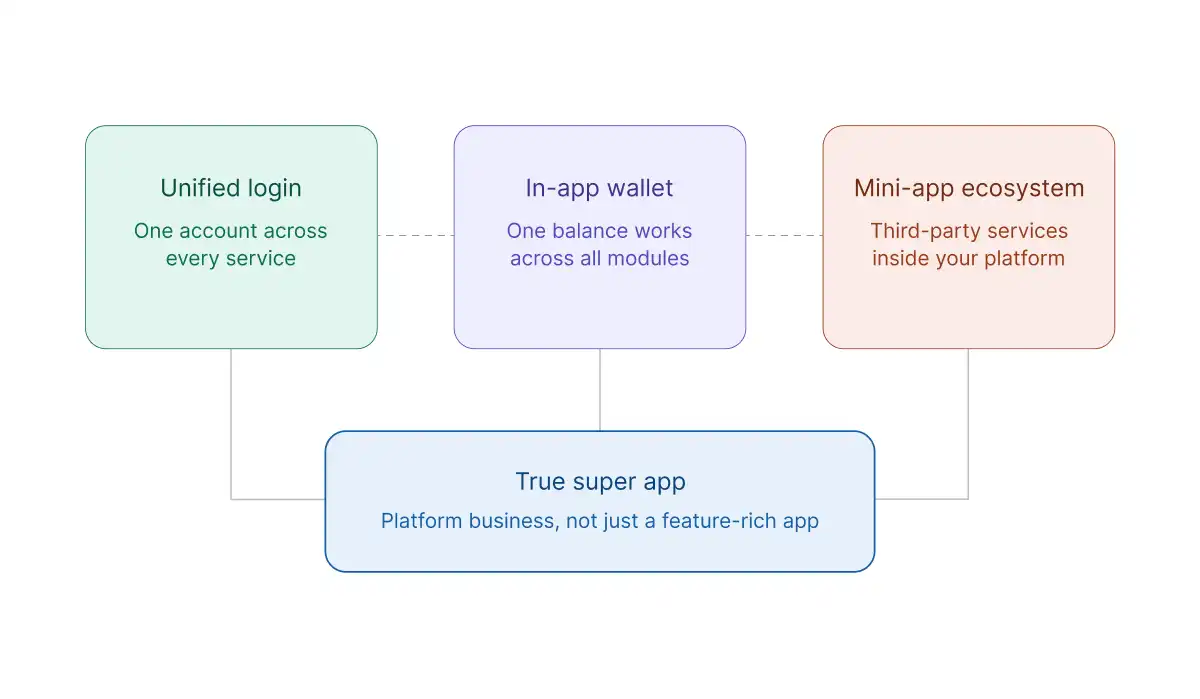
Three things define a true super app, structurally, regardless of which services it offers: unified login and identity — one account works across every module, with no separate sign-up per service. An in-app wallet that works across every service, so a user’s balance or payment method is the same whether they’re booking a ride or ordering food. And often, eventually, a mini-app ecosystem — an internal app store or SDK that lets third-party developers or merchants build and deploy their own services inside your platform, the way WeChat’s mini-programs work.
The single architectural decision that determines whether expansion is cheap or expensive later: If your unified login, wallet, and user data model are built correctly from the very first service — even when you only have one module live — adding a second and third service later is genuinely cheap, because the hard shared infrastructure already exists. If you build your first service as a standalone app and try to bolt on a “super app” identity layer later, that retrofit is often more expensive than building it right the first time would have been. This is the single highest-leverage technical decision in the entire project, and it costs almost nothing extra to get right at MVP stage.
How Grab, Gojek & WeChat Actually Started
Grab started with ride-hailing. Gojek with bike taxis. WeChat with messaging. None launched as a super app. Each earned trust in one service first — then expanded. That’s the only model that works.
Gojek (Indonesia)
Started 2010 as motorcycle taxi booking — solving traffic congestion and cash-dependency. Added GoFood, GoPay, and GoSend years later, once the driver-partner network was proven.
→ 190M+ users, $10B+ valuation
Grab (Southeast Asia)
Started as ride-hailing. Expanded into financial services, grocery, and insurance only after ride-hailing won real market trust across multiple countries.
→ Became a ~$15B company
WeChat (China)
Started purely as messaging. Payments, shopping, and mini-programs were added over years as the user base and daily habit were already firmly established.
→ 1.3B+ monthly active users
Tata Neu (India)
The rare exception — launched super-app-first, but only because Tata Group already had existing brands (groceries, fashion, electronics) and capital to cross-leverage from day one.
→ Conglomerate advantage, not a startup playbook
Why Tata Neu’s launch strategy doesn’t apply to most founders reading this: Tata Neu could launch with multiple services unified from day one because it inherited existing customer relationships, brand trust, and capital across several already-successful Tata Group businesses. A startup founder building from zero doesn’t have that — which is exactly why conglomerates and telcos are generally better positioned to launch super-app-first than independent startups. If you’re not starting from an existing portfolio of trusted brands, the one-service-first path isn’t a compromise — it’s the only path that’s actually worked for an independent founder.
Super App Development Cost: Module-by-Module Breakdown
This is the breakdown most super app guides skip in favour of one giant number. Knowing the cost of each individual module lets you sequence your build intelligently instead of either overpaying for everything at once or underbuilding the shared infrastructure.
Unified Login + Identity
Single sign-on across all current and future modules. Build this once, correctly, from day one.
→ $2,500–$5,000
In-App Wallet
Shared balance and payment method across every service. The financial backbone of the whole platform.
→ $4,000–$9,000
Ride-Hailing Module
Rider/driver apps, GPS tracking, dispatch logic — see our dedicated taxi app guide for the full breakdown.
→ $8,000–$20,000
Food/Delivery Module
Restaurant/vendor panel, delivery partner app, order tracking — reuses the wallet and identity layer already built.
→ $9,000–$20,000
On-Demand Services Module
Home services, courier, handyman booking — a third anchor service many super apps add after the first two prove out.
→ $8,000–$18,000
Mini-App Ecosystem / SDK
Internal app store letting third parties build inside your platform. The most advanced and most expensive layer — add only at real scale.
→ $25,000–$70,000+
Super App Build Cost: 3 Stages from MVP to Full Platform
Not every super app needs to be built at once. Stage 1 costs $15K–$30K, Stage 2 runs $40K–$90K, and a full platform starts at $80K. All fixed-price, Flutter-based, at India rates.
Stage 1
Single Service + Super-App Foundation
$15K–$30K
US/UK equiv: $60,000–$150,000
One anchor service (ride-hailing, delivery, etc.)
Unified login + identity built in from day one
Basic in-app wallet
Admin panel for the one live service
Architecture ready for module expansion
Single market/city launch
Most Realistic PathStage 2
2–3 Integrated Services
$40K–$90K
US/UK equiv: $150,000–$300,000
All Stage 1 features
Two additional service modules added
Full wallet with cross-service spending
Unified loyalty/rewards across services
Multi-city support
Advanced admin analytics across all modules
Stage 3
Full Platform + Mini-App Ecosystem
$80K–$200K+
US/UK equiv: $300,000+
All Stage 2 features
4–6+ integrated service modules
Third-party mini-app SDK
AI-powered cross-service personalisation
Multi-country, multi-currency support
Dedicated fraud and compliance layer
“The fastest way to spend $300,000 and still fail is to build all six modules before you know if anyone actually wants the first one. The fastest way to build a real super app is to build the one service people need daily, earn the habit, and let demand tell you what to add next.”
Super App Tech Stack 2026: Flutter, Microservices & More
The single biggest technical difference between a super app and a regular app isn’t any individual technology — it’s that the architecture has to anticipate modules that don’t exist yet. A microservices backend, where each service (rides, delivery, wallet) runs as its own independently deployable unit sharing common identity and payment services, is what makes adding a third or fourth module a contained project instead of a risky rewrite of the whole system.
Customer App
Flutter
Admin / Partner Panels
React.js / Next.js
Backend Architecture
Microservices (Node.js)
Database
PostgreSQL (per-service)
Caching / Sessions
Redis
Wallet & Payments
Stripe / Razorpay
Container Orchestration
Kubernetes
Cloud Infra
AWS / GCP
Why microservices are essential for multi-service app development: A monolithic backend — where ride-hailing, delivery, and payments all live in one tightly coupled codebase — works fine for a single service, but becomes a genuine liability the moment you try to add a second one. A bug or a traffic spike in your delivery module shouldn’t be able to take down ride-hailing. Microservices let each service scale, deploy, and fail independently, which is precisely the property a super app needs as it grows. This adds real complexity at the very start, but it’s the foundation that makes the whole “add modules over time” strategy technically possible rather than just a nice idea.
Super App Monetization Models That Actually Work
Per-Service Commission
10–30% commission on transactions within each module (food delivery, marketplace, mini-apps) — the most direct revenue stream.
→ Core revenue, scales with each new module
Cross-Service Subscription
A single membership ($3–$25/month) offering priority service or discounts across multiple modules — works only once you have 2+ live services.
→ Strongest retention-monetisation combo at scale
Fintech / Lending
In-app credit, micro-loans, and insurance products built on top of transaction history — high-margin, but requires regulatory groundwork.
→ Major long-term revenue driver for mature platforms
Mini-App / Platform Fees
Charge third-party developers or merchants for access to your user base and identity/payment infrastructure.
→ Only viable once you have real platform scale
The super app monetization mistake that drains budget fastest: Trying to monetize the mini-app ecosystem or fintech lending products before you have a large, habitual user base is close to pointless - third-party developers won’t build inside your platform for an audience that doesn’t exist yet, and lending products need transaction history you simply don’t have on day one. Monetise your first anchor service properly first. The advanced revenue streams are real, but they’re a Stage 3 conversation, not a Stage 1 one.
Primocys · Super App Development
We Build the Foundation Right, Then Add Modules as You Grow
Primocys builds super apps starting with one properly architected anchor service — unified login and wallet built in from day one — so adding your second and third module later is a contained project, not a rebuild. Flutter mobile apps, microservices backend, fixed price from $15,000.
One-service-first strategy
We help you pick the right anchor service and resist the urge to launch everything at once.
Microservices from day one
Each module scales and deploys independently — adding a service later doesn’t risk the ones already live.
Shared wallet, built right
One payment and identity layer across every current and future module — no costly retrofits.
Flutter — 35% cheaper than native
Clutch Top Flutter Developer 2024 & 2026. One codebase across every customer-facing module.
Module-by-module roadmap
Ride-hailing, food delivery, and on-demand services modules already proven in our own builds.
Fixed price from $15,000
Cost agreed before development starts. Milestone payments. Full source code ownership.
Super app development in 2026 is not about building everything at once — it’s about building the right thing first. Every successful platform, from Grab to Gojek to WeChat, started with a single high-frequency service, earned daily habitual use, and only then expanded into a true all-in-one app.
The one-service-first strategy isn’t a compromise — it’s the only startup playbook that’s actually worked for independent founders in this space. Get the shared infrastructure right from day one: unified login, in-app wallet, and a microservices architecture that makes each future module a contained addition, not a risky rebuild.
If you’re planning to build an app like Grab or Gojek, the smartest move is to pick your anchor service, validate it in one city or market, and design the foundation to scale. A super app MVP starts from $15,000 at India development rates — a fraction of what US agencies quote for equivalent scope.
Ready to scope your super app the right way? Tell us your anchor service and target market. We’ll give you an honest architecture recommendation and a fixed-price estimate within 48 hours — no sales call required. Get your free estimate →
Super App Development FAQ
How much does it cost to build a super app like Grab or Gojek in 2026?
Building a super app costs $15,000–$30,000 for an MVP with one core service (such as ride-hailing or delivery) plus shared infrastructure like unified login, wallet, and user management at India development rates. Adding each new service module typically costs $10,000–$25,000. A platform with 4–6 integrated services and an in-app wallet usually costs $80,000–$200,000+. US agencies often quote $150,000–$400,000+ for similar projects. Get a personalised estimate →
Should I launch all my super app’s services at once or one at a time?
Start with one high-frequency service, prove demand, then expand gradually. Every successful super app followed this path. Gojek began with motorcycle taxi booking, Grab with ride-hailing, and WeChat with messaging before adding more services. Launching 10–15 modules at once increases development cost, operational complexity, and execution risk. The safest strategy is to validate one core service first, then add new modules as user adoption grows.
What is the difference between a super app and a regular app with many features?
A super app is more than a feature-rich application—it’s a platform business. Unlike a regular app owned for a single purpose, a super app connects multiple services through one login, a shared wallet, and often a partner ecosystem. Success depends on building an integrated platform that becomes part of users’ daily lives, not just adding more features.
Is the US or Western market a good opportunity for super app development in 2026?
Yes, but with a caveat. While Southeast Asia has Grab and Gojek, no dominant super app has unified ride-hailing, delivery, payments, and daily services across North America or most of Western Europe. The opportunity exists, but success typically comes from launching with one strong service in a single city before expanding into a broader super app ecosystem.
What is a Gojek clone app and is it the right starting point?
A Gojek clone app is a multi-service platform built using Gojek’s architecture as a reference — unified login, in-app wallet, and multiple service modules (ride-hailing, food delivery, on-demand services) under one app. It’s a useful mental model, but “clone” is misleading if it implies launching all modules at once. The right starting point is a Gojek-inspired architecture — microservices backend, shared identity and wallet — with just one live anchor service. This gives you the expandability of a super app at the cost and risk profile of a single-service app. Talk to us about scoping your build →
Ready to Build Your Super App — One Service at a Time
Tell us your target market and your anchor service idea. We’ll help you scope Stage 1 correctly and give you a fixed-price estimate within 48 hours.
Arpan leads product and engineering at Primocys, a Top-Rated Clutch app development company based in Ahmedabad, India. With over 10+ years of experience, he has successfully delivered real-time communication platforms for 1,200+ clients worldwide.
He is directly involved in overseeing the development of chat and messaging applications, ensuring high performance, scalability, and seamless user experience in every project.
📧 Email: [email protected]
📱 WhatsApp: Chat on WhatsApp
Trusted by Global Businesses for AI, Mobile, SaaS & Custom Software Development. Your Vision, Our Expertise.Trusted by Global Businesses for AI, Mobile, SaaS & Custom Software Development. Your Vision, Our Expertise.Trusted by Global Businesses for AI, Mobile, SaaS & Custom Software Development. Your Vision, Our Expertise.Trusted by Global Businesses for AI, Mobile, SaaS & Custom Software Development. Your Vision, Our Expertise.Trusted by Global Businesses for AI, Mobile, SaaS & Custom Software Development. Your Vision, Our Expertise.Trusted by Global Businesses for AI, Mobile, SaaS & Custom Software Development. Your Vision, Our Expertise.
Hear from our clients and why 1200+ businesses trust Primocys
"Our B2B and B2C platform helps Nigerian manufacturers sell at wholesale
prices and suppliers offer competitive retail pricing, with a strong focus on Made in Africa products
and easy local and international distribution.
The app has received excellent user reviews for its design and unique features. Communication with the
Primocys team was smooth in an agile setup, even beyond office hours when needed. Their mobile app
development expertise is excellent—highly professional and reliable."
Adegbuyi OduguwaCEO & Co-Founder
"The dating app was delivered successfully and approved by both Apple App
Store and Google Play. Our users are highly impressed with the design, UI, and overall functionality.
The project was well planned with clear milestones, and all modules were delivered on time.
The team is talented, patient, and flexible, accommodating multiple scope revisions as requirements
evolved. Their 24/7 development and support availability made the entire process smooth and reliable."
Revanth KExecutive
" We hired Primocys to develop a highly complex and specialized mobile
application, and they delivered outstanding results. The app includes advanced features such as
timeline mixers, classifieds, payments, advertisements, GPS functionality, and more. Their technical
skills, timely delivery, availability, and the personal attention Arpan Sagar brings to each project
truly stand out. The team stays focused and committed from start to finish—an excellent experience
overall."
Gregor Skerl Founder PROHUNTER
" Great team with excellent communication and a strong commitment to on-time
delivery. They developed a fully customized mobile app for both Android and iOS, perfectly matching
our requirements. The entire process was smooth and professional, with clear updates at every stage.
They are reliable, skilled, and very easy to work with. We’re continuing our partnership on more
projects, and choosing them has been one of the best business decisions I’ve made."