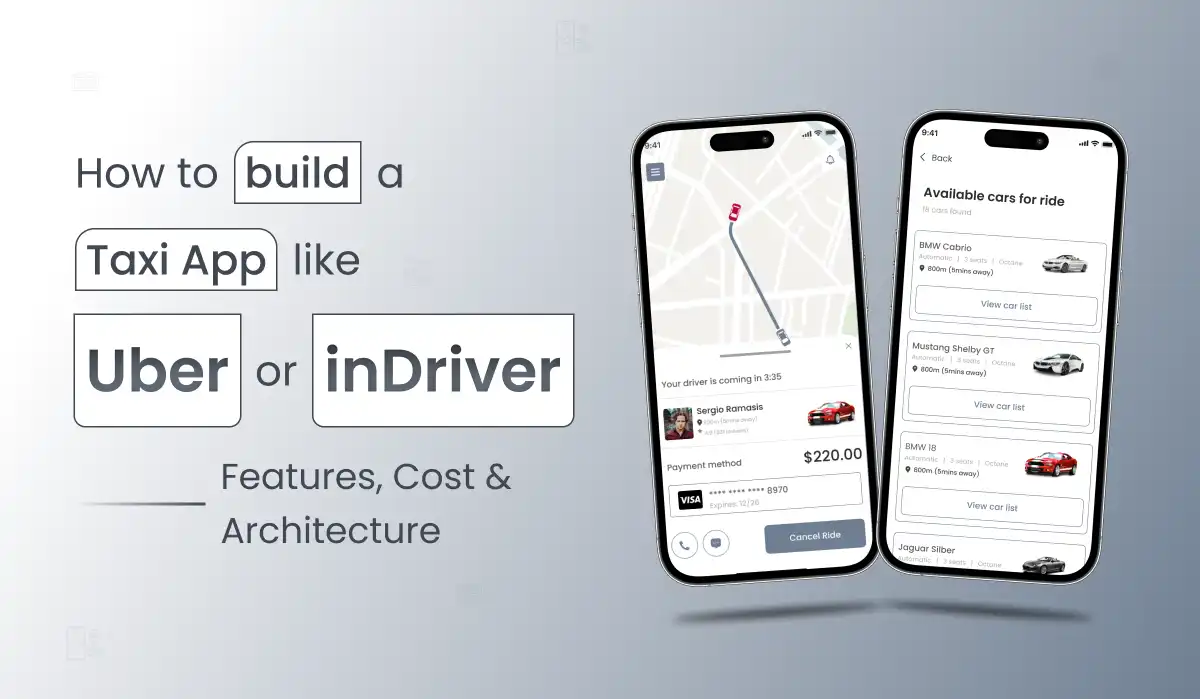
How to Build a Taxi App Like Uber or inDriver in 2026: Features, Cost & Architecture
Date
13 Jul, 2026
Share:
Every “how to build a taxi app” guide starts with features. This one starts with the question that actually determines your architecture, your UX, and your market: are you building Uber’s fixed-price model or inDriver’s bidding model? The answer changes everything — and it starts with your target geography.
The number you came here for
A taxi app like Uber costs $8,000–$20,000 for an MVP (rider app, driver app, admin panel, real-time GPS tracking, fare calculation, Stripe payment) at India development rates using Flutter. A mid-tier platform with surge pricing, multiple vehicle categories, and driver wallet costs $22,000–$50,000. A full enterprise platform with AI dispatch and multi-city support costs $60,000–$150,000+. US agencies quote $30,000–$300,000+ for the same scope at US hourly rates — zero India-rate options cited across competitor guides. Beyond the build: budget $800–$3,000/month for ongoing infrastructure — and Google Maps API is usually the largest variable cost, so monitor it from day one. See our Uber clone app development service →
Uber generated $43.98 billion in revenue in 2023. Its ride-hailing market is valued at $55 billion globally in 2026 and growing at 18.6% annually. inDriver — using a completely different pricing model where passengers set their own price and drivers negotiate — is now the most downloaded ride-hailing app in 30+ countries and number one in over 50 markets across Africa, India, and Latin America. These two facts together tell you everything important about building a taxi app in 2026: the market is growing, and there isn’t one model that wins everywhere.
Primocys has built and operates a live ride-hailing platform currently processing 12,000+ weekly trips in production. When this guide describes the real cost of Google Maps API at scale, or the reason PostGIS matters more than your primary framework choice, or why the bidding model outperforms fixed pricing in emerging markets — it comes from running a platform under real conditions, not describing one theoretically.
$55B
Global ride-hailing market 2026
18.6%
CAGR through 2033 (Grand View)
$8K
MVP starting cost (India rates)
50+
inDriver #1/#2 Markets
12K+
Weekly Ride-Hailing Trips
Taxi App Development: Fixed Price or Bidding Model?
This is the question most taxi app development guides skip entirely, jumping straight to features. Your pricing model is not a UI preference — it determines your backend architecture, your driver matching logic, your UX flow, and critically, which geographic market your ride hailing app can realistically win. Getting this wrong and pivoting later is expensive.
Fixed-Price Model (Uber-style)
Algorithm sets fare
How it works — Algorithm calculates fare upfront. Rider sees price before confirming. Surge pricing in peak demand
Best markets — US, UAE, Europe, Australia — premium, reliability-focused
Why inDriver is winning in markets where Uber dominates elsewhere — the honest explanation: Uber’s model fixes the fare algorithmically, then adds surge pricing during peak demand. In markets where average monthly income is $200–$400, a surge-priced Uber ride that costs $8 where riders expect to pay $3 creates enormous resentment. inDriver removes the algorithm entirely — riders post what they’re willing to pay, drivers decide whether it’s worth their time. Both sides feel they got a fair deal rather than being priced by an algorithm neither controls. This cultural alignment with negotiation norms in Africa, India, and Southeast Asia is why inDriver hit 50 million monthly active users in markets where Uber is technically present but not dominant. The lesson: your pricing model is not an engineering preference, it’s a product-market fit decision.
Real Uber Clone App Development — Built and Running in Production
We’re not describing taxi app architecture theoretically. Our live ride-hailing platform — built and operated by Primocys — is currently processing 12,000+ weekly trips in production. The challenges we solved — geospatial driver matching that doesn’t slow down at scale, Google Maps API costs that compounded unexpectedly, ride cancellation logic that required three iterations to get right — are part of every project we scope.
Our Live Production Platform
12,000+
Weekly trips in production
Flutter
iOS + Android, one codebase
PostGIS
Geospatial driver matching
Node.js
Real-time WebSocket backend
This is a real, operating ride-hailing platform — not a demo or a mockup. It faces the same production challenges every taxi app encounters: driver location updates at high frequency, map API costs that scale with usage, payment gateway edge cases, driver cancellation abuse patterns, and the infrastructure cost that compounds as trip volume grows. When Primocys scopes your taxi app, we’re drawing on experience managing a live platform with real economics — not just development experience.
Taxi Booking App Architecture: The 3-App Structure
The most common and most expensive mistake in taxi app development is scoping one app first. Every ride-hailing platform requires three coordinated applications built and deployed simultaneously — the rider app, the driver app, and the admin panel. These are not variations of the same app. They serve different users, have different interaction models, and require different backend permissions and data access. Building them sequentially compounds development time and creates integration problems that are significantly more expensive to fix than designing them together from day one.
Rider App
Passenger-facing mobile app
Register via phone OTP
Book ride + fare estimate upfront
Live driver location on map
In-app payment (card, wallet, cash)
Real-time trip status notifications
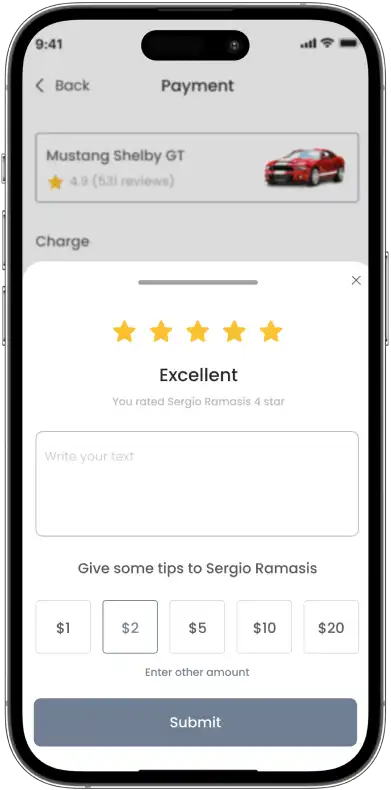
Rate driver after trip
Trip history + receipts
Safety SOS + share trip
Driver App
Equally complex as rider app
Driver registration + KYC upload
Go online/offline toggle
Accept / decline / counter ride requests
Turn-by-turn navigation to pickup
Start and end trip controls
Earnings dashboard + daily summary
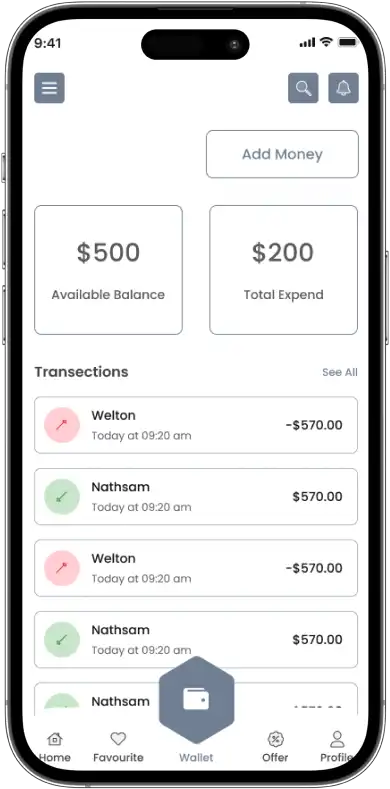
Driver wallet + payout request
Earnings history + trip log
Admin Panel
Platform operator web dashboard
Live trip map — all ongoing rides
Driver approval + KYC review
Fare rules + surge pricing config
Commission rules + payout management
Dispute resolution tools
Revenue + analytics dashboard
Promo codes + discount campaigns
Fraud flagging + account suspension
Why the driver app takes as long to build as the rider app — and why that surprises founders: Riders interact with a taxi app for 5–10 minutes per trip. Drivers interact with it continuously for 8–12 hours per working day. The driver app needs to handle background GPS location broadcasting without killing the phone battery, process incoming ride notifications reliably when the app is backgrounded, navigate in-app while also accepting new requests, and manage earnings tracking in real time. The interaction surface area is larger, the reliability requirement is higher (a missed notification means a missed fare), and the edge cases — what happens when two ride requests arrive simultaneously, or when a driver accepts and immediately loses signal — require more careful engineering. Budget for the driver app taking roughly as long as the rider app. It always does.
Geospatial Driver Matching for Ride Hailing Apps
Driver matching is the core real-time operation of every ride-hailing platform: when a rider requests a trip, the system needs to immediately find all available drivers within a certain radius, calculate distances, rank them, and notify the closest ones. This sounds straightforward and is — until you have real driver volumes.
Why a Naive Approach Fails in Production
A naive implementation runs a database query comparing the rider’s latitude/longitude against every driver’s stored location using the Haversine formula for each pair. With 100 drivers online in a city, this runs in milliseconds. With 5,000 drivers online across a busy metro area during rush hour — which is exactly when your matching system is under the most load — this becomes a serious latency problem that makes your app feel broken to users who are already impatient.
How to Do It Correctly: PostGIS + Spatial Indexing
PostGIS is a geospatial extension for PostgreSQL that adds native support for geographic data types and spatial indexes. With PostGIS, the query “find all available drivers within 2km of this point” runs against a spatial index in milliseconds regardless of total driver count, because the index pre-organizes location data by geographic proximity rather than requiring a full table scan. Primocys uses PostGIS for all driver matching queries on our live ride-hailing platform. It’s not optional at real production traffic — it’s what separates platforms that feel responsive from platforms that feel broken at peak hours.
Google Maps API — the hidden cost that compounds faster than anything else in ride-hailing: Every map display, every route calculation, every geocoding request in your app costs Google. A rider app that shows the live map during booking and tracking generates 5–15 API calls per trip. The driver app generates more — route display, navigation updates, pickup ETA recalculation. At 12,000 weekly trips on our live platform, Google Maps API is consistently our largest variable operational cost — more than server hosting for most months. Budget $800–$3,000/month for a single-city platform at reasonable trip volume, and monitor usage from day one. OpenStreetMap with Mapbox or TomTom are genuine alternatives that can reduce mapping costs by 60–70% for platforms where API cost becomes a real margin concern.
Ready to Start Your Taxi App Development?
Get a feature-by-feature cost breakdown for your taxi app — fixed-price or bidding model, three-app architecture, and PostGIS-powered driver matching — quoted within 24 hours.
Taxi App Development Strategy: Own a Niche, Not a City
Uber’s competitive advantage isn’t its app. It’s driver supply built city by city over a decade, regulatory relationships in every market, and brand trust at global scale. Anyone looking to build a ride sharing app in 2026 and compete head-on with Uber for general consumer rides in a city where Uber already operates is competing with all of that simultaneously. The realistic path for a new entrant in 2026 is a specific niche or vertical where Uber’s general-purpose model serves users poorly.
Corporate Employee Transport
Scheduled employee pickups, monthly billing to companies, dedicated account management. A B2B model where Uber’s consumer UX is genuinely mismatched to the need.
→ Monthly SLA contracts, predictable revenue
Airport Transfer Specialists
Pre-booked or on-demand airport pickup with flight tracking for delays. A specific, high-value use case with predictable demand and premium pricing tolerance.
→ Higher AOV, premium segment, repeat travelers
Bike Taxi / Auto-Rickshaw
Two and three-wheeled transport for short urban trips in India, Southeast Asia, and Africa. 30-50% cheaper than car rides, dominant for last-mile connectivity.
→ Rapido: 25M+ rides/month in India alone
Women-Only Transport
Female drivers for female passengers only. A genuine safety differentiator in markets where women-only transport is an expressed demand — India, Middle East, Southeast Asia.
→ High loyalty, safety-first premium positioning
Medical & Non-Emergency Transport
Hospital-to-home, clinic appointments, elderly transport. Wheelchair-accessible vehicles, trained drivers. An underserved vertical even in mature markets.
→ Healthcare partnerships as distribution channel
Specific City or Region
A ride-hailing app focused on a tier-2 or tier-3 city that Uber doesn’t serve densely, or a regional market where local language and payment methods matter significantly.
→ First-mover with no Uber competition locally
“Trying to out-Uber Uber is not a business strategy in 2026. Owning a specific vertical, geography, or underserved user segment — that’s where new ride-hailing platforms consistently find their first 100,000 trips. Finding your market by being specific, not generic — that’s the model that works.”
Taxi App Development Cost 2026 — 3 Pricing Tiers
Tier 1
MVP — Single City, Core Model
$8K–$20K
US equiv: $30,000–$80,000
Rider app + Driver app (Flutter)
Admin panel (web dashboard)
Real-time GPS tracking (Google Maps)
Basic fare calculation (fixed or bidding)
Stripe / local payment gateway
Driver KYC + approval flow
Push notifications (FCM + APNs)
Most CommonTier 2
Growth Platform — Multi-Vehicle
$22K–$50K
US equiv: $70,000–$160,000
All Tier 1 features
Surge pricing engine (fixed model)
Multiple vehicle categories
Driver wallet + payout management
Referral + promo codes system
Advanced analytics dashboard
Scheduled rides
Tier 3
Enterprise — Multi-City AI Dispatch
$60K–$150K+
US equiv: $150,000–$300,000+
All Tier 2 features
AI-powered driver dispatch
Multi-city infrastructure
Corporate accounts + B2B billing
Advanced fraud detection (ML)
Fleet management for operators
White-label for regional partners
The operational cost founders forget to budget: $800–$3,000/month from day one: Build cost is paid once. Operational cost is paid every month forever. For a single-city taxi app MVP at reasonable trip volume: Google Maps API $300–$1,200/month (scales directly with trip count), cloud hosting $150–$400/month (AWS or GCP), SMS gateway for OTPs $50–$200/month, payment gateway fees 2.9% + $0.30 per transaction (Stripe), push notification service $20–$100/month. Total: $800–$3,000/month operational before revenue. This number grows proportionally with trips. Budget for it before launch — the most common financial surprise in ride-hailing startup post-mortems is founders who built the app but didn’t model operational costs at real trip volumes.
Ride Hailing App Tech Stack 2026
Mobile Apps
Flutter
Backend API
Node.js
Database
PostgreSQL + PostGIS
Real-Time
Socket.io / WebSocket
Mapping
Google Maps / Mapbox
Payments
Stripe / Razorpay
Push Notifications
FCM + APNs
Cloud Infra
AWS / GCP
Uber vs inDriver: Feature & Architecture Comparison
Feature / Component
Fixed Price (Uber)
Bidding (inDriver)
Build Difference
Fare calculation
Algorithm — base + per-km + surge
Passenger-entered price
Fixed needs pricing engine; bidding is simpler
Surge pricing
Required — heat map, demand data
Not applicable — market sets price
+$5K–$15K for surge engine (fixed model only)
Driver matching
Nearest driver notified first
All nearby drivers see request simultaneously
Bidding needs offer-counteroffer state machine
Rider UX flow
Enter destination → see price → confirm
Enter destination → enter price → wait for offers
Bidding needs offer inbox + timer UX
Best market
US, UAE, Europe, Australia
Africa, India, SE Asia, Latin America
Determined by target geography first
Driver acceptance flow
Accept / decline binary choice
Accept / counter-offer / decline
Bidding adds negotiation state to driver app
Cancellation policy
Fee after N minutes
Usually no fee — passenger sourced price
Cancellation logic affects driver trust model
Platform commission
15–25% of fare (Uber model)
5–10% flat fee — lower, volume-dependent
Revenue model affects business case significantly
Primocys · Taxi App Development
We Run a Live Taxi Platform. We Build Yours with That Experience.
Our live ride-hailing platform processes 12,000+ weekly trips in production on a Flutter + Node.js + PostGIS stack built by Primocys. When we scope your taxi app, we’re drawing on real operational experience — not just development experience. Fixed price from $8,000, full source code.
Live production proof
12,000+ weekly trips in production. We know where taxi apps break in the real world.
PostGIS geospatial matching
Spatial indexing for fast driver matching that doesn’t degrade at scale. Not a naive distance scan.
Right model for your market
Fixed-price or bidding based on your target geography — not whichever is easier to build.
Flutter — three apps at once
Rider app, driver app, and admin panel scoped and built together. Not sequentially.
Map cost management
We model Google Maps API costs before development and build usage monitoring in from day one.
Fixed price from $8,000
Cost agreed before development. Milestone payments. Full source code ownership.
Conclusion: Build the Right Taxi App for Your Market
Taxi app development in 2026 isn’t about copying Uber’s feature list — it’s about picking the right pricing model, the right niche, and the right architecture for your target market before writing a single line of code. Whether you choose a fixed-price model like Uber or a bidding model like inDriver, the fundamentals stay the same: a three-app architecture built together, PostGIS-powered driver matching that holds up at scale, and a realistic budget for both build and monthly operational cost.
Primocys has already solved these problems while building and running our own live ride-hailing platform. If you’re planning to build a ride sharing app or need an honest uber clone app development quote at India rates, talk to our team — we’ll send a feature-by-feature cost breakdown within 48 hours.
The single most important step before you hire a taxi app development company: Tell us whether you’re building fixed-price or bidding model, which market you’re targeting, and whether you need multi-vehicle categories at launch or post-MVP. We’ll give you an honest scope recommendation — including PostGIS geospatial architecture and driver matching logic — and a fixed-price estimate broken down by feature within 48 hours, no commitment required.
How much does it cost to build a taxi app like Uber in 2026?
Building a taxi app like Uber costs $8,000–$20,000 for an MVP in India, including rider and driver apps, an admin panel, GPS tracking, fare calculation, and payments. Mid-tier platforms cost $22,000–$50,000, while enterprise solutions range from $60,000–$150,000+. Plan an additional $800–$3,000/month for hosting, maps, SMS, and payment services. Get a personalised estimate →
Should I build a fixed-price model like Uber or a bidding model like inDriver?
Build a fixed-price (Uber-style) model for premium markets like the US, UAE, Western Europe, and Australia, where riders expect predictable fares. Choose a bidding (inDriver-style) model for price-sensitive regions such as India, Africa, Bangladesh, Southeast Asia, and Latin America, where fare negotiation is common. Your target market—not development preference—should determine the pricing model.
What is the three-app architecture required for a taxi booking app?
Every ride-hailing platform needs three apps: a Rider App for booking rides, tracking drivers, and payments; a Driver App for accepting trips, navigation, and earnings; and an Admin Panel to manage users, pricing, trips, disputes, and analytics. Building only the rider app isn’t enough—the driver app and admin panel are essential to launch and operate the platform successfully.
Why do taxi apps need PostGIS instead of a regular database?
PostGIS lets PostgreSQL perform fast location-based searches using spatial indexes. Instead of comparing every driver’s GPS coordinates one by one, it instantly finds nearby available drivers — even with thousands online. This keeps ride matching fast during peak demand. Primocys uses PostGIS in our live ride-hailing platform, currently processing 12,000+ weekly trips. Tell us your niche — free scope call →
Build Your Taxi App With a Team That Already Runs One
Tell us your target market, pricing model (fixed or bidding), and vehicle categories. We’ll send a feature-wise cost estimate and architecture recommendation within 24 hours.
Arpan leads product and engineering at Primocys, a Top-Rated Clutch app development company based in Ahmedabad, India. With over 10+ years of experience, he has successfully delivered real-time communication platforms for 1,200+ clients worldwide.
He is directly involved in overseeing the development of chat and messaging applications, ensuring high performance, scalability, and seamless user experience in every project.
📧 Email: [email protected]
📱 WhatsApp: Chat on WhatsApp
Trusted by Global Businesses for AI, Mobile, SaaS & Custom Software Development. Your Vision, Our Expertise.Trusted by Global Businesses for AI, Mobile, SaaS & Custom Software Development. Your Vision, Our Expertise.Trusted by Global Businesses for AI, Mobile, SaaS & Custom Software Development. Your Vision, Our Expertise.Trusted by Global Businesses for AI, Mobile, SaaS & Custom Software Development. Your Vision, Our Expertise.Trusted by Global Businesses for AI, Mobile, SaaS & Custom Software Development. Your Vision, Our Expertise.Trusted by Global Businesses for AI, Mobile, SaaS & Custom Software Development. Your Vision, Our Expertise.
Hear from our clients and why 1200+ businesses trust Primocys
"Our B2B and B2C platform helps Nigerian manufacturers sell at wholesale
prices and suppliers offer competitive retail pricing, with a strong focus on Made in Africa products
and easy local and international distribution.
The app has received excellent user reviews for its design and unique features. Communication with the
Primocys team was smooth in an agile setup, even beyond office hours when needed. Their mobile app
development expertise is excellent—highly professional and reliable."
Adegbuyi OduguwaCEO & Co-Founder
"The dating app was delivered successfully and approved by both Apple App
Store and Google Play. Our users are highly impressed with the design, UI, and overall functionality.
The project was well planned with clear milestones, and all modules were delivered on time.
The team is talented, patient, and flexible, accommodating multiple scope revisions as requirements
evolved. Their 24/7 development and support availability made the entire process smooth and reliable."
Revanth KExecutive
" We hired Primocys to develop a highly complex and specialized mobile
application, and they delivered outstanding results. The app includes advanced features such as
timeline mixers, classifieds, payments, advertisements, GPS functionality, and more. Their technical
skills, timely delivery, availability, and the personal attention Arpan Sagar brings to each project
truly stand out. The team stays focused and committed from start to finish—an excellent experience
overall."
Gregor Skerl Founder PROHUNTER
" Great team with excellent communication and a strong commitment to on-time
delivery. They developed a fully customized mobile app for both Android and iOS, perfectly matching
our requirements. The entire process was smooth and professional, with clear updates at every stage.
They are reliable, skilled, and very easy to work with. We’re continuing our partnership on more
projects, and choosing them has been one of the best business decisions I’ve made."