
LLM Usage
Input/output tokens, caching and model-specific charges.
 DapkeSocial video app with live streaming and PK battles.
 Lika Real EstateProperty discovery platform for listings and leads.
 BurpoutSocial fitness challenges that keep people moving.
 ChatLivoConnected customer communication SaaS workspace.
 EmoTalesAI storytelling adventures designed for children.
 EarnifyTrack Income from Multiple Sources with Analytics & Tax Planning.
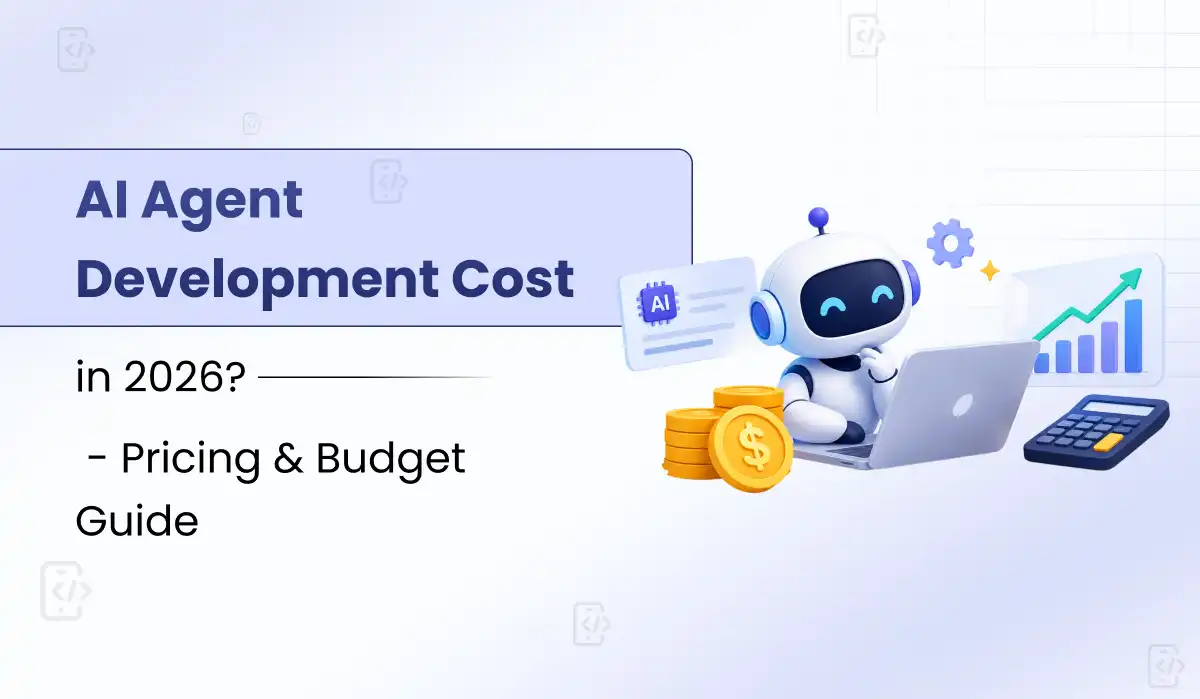
AI agent development can cost very little for a narrow prototype or become a substantial software project when the agent needs private knowledge, several business tools, approval rules and production evaluation. This guide breaks the budget down by what the agent actually has to know, decide and do—so you can estimate scope before comparing development quotes. For teams planning a production-ready solution, explore our AI Agent Development services .
Quick answer: A focused single-workflow agent may begin around $8,000–$18,000. A production business agent with several tools, RAG, permissions and evaluation may fall around $20,000–$60,000+. Complex multi-agent or enterprise systems can exceed $60,000. These are illustrative planning ranges—not a fixed Primocys quote or a universal market average.
The word “agent” covers very different products. A read-only assistant that checks one CRM is not comparable to a system that plans work across several tools, uses private knowledge and can update business records. Use these figures for early budgeting, then scope the actual workflow before treating any number as a quote.
| Project Type | Typical Scope | Planning Range | Indicative Timeline |
|---|---|---|---|
| Focused Agent / Prototype | One workflow, one or two tools, limited state, human-reviewed output | $8K–$18K | 3–6 weeks |
| Production Business Agent | Several tools, approvals, structured state, integrations and evaluation | $20K–$45K | 6–12 weeks |
| RAG + Tool-Using Agent | Private knowledge, retrieval, permissions, citations and business actions | $30K–$60K+ | 8–16 weeks |
| Complex / Multi-Agent System | Specialized agents, coordination, broader access control and observability | $60K–$120K+ | 12–24+ weeks |
A model can interpret a request, but the real cost to build an AI agent comes from the software built around that model. AI agent pricing usually covers application logic, tools, integrations, state, data access, permissions, evaluation and the interface where people supervise or use the workflow.
State, routing, retries, stopping conditions and next-step logic.
CRM, ERP, email, calendar, databases and internal services.
Private knowledge, retrieval, metadata, citations and permissions.
Review states for actions that should not run automatically.
Representative tests for tools, failures, permissions and completion.
User interface, authentication, logs, admin tools and deployment.
For the technical architecture, see AI Agent Development Company.
The largest difference is often not which model you select—it is how many decisions the software must coordinate. A workflow with one predictable action is easier to build and evaluate than one with branching logic, exceptions, retries and several possible outcomes.
Agents become valuable when they can work with real systems, but integrations add authentication, field mapping, validation, error handling and permissions. The cost is not only “connect Salesforce” or “connect Gmail”; it is deciding exactly what the agent may read or change and what happens when the external system fails.
Simpler because the agent retrieves information without changing records.
Require stronger validation because the agent creates or updates data.
Adds review states, UI, notifications and workflow resumption.
Can require extra backend work when docs or data are inconsistent.
If the agent needs policies, product documents, customer-specific data or internal knowledge, the project may need Retrieval-Augmented Generation. RAG agent development cost comes from the knowledge pipeline around retrieval—not simply from paying for a vector database.
Connect and clean documents, websites, databases or supported APIs.
Chunk content, attach metadata, create embeddings and find evidence.
Control data access and test whether the right information is retrieved.
See RAG Development for the deeper retrieval architecture.
Some agents only need the current task state. Others keep conversation context, durable workflow history or approved long-term information. The moment an agent can change business records, the application also needs stronger safeguards around actions.
Track the current workflow and tool results.
Store approved long-term information when genuinely required.
Prepare an action and wait for user approval.
Route higher-impact actions to an authorized person.
Some agents only need the current task state. Others keep conversation context, durable workflow history or approved long-term information. The moment an agent can change business records, the application also needs stronger safeguards around actions.
Did the workflow reach the intended outcome?
Did the agent choose the correct approved tool?
What happens when a model or downstream API fails?
Did it stay inside application access boundaries?
Does it stop at the intended human checkpoint?
How long does the complete workflow take?
How many model and tool calls are required?
Do updates break workflows that previously worked?
Model providers charge for usage, commonly by tokens and sometimes by tools or other units. Capable 2026 models span a wide cost range, so a production agent can route routine steps to lower-cost models and reserve stronger models for tasks where they actually improve the result.
| Provider / Model | Input | Output | Pricing Note |
|---|---|---|---|
| OpenAI GPT-5.6 Sol | $4 / 1M tokens | $20 / 1M tokens | Current standard price shown by OpenAI on Sep. 9, 2026; promotional terms can change. |
| OpenAI GPT-5.6 Terra | $2 / 1M tokens | $12 / 1M tokens | Lower-cost GPT-5.6 tier for workloads that do not need the flagship model on every step. |
| Anthropic Claude Opus 4.8 | $5 / 1M tokens | $25 / 1M tokens | Anthropic global list price effective May 27, 2026. |
The useful operating metric is usually cost per completed task, not only cost per token. One task may involve planning, retrieval, tool selection, result checking and a final response.
AI agent maintenance cost and the initial build are separate budgets. Some expenses grow with usage, while others are relatively fixed. A production estimate should show both instead of hiding API and infrastructure costs inside one development number.
Input/output tokens, caching and model-specific charges.
Servers, queues, databases, storage and background jobs.
Embeddings, vector/search services and knowledge sync.
Logs, traces, evaluation data and failure analysis.
CRM, messaging, search, telephony or other services.
Model changes, API changes and workflow improvements.
Some workflows continue to need operational review.
More successful usage increases total inference volume.
Multi-agent system cost rises quickly because architecture adds coordination, more state transitions and often more model calls. It should solve a real architecture problem rather than become a feature added for marketing.
One agent coordinates the workflow and can still use several tools. Usually simpler to evaluate, debug and operate.
Specialized agents coordinate separate responsibilities. Useful when roles or context truly differ, but more expensive to orchestrate and test.
If one well-designed agent can complete the workflow, the simpler architecture is normally the better first production baseline.
Teams often compare AI agent pricing against a chatbot or automation quote for systems that are not technically equivalent. A chatbot, deterministic automation and an agent may all appear in one interface, but their decision-making and integration requirements are different.
| Capability | AI Chatbot | Workflow Automation | AI Agent |
|---|---|---|---|
| Conversation | Primary | Optional | Optional |
| Fixed workflow | Sometimes | Primary | Can use one |
| Dynamic next-step selection | Limited | Rule-based | Yes, within permissions |
| Tool use | Possible | Predefined | Core capability |
| Multi-step reasoning | Limited | No | Often required |
| Evaluation complexity | Moderate | Usually deterministic | Higher |
Related: AI Chatbot Development and AI Automation Services.
Not every agent requires custom software. If the workflow is mostly deterministic and the required tools already have stable connectors, an automation platform can be a practical way to validate the process before investing in a deeper custom agent.
“Custom is cheaper long term” is not universally true. For many simple workflows, staying on an automation platform is completely reasonable.
These are fictional planning scenarios designed to show how scope affects price. They are not quotes for a specific client.
$10K–$18K
$20K–$35K
$30K–$55K
$50K–$90K+
The best savings usually come from reducing unnecessary scope, not from skipping evaluation or access control. A smaller first workflow is easier to prove, measure and improve before adding more tools or autonomy.
A useful quote should describe the workflow, not only say “build an AI agent.” If two vendors are pricing different interpretations of the same one-line requirement, comparing their totals tells you very little.
A low quote can be reasonable for a narrow workflow, and a high quote can be justified for a complex one. What matters is whether the proposal makes the hidden engineering visible enough to compare like with like.
Development ranges in this article are illustrative planning ranges used to explain project scope. Model API prices are time-sensitive, so provider sources should be checked whenever this article is materially updated.
GPT-5.6 Sol and Terra token prices referenced from OpenAI’s current API documentation on September 9, 2026. OpenAI API pricing →
Claude Opus 4.8 global list pricing referenced from Anthropic’s May 27, 2026 pricing publication. Anthropic pricing →
AI agent development cost in 2026 depends far more on workflow complexity, tool integrations, RAG requirements, permissions and evaluation than on the model API alone. A focused single-workflow agent can start near $8,000–$18,000, while a production, RAG-enabled or multi-agent system moves the AI agent development cost toward $30,000–$120,000+. Define the workflow, tools and approval rules first, then treat the model as one line item in a larger budget.
Not sure where your project fits? Share your workflow with our team and get a scope-based AI agent development estimate — no generic pricing, just a number based on what you actually need to build.

Hear from our clients and why 1200+ businesses trust Primocys

"Our B2B and B2C platform helps Nigerian manufacturers sell at wholesale prices and suppliers offer competitive retail pricing, with a strong focus on Made in Africa products and easy local and international distribution. The app has received excellent user reviews for its design and unique features. Communication with the Primocys team was smooth in an agile setup, even beyond office hours when needed. Their mobile app development expertise is excellent—highly professional and reliable."

"The dating app was delivered successfully and approved by both Apple App Store and Google Play. Our users are highly impressed with the design, UI, and overall functionality. The project was well planned with clear milestones, and all modules were delivered on time. The team is talented, patient, and flexible, accommodating multiple scope revisions as requirements evolved. Their 24/7 development and support availability made the entire process smooth and reliable."

" We hired Primocys to develop a highly complex and specialized mobile application, and they delivered outstanding results. The app includes advanced features such as timeline mixers, classifieds, payments, advertisements, GPS functionality, and more. Their technical skills, timely delivery, availability, and the personal attention Arpan Sagar brings to each project truly stand out. The team stays focused and committed from start to finish—an excellent experience overall."

" Great team with excellent communication and a strong commitment to on-time delivery. They developed a fully customized mobile app for both Android and iOS, perfectly matching our requirements. The entire process was smooth and professional, with clear updates at every stage. They are reliable, skilled, and very easy to work with. We’re continuing our partnership on more projects, and choosing them has been one of the best business decisions I’ve made."

AWARDS


TRUSTED BY GLOBAL BRANDS