






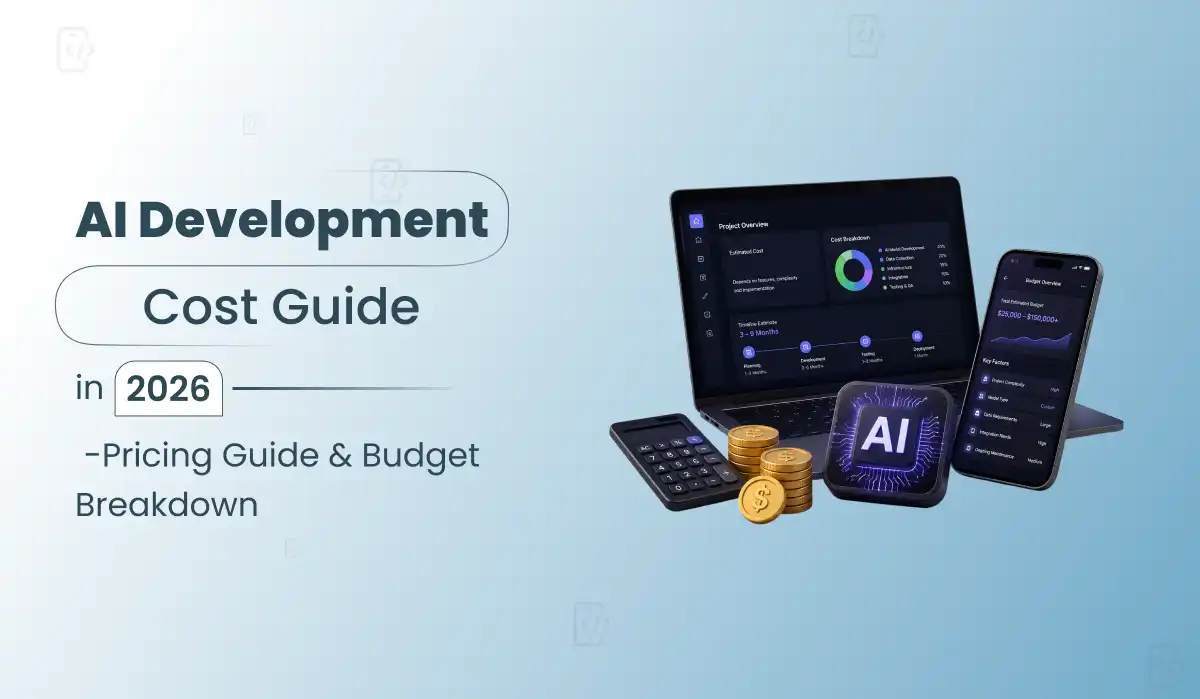
AI development cost in 2026 can range from a focused model or API feature costing a few thousand dollars to a complete AI SaaS platform or enterprise system running into six figures. The gap between those numbers usually isn’t the AI model — it’s product scope, data, integrations, retrieval, agent behavior, user roles, security and evaluation, and how much infrastructure the system needs once it’s live. Whether you’re pricing an AI app development cost for a single feature or hiring an AI development company for a full multi-system platform, the same drivers apply. cost for a multi-system platform, the same drivers apply.
How Much Does AI Development Cost in 2026?
Here’s the short version before the detail: most custom AI projects land somewhere between $5,000 and $150,000+, and the number is set almost entirely by scope rather than by which AI model is behind it.
2026 planning ranges by project type — not fixed Primocys quotations
| Project Type | Planning Range | Typical Complexity | Common Scope |
|---|---|---|---|
| Focused AI Feature / Prototype | $5K–$15K | Lower | One or two AI workflows, limited integrations, feasibility validation |
| Production AI Application | $15K–$40K | Lower–Medium | User-facing AI feature, backend, authentication, admin, production deployment |
| RAG / Knowledge Assistant | $20K–$60K+ | Medium–High | Ingestion, embeddings, retrieval, permissions, citations, UI, evaluation |
| AI Agent / Workflow Automation | $25K–$80K+ | High | Tool/API use, workflow state, human approvals, system integrations |
| AI SaaS Platform | $40K–$120K+ | Medium–High | Accounts, workspaces, AI functionality, billing, usage controls, admin |
| Enterprise AI System | $80K–$150K+ | High | Multiple business systems, permissions, data, monitoring, complex workflows |
| Complex Enterprise / Multi-System AI | $150K+ | High | Multiple teams, systems, governance or unusually complex requirements |
These are planning ranges, not fixed Primocys quotations. Independent market estimates can run higher depending on geography, compliance requirements, team model and enterprise scope.
Two companies can ask for “an AI chatbot” and end up with completely different invoices. One means a widget that answers five FAQs using a stock model with no memory of past conversations. The other means a bot that authenticates the customer, looks up their order in an ERP, checks a refund policy, and updates a support ticket — all inside the same-looking chat window. The visible product looks identical. The engineering behind it is not, and neither is the AI solution development cost it needs.
AI Development Cost Is More Than the Model API
Model usage is often the smallest line item in an AI project’s budget. Most of the cost sits in the engineering work required to connect that model safely and usefully to a real business.
Product & UX
Designing the actual interaction — chat, form, dashboard or embedded widget — including how the system handles uncertainty, errors and edge cases the user will actually hit.
Backend Development
APIs, business logic, data models and the services that sit between the AI layer and the rest of the product, including anything not handled by the model itself.
AI / Model Integration
Prompting strategy, structured outputs, model routing, tool-calling setup and the glue code that turns a raw model response into something the product can act on.
Data & RAG
Collecting, cleaning, chunking and indexing the content the AI needs to know, plus the retrieval logic that decides what gets shown to the model at request time.
Business-System Integrations
Connecting the AI to CRM, ERP, helpdesk, payment or internal tools — usually the single biggest source of unplanned engineering time.
Evaluation & QA
Building test sets, scoring outputs, and catching regressions before they reach users — the AI equivalent of a test suite, and just as necessary.
Infrastructure & Deployment
Hosting, vector storage, queues, environments and the deployment pipeline that gets the system into production reliably.
Monitoring & Maintenance
Logging, cost tracking, drift detection and the ongoing work of keeping the system accurate as data, usage and provider models change.
A company may spend only a few dollars in model usage during early testing while spending far more engineering time connecting the AI safely to its CRM, knowledge base, authentication and customer workflow. The model call is often the cheapest and fastest part of the whole build.
AI Development Cost by Solution Type
AI chatbot development cost, RAG system cost, AI agent development cost and AI SaaS development cost all follow different technical cost profiles. Here’s what typically moves the number up or down within each one.
AI Chatbot
Usually includes
Can be lower
Can increase
RAG Knowledge Assistant
Usually includes
Can be lower
Can increase
AI Agent
Usually includes
Can be lower
Can increase
AI Automation (Workflow / Ops)
Usually includes
Can be lower
Can increase
Generative AI Application
Usually includes
Can be lower
Can increase
AI SaaS Platform
Usually includes
Can be lower
Can increase
Machine Learning System
Usually includes
Can be lower
Can increase
Computer Vision / Document AI
Usually includes
Can be lower
Can increase
AI Integration Into Existing Software
Usually includes
Can be lower
Can increase
AI Workflows vs. Screens: What Really Drives Cost
Traditional app estimates often count screens. That approach breaks down for AI systems, because a single chat screen can hide almost any amount of underlying logic.
Consider two versions of the “same” chatbot:
Both versions can use the exact same chat UI. A visitor to the product would see no visible difference between them. But the second one requires authentication logic, a data lookup, a policy engine, a pricing integration, a CRM write, an approval workflow and a notification system — each of which needs to be built, tested and monitored on its own. A 10-screen AI app can cost more than a 30-screen normal application if those 10 screens depend on complex retrieval, model evaluation and business-system actions.
This is why a screen count or page count is a poor proxy for AI project cost. The better question is: how many distinct decisions, lookups and actions does the AI need to complete per request, and how many of those touch a system where a mistake actually matters?
How RAG Changes AI Development Cost
Connecting an AI system to private company knowledge is often described as “uploading some PDFs.” In practice it involves several distinct engineering steps, each of which affects both quality and cost.
- Content ingestion from documents, wikis, tickets or databases
- Vector search and hybrid (keyword + semantic) retrieval
- Cleaning inconsistent formatting, duplicates and outdated content
- Reranking results before they reach the model
- Chunking text into retrievable, meaningfully sized pieces
- Enforcing per-user or per-role access permissions
- Generating and storing embeddings
- Attaching source citations to answers
- Attaching metadata for filtering and permissions
- Refreshing content as source material changes
- Evaluating whether retrieved answers are actually correct
Illustrative range: RAG / Knowledge Assistant — $20K–$60K+ (2026 planning range)
The expensive part of RAG is rarely the vector database by itself. The work is getting the right information into the index, retrieving the right context, respecting access rules and proving that the answers are actually useful.
A 50-document knowledge base with one user role and no sensitive content is a very different build from an enterprise knowledge platform where different employees are only allowed to see different subsets of the same content, where source material updates daily, and where every answer needs a traceable citation for compliance reasons. The first can be a few weeks of work. The second is closer to a standalone product. For a deeper look at building RAG systems, see our RAG Development page.
AI Agent Cost: Why Agents Cost More Than Chatbots
AI agent development cost comes from the actions it can take and the integrations, permissions and failure handling those actions require — not from the model that powers its reasoning.
Tools & APIs
Each system the agent can call needs its own integration, error handling and rate-limit strategy.
State & Memory
Tracking where a multi-step task is, and what’s already been done, across a conversation or workflow.
Workflow Logic
Deciding what happens next based on tool results, not just the model’s raw output.
Permissions
Controlling exactly what the agent is allowed to read versus change.
Approval Checkpoints
Routing higher-risk actions to a human before they execute.
Retries & Error Handling
Deciding what the agent does when a tool call fails or returns something unexpected.
Observability
Logging every step so a failed or incorrect action can actually be traced.
Evaluation
Testing the agent against realistic scenarios before it’s trusted with production traffic.
Illustrative range: AI Agent / Multi-Step Automation — $25K–$80K+ (2026 planning range)
A chatbot can answer a question. An agent may need to understand the question, retrieve data, call a business system, validate the result and decide whether a person must approve the action.
Giving an agent permission to read a CRM is one engineering problem. Allowing it to update customer records automatically is a very different risk and testing problem — and that difference is usually where agent budgets grow. See AI Agent Development for more on how we scope agent engineering.
Add AI to Existing Software or Build New?
It depends on the health of what already exists. Existing software can save real money — or it can quietly cost more than starting fresh.
Adding AI to an existing product can save money because authentication, the database, core workflows and the UI already exist, and users are already using the product day to day. But that advantage disappears quickly if the legacy code is fragile, APIs are missing, permissions are unclear, data is inconsistent, or the original architecture was never designed to support integrations.
| Factor | Existing Product + AI | New AI Product |
|---|---|---|
| UI | Reused, may need rework for AI interactions | Built from scratch, full design freedom |
| Backend | Reused if stable | Built to match AI-specific needs |
| Authentication | Already exists | Must be built |
| Data migration | Sometimes required if data is inconsistent | Not applicable |
| Integration | Can be smooth or costly depending on legacy code | Designed in from day one |
| Architecture freedom | Constrained by existing decisions | Full control |
| Time | Often faster if codebase is healthy | Predictable but starts from zero |
| Risk | Higher if legacy code is fragile | Lower technical risk, higher scope risk |
If you’re evaluating this for your own product, see AI Integration for Existing Software for how we assess a codebase before scoping the work.
AI API Cost vs. Development Cost
Development cost is the one-time engineering investment to build the system. API or model usage cost is an ongoing operating expense based on volume — similar to a cloud hosting bill. Buyers should plan for both, separately.
| Provider | Pricing Model | Note |
|---|---|---|
| OpenAI | Per-token, tiered by model | Reverify against OpenAI |
| Anthropic Claude | Per-token, tiered by model | Reverify against anthropic.com/pricing |
| Google Gemini | Per-token, tiered by model | Reverify against Google’s official pricing |
API prices change frequently. Reverify against official provider pricing on the publication/update date.
The rough formula behind a monthly AI operating cost looks like this:
Monthly AI cost: (number of requests × average input tokens × input rate) + (average output tokens × output rate) + embeddings / search / tool / voice / infrastructure costs
As an illustrative example only — not a prediction — a support assistant handling a few thousand conversations a month, each involving a modest amount of retrieved context, might land in the low hundreds of dollars in monthly model usage once retrieval and tool calls are included. An enterprise agent making frequent tool calls across a much larger user base could run into the low thousands. These numbers move a great deal based on model choice, context size and request volume, which is exactly why they should be modeled against your actual expected usage rather than assumed.
Several techniques directly affect this ongoing cost: routing simple requests to smaller, cheaper models; caching repeated queries; keeping context size to what’s actually needed; batching non-urgent requests; designing retrieval so the model isn’t fed more text than necessary; and controlling output length. API price is operating cost. Building the product around that API is development cost. Buyers should budget for both.
AI Development Costs Businesses Often Miss
None of these are dramatic on their own, but they’re easy to leave out of an early budget and then discover later.
- Data cleanup before the AI can use it reliably
- Third-party APIs beyond the core model provider
- Vector database and search infrastructure
- Model usage that scales with adoption, not with the original plan
- Voice, speech-to-text or text-to-speech where applicable
- Observability and logging tooling
- Evaluation datasets and the time to build them
- Human review during early production
- Security work, especially around data access
- Cloud resources beyond the initial estimate
- Ongoing monitoring once the system is live
- Maintenance as provider models change or deprecate
The cheapest model is not automatically the cheapest system. A cheaper model that needs repeated retries or produces more manual review can increase total operating cost.
What Increases AI Development Cost?
The cost of AI development depends on more than features—model complexity, integrations, data requirements, security, scalability, and ongoing optimization can quickly shape your final budget.
Each additional source means its own ingestion, cleaning and refresh logic.
Different roles usually mean different permissions, views and edge cases to test.
Every connected system adds authentication, error handling and maintenance surface.
Read access is low-risk. Write access requires validation, rollback plans and stricter testing.
Low-latency responses constrain architecture choices and raise infrastructure cost.
More languages mean more testing and, often, separate evaluation per language.
Adds speech, audio or image pipelines on top of the core text system.
Fine-tuning or training adds data preparation and ongoing retraining overhead.
Fine-grained, per-document or per-field access control takes real engineering time.
Compliance requirements add documentation, auditing and review steps.
Supporting many simultaneous users changes infrastructure and cost-control needs.
Usage dashboards and reporting are a separate build on top of the core feature.
Each additional platform is close to its own build, not a minor extension.
Staging, production and client-specific environments multiply testing and release work.
How to Reduce AI Development Cost
Cutting scope carelessly produces a weak product. Cutting scope deliberately, around the riskiest unknowns first, produces a lean one.
Budget Control
- Start with one valuable workflow instead of many at once
- Use existing models before considering custom training
- Separate deterministic logic from AI so only genuinely ambiguous steps use the model
- Reuse existing application infrastructure where it’s genuinely solid
- Validate RAG on a small scale before building a giant knowledge platform
- Limit agent tools in V1 to the two or three that matter most
- Establish evaluation before scaling usage, not after
- Route simple tasks to cheaper, smaller models
- Build usage tracking from the beginning, not after a surprise bill
- Postpone “nice to have” AI features until the core workflow is proven
The cheapest V1 is usually not the version with the fewest screens. It is the version with the fewest uncertain workflows.
Build Custom AI or Buy an Existing Tool?
Custom development isn’t always the right call. An experienced AI development company can help determine whether a standard workflow is enough or the AI needs to become part of the product itself.
Off-the-shelf tools usually make sense when
- The workflow is standard and widely solved
- Customization needs are low
- No proprietary integration is required
- The team is small
- Requirements are generic across the industry
Custom development usually makes more sense when
- AI is part of the product’s own IP
- Workflows or data are proprietary
- Deep CRM/ERP/platform integration is required
- It’s a customer-facing product, not an internal tool
- Permissions or automation needs are specialized
- It’s a multi-tenant SaaS product
- Control over UX, data and model strategy matters
AI Project Budget Examples
Illustrative planning scenarios — not Primocys client quotations. These composites show how scope, not model choice, sets the budget.
Customer Support Knowledge Assistant
RAG over a website and PDF knowledge base, embedded chat widget, admin panel for content updates, human handoff for unresolved queries.
CRM Sales Copilot
CRM integration, account summarization, lead intelligence pulled from historical activity, and AI-assisted outreach drafting inside the existing sales workflow.
Multi-Step AI Agent
RAG for policy lookup, integration with two internal business APIs, an approval workflow for higher-risk actions, and full action logging.
AI SaaS Platform
Multi-tenant accounts and workspaces, usage-based billing, a combination of RAG and agent features, and admin tooling for customer-side configuration.
What We Need for an Accurate AI Estimate
A meaningful number depends on specifics, not a category label. Coming prepared with the following turns a generic range into an actual scoped estimate.
Without this, any number offered is a guess dressed up as an estimate. With it, a scoped range can be built around your actual workflows instead of a generic category — the difference between an AI project budget that holds up through delivery and one that gets renegotiated at milestone two.
Conclusion: AI Development Cost Comes Down to Scope, Not the Model
Whether you’re pricing an AI chatbot, a RAG system, an AI agent or a full AI SaaS platform, the pattern holds: the AI model is rarely the expensive part. Data, integrations, permissions, evaluation and production infrastructure are what actually move an AI development cost from a few thousand dollars to six figures.
Use the 2026 planning ranges in this guide as a starting point, not a final number. A focused AI feature can land at $5,000–$15,000, a production AI app usually runs $15,000–$40,000, and RAG systems, AI agents and AI SaaS platforms climb from there based on data volume, integrations and how much risk the system is allowed to take on. If you’re ready to move past planning ranges and get a real, scoped AI development cost estimate for your project, our team can help you turn requirements into a number you can actually budget against.
Common Questions About AI Development Pricing
How much does AI development cost in 2026?
How much does an AI chatbot cost to develop?
How much does a RAG system cost?
How much does an AI agent cost?
Do AI API fees come with the development cost?
Can AI be added to existing software?
How long does an AI development project take?
What information is needed for an accurate quote?
Related Articles

Build your scalable apps today.
Contact UsLeaving Already?
Hear from our clients and why 1200+ businesses trust Primocys

"Our B2B and B2C platform helps Nigerian manufacturers sell at wholesale prices and suppliers offer competitive retail pricing, with a strong focus on Made in Africa products and easy local and international distribution. The app has received excellent user reviews for its design and unique features. Communication with the Primocys team was smooth in an agile setup, even beyond office hours when needed. Their mobile app development expertise is excellent—highly professional and reliable."

"The dating app was delivered successfully and approved by both Apple App Store and Google Play. Our users are highly impressed with the design, UI, and overall functionality. The project was well planned with clear milestones, and all modules were delivered on time. The team is talented, patient, and flexible, accommodating multiple scope revisions as requirements evolved. Their 24/7 development and support availability made the entire process smooth and reliable."

" We hired Primocys to develop a highly complex and specialized mobile application, and they delivered outstanding results. The app includes advanced features such as timeline mixers, classifieds, payments, advertisements, GPS functionality, and more. Their technical skills, timely delivery, availability, and the personal attention Arpan Sagar brings to each project truly stand out. The team stays focused and committed from start to finish—an excellent experience overall."

" Great team with excellent communication and a strong commitment to on-time delivery. They developed a fully customized mobile app for both Android and iOS, perfectly matching our requirements. The entire process was smooth and professional, with clear updates at every stage. They are reliable, skilled, and very easy to work with. We’re continuing our partnership on more projects, and choosing them has been one of the best business decisions I’ve made."

AWARDS


Share Your Requirements
TRUSTED BY GLOBAL BRANDS