
No-Code Workflow Agent
$0–$3K
US equiv: same
- n8n, Zapier, or Make
- LLM API wired in
- Single internal workflow
- Low-risk data only
 DapkeSocial video app with live streaming and PK battles.
 Lika Real EstateProperty discovery platform for listings and leads.
 BurpoutSocial fitness challenges that keep people moving.
 ChatLivoConnected customer communication SaaS workspace.
 EmoTalesAI storytelling adventures designed for children.
 EarnifyTrack Income from Multiple Sources with Analytics & Tax Planning.
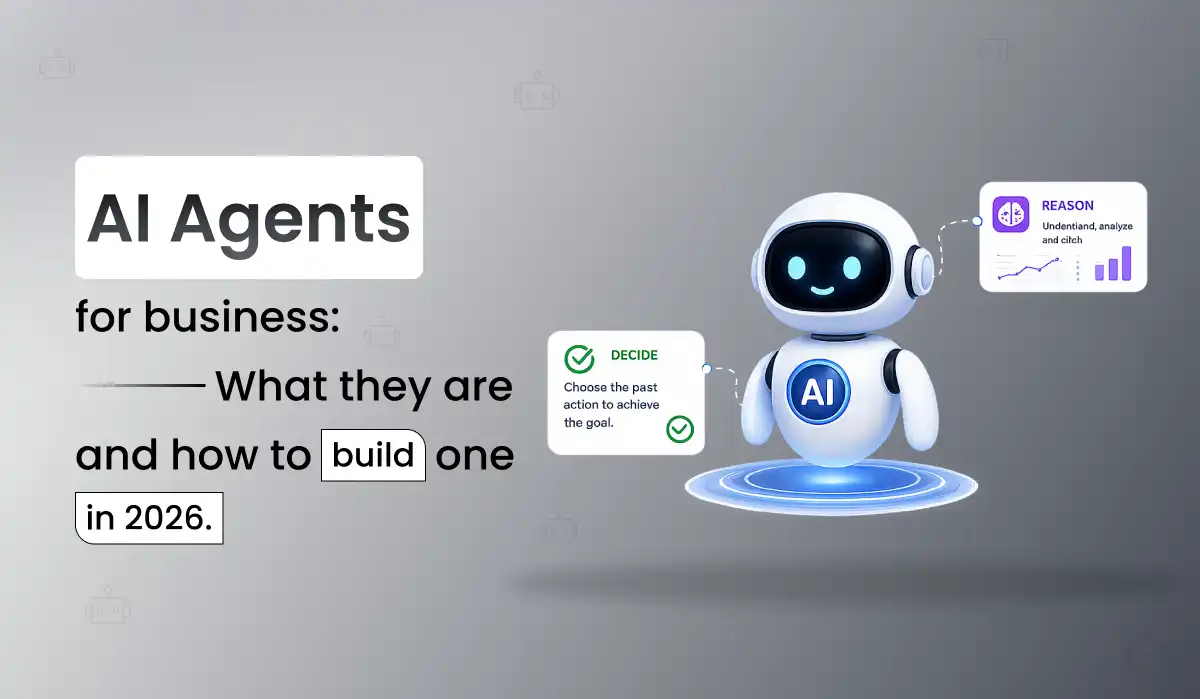
Most “AI agent” guides cover the concept and stop. This one covers the cost, the architecture, the exact build path, and the reason 40% of agentic AI projects get quietly cancelled — before you commit a budget to yours.
The number you came here for A custom AI agent for business costs $15,000–$40,000 for an MVP (one specific workflow, real data access via RAG, tool integrations, guardrails, evaluation harness) at India development rates. A no-code agent on n8n or Zapier costs $0–$3,000 and ships in days. A production multi-agent system across departments costs $40,000–$120,000+ and runs 3–6 months. US agencies quote $50,000–$150,000+ for equivalent custom scope. India-based custom AI agent development delivers the same LangChain, RAG, and guardrail architecture at 60–70% lower engineering cost. Get a free scoping call →
Building AI agents for business no longer requires a research lab or a six-figure AI team. The building blocks — capable language models, mature orchestration frameworks, affordable vector databases, and agent hosting built directly into AWS, Azure, and Google Cloud — are now sitting on the shelf. What separates the custom AI agent development projects that ship from the ones quietly failing is not budget or model choice. It’s whether the team started with one specific, measurable job.
This guide covers what an AI agent for business actually is, why 2026 is genuinely different from 2023 or 2024, where AI agents earn their keep in a real business, what custom AI agent development costs, and the steps to get from idea to something running in production.
Strip away the marketing and an AI agent for business is software built around a loop: it observes the current state of something, reasons about what needs to happen next, takes an action through a tool or API, and checks whether that action got it closer to the goal. It repeats that loop until the job is done or it hits a point where it needs a human.
That sounds close to what a chatbot or an automation script already does. The difference shows up the moment something doesn’t go according to plan.
The failure mode nobody warns you about: An AI agent can return a confident, well-formed answer that’s simply wrong for the situation — no error thrown, nothing in the logs flagged. The failure is semantic, not technical. This is exactly why the evaluation and guardrail layer matters as much as the model choice.
Three things converged in roughly the last eighteen months. Vector databases got cheap and fast enough that they’re no longer a Google-scale luxury. Cloud providers shipped native agent hosting: AWS Bedrock Agents, Azure AI Agent Service, and Google Vertex AI Agents all launched proper agent infrastructure in 2025. And the underlying models got both cheaper and noticeably more reliable at multi-step tool use — the actual hard part of agent work.
The combined effect: the cost of building a genuinely useful AI agent for business has fallen by roughly 60% since 2024. If you’ve been watching from the sidelines, that wait is largely over — the harder open question now is process, not capability.
Skip the “AI agents for everything” pitch. The deployments that actually deliver ROI cluster around a specific shape: high volume, clear success criteria, and enough ambiguity in the input that a rigid script would fall over. Here are the AI agent use cases for business that consistently earn their keep.
Reads an incoming ticket, classifies it, pulls relevant knowledge-base articles, drafts or sends a response, and escalates to a human only when its own confidence is low.
Scores inbound leads against an ideal-customer profile, drafts personalized first-touch messages, and logs every update directly into the CRM.
Watches stock levels and shipment data across systems, flags disruptions early, and suggests reorder or reroute actions before a human would have caught the pattern.
Extracts line items from incoming invoices, matches them against purchase orders, flags discrepancies, and routes anything outside tolerance for human sign-off.
Answers policy questions from a live knowledge base, kicks off onboarding checklists, and routes anything sensitive straight to a person.
Triages access requests and common technical issues, resolves the routine ones directly, and hands off anything that touches credentials or production systems.
Five parts, working together. None of them is optional if you want something that survives contact with real users.
Why guardrails are the layer most failed AI agent projects skipped: Access controls, permissioning, prompt-injection defenses, and a human checkpoint on anything high-stakes or irreversible. Retrofitting this after an incident costs three to four times more than designing it in from day one — exactly the same pattern as compliance in fintech.
The order matters here more than the tools you pick. Most failed custom AI agent development projects skipped step one and tried to make up for it with a bigger model.
“Help with customer service” fails. “Triage and route every incoming support ticket within 60 seconds” succeeds. Narrow, specific mandates ship; broad ones stall in committee.
No-code if the workflow fits inside an existing platform’s connectors and the data is low-risk. Custom AI agent development if you need specific guardrails, proprietary data, or integrations a no-code tool doesn’t reach.
Connect the agent to the actual systems it needs — your knowledge base via RAG, your CRM, your ticketing API. An AI agent with no real data access is just an expensive chatbot.
Decide which actions need human sign-off before the agent ever touches a live customer or a live invoice. Retrofitting guardrails after an incident costs far more than designing them in.
Assemble a set of real, varied scenarios — including edge cases — and run the agent against all of them before it touches production. This evaluation pipeline matters more to quality than which model you chose.
Name who gets paged when the agent misbehaves and how its instructions get regression-tested after updates. Prove the value on this one workflow before adding a second AI agent for business.
This is the first real fork in the road, and the right answer depends entirely on how specific your workflow is — not on your budget alone.
The middle path most teams miss: Configuring a platform-native agent (AWS Bedrock Agents, Azure AI Agent Service, Google Vertex AI Agents) instead of building orchestration from scratch. It costs more than a pure no-code workflow but considerably less than a fully custom AI agent development project — worth a serious look before committing to either extreme.
All prices below are at India development rates. These ranges are based on real project scopes — not theoretical estimates built around inflated hourly rates.
Why India-based custom AI agent development costs 60–70% less: The AI model costs — OpenAI, Anthropic, AWS Bedrock — are identical globally. What changes is the engineering cost to wire them together correctly, build the RAG pipeline, design the guardrails, and build the evaluation harness. That engineering gap is where India rates deliver the real saving. Get a free fixed-price estimate →
The model matters less than teams assume: Context, the RAG pipeline, tool integrations, and the evaluation harness consistently matter more to real-world AI agent performance than which LLM sits inside. A well-scoped agent on GPT-4o mini with a strong RAG pipeline will outperform a poorly scoped agent on GPT-4o every time.
Analysts have been blunt about this: a meaningful share of agentic AI initiatives are expected to be scrapped within the next year or two, and the reasons are consistent across industries.
⚠ COMMON AI AGENT FAILURE PATTERNS
A vague mandate. “Build an AI agent for customer support” has no finish line. “Triage tickets within 60 seconds” does.
No evaluation pipeline. Without a test set, nobody can say whether the agent improved last week or quietly got worse.
No human checkpoint on high-stakes actions. Letting an under-tested agent write to billing or customer records is how a small mistake becomes a costly one.
A thin wrapper, not a system. An agent that’s just a prompt on top of a generic model, with no RAG or workflow integration, is vulnerable to every model update.
No owner after launch. Someone needs to be paged when the AI agent misbehaves and responsible for regression-testing it after every change.
The same honest advice applies here as it does for any software category: competing across every department at once with a vague AI agent mandate is not a realistic path for a first deployment. The real opportunity in AI agents for business in 2026 is in narrow, high-volume, clearly measurable workflows that the agent can own end-to-end.
One team, one job, one measurable outcome. Ticket triage, lead qualification, invoice processing — prove value before expanding scope.
Add the AI agent inside your CRM, helpdesk, or ERP — not as a standalone tool. Lower adoption friction and faster measurable ROI.
Only after one agent proves value. Cross-department deployment with shared memory, handoff protocols, and unified audit logging.
“The AI agent projects that actually ship in 2026 aren’t the ones trying to automate everything at once. They’re the ones that picked one specific, measurable job — and built an evaluation harness before they called it done.”
Primocys scopes every custom AI agent development engagement around one workflow first — because that’s the version that actually ships and actually gets adopted. In-house Python and ML engineers building the RAG pipeline, tool integrations, and evaluation harness — not a reseller layer on someone else’s API. Fixed price from $15,000, full source code.
Not a platform-wide rollout — the version that ships and gets adopted.
Your proprietary data, wired in correctly — not a generic knowledge base.
Human checkpoints on high-stakes actions designed in, not bolted on.
Real test scenarios before production — not discovered after an incident.
Not a reseller layer — we build the RAG pipeline and tool integrations ourselves.
Cost agreed before development starts. Full source code. No API reseller lock-in.
Not a broad mandate — a specific, measurable workflow with a clear finish line.
No-code, platform-native, or custom AI agent development — before you start evaluating tools.
An AI agent without retrieval-augmented generation is guessing, not reasoning about your business.
Anything irreversible or high-stakes gets a checkpoint before it ships.
You can’t improve — or trust — what you haven’t measured against real, varied cases.
Someone is accountable for what the AI agent does after launch, not just before.
One working AI agent earns the budget for a second one. A shaky pilot doesn’t.
The technology stopped being the bottleneck sometime in the last year. What separates AI agents for business that actually run in production from the ones quietly cancelled in 2027 isn’t budget or model choice — it’s whether the team started with one specific, measurable job and built the evaluation and guardrail layer before launch instead of after a problem forced the issue.
India-based custom AI agent development delivers the same LangChain , RAG pipeline, and multi-agent architecture at 60–70% lower engineering cost than US or UK agencies. The AI model costs — OpenAI, Anthropic, AWS Bedrock — are identical globally. What changes is the engineering cost to wire them together correctly, build the evaluation harness, and design the guardrails. That gap is where the real saving is, and for a $15,000–$40,000 custom AI agent MVP, it’s the difference between a project that ships and one that runs out of budget before launch.
The single most important step before you hire an AI agent development company: Tell us the one workflow you want to automate, the systems it touches, and what “success” looks like in measurable terms. We’ll scope whether a no-code tool, platform-native agent, or custom AI agent development is the right fit — and give you a fixed-price estimate within 48 hours, no commitment required. Get your free AI agent scoping call →

Hear from our clients and why 1200+ businesses trust Primocys

"Our B2B and B2C platform helps Nigerian manufacturers sell at wholesale prices and suppliers offer competitive retail pricing, with a strong focus on Made in Africa products and easy local and international distribution. The app has received excellent user reviews for its design and unique features. Communication with the Primocys team was smooth in an agile setup, even beyond office hours when needed. Their mobile app development expertise is excellent—highly professional and reliable."

"The dating app was delivered successfully and approved by both Apple App Store and Google Play. Our users are highly impressed with the design, UI, and overall functionality. The project was well planned with clear milestones, and all modules were delivered on time. The team is talented, patient, and flexible, accommodating multiple scope revisions as requirements evolved. Their 24/7 development and support availability made the entire process smooth and reliable."

" We hired Primocys to develop a highly complex and specialized mobile application, and they delivered outstanding results. The app includes advanced features such as timeline mixers, classifieds, payments, advertisements, GPS functionality, and more. Their technical skills, timely delivery, availability, and the personal attention Arpan Sagar brings to each project truly stand out. The team stays focused and committed from start to finish—an excellent experience overall."

" Great team with excellent communication and a strong commitment to on-time delivery. They developed a fully customized mobile app for both Android and iOS, perfectly matching our requirements. The entire process was smooth and professional, with clear updates at every stage. They are reliable, skilled, and very easy to work with. We’re continuing our partnership on more projects, and choosing them has been one of the best business decisions I’ve made."

AWARDS


TRUSTED BY GLOBAL BRANDS