





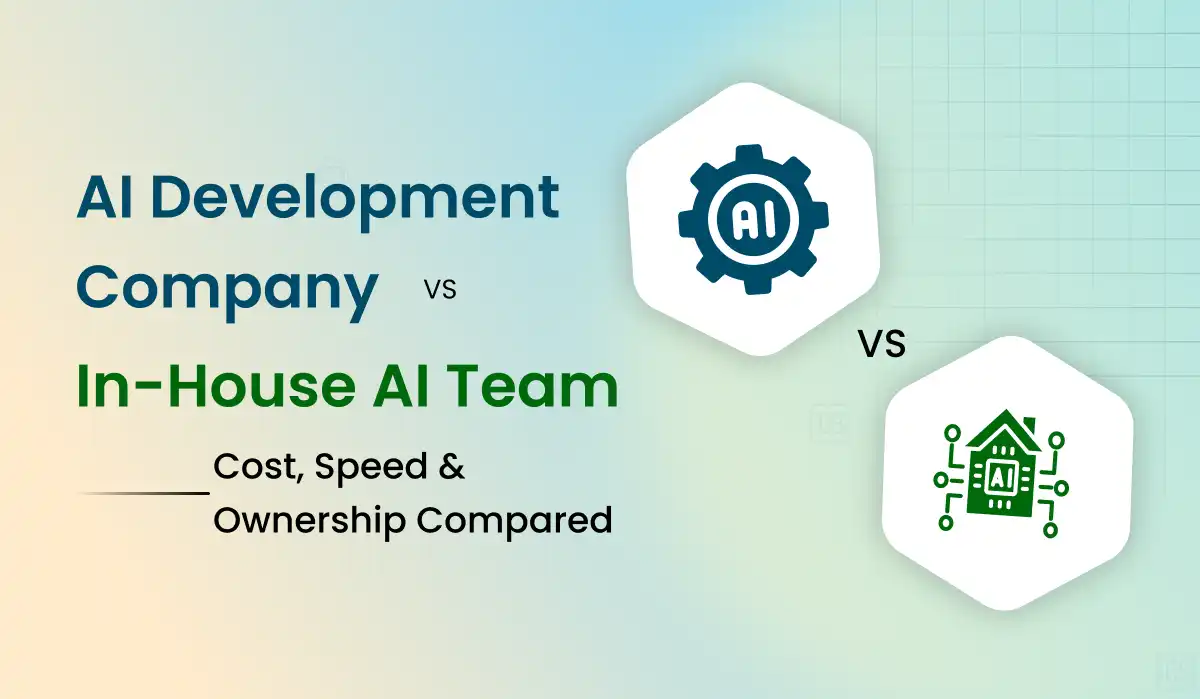
Should you hire AI specialists or partner with an AI development company? The answer is not simply which hourly rate looks lower. It is about how quickly you can build something useful, who makes the decisions, what you own, and what it takes to keep the product reliable after launch.
Build vs Buy AI: Which Model Is Better?
The build vs buy AI decision comes down to scope, speed, ownership and how central AI is to your product. An AI development company is often a better fit when you have a defined use case, need cross-functional expertise quickly, or want to validate a product before hiring a permanent team. An in-house AI team is often a better fit when AI is central to your long-term competitive advantage, you need continuous experimentation, and you can sustain specialist hiring and management.
For many businesses, the strongest answer is hybrid: keep product direction, sensitive data decisions and technical ownership internally while using an external partner for implementation and acceleration.
Important: Neither outsourcing nor hiring automatically determines IP ownership, security or product quality. Those depend on contracts, architecture, governance and execution.
Not sure which model fits?: Share your use case and we will review your build vs buy options. Get a free AI project review → .
In-House AI Team vs Outsourcing: At a Glance
This in-house AI team vs outsourcing comparison shows typical tradeoffs, not guarantees. The actual result depends on project complexity, the hiring market and the partner you select.
| Factor | AI development company | In-house AI team |
|---|---|---|
| Initial commitment | Scoped project or retainer | Recruitment plus ongoing salaries and infrastructure |
| Time to start | Can be quicker if the partner has capacity and relevant expertise | Depends on recruitment and onboarding |
| Skills coverage | Access to an existing mix of engineers, designers, QA and specialists | Build the specific skill mix you hire |
| Product control | High with clear governance; execution shared with vendor | Direct day-to-day management |
| IP ownership | Contractual; requires explicit assignment and license terms | Usually governed by employment and company policies |
| Long-term knowledge | Requires documentation and transfer discipline | Knowledge retained within team, subject to employee turnover |
| Scaling capacity | Adjust contract scope or vendor resources | Recruit, train or reorganize employees |
| Best fit | Defined MVPs, integrations, time-sensitive projects | Core ongoing AI research and sustained product iteration |
Cost of Hiring an In-House AI Team vs Outsourcing
AI development outsourcing proposals usually show project fees, milestones or monthly retainers. Internal budgets often begin with salary—but the cost of hiring an in-house AI team goes well beyond salary. A fair comparison uses the same scope and the same period, including what happens after launch.
Discovery, design, engineering, QA, project management, integration work, vendor coordination, support and change requests.
Recruitment, salary, benefits, management, onboarding, equipment, cloud tools, retention and hiring gaps.
Model/API usage, hosting, storage, vector databases, evaluation, monitoring, security reviews and customer support.
Documentation, knowledge transfer, refactoring, ownership of infrastructure and future vendor or employee replacement.
AI Team Hiring Cost vs Development Company: Example
Consider a business building an AI knowledge assistant. The figures below are hypothetical planning inputs, not market quotations. Replace them with actual vendor proposals and local compensation data.
| Illustrative six-month item | External team | In-house team |
|---|---|---|
| Engineering and delivery | $45,000 fixed scope | $72,000 loaded team cost |
| Cloud/model/API usage | $6,000 | $6,000 |
| Recruitment/onboarding | $0 in this example | $8,000 |
| Six-month planning total | $51,000 | $86,000 |
The example suggests a $35,000 difference for that assumed scope and period. It does not mean agencies are universally cheaper: expanded scope, recurring vendor fees or a longer horizon can change the outcome. A mature internal team may deliver multiple products and lower marginal cost over time. For a fuller budget view, read our AI development cost guide .
Calculation: Total cost of ownership = implementation or loaded team cost + recruiting/onboarding + infrastructure/model usage + maintenance + security/compliance + transition costs.
Want numbers for your project? Send your scope and timeline and we will compare outsourcing against hiring for your case. Request a cost review →
AI Development Outsourcing vs Hiring: Which Is Faster?
With an AI development partner vs internal team, an experienced external team may start faster because its engineers, designers and QA specialists already work together. That advantage disappears if requirements are unclear, data access is delayed or approvals take weeks. Internal teams can move quickly too—especially when the people and infrastructure are already in place.
External team advantage
Useful when the project has clear acceptance criteria and the partner has proven relevant delivery capabilities.
In-house advantage
Useful when requirements evolve daily, AI research is continuous and deep product context matters.
Shared bottlenecks
Data preparation, security approvals, evaluation design, integrations and stakeholder decisions can slow either approach.
Speed metric that matters
Measure time to a validated, usable release—not merely the first demo or prototype.
Before comparing timelines, ask both options to estimate the same milestones: discovery, working prototype, evaluation against real cases, integration, user acceptance testing and production support.
Who Owns AI Code When Outsourcing? IP, Data & Models
Working with an AI development company does not mean giving away your product. But paying an invoice does not, by itself, settle every intellectual-property question either. Whether you outsource or build internally, put AI project ownership and IP terms in writing before development begins.
IP & OWNERSHIP CHECKLIST
- Custom source code: specify ownership, delivery format, repository access and rights to modify.
- Pre-existing components: identify reusable vendor frameworks and the license you receive.
- Third-party models: model weights, hosted APIs and open-source libraries remain subject to their own terms.
- Prompts and workflows: define ownership of custom prompt libraries, orchestration and configuration.
- Data: clarify collection rights, training restrictions, retention, deletion and access.
- Infrastructure: decide who controls cloud accounts, API keys, domains, logs and deployment pipelines.
- Handover: require documentation, environment setup, tests and a transition period.
For in-house development, employment agreements, open-source licenses and third-party API terms still matter. Internal hiring is not a shortcut around IP governance.
AI Outsourcing Risks: Security, Quality & Maintenance
AI software introduces failure modes beyond conventional application development: incorrect answers, data leakage, model changes, prompt injection, drift and unpredictable inference costs. AI outsourcing security risks and in-house risks differ in who controls access, but neither model removes them.
Use least-privilege access, encrypted data flows, logging, vendor review and appropriate deployment controls.
Test representative real-world cases, refusal behavior, retrieval quality, edge cases and escalation paths.
Keep review steps for high-impact decisions and provide a way to correct or escalate uncertain outputs.
Assign responsibility for monitoring, incident response, model updates, cost control and user feedback.
In an outsourced build, agree in the contract who owns security reviews, access to production data and incident response. In-house, your own team carries those duties directly, so confirm you have the specialists to do it.
If the product handles sensitive or regulated information, involve legal and security specialists to evaluate applicable requirements. Do not treat a vendor’s generic “enterprise-ready” label as evidence of compliance.
Hybrid AI Team Model: The Practical Middle Ground
A hybrid AI team model combines internal ownership with external execution. Your team defines the product, approves data access, owns repositories and cloud accounts, and measures outcomes. A development partner provides engineering capacity, integrations, UI/UX and testing.
HYBRID TEAM SETUP
- Appoint an internal product owner and technical decision-maker.
- Keep the production infrastructure and source repositories under your organization’s control where feasible.
- Agree on milestones, acceptance tests and documentation before coding.
- Require architecture walkthroughs, code review and regular knowledge transfer.
- Plan whether to continue with a partner, hire internally or use both after launch.
This approach can reduce early hiring pressure without making the company permanently dependent on one supplier—provided handover is planned from day one.
Planning a hybrid AI team?: We can help define ownership, milestones and handover before you commit. Talk to Primocys →
Which AI Model Fits Your Business?
Three common situations show how the choice usually plays out. Use them as a starting point, then test them against your own budget, timeline and data constraints.
Startup validating an AI MVP
Best fit: AI development company. You need to test the idea quickly and cannot wait months to hire. Plan handover of code, repositories and cloud accounts from day one so you can build a team later.
Company with a defined AI project
Best fit: hybrid. Keep a product owner and data decisions internally, and use a partner for implementation and integration with your existing software.
Company where AI is the core product
Best fit: in-house, with partner support early on. Continuous experimentation and deep product context justify a permanent team, once you can recruit and retain the specialists.
Related Primocys capabilities include AI integration for existing software . and AI consulting services
In-House vs Outsourced AI Development: How to Decide
Asking whether to hire AI engineers or outsource? Use these questions in your planning meeting. The goal is not to score one model as universally superior, but to expose the tradeoffs that matter for your product.
Choose an AI development partner when…
You need a defined MVP, fast access to a mixed skill set, or a bounded integration project without building a permanent team first.
Build an AI team in-house when…
AI is your core differentiator, the roadmap requires continuous experimentation, and you can recruit and retain the right specialists.
Choose hybrid when…
You want internal product and data ownership but need extra capacity to accelerate implementation and transfer knowledge.
Revisit the decision when…
The product is validated, requirements stabilize, usage scales or AI becomes a larger part of your competitive advantage.
Questions to ask before signing or hiring
- What business outcome and acceptance criteria define success?
- Which skills are needed for the first release versus long-term operation?
- Who owns the code, prompts, datasets, cloud accounts and deployment pipeline?
- What happens if the model provider changes prices or capabilities?
- Who is responsible for security reviews, evaluation and incidents?
- What is the full 12- to 24-month cost under realistic usage assumptions?
- How will knowledge be documented and transferred?
If you decide to outsource, our guide on how to choose an AI development company covers a vendor scorecard and 20 questions to ask. For the wider software view, see our build vs buy software guide .
Conclusion: Build, Buy or Go Hybrid?
The right choice between an AI development company and an in-house AI team depends on how central AI is to your product, how fast you need to launch and how much ownership you want from day one. Outsource to validate quickly, build in-house when AI is your long-term advantage, and use a hybrid model when you need both speed and control.
Whichever route you choose, compare total cost over the same period, put code, data and IP terms in writing, and plan handover from the start. Primocys works as an ai development company and as an AI consulting partner to help you decide before you commit.
AI Development Company vs In-House AI Team: FAQs
Is an AI development company cheaper than an in-house AI team?
Should we hire AI engineers or outsource AI development?
Who owns AI code when you outsource development?
What are the risks of outsourcing AI development?
Is outsourcing AI development less secure than an in-house AI team?
Can we start with an AI development company and move in-house later?
Can a hybrid AI team work?
How do we avoid vendor lock-in when outsourcing AI development?
Related Guides & Services

Build your scalable apps today.
Contact UsLeaving Already?
Hear from our clients and why 1200+ businesses trust Primocys

"Our B2B and B2C platform helps Nigerian manufacturers sell at wholesale prices and suppliers offer competitive retail pricing, with a strong focus on Made in Africa products and easy local and international distribution. The app has received excellent user reviews for its design and unique features. Communication with the Primocys team was smooth in an agile setup, even beyond office hours when needed. Their mobile app development expertise is excellent—highly professional and reliable."

"The dating app was delivered successfully and approved by both Apple App Store and Google Play. Our users are highly impressed with the design, UI, and overall functionality. The project was well planned with clear milestones, and all modules were delivered on time. The team is talented, patient, and flexible, accommodating multiple scope revisions as requirements evolved. Their 24/7 development and support availability made the entire process smooth and reliable."

" We hired Primocys to develop a highly complex and specialized mobile application, and they delivered outstanding results. The app includes advanced features such as timeline mixers, classifieds, payments, advertisements, GPS functionality, and more. Their technical skills, timely delivery, availability, and the personal attention Arpan Sagar brings to each project truly stand out. The team stays focused and committed from start to finish—an excellent experience overall."

" Great team with excellent communication and a strong commitment to on-time delivery. They developed a fully customized mobile app for both Android and iOS, perfectly matching our requirements. The entire process was smooth and professional, with clear updates at every stage. They are reliable, skilled, and very easy to work with. We’re continuing our partnership on more projects, and choosing them has been one of the best business decisions I’ve made."

AWARDS


Share Your Requirements
TRUSTED BY GLOBAL BRANDS