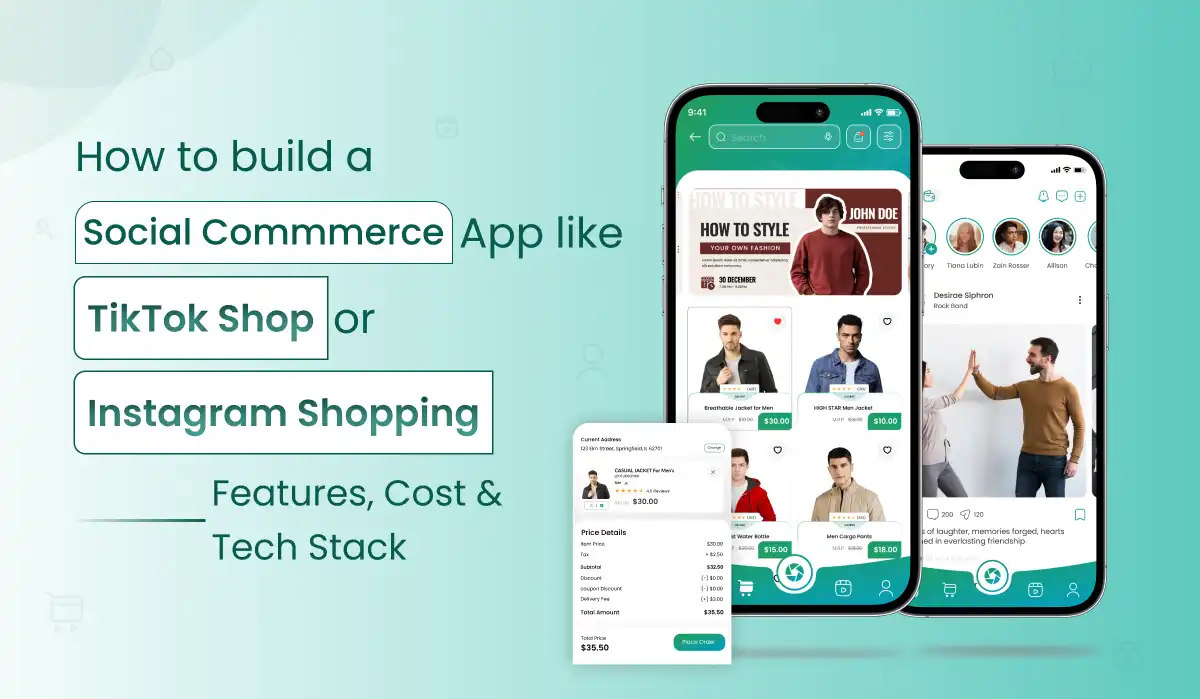
How to Build a Social Commerce App Like TikTok Shop or Instagram Shopping in 2026: Features, Cost & Tech Stack
Date
07 Jul, 2026
Share:
TikTok Shop hit $66 billion in global GMV in 2025 on a model that didn’t exist at scale three years ago. The reason it works isn’t clever marketing — it’s architecture. Commerce embedded so deep into content that the line between watching and buying disappears entirely.
The number you came here for
A social commerce app like TikTok Shop costs $20,000–$45,000 for an MVP (shoppable video feed with product tagging, in-app checkout via Stripe, seller dashboard, basic product catalog, buyer purchase history) at India development rates. A mid-tier platform with live shopping, creator affiliate system, and AI product discovery costs $50,000–$120,000. A full-scale marketplace with multi-seller logistics and advanced AI costs $130,000–$300,000+. Industry competitor quotes range from $40,000 to $200,000+ at US or Eastern European rates — zero India-rate options cited across any competitor article in this category. See our TikTok clone and short video app service →
The difference between social commerce and regular eCommerce is one word: friction. Amazon shows you a product you searched for and asks for six clicks to buy it. TikTok Shop shows you a product you didn’t know you wanted inside a video you were already watching, and asks for one tap. That friction reduction — from discovery to purchase without leaving the content — is what drove TikTok Shop from zero to $66 billion in global GMV in roughly two years, and it’s the architectural principle that determines every feature decision in a social commerce platform.
Every guide covering social commerce in 2026 is written for sellers setting up a TikTok Shop or Instagram Shopping account, not founders building a competing platform. That’s the gap this guide fills. The architecture of a social commerce app is genuinely different from a conventional eCommerce app — three distinct surfaces, each requiring different infrastructure, each with different performance requirements, and each failing in a different way if not built correctly.
$1.2T
Global Social Commerce
$87B
TikTok Shop projected GMV 2026
$20K
MVP starting cost (India rates)
40%
Gen Z Starts on TikTok
76%
2025 TikTok Live Buyers
Social Commerce App Architecture: Three Surfaces, Three Systems
Social commerce isn’t a single product — it’s three distinct commerce surfaces that happen to live in the same app. Each requires different backend infrastructure. Build all three as one generic product and you get mediocre performance on all three. Build each surface correctly and they compound on each other — discovery feeds the live sessions, live sessions drive catalog browsing, catalog browsing reinforces the algorithm.
Shoppable Video
Discovery surface — passive intent
3–5%
Typical click-through on product tags
AI recommendation engine is the core product
Product tags embedded in video timeline
Checkout without leaving the video
Real-time engagement signals fed back to algorithm
Requires CDN + HLS video delivery infrastructure
Live Shopping
Highest-converting surface
3–10×
Higher conversion vs standard social posts
RTMP ingest → HLS delivery for viewers
Real-time inventory countdown overlay
Live chat + Q&A moderation layer
Host product spotlight triggers checkout
Urgency mechanics: flash deals, countdown timers
Shop Tab / Catalog
Intent surface — active search
24.1%
TikTok Shop’s US social commerce share by 2027
Searchable product catalog with filters
Personalized recommendations from video behavior
Seller storefronts with product collections
Reviews, ratings, Q&A per product
Requires Elasticsearch for search at catalog scale
Why the AI recommendation engine must be designed before any other feature: The shoppable video feed isn’t a product listing page with video on top — it’s a system where the algorithm determines what each individual user sees, in what order, based on what they’ve watched, what they’ve tapped, how long they spent on each video, and what similar users bought. Designing this correctly means instrumenting every user interaction as a training signal from day one, even if your first algorithm is rule-based rather than machine learning. The data accumulated in your first six months of operation is the training set for the model that will determine your platform’s relevance at month twelve. Build the data pipeline before you need the model, not after you’ve realized your recommendations are showing users products they’ve already bought.
Discovery Commerce Platform — Why It Changes the Architecture
Traditional eCommerce is intent-driven. A user searches for “blue running shoes,” gets results, compares, buys. The algorithm responds to expressed intent. Social commerce in 2026 is discovery-driven: 83% of TikTok shoppers report discovering a new product on the platform, and 40% of Gen Z consumers now start product searches on TikTok rather than Google. Products are surfaced to consumers by the algorithm before they have any purchase intent — and purchase intent is created by the content itself.
This distinction matters architecturally because it means your recommendation engine isn’t serving search results — it’s making editorial decisions about what each user should want next, based on content engagement signals rather than expressed search queries. The technical inputs to that recommendation system are completely different from a search-and-filter product catalog, and the infrastructure that serves high-quality personalised video at 60 frames per second to millions of concurrent users simultaneously is materially more complex than serving product pages.
In-App Checkout Development — Why Friction Is the Enemy
The defining feature of TikTok Shop versus every social commerce attempt before it is that checkout happens entirely inside the app. No redirect to a website. No re-entering payment details. No trust gap where a user leaves the familiar social environment for an unfamiliar storefront. One tap from product tag to purchase confirmation, using payment credentials already stored in the app.
Video watching
Algorithm surfaces product
Product tag tap
In-video product card
Product detail
Images, reviews, size select
One-tap checkout
Saved payment, no redirect
Order confirmed
Returns to video feed
Why saved payment credentials are the checkout feature most founders underscope: The first purchase on any platform always has friction — users enter their card details, shipping address, and billing information. The second purchase on a platform with properly implemented saved credentials takes one tap. The conversion rate difference between first purchase (with full form entry) and repeat purchase (with saved credentials) is typically 3–5× on social commerce platforms. This means your payment architecture needs to handle tokenized credential storage compliantly from day one — not because users will notice the feature in week one, but because the retention mechanism that converts one-time buyers into repeat customers depends on it being there at first purchase. Use Stripe for the actual payment processing and compliance; store only the Stripe customer ID, not raw card data.
Live Shopping App Development — The Highest-Converting Format
Live shopping is where social commerce diverges most sharply from both regular eCommerce and regular live streaming, because it requires both simultaneously. A standard eCommerce platform processes transactions at predictable rates. A standard live stream delivers video to concurrent viewers. Live shopping requires both: delivering real-time video to potentially thousands of simultaneous viewers while processing transactions, updating inventory in real time, managing a live chat stream, and rendering urgency mechanics like countdown timers and “only 3 left” inventory indicators — all without a single second of checkout friction during the peak engagement moment of a live session.
The live shopping infrastructure point that surprises most development teams: When a host spotlights a product during a live session and 500 viewers simultaneously tap “buy,” your inventory system receives 500 concurrent requests for the same SKU within a sub-second window. Without proper inventory reservation logic — a lock that holds stock during the checkout flow rather than only at order confirmation — you will oversell, fail to fulfil, issue refunds, and trigger review-score damage within the first successful live session. This isn’t an edge case; it’s the load pattern of every high-performing live shopping event. Design concurrent inventory reservation into the data model before any other commerce feature, because retrofitting it after overselling incidents is significantly more expensive than designing it correctly on day one. See our live streaming architecture guide for the video infrastructure side →
Why a TikTok Shop Clone Isn’t the Goal — the Real Opportunity
TikTok Shop has 150 million monthly active US users, 100,000+ enrolled creator affiliates, and a discovery algorithm trained on billions of user interactions. A generic TikTok Shop clone competing head-on doesn’t have a path to that discovery network. The real opportunity in social commerce app development is in verticals TikTok Shop’s horizontal model serves poorly.
Independent Fashion & Boutiques
A live shopping platform specifically for independent fashion designers and boutique retailers — discovery tools, inventory management, and creator collaboration built for smaller sellers TikTok Shop’s algorithm treats as secondary.
→ Underserved by horizontal platforms
Collectibles & Limited-Release
Live auctions and drops for sneakers, trading cards, luxury goods — high-intent buyers, transparent pricing, fraud protection built for high-value items. Different from general marketplace.
→ High AOV, repeat buyer community
Food & Specialty Groceries
Social commerce for artisan food producers, specialty importers, and direct-from-farm sellers — product storytelling through live video is the format food commerce is built for.
→ Live demo format works perfectly for food
B2B Wholesale Discovery
Retailers discovering new brands through live product showcases — a format that replicates trade show discovery but with persistent catalog and instant ordering. Faire-meets-TikTok architecture.
→ B2B pricing, high transaction value
Beauty Creator Commerce
A platform where beauty creators own storefronts and sell directly to their audience through tutorials — tighter creator-buyer relationship than TikTok Shop’s broader affiliate model allows.
→ Creator loyalty, recurring community revenue
Regional Social Commerce
TikTok Shop operates in 16 markets — significant gaps in Eastern Europe, South Asia, Africa, and LATAM where local sellers need local payment rails, local languages, and local logistics integration.
→ First-mover in underserved markets
“The social commerce category hit $1.2 trillion globally in 2026 — but the founders who build successful platforms aren’t trying to out-algorithm TikTok. They’re building the platform for a specific category of sellers and buyers that TikTok’s horizontal model will never serve as well as a focused vertical product can.”
Thinking of Building Your Own Social Commerce App?
Tell us your niche and whether live shopping is in scope — get an honest architecture recommendation and a fixed-price estimate within 24 hours.
Social Commerce App Development Cost — 3 Tiers, India Rates
Tier 1
MVP — Shoppable Video + Checkout
$20K–$45K
US equiv: $50,000–$120,000
Shoppable video feed with product tagging
In-app native checkout (Stripe)
Seller dashboard (listing, orders, analytics)
Buyer account + purchase history
Basic product catalog with search
Rule-based recommendation engine
Most CommonTier 2
Full Platform + Live Shopping + AI
$50K–$120K
US equiv: $120,000–$250,000
All Tier 1 features
Live shopping with real-time inventory
Creator affiliate system + commission tracking
AI-powered product discovery engine
Flash deals, countdown timers, urgency mechanics
Seller analytics and performance dashboard
Tier 3
Enterprise Marketplace + Logistics
$130K–$300K+
US equiv: $300,000+
All Tier 2 features
Multi-seller marketplace architecture
Fulfilled-by-Platform logistics integration
Advanced fraud detection (ML-based)
Multi-region, multi-currency
B2B wholesale tier with contract pricing
Social Commerce Tech Stack — Live Shopping & Shoppable Video
Mobile App
Flutter
Web / Seller Dashboard
Next.js
Backend API
Node.js
Database
PostgreSQL
Product Search
Elasticsearch
Video Delivery
HLS + Mux / CloudFront
Live Streaming Ingest
RTMP + FFmpeg
Payments
Stripe Connect
Why Stripe Connect matters more than regular Stripe for a marketplace: Standard Stripe processes payments between a buyer and a single seller — your platform. Stripe Connect enables payments between a buyer and multiple independent sellers, each with their own Stripe account, with your platform collecting a commission on each transaction automatically. For a social commerce platform with multiple independent sellers, this distinction is architectural: Connect handles the split payment, the payout to each seller’s bank account, the platform’s commission deduction, and the tax and 1099 reporting for each seller — all within Stripe’s compliance infrastructure. Building a multi-seller payment flow without Connect means implementing all of this manually, which is where most marketplace founders encounter their most expensive architectural regret. See our eCommerce marketplace architecture guide →
How Social Commerce Platforms Make Money
Transaction Commission
A percentage of every sale processed through the platform. TikTok Shop charges 2–8% commission per transaction. The primary revenue model — scales directly with GMV.
→ 2–8% of GMV, recurring
Promoted Listings & Discovery Ads
Sellers pay to have products surfaced higher in the discovery feed or product catalog. Requires sufficient catalog scale to make the auction mechanism competitive.
→ CPC or CPM, works at scale
Creator Affiliate Commission
Creators earn 5–20% on sales they drive. Platform takes a cut of the affiliate commission or charges brands for affiliate program access. Drives organic discovery at zero platform marketing cost.
→ 10–30% of affiliate payout back to platform
Fulfillment-by-Platform
Sellers send inventory to platform warehouses, platform handles pick-pack-ship. Premium margin on logistics vs commission-only model. Requires real operational infrastructure.
→ Highest margin, Stage 3 decision
Primocys · Social Commerce & eCommerce App Development
We Build the Full Stack — Shoppable Video, Live Shopping, In-App Checkout
Primocys brings real experience from both sides of social commerce, video platform architecture (ReelBoost, TikTok-style apps) and eCommerce platform development (Amazon-style marketplace guide). Flutter mobile apps, Next.js seller dashboard, Stripe Connect for multi-seller payouts. Fixed price from $20,000, full source code ownership.
Shoppable video architecture
HLS delivery, product tag system, recommendation engine instrumented from day one.
Live shopping infrastructure
RTMP ingest + real-time inventory reservation — concurrent oversell prevention designed in.
Conclusion: Is Now the Right Time to Build a Social Commerce App?
Yes — but only if the architecture is built for how people actually buy in 2026. The $1.2 trillion global social commerce market isn’t rewarding platforms that bolt a checkout button onto a video feed; it’s rewarding platforms where discovery, live shopping, and in-app checkout are designed as one coordinated system from day one. TikTok Shop and Instagram Shopping proved the model works. What’s still wide open is the vertical layer — a live shopping app development project for a specific creator community or product category that the horizontal giants serve poorly.
The single most important decision before you start building: Pick your niche, your seller base, and whether live shopping app development is in your MVP scope before you write a single line of code. A social commerce app for independent beauty creators has a completely different recommendation model, checkout flow, and seller dashboard than a general shoppable video app development project competing head-on with TikTok Shop. Get this right first — everything else, from tech stack to cost tier, follows from it. If you’re not sure, talk to us before you scope — it’s a conversation we have with every founder, at no charge.
Questions About Building a Social Commerce App
How much does it cost to build a social commerce app like TikTok Shop in 2026?
Building a social commerce app like TikTok Shop costs $20,000–$45,000 for an MVP at India development rates. A mid-tier platform with live shopping, creator affiliates, and AI discovery costs $50,000–$120,000. An enterprise platform with multi-seller support, inventory sync, fraud detection, and fulfillment features typically costs $130,000–$300,000+. Get a personalised estimate →
What are the three core surfaces of a social commerce platform?
A social commerce platform combines three core experiences: Shoppable Video for product discovery with tagged videos, Live Shopping for real-time selling and high-conversion purchases, and a Product Catalog/Shop Tab for browsing and search. Each requires different backend architecture for video delivery, live streaming, inventory, checkout, recommendations, and catalog management to work together reliably.
What is discovery commerce and why does it change how social commerce apps are built?
Discovery commerce shows users products before they actively search. TikTok Shop is built around this model, with AI-powered recommendations driving product discovery. For a social commerce app, the recommendation engine should be a core part of the architecture—not an afterthought. Even if you launch with a simple rule-based system, design the data pipeline to support future AI personalization and scaling.
Should I build a general social commerce platform or focus on a niche category?
Build a niche social commerce platform focused on a specific product category or community instead of competing directly with TikTok Shop. Strong opportunities include live shopping for fashion boutiques, creator-driven beauty marketplaces, live auctions for collectibles, or B2B wholesale discovery. Vertical platforms can offer specialized features, stronger communities, and a more tailored buying experience. Tell us your niche — free scope call →
Ready to Build Your Social Commerce Platform — All Three Surfaces, Done Right
Tell us your niche, your seller profile, and whether live shopping is in your MVP scope. We’ll give you an honest architecture recommendation and a fixed-price estimate within 24 hours.
Arpan leads product and engineering at Primocys, a Top-Rated Clutch app development company based in Ahmedabad, India. With over 10+ years of experience, he has successfully delivered real-time communication platforms for 1,200+ clients worldwide.
He is directly involved in overseeing the development of chat and messaging applications, ensuring high performance, scalability, and seamless user experience in every project.
📧 Email: [email protected]
📱 WhatsApp: Chat on WhatsApp
Trusted by Global Businesses for AI, Mobile, SaaS & Custom Software Development. Your Vision, Our Expertise.Trusted by Global Businesses for AI, Mobile, SaaS & Custom Software Development. Your Vision, Our Expertise.Trusted by Global Businesses for AI, Mobile, SaaS & Custom Software Development. Your Vision, Our Expertise.Trusted by Global Businesses for AI, Mobile, SaaS & Custom Software Development. Your Vision, Our Expertise.Trusted by Global Businesses for AI, Mobile, SaaS & Custom Software Development. Your Vision, Our Expertise.Trusted by Global Businesses for AI, Mobile, SaaS & Custom Software Development. Your Vision, Our Expertise.
Hear from our clients and why 1200+ businesses trust Primocys
"Our B2B and B2C platform helps Nigerian manufacturers sell at wholesale
prices and suppliers offer competitive retail pricing, with a strong focus on Made in Africa products
and easy local and international distribution.
The app has received excellent user reviews for its design and unique features. Communication with the
Primocys team was smooth in an agile setup, even beyond office hours when needed. Their mobile app
development expertise is excellent—highly professional and reliable."
Adegbuyi OduguwaCEO & Co-Founder
"The dating app was delivered successfully and approved by both Apple App
Store and Google Play. Our users are highly impressed with the design, UI, and overall functionality.
The project was well planned with clear milestones, and all modules were delivered on time.
The team is talented, patient, and flexible, accommodating multiple scope revisions as requirements
evolved. Their 24/7 development and support availability made the entire process smooth and reliable."
Revanth KExecutive
" We hired Primocys to develop a highly complex and specialized mobile
application, and they delivered outstanding results. The app includes advanced features such as
timeline mixers, classifieds, payments, advertisements, GPS functionality, and more. Their technical
skills, timely delivery, availability, and the personal attention Arpan Sagar brings to each project
truly stand out. The team stays focused and committed from start to finish—an excellent experience
overall."
Gregor Skerl Founder PROHUNTER
" Great team with excellent communication and a strong commitment to on-time
delivery. They developed a fully customized mobile app for both Android and iOS, perfectly matching
our requirements. The entire process was smooth and professional, with clear updates at every stage.
They are reliable, skilled, and very easy to work with. We’re continuing our partnership on more
projects, and choosing them has been one of the best business decisions I’ve made."