
Global overall
Android 72%
iOS 28%
 DapkeSocial video app with live streaming and PK battles.
 Lika Real EstateProperty discovery platform for listings and leads.
 BurpoutSocial fitness challenges that keep people moving.
 ChatLivoConnected customer communication SaaS workspace.
 EmoTalesAI storytelling adventures designed for children.
 EarnifyTrack Income from Multiple Sources with Analytics & Tax Planning.
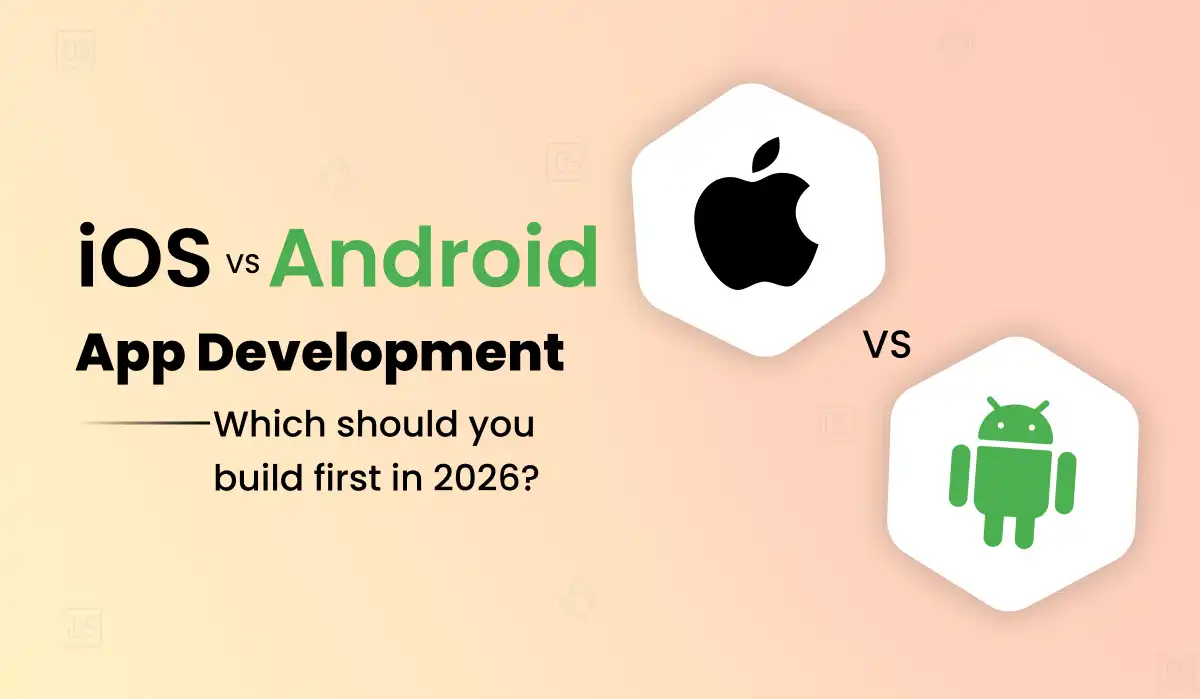
Every founder building their first mobile app hits this question within the first 10 minutes of scoping: iOS or Android app development? Build one now, one later? Or try to do both simultaneously? The answer matters — it affects your launch budget, your development timeline, your first-year revenue, and which half of the world actually gets to use your app.
There’s no single right answer. But there is a framework for getting to the right answer for your specific app, target audience, and budget. This guide gives you the data, the real development differences, and the business logic to make the call confidently — including when the smarter move is to skip the debate entirely and build both platforms at once with Flutter .
Quick Summary: Build iOS first if targeting the US, UK, Australia, or Western Europe — iOS users spend 2× more and generate higher app revenue. Build Android first if targeting India, Southeast Asia, Africa, or Latin America — Android holds 72%+ global market share and 95%+ in emerging markets. Build both with Flutter if your budget is $25K+, you can’t afford to miss half your market, and you want to launch in both stores simultaneously — one codebase, native performance on both.
Android app development decisions often go wrong when founders assume their personal device preference reflects the market. It usually doesn’t — especially if they’re in a different country from their target users.
// Global Market Share by Region · 2026
The data tells a clear story: iOS dominates high-income English-speaking markets. Android dominates almost everywhere else by an enormous margin. If your app targets the US market, you’re building for an audience where iOS is the majority. If you’re building for India — where Primocys is headquartered and where we’ve shipped hundreds of mobile apps — Android is not optional, it is the market.
This is where the data surprises most people. Android has nearly 3× the global user base, yet the Apple App Store generated almost double Google Play’s developer payouts in 2024 — $89 billion vs $47 billion. That gap is driven entirely by user spending behavior, not platform size.
iOS users spend, on average, 2× more on apps than Android users. This is partly demographic — iOS users skew toward higher-income brackets in high-spending markets — and partly behavioral. The App Store’s payment infrastructure has historically made purchasing feel more friction-free. For subscription apps, premium apps, and in-app purchase-driven models (games, social apps with virtual goods), iOS almost always outperforms Android in revenue per active user.
While iOS wins on revenue per user, Android’s scale means total Android revenue is growing fast. The Indonesia and Malaysia markets — both Android-dominant — represent over 370 million mobile users. Sub-Saharan Africa is 90%+ Android. Latin America is 85%+ Android. If your app is ad-supported, freemium, or monetizes through marketplace commissions (like our food delivery app clients), volume beats per-user spend.
| Monetization Model | iOS Advantage | Android Advantage | Recommendation |
|---|---|---|---|
| Paid app (upfront purchase) | ✓ Stronger — users more likely to pay | Lower willingness to pay upfront | iOS first |
| Subscription | ✓ Higher ARPU in US/UK/AU markets | Narrowing gap in 2026 | iOS first (West), Android first (emerging) |
| In-app purchases / virtual goods | ✓ Higher spend on gifts, coins, boosts | High volume in large markets | iOS first, then Android |
| Advertising (CPM/CPC) | Higher CPM rates | ✓ Larger reach for ad impressions | Both — but Android for volume markets |
| Commission / marketplace | Higher-value transactions | ✓ More transactions in emerging markets | Depends on target market |
| Freemium | Better premium conversion rate | ✓ Larger free user acquisition | Both essential |
⌘ The iOS Revenue Rule of Thumb For every $1 you make per user on iOS in the US, you’ll typically make $0.40–$0.60 per user on Android in the same market. The gap narrows in emerging markets and widens in premium app categories. For subscription apps specifically, iOS users have a 2.5× higher 12-month LTV than Android users targeting the same US demographic. This is why most Western startup apps launch iOS first.
Development cost is one of the most misunderstood aspects of the iOS vs Android decision. Most people assume one platform is dramatically cheaper than the other. The reality is more nuanced — and there’s a third option that changes the math entirely.
The cost parity between iOS and Android might surprise you — building native iOS is often slightly cheaper (10–15%) because Apple’s smaller device ecosystem means less testing effort. But both native builds together cost 60–80% more than building with Flutter . For most startups where budget matters, Flutter is the answer to the iOS vs Android debate: build both, for less, simultaneously.
Timeline matters enormously for startups. Every week of development is a week of burn without revenue. Here’s the honest breakdown of how long each path takes:
| App Complexity | Native iOS (Swift) | Native Android (Kotlin) | Flutter (Both) |
|---|---|---|---|
| Simple MVP (10–15 features) | 10–14 weeks | 12–16 weeks | 10–14 weeks total |
| Mid-complexity (social, marketplace) | 14–18 weeks | 16–20 weeks | 14–18 weeks total |
| Complex (real-time, payments, AI) | 18–26 weeks | 20–28 weeks | 18–24 weeks total |
| Both platforms natively | 26–40 weeks (some overlap possible) | Same as single native app | App Store review time | 1–3 days | 1–3 days | Same as above |
| First rejection risk | ~40% of first submissions | ~25% of first submissions | Same as above |
The Flutter timeline advantage is significant: building both platforms natively takes 26–40 weeks, while Flutter delivers both in 14–18 weeks for the same mid-complexity app. For a startup launching a social media app , messaging platform , or on-demand service app , that 12–22 week difference can be the margin between launching before and after a competitor.
If you’re evaluating development partners or trying to understand what your team is actually building, here’s a clean summary of the core technical differences between iOS and Android development:
One key practical difference: Android device fragmentation. iOS runs on a defined set of iPhone and iPad models with well-tested hardware variants. Android runs on over 24,000 device models from Samsung, Xiaomi, OnePlus, OPPO, Realme, and hundreds of others — each with slightly different screen sizes, processors, and OS customizations. This makes Android development require broader testing effort and occasionally causes UI and performance issues that don’t appear on iOS. Most experienced Android developers have established testing frameworks to manage this, but it’s a real cost driver.
◆ Why Flutter eliminates the Swift vs Kotlin debate Flutter uses Dart — a language similar to TypeScript and Java in syntax, easy to learn for most developers. One Dart codebase compiles to native ARM code for iOS and Android (not a web wrapper). Your team learns one language, maintains one codebase, and ships features to both platforms simultaneously. Primocys has been building Flutter apps since Flutter 1.0 — we’re a Clutch Top Flutter Developers 2026 award winner with 200+ Flutter apps in production. See our Flutter app development services .
The App Store and Google Play are not the same — and the differences affect your launch timeline, revenue strategy, and ongoing maintenance overhead. Here’s what you need to know before submitting:
| Factor | Apple App Store | Google Play Store |
|---|---|---|
| Developer fee | $99/year (USD) | $25 one-time lifetime |
| Revenue cut (standard) | 30% (15% for small biz under $1M/year) | 30% (15% for first $1M/year for all) |
| Review time | 1–3 days typically | 1–3 days typically |
| First rejection rate | ~40% of first submissions | ~25% of first submissions |
| Review strictness | Strict — privacy, IAP, UI guidelines enforced | More permissive on features, UI |
| Side-loading allowed | No (except enterprise MDM) | Yes — APK installs permitted |
| In-app subscription billing | Must use StoreKit (Apple’s system) | Must use Play Billing (Google’s system) |
| Physical goods IAP rule | No commission on physical goods | No commission on physical goods |
| Update approval required | Yes — every update goes through review | Yes — though typically faster |
| TestFlight / Beta | TestFlight (up to 10,000 testers) | Internal/Open/Closed testing tracks |
Apple’s Most Common Rejection Reasons (avoid these): Missing privacy policy — required for any app that collects user data. Improper in-app purchase handling — must use StoreKit for digital goods sold in-app. UI violates Human Interface Guidelines — especially tab bars, navigation patterns, and button styles. App crashes on review device — test on real devices, not just simulator. Placeholder content — submitting with Lorem ipsum or test data. Working with an experienced iOS app development company like Primocys gets apps approved on first submission — a meaningful time and money saver.
For many founders, the iOS vs Android question is a false choice created by the assumption that building both means doubling the budget and timeline. Flutter breaks that assumption entirely.
Flutter is Google’s open-source UI framework. You write one Dart codebase that compiles to native ARM machine code for iOS and Android — not a web wrapper or JavaScript bridge. The UI renders identically on both platforms using Flutter’s own rendering engine (Skia/Impeller), with platform-specific adaptive widgets that respect iOS and Android design conventions where needed.
Flutter is not the answer for every project. Choose native iOS or Android development when: you need deep integration with platform-specific APIs that Flutter doesn’t fully expose yet (ARKit for iOS, specific Android hardware APIs); your app’s core experience relies on the absolute bleeding-edge of platform UI (like using the latest SwiftUI animations in iOS-only apps); or you have an existing large native codebase that would cost more to migrate than to maintain.
For most apps we cost in 2026 — social platforms, on-demand services, messaging apps, fintech apps, fitness apps — Flutter delivers equivalent performance at significantly lower cost. Our TikTok clone app Reelboost , our Instagram clone apps , and our WhatsApp clone apps are all built with Flutter — and they’re live on both stores.
The platform decision changes significantly depending on what type of app you’re building. Here’s our recommendation by category based on 200+ apps shipped:
| App Category | iOS Priority | Android Priority | Best Approach |
|---|---|---|---|
| Dating apps | ✓ Higher premium conversion | Large volume in emerging markets | iOS first (US/UK) or Flutter both |
| Food delivery apps | Higher order values per user | ✓ Volume in India/SEA markets | Flutter — needs both markets |
| Social media / photo sharing | ✓ Better content creator experience | Larger global audience | Flutter — social needs scale |
| Short video apps | Higher in-app coin purchases | ✓ Larger ✓ Regional language content markets | Flutter — short video is global |
| Messaging apps | US/Europe first | ✓ India/SEA/Africa dominant markets | Flutter — messaging must be cross-platform |
| Fintech / Banking | ✓ Higher transaction values | Required in India/Africa (90%+ Android) | Flutter — financial apps need both |
| Fitness / Wellness | ✓ Apple Health integration | Google Fit / Wear OS market | iOS first, then Flutter for Android |
| B2B / Enterprise tools | ✓ Professionals often use iPhone | Android tablets in warehouses/logistics | iOS first for desk workers, Android for field |
| On-demand services | Customer side: iOS first (US) | ✓ Service providers often use Android | Flutter — both sides of marketplace need both |
| Gaming | ✓ Higher IAP revenue per user | Larger total player base | iOS first for premium, Flutter for casual |
◆ DATING APP · FLUTTER · iOS + ANDROID
PROHUNTER’s founder wanted to reach both iOS users in the US and Android users in South Asia simultaneously. Building two native apps would have extended the timeline by 14+ weeks and added $40,000+ to the budget. We built with Flutter — one Dart codebase, launched on both App Store and Google Play simultaneously. First submission approved by both Apple and Google. Now at 50,000+ active users with a 4.7★ App Store rating.
Active users across both platforms
App Store rating
Both stores approved first submission
◆ FINTECH · NATIVE iOS + NATIVE ANDROID · WHY WE BUILT NATIVE
BatPay is a multi-currency digital wallet processing $5M+ monthly. They needed deep biometric authentication (Face ID, fingerprint), device-level encryption, and hardware security module (HSM) integration that required native-level APIs at the time of development. We built native iOS (Swift) and native Android (Kotlin) separately — justified by the security requirements and the $5M+ monthly transaction volume that demanded absolute performance certainty. This is the exception, not the rule.
Monthly transaction volume
Transaction success rate
Compliance achieved
Startups face a unique challenge: limited budget, tight timeline, and the pressure to reach as many users as possible from day one. The platform decision is even more critical at the early stage because a wrong call can mean 6 months of lost time and a depleted runway.
For startups with a budget of $25K+, cross platform app development with Flutter is almost always the right answer. You launch on both the App Store and Google Play simultaneously — capturing iOS users in the US and UK while also reaching Android-dominant markets like India, Southeast Asia, and Africa. A single Flutter codebase means one team, one QA cycle, and one set of updates — dramatically reducing burn rate after launch.
For India-based startups or apps targeting South Asian markets, android app development is the logical starting point — Android holds 95%+ market share in India. With mobile app development india rates averaging $20–$50/hour, a well-scoped Android MVP can launch in 10–14 weeks for $15,000–$40,000 — significantly lower than Western agency rates for the same output quality.
For startups targeting the US, UK, or Australian markets, iOS app development first makes strong commercial sense. iOS users in these markets spend 2× more on apps, convert at higher subscription rates, and provide higher-quality early feedback. An ios app development company usa partner or an India-based team with proven US-market iOS experience can deliver an iOS MVP in 10–14 weeks — typically the fastest path to revenue validation in premium markets.
Stop agonizing and use this framework. Answer two questions: (1) Where do your first 1,000 users live? (2) How does your app make money? These two answers determine your platform strategy more than anything else.
✓ Primocys Recommendation for 80% of Projects: For most mobile app development projects we scope in 2026, Flutter is the right answer. It delivers both platforms simultaneously at 30–40% lower total cost, with near-native performance that’s indistinguishable from native for the vast majority of app types. The only compelling reasons to go native are: (1) extremely deep platform-specific integrations, (2) an existing large native codebase, or (3) a single-platform app targeting a very specific audience (like an Apple Watch-only fitness app). For everything else — especially social apps, messaging platforms, on-demand services, and fintech — Flutter is the answer to the iOS vs Android question.
The iOS vs Android debate in 2026 is no longer purely a technical question — it is a strategic business decision shaped by your target market, revenue model, timeline, and budget.
At Primocys — a mobile app development india-based team trusted by clients across the ios app development company usa and android app development company uk markets — we help founders make this decision every week. Our recommendation is almost always Flutter for new products: ship faster, spend less, reach more users.
Ready to make the call? Get a free 60-minute platform strategy consultation — we’ll tell you exactly which platform to build first based on your specific audience, monetization model, and budget.

Hear from our clients and why 1200+ businesses trust Primocys

"Our B2B and B2C platform helps Nigerian manufacturers sell at wholesale prices and suppliers offer competitive retail pricing, with a strong focus on Made in Africa products and easy local and international distribution. The app has received excellent user reviews for its design and unique features. Communication with the Primocys team was smooth in an agile setup, even beyond office hours when needed. Their mobile app development expertise is excellent—highly professional and reliable."

"The dating app was delivered successfully and approved by both Apple App Store and Google Play. Our users are highly impressed with the design, UI, and overall functionality. The project was well planned with clear milestones, and all modules were delivered on time. The team is talented, patient, and flexible, accommodating multiple scope revisions as requirements evolved. Their 24/7 development and support availability made the entire process smooth and reliable."

" We hired Primocys to develop a highly complex and specialized mobile application, and they delivered outstanding results. The app includes advanced features such as timeline mixers, classifieds, payments, advertisements, GPS functionality, and more. Their technical skills, timely delivery, availability, and the personal attention Arpan Sagar brings to each project truly stand out. The team stays focused and committed from start to finish—an excellent experience overall."

" Great team with excellent communication and a strong commitment to on-time delivery. They developed a fully customized mobile app for both Android and iOS, perfectly matching our requirements. The entire process was smooth and professional, with clear updates at every stage. They are reliable, skilled, and very easy to work with. We’re continuing our partnership on more projects, and choosing them has been one of the best business decisions I’ve made."

AWARDS
TRUSTED BY GLOBAL BRANDS