







From a lean customer portal to a full-scale business platform, here is what web app development cost really covers—and how to avoid paying for features you do not need yet.
Quick answer: A narrowly scoped custom web app can start around $5,000–$15,000 with an offshore development team. A capable business web application often needs $15,000–$50,000, and complex enterprise systems may exceed $50,000. These are illustrative planning ranges, not guaranteed quotes. Workflows, integrations, security and team location decide your final price.
Here is a familiar situation: a business owner asks for “a dashboard where customers can log in.” It sounds small. Then the conversation reveals six user roles, recurring billing, reports, third-party data sync and approval workflows. Suddenly, the dashboard is a product. The difference is not the number of screens—it is what must happen behind them.
Web app vs website: A marketing website mainly publishes content. A web application lets people perform tasks—manage accounts, book services, collaborate, pay, approve requests or work with business data. This guide is about the second category. For simpler websites, see Primocys web development services .
Web App Development Cost by Project Type
See what a web app costs by project type, from lean MVPs to enterprise platforms. Compare budgets and timelines, then get a free estimate for your project.
| Project type | Illustrative build budget (USD) | Typical first-release scope | Indicative timeline |
|---|---|---|---|
| Lean web app MVP | $5,000–$15,000 | Login, one core workflow, simple admin, basic reporting | 6–12 weeks |
| Customer or partner portal | $8,000–$25,000 | Role-based access, records, notifications, document handling | 8–16 weeks |
| Booking or marketplace web app | $12,000–$35,000 | Listings, scheduling, payments, admin and transaction flows | 10–20 weeks |
| Custom CRM or operations platform | $15,000–$50,000 | Multiple workflows, reporting, permissions, integrations | 3–6 months |
| Complex enterprise web platform | $50,000–$150,000+ | Advanced compliance, migration, audit logs, SSO, complex integrations | 6–12+ months |
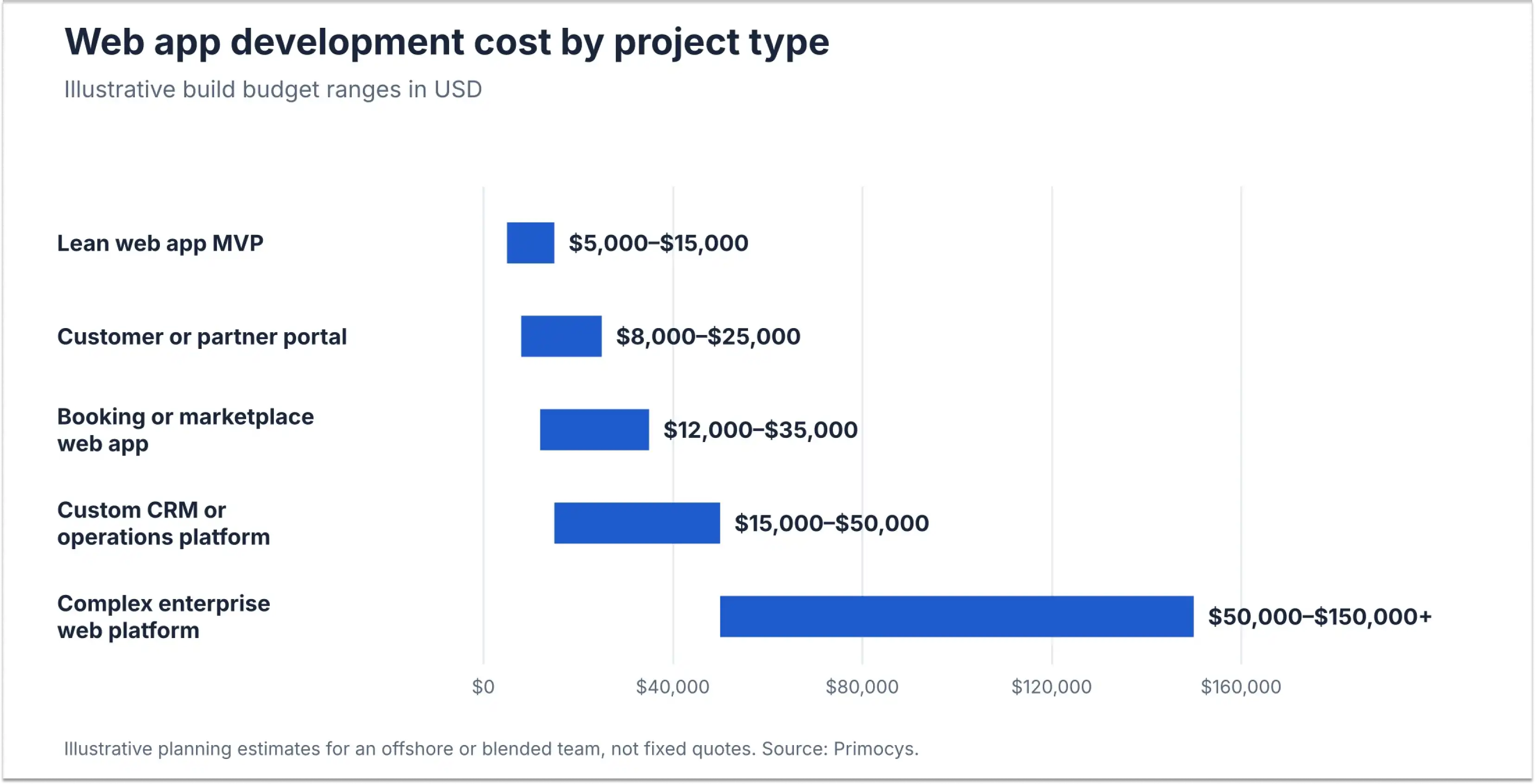
Why the wide ranges? Two customer portals can look nearly identical and have very different engineering needs. A portal showing records already stored in one database is much simpler than a portal that reconciles data from four vendors, manages sensitive records and maintains a detailed audit trail. That is why the cost to build a web app is better estimated from workflows than from screen counts, and why enterprise web app development cost rises sharply once compliance, migration and audit logs are required.
What determines web application development cost?
Five factors shape your web app budget, from business logic to growth plans. Know what drives the price, then share your project for a free web app estimate.
Business logic, not just the interface
A booking form can simply save a date. A production booking engine also handles double bookings, time zones, refunds, cancellation rules and commissions. Those rules take time to design, build and test.
Number of user roles
One login type is relatively straightforward. Separate experiences for customers, staff, managers, vendors and administrators create more permissions, edge cases and testing.
Integrations and data migration
Connecting Stripe or an email provider may be routine. Synchronizing an older ERP or importing years of inconsistent records is not. Ask whether your quote includes API discovery, error handling, retries and reconciliation.
Security, privacy and compliance
Secure authentication, backups and sensible access controls should not be optional. Systems handling medical, financial or other sensitive data may also need additional controls, audits and specialist review. Compliance is not something a generic template can promise.
Performance and growth expectations
A dashboard for 40 employees is not the same infrastructure challenge as a public platform serving tens of thousands of concurrent users. Design for a realistic first-year workload, with a path to scale.
Web App Development Cost by Feature
Every feature adds to your web app budget, but not in a simple sum, since features share design, backend and testing work. Use these ranges, then get a free estimate.
| Feature | Illustrative additional cost | What changes the estimate? |
|---|---|---|
| Authentication and profiles | $500–$2,500 | SSO, MFA, account recovery, roles |
| Custom dashboard and reporting | $1,000–$5,000 | Data sources, filters, exports, chart complexity |
| Payment or subscription integration | $1,000–$4,000 | Trials, tax, invoices, refunds, proration |
| Booking and scheduling | $1,500–$6,000 | Availability, calendars, cancellations, time zones |
| Admin panel and permissions | $1,500–$6,000 | Approval workflows, audit trails, multiple roles |
| Third-party API integration | $750–$5,000+ | API quality, data mapping, error recovery |
| Real-time chat or notifications | $1,500–$7,000 | Presence, attachments, scale, delivery guarantees |
| AI-powered feature | $2,000–$10,000+ | Knowledge retrieval, evaluation, safeguards, usage costs |
Example: a $20,000 customer portal budget
Imagine a growing service company replacing spreadsheets and email chains with a portal. Customers submit requests, staff manage them, and managers see progress. This is a hypothetical planning example, not a disclosed client invoice.
| Workstream | Budget |
|---|---|
| Discovery, requirements and workflow mapping | $1,500 |
| UI/UX design and responsive layouts | $2,500 |
| Frontend portal and dashboard | $4,500 |
| Backend, database and permissions | $5,000 |
| Email notifications and one integration | $2,000 |
| QA, security review and deployment | $2,500 |
| Contingency for scoped unknowns | $2,000 |
| Total | $20,000 |
What is deliberately excluded? A mobile app, complex analytics, multiple legacy integrations and advanced automation. Those could follow once the team sees how customers actually use the portal.
Where Your Web App Development Budget Goes
Know where your web app budget goes, from discovery to post-launch support. Share your project and get a free estimate with every phase clearly scoped.
Discovery
Understand the problem, user roles, dependencies and acceptance criteria.
Design
Map the workflows, create wireframes and confirm key interactions.
Development
Build frontend screens, backend logic, database structures and APIs.
Testing
Check functional flows, permissions, edge cases, performance and browser behavior.
Deployment
Configure hosting, monitoring, backups and production releases.
Post-launch support
Fix defects, watch usage and prioritize improvements.
Be cautious when a quote describes only “frontend and backend development.” Ask who owns requirements, QA, deployment, documentation and the handover. Omitting those tasks does not make them disappear.
Which technology stack makes sense?
For many modern business applications, a practical architecture is React or Next.js for the interface, Node.js or NestJS for backend services, and PostgreSQL for structured data. Real-time collaboration might use Socket.io; file uploads might use object storage. But the right stack follows the product requirements, not a trend.
A simple internal tool may benefit from existing frameworks and managed services. A regulated or highly customized platform may require more deliberate architecture. The expensive mistake is choosing technology before defining the workflows.
Web App, PWA or Mobile App: What Should You Build First?
Not sure whether to build a web app, a PWA or a mobile app? The choice changes your budget and timeline, so decide it before you request quotes.
| Option | Best when | Cost and effort | Main trade-off |
|---|---|---|---|
| Responsive web app | Users mostly work on laptops or desktops, or you need the fastest first release | Usually the lowest build effort, because one codebase runs in the browser | Limited access to some device features and no app-store presence |
| Progressive web app (PWA) | Users mostly use browsers but want installable, app-like behavior such as offline access and notifications | PWA development cost usually sits between a basic web app and a native mobile app, because offline and caching logic add work | Support for some features varies by browser and device |
| Mobile app (native or Flutter) | Your product depends on deep device features, app-store distribution or frequent mobile use | Highest effort, since it adds platform testing and store submission | Higher cost and a longer timeline |
Many teams validate the idea with a responsive web app or PWA first, then add a mobile app once real usage proves the need. For mobile budgets, see our mobile app development cost guide and the app cost calculator.
Web App Development Company vs Freelancer vs In-House
Choosing who builds your web app changes cost, speed and risk. Compare agency, freelancer and in-house options, then share your project for a free estimate.
| Model | Best suited for | Main trade-off |
|---|---|---|
| Freelancer | Small, well-defined tasks and prototypes | Limited coverage for design, QA and continuity |
| Development agency | End-to-end delivery with several disciplines | Higher coordination cost than one contractor |
| In-house team | Long-term core product with continuous development | Recruitment, salaries, management and retention |
| Dedicated remote team | Ongoing roadmap needing flexible capacity | Requires clear ownership and communication practices |
When comparing quotes, compare deliverables, not just hourly rates. One team may include UX, QA and deployment; another may charge separately. Also confirm who owns the repository, hosting accounts and source code.
Web App Development Cost per Hour by Region
Where your team is based changes your web app price as much as what you build. Compare hourly rates by region, then get a free estimate for your project.
| Region | Typical hourly rate (USD) | What to expect |
|---|---|---|
| United States | $65–$250 | Highest rates, with senior and agency teams at the top of the range |
| Western Europe (including the UK) | $40–$170 | Strong talent, with rates varying widely by country and seniority |
| Eastern Europe | $25–$110 | Good engineering depth at mid-range pricing |
| India and South Asia | $20–$50 | Most cost-efficient for full-stack delivery; check time-zone overlap and IP ownership |
These ranges come from published 2026 industry guides, so use them to compare proposals rather than as quotes. Primocys is based in India and lists $25–$49 per hour on its Clutch profile. Ask every vendor what the rate includes, such as design, QA, project management and deployment. If you plan a long-term roadmap, you can also hire web app developers as a dedicated team on a monthly basis.
Web App Pricing Model: Fixed vs Hourly vs Dedicated Team
How you pay shapes your web app budget as much as the rate. Compare three pricing models, then share your project for a free estimate.
| Pricing model | How you pay | Best for | Watch out for |
|---|---|---|---|
| Fixed price | One agreed price for a defined scope | Clear requirements, shorter projects and tight budget approval | Changes usually mean a new quote, so the scope must be precise |
| Time and materials | You pay for the actual hours worked | Evolving requirements and early-stage products | Needs a budget cap and regular progress reports |
| Dedicated team | A monthly fee for a team working on your roadmap | Long-term products and continuous development | Needs clear ownership and communication practices |
Many teams start with a fixed-price discovery phase, then move to a milestone-based or monthly model once the scope is clear. Ask each vendor to explain its web app development pricing model in writing.
Ongoing Web App Costs Most Teams Underestimate
Hidden running costs can inflate your web app budget after launch. See what to plan for, then share your project for a free estimate that covers year one.
ONGOING WEB APP COSTS
- Cloud hosting and databases: Usually modest at launch, but affected by traffic, storage and redundancy.
- Third-party services: Payments, email, SMS, maps, AI APIs and analytics may charge by usage.
- Security and maintenance: Dependency updates, vulnerability fixes, monitoring and backup checks.
- Support: Handling production incidents, user requests and minor enhancements.
- Compliance and legal review: Additional work when the platform handles regulated or sensitive data.
A useful first-year budget separates one-time development from monthly operating costs. A low build quote is not necessarily cheaper if it creates expensive manual work or high usage fees later.
Web app maintenance cost: what to budget each year
A web app needs ongoing care after launch. Many 2026 cost guides suggest budgeting roughly 15–20% of the original build cost per year for maintenance, though traffic, integrations and support needs can move that figure.
Example: for the hypothetical $20,000 customer portal above, that rule of thumb points to roughly $3,000–$4,000 per year for updates, security patches, monitoring and minor fixes. Hosting and third-party usage fees are usually billed separately.
Ask for a written support plan at handover that lists what is covered, response times and the monthly fee. That way, your web app maintenance cost is a planned line in the budget, not a surprise after launch.
Our Web App Product Experience
See how Primocys approaches real web products, from live chat to team messaging. Share your idea and get a phased scope and free estimate.
Chatlivo — SaaS live chat and AI support platform
- Challenge: A business chat platform must manage visitor conversations, agent workflows and a usable administration experience without making the interface overwhelming.
- Solution approach: Organize the product around chat workflows, visitor context, agent assignment and integrations, with AI support as a distinct capability.
- Delivered experience: Chatlivo demonstrates experience with a browser-based SaaS interface, live-chat operations, visitor tracking and AI-assisted support features. Its development cost is not presented here as a representative client quote.
WHOXA BUSINESS — WEB-BASED TEAM MESSAGING
- Challenge: Team messaging tools need clear conversations, account access and dependable real-time behavior.
- Solution approach: Combine a web chat interface with backend messaging logic and administration tools.
- Delivered experience: Whoxa Business provides a relevant example of Primocys’s web messaging product work. This is not a claim about third-party client savings, adoption or revenue.
Cut Web App Development Cost, Keep the Quality
Smart scoping can cut your web app budget without hurting quality. Follow these seven steps, then share your project with us for a free web app estimate.
Choose one outcome for version one
“Customers can submit and track requests” is clearer than “a complete digital platform.”
Map permissions early
User roles discovered late often cause expensive rework.
Use established components carefully
Authentication, payments and email do not always need to be reinvented.
Limit integrations at launch
Start with the one that unlocks the main workflow.
Agree on acceptance criteria
A short, testable definition of done is better than a vague list of features.
Keep the source code and infrastructure accessible
Clear ownership helps avoid costly handover problems.
Plan a second phase
Launch, learn and prioritize features based on real usage.
Red Flags in a Web App Development Quote
Spot costly quote mistakes before you sign. Review these seven red flags, then share your project with us for a clear, fully scoped web app estimate.
One total with no scope
A price without assumptions, deliverables or exclusions cannot be compared.
No time for discovery, QA or deployment
These tasks do not disappear when they are left out of a quote.
A guaranteed fixed price for vague requirements
Unclear scope usually returns later as change requests.
Unclear ownership
The source code, repository and hosting accounts should be yours.
No support period after launch
Ask what happens when something breaks in the first weeks.
No named project lead or regular demos
You should see working progress, not just receive a final handover.
A price far from every other quote
A very low or very high offer needs a clear explanation.
Compare at least two written proposals from any web app development company side by side, and ask each one to list exactly what is included.
What to include when requesting a web app quote
You do not need a 60-page specification. A useful first brief answers: Who are the users? What are their three most important actions? Which existing systems must connect? What data is sensitive? Do you have a preferred launch window? Is there a target budget?
With that information, a development partner can suggest a lean release and explain the trade-offs. For a wider look at the service, visit Primocys web development . If you are planning a subscription product, the SaaS platform development cost guide covers SaaS web app development cost, recurring billing and multi-tenant complexity in more depth.
Conclusion: Plan Your Web App Budget
Web app development cost depends on your workflows, integrations, security needs and the team you choose. A lean MVP can start in the illustrative $5,000–$15,000 range, while enterprise platforms with compliance and migration needs can exceed $50,000. The safest approach is to launch one essential workflow first, ask for a written scope with exclusions and compare at least two proposals from any web app development company before you commit.
If you want a realistic number for your own project, share your users, workflows and systems with the Primocys team. We will suggest a phased scope, explain what is and is not included and give you a clear estimate before you commit to a larger build.
Web App Development Cost: FAQs
How much does it cost to build a custom web app?
How long does it take to develop a web application?
What increases web app development cost the most?
How much does it cost to build a web app for a startup?
How much does web app maintenance cost?
How much does web app development cost per hour?
How do I choose a web app development company?
Is it cheaper to build a web app or a mobile app?
Related Guides

Build your scalable apps today.
Contact UsLeaving Already?
Hear from our clients and why 1200+ businesses trust Primocys

"Our B2B and B2C platform helps Nigerian manufacturers sell at wholesale prices and suppliers offer competitive retail pricing, with a strong focus on Made in Africa products and easy local and international distribution. The app has received excellent user reviews for its design and unique features. Communication with the Primocys team was smooth in an agile setup, even beyond office hours when needed. Their mobile app development expertise is excellent—highly professional and reliable."

"The dating app was delivered successfully and approved by both Apple App Store and Google Play. Our users are highly impressed with the design, UI, and overall functionality. The project was well planned with clear milestones, and all modules were delivered on time. The team is talented, patient, and flexible, accommodating multiple scope revisions as requirements evolved. Their 24/7 development and support availability made the entire process smooth and reliable."

" We hired Primocys to develop a highly complex and specialized mobile application, and they delivered outstanding results. The app includes advanced features such as timeline mixers, classifieds, payments, advertisements, GPS functionality, and more. Their technical skills, timely delivery, availability, and the personal attention Arpan Sagar brings to each project truly stand out. The team stays focused and committed from start to finish—an excellent experience overall."

" Great team with excellent communication and a strong commitment to on-time delivery. They developed a fully customized mobile app for both Android and iOS, perfectly matching our requirements. The entire process was smooth and professional, with clear updates at every stage. They are reliable, skilled, and very easy to work with. We’re continuing our partnership on more projects, and choosing them has been one of the best business decisions I’ve made."

AWARDS



Share Your Requirements
TRUSTED BY GLOBAL BRANDS