






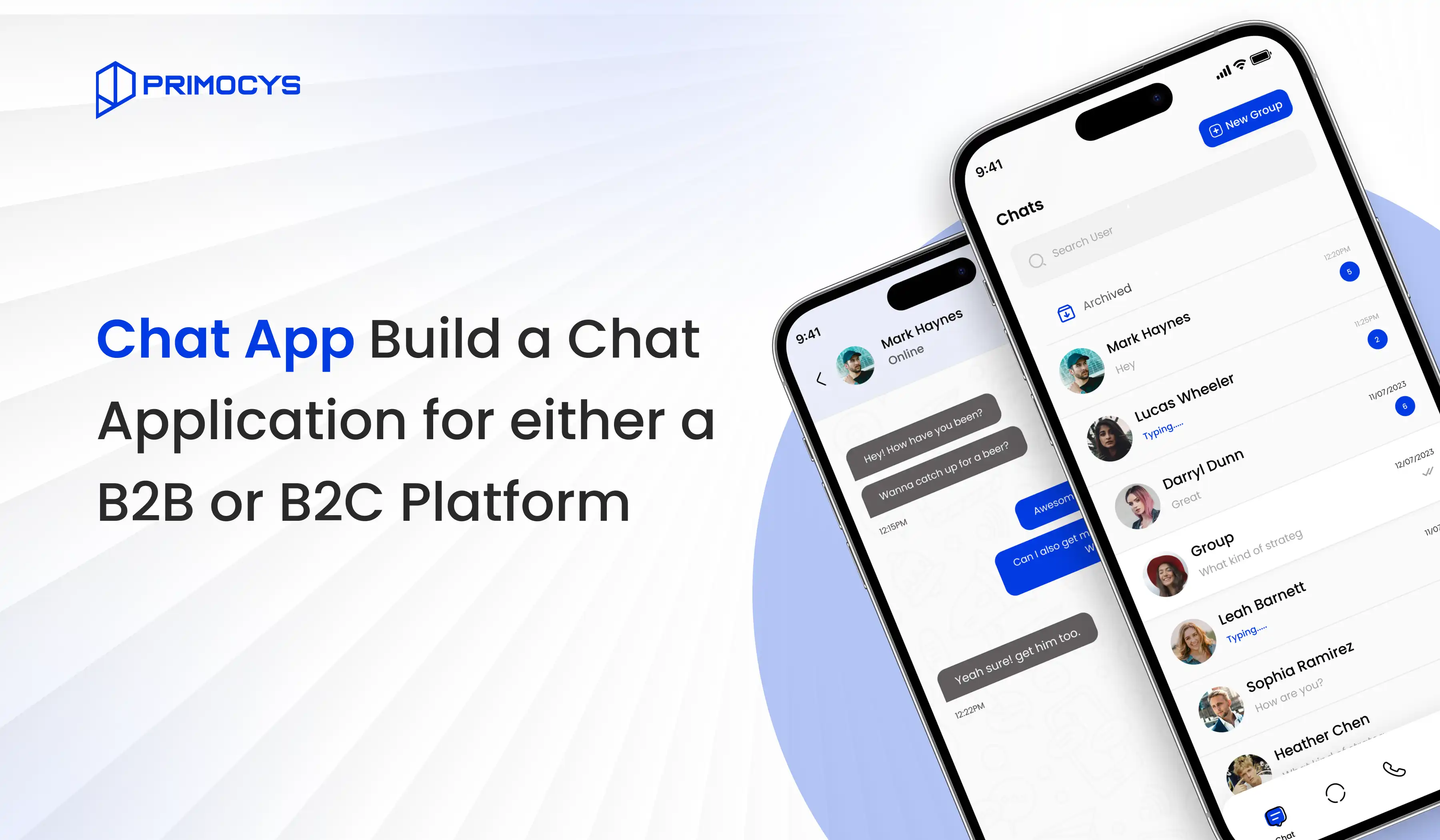
Chat applications and real-time messaging play a vital role in today’s digital landscape, where seamless communication drives business success. Whether you plan to build a b2b chat app for enterprise teams or a b2c mobile app for consumer audiences, an efficient chat application enhances user engagement, improves customer service, and drives measurable sales growth.
This guide explores what goes into building a production-ready chat application. — from defining your audience and choosing a technology stack, to deploying core features and securing your platform. We’ll also cover the top chat app features users love and where a WhatsApp clone solution can fast-track your launch.
Monthly active users on mobile messaging apps globally in 2026
Of B2B buyers prefer chat over phone for first-contact communication
Of consumers say live chat is the most satisfying support channel
The Importance of Chat Applications in B2B and B2C
Chat applications enable real-time communication, allowing users to connect instantly via text, voice, or video. They are essential for b2b chat software, customer support systems, team collaboration, and sales growth. The emergence of b2b app development and b2c mobile apps has changed how businesses interact with clients, making it crucial for companies to implement effective chat solutions.
Why Every B2B Chat App Must Be Purpose-Built for Business
Unlike consumer messaging tools, a dedicated b2b chat software solution offers the security, compliance, and workflow integrations that enterprise teams require. Investing in proper b2b application development from day one prevents costly retrofitting as your organization scales.
Instant Communication
Close deals, share documents, and align with partners in real time — no email lag, no missed context.
Team Collaboration
Real-time updates, project threads, and task-linked messaging accelerate decision cycles across departments.
Vendor & Partner Interaction
Direct channels with suppliers promote transparency and efficiency across your entire supply chain.
Data Security & Compliance
Enterprise chat must safeguard sensitive business information with encryption and regulatory compliance.
Why B2C Mobile Apps Must Prioritize Chat From Day One
B2c mobile apps that embed real-time chat see 40–60% higher Day-30 retention compared to apps without in-app messaging. Chat applications that feel personal, fast, and intelligent are no longer a feature — they’re a baseline expectation for any consumer platform in 2026.
Customer Support
Instant responses to inquiries and rapid issue resolution improve satisfaction scores and reduce churn.
Marketing & Engagement
Send personalized offers, product updates, and triggered campaigns directly in the conversation thread.
Transaction Assistance
AI chatbots guide users through purchases, payment flows, and post-sales support without human overhead.
Community Building
Brand groups and customer forums foster loyalty and turn buyers into active brand advocates.
B2B Chat Software vs B2C Mobile Apps: Key Differences Explained
Understanding the distinction between b2b chat software and b2c mobile apps before you build is the single most important architectural decision in your b2b app development or b2c application development project. The table below maps every major dimension.
| FEATURE / CONSIDERATION | B2B CHAT APP | B2C CHAT APP |
|---|---|---|
| Primary Users | Teams, partners, vendors | End consumers, customers |
| Authentication | SSO, LDAP, OAuth 2.0 | Email, Phone, Social login |
| Access Control | Role-based (RBAC), granular | User-level settings |
| AI Chatbots | Internal workflows, routing | Support, sales, FAQ |
| CRM Integration | ✓ Critical | Optional |
| Compliance (GDPR, HIPAA) | ✓ Mandatory | Recommended |
| White Labelling | ✓ Common | ✓ Common |
| Broadcast / Campaigns | Team announcements | ✓ Marketing campaigns |
| Monetization | SaaS subscriptions, seat-based | Ads, in-app purchases, premium |
| Scalability Priority | Reliability, uptime | Concurrent users, global CDN |
Core Features Every B2B Chat App and B2C Chat Application Must Have
Whether you are investing in b2b application development for an enterprise team or building b2c mobile apps for consumer markets, these features are non-negotiable. Skipping any of them will cost you users — and for b2b chat software, skipping security features can cost you enterprise contracts. top 10 chat app features users love
Real-Time Messaging
Sub-100ms message delivery via WebSockets with typing indicators, read receipts, and online presence.
AI-Powered Chatbots
Handle FAQs, route support tickets, assist purchases, and provide 24/7 automated responses. Essential for any WhatsApp-like chat platform.
Multi-Channel Integration
Connect with Web, iOS, Android, Facebook Messenger, WhatsApp, and your existing CRM tools seamlessly.
End-to-End Encryption
AES-256 + RSA encryption for all messages, calls, and file transfers. GDPR and HIPAA compliance built in.
Voice & Video Calls
HD quality 1:1 and group calling built natively — no third-party apps required. Increases user retention significantly.
Group Chats & Channels
Threaded groups for project teams, broadcast channels for announcements, role-based permissions for admins.
File & Media Sharing
Send documents, images, videos, and PDFs with inline preview. Essential for B2B collaboration workflows.
Multi-Language Support
Auto-detect and translate messages for global teams and international customer bases. Critical for B2C expansion.
Quick context At Primocys, we have built multiple live messaging platforms — including Corex Messenger (enterprise B2B) and Vemenne (student B2C community). Every feature in this list comes from real product decisions made on real shipped apps, not theory.
Real Examples: Corex Messenger (B2B) & Vemenne (B2C)
Rather than describing what is possible in theory, here are two live messaging platforms built and delivered by Primocys — one B2B, one B2C — that demonstrate exactly how these two approaches differ in practice.
Corex Messenger — B2B Enterprise Chat
Corex is a fully branded enterprise internal communication platform — built to replace WhatsApp for corporate teams. Every message and call is hosted on the client’s own server, with no third-party access. Administrators manage departments, control user access levels, and monitor activity through a complete admin panel. Voice and video calls run on self-hosted WebRTC with zero per-call charges.
- Self-hosted WebRTC voice & video — no Agora or Twilio fees
- End-to-end encryption across all messages, calls, and media
- Role-based access — Owner, Admin, Moderator, Member
- Full admin dashboard with user management and analytics
- Cloud Complete white-label — client’s own brand, domain, and app store listing
- All data hosted on client’s own server infrastructure
Vemenne — B2C Student & Education Messenger
Vemenne is a consumer-facing messaging app built for students and university communities — with a standout differentiator: real-time message translation between languages. Students across multilingual campuses message in their native language and have messages auto-translated for recipients. The UX is built mobile-first for Gen Z users.
- Real-time message translation across multiple languages
- Student group chats and campus community channels
- File sharing — PDF, PPT, DOC — shared directly in conversation
- Broadcast channels for department-wide announcements
- Mobile-first UX designed for everyday student use
- Multilingual support built into the core app architecture
The verified tick model is one of the highest-margin monetisation features in any B2C chat app — businesses and creators pay a recurring fee for a verification badge. Zero operational cost, pure recurring revenue. We recommend building it into every consumer chat platform from day one.
Recommended Technology Stack for B2B App Development & B2C Mobile Apps
Choosing the right stack is the single most important technical decision in your chat app project. Below is a battle-tested setup for production-grade B2B and B2C chat platforms, aligned with how we build at Primocys using Node.js.
How to Build a Chat Application: Step-by-Step
Building a chat app is a multi-phase engineering effort. Whether you’re going custom from scratch or starting from a ready-made WhatsApp clone, these five steps define the path from idea to production.
Define Your Requirements & Audience
Before writing a single line of code, map out your audience (B2B, B2C, or hybrid), core use cases, regulatory requirements, and monetization model. Ambiguity at this stage multiplies cost later.
Choose Your Technology Stack
Select backend, frontend, real-time protocol, and database based on your expected user volume and geography. For global scale, pair Node.js with Redis pub/sub and WebSockets. For cross-platform mobile, Flutter is the fastest path to iOS + Android.
Build Core Features First
Prioritize the essentials in your MVP:
- User authentication (JWT, OAuth)
- Real-time 1:1 and group messaging
- End-to-end encryption
- Push notifications (Firebase Cloud Messaging)
- File and media sharing
Design for Experience
A technically brilliant chat app fails if users find it confusing. Prioritize intuitive navigation, dark/light mode, accessible typography, and smooth micro-interactions. Reference our feature guide for UX benchmarks users expect.
Test, Optimize & Deploy
Run load tests simulating 10,000+ concurrent users before launch. Validate E2E encryption, check cross-device sync, and set up auto-scaling on your cloud provider (AWS, GCP, or Azure). Use blue-green deployment to eliminate downtime on updates.
Key Benefits of B2B Chat Software and B2C Mobile Apps for Business Growth
- Streamlined collaboration between distributed teams and external partners
- Faster decision-making cycles with context-rich threaded conversations
- Secure, encrypted communication protects IP and contractual data
- CRM and ERP integration reduces context switching for sales teams
- Audit trails and chat history support compliance and legal discovery
- Higher customer satisfaction scores via instant support resolution
- Increased conversion rates with in-chat purchase assistance
- Personalized AI-driven engagement boosts repeat purchase rates
- Broadcast channels reduce email dependency for campaigns
- Community features increase app stickiness and daily active users
Future Trends Shaping Chat Applications
The next generation of chat applications will reshape both b2b chat software and b2c mobile apps simultaneously. From agentic AI to decentralized messaging, here are the four trends every founder in b2b app development or consumer b2c mobile app development must understand before they build.
Agentic AI in Chat
Next-gen chatbots don’t just answer — they take actions. Booking meetings, processing orders, and escalating tickets autonomously based on conversation context.
Omnichannel Unification
Businesses are merging WhatsApp, Instagram DM, in-app chat, and email into a single inbox. Building for omnichannel from day one is now a competitive baseline.
Voice-First Messaging
Push-to-talk and async voice notes are growing 3x faster than text in Gen-Z demographics — a key consideration for B2C consumer apps targeting emerging markets.
Decentralised & Zero-Knowledge Chat
Privacy-first architectures where even the platform operator cannot read message content are gaining traction in regulated industries like finance and healthcare.
Final Thoughts
Creating a production-ready b2b chat app or consumer-facing b2c mobile app involves careful planning, selecting the right technology stack, and integrating the right feature set. Whether your goal is streamlining b2b application development workflows with a robust b2b chat software platform — or building chat applications that acquire and retain millions of consumers — the approach starts the same way: define your audience, then build exactly what they need.
By following a structured approach, utilizing AI, and ensuring robust security, businesses can develop a future-proof chat platform that meets their needs. Start developing your Chat application today to transform digital communication!
Frequently Asked Questions
What is the key difference between B2B and B2C chat applications?
How long does it take to build a chat application?
What is the cost to build a chat application in 2026?
Can I build a WhatsApp-like chat app for my business?
Can Primocys build a custom chat app with all these features?

Build your scalable apps today.
Contact UsLeaving Already?
Hear from our clients and why 1200+ businesses trust Primocys

"Our B2B and B2C platform helps Nigerian manufacturers sell at wholesale prices and suppliers offer competitive retail pricing, with a strong focus on Made in Africa products and easy local and international distribution. The app has received excellent user reviews for its design and unique features. Communication with the Primocys team was smooth in an agile setup, even beyond office hours when needed. Their mobile app development expertise is excellent—highly professional and reliable."

"The dating app was delivered successfully and approved by both Apple App Store and Google Play. Our users are highly impressed with the design, UI, and overall functionality. The project was well planned with clear milestones, and all modules were delivered on time. The team is talented, patient, and flexible, accommodating multiple scope revisions as requirements evolved. Their 24/7 development and support availability made the entire process smooth and reliable."

" We hired Primocys to develop a highly complex and specialized mobile application, and they delivered outstanding results. The app includes advanced features such as timeline mixers, classifieds, payments, advertisements, GPS functionality, and more. Their technical skills, timely delivery, availability, and the personal attention Arpan Sagar brings to each project truly stand out. The team stays focused and committed from start to finish—an excellent experience overall."

" Great team with excellent communication and a strong commitment to on-time delivery. They developed a fully customized mobile app for both Android and iOS, perfectly matching our requirements. The entire process was smooth and professional, with clear updates at every stage. They are reliable, skilled, and very easy to work with. We’re continuing our partnership on more projects, and choosing them has been one of the best business decisions I’ve made."

AWARDS


Share Your Requirements
TRUSTED BY GLOBAL BRANDS