






You don’t need to build the entire product to find out whether customers want it. Here’s what MVP development cost looks like in 2026, what changes the quote, and where founders can save without cutting the essentials.
When a founder asks, “How much will my MVP cost?”, the answer usually starts with another question: What is the one thing users must be able to do on day one?
A marketplace where customers book one type of service is a different project from a marketplace with live tracking, subscriptions, provider verification, chat, automated payouts and three separate dashboards. Both might be described as an “MVP” in a proposal. Their costs won’t be close.
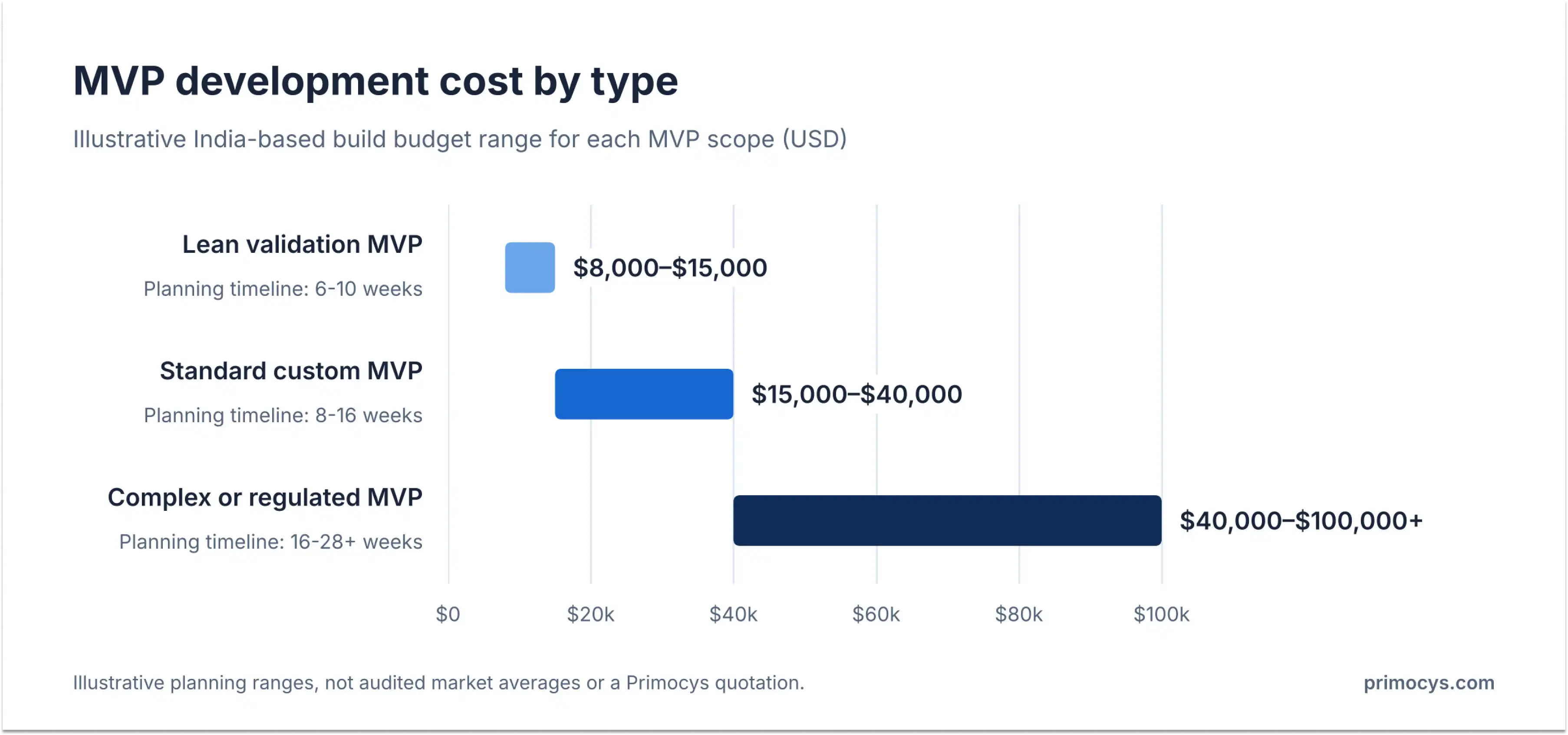
Quick answer: Most MVPs cost between $8,000 and $100,000+ in 2026, depending on scope. A narrowly scoped custom MVP can fall around $8,000–$15,000, a typical startup MVP around $15,000–$40,000, and a complex or regulated MVP around $40,000–$100,000+. Platform choice, design, integrations, QA and scope can move the price substantially. These are illustrative budgets for India-based delivery, not fixed Primocys packages or verified industry averages.
MVP development cost in 2026: a practical breakdown
MVP development cost in 2026 ranges from $8,000 to $100,000+, based on scope. Compare lean, standard and complex MVP budgets and timelines to plan your launch without overspending.
| MVP type | Illustrative build budget (USD) | Typical scope | Planning timeline |
|---|---|---|---|
| Lean validation MVP | $8,000–$15,000 | One core workflow, basic design, limited roles, few integrations | 6–10 weeks |
| Standard custom MVP | $15,000–$40,000 | Customer experience, backend, essential admin, payments or notifications | 8–16 weeks |
| Complex or regulated MVP | $40,000–$100,000+ | Several roles, complex permissions, integrations, security or compliance work | 16–28+ weeks |
These ranges assume India-based delivery, a focused launch scope and conventional cloud architecture. They are planning estimates, not quotations, and taxes, cloud usage and third-party subscriptions may be extra. Budgeting a larger platform? See our custom software development cost guide or SaaS platform development cost breakdown.
MVP development cost India vs US and UK
Team location is one of the biggest levers on MVP development cost. The ranges in this guide assume India-based delivery. The same scope usually costs more with a local agency in the US, UK or Western Europe, because hourly rates are higher.
| Team location | Illustrative hourly budget (USD) | What to check |
|---|---|---|
| India-based agency | $20–$60 | Time-zone overlap, communication process, vendor vetting |
| US, UK or Western Europe agency or contractor | $80–$150+ | Higher rates, easier overlap, local contracting |
| Independent freelancer (any region) | Varies widely | Availability, continuity, code ownership |
Hourly figures are illustrative planning ranges, consistent with our hire dedicated developers guide. They are not market averages or a Primocys quotation.
A lower rate only saves money if quality, communication and code ownership hold up. Before you shortlist a team, review relevant work, agree milestones and compare options in our guide to the best mobile app development companies in India.
MVP app development cost by product type
Minimum viable product development cost changes with the kind of product you build. Find your product type below to see which budget tier it usually starts in, then refine it with your real scope.
| Product type | Typical starting tier (illustrative, USD) | What pushes the cost up |
|---|---|---|
| Service-booking app | Standard ($15,000–$40,000) | Payments, provider roles, location logic |
| Multi-role marketplace | Starts Standard ($15,000–$40,000) | Can reach Complex ($40,000–$100,000+) with payouts, disputes, verification and several dashboards |
| SaaS or B2B dashboard | Standard ($15,000–$40,000) | Permissions, integrations, billing |
| Chat or social app | Starts Standard ($15,000–$40,000) | Can reach Complex ($40,000–$100,000+) with real-time messaging, calling, moderation and scale |
| Fintech or healthcare app | Complex ($40,000–$100,000+) | Security, consent, audit trails, compliance review |
| AI-powered product | Starts Standard ($15,000–$40,000) | Can reach Complex ($40,000–$100,000+) with model integration, evaluation and usage-based API costs |
Tiers reuse the planning ranges above and are not fixed packages. For AI features, see our AI development services; for full apps beyond a first release, read our mobile app development cost guide.
What is a minimum viable product (MVP)?
A minimum viable product (MVP) is the smallest usable version of your product that lets real people complete its central task and gives you evidence about what to improve next. It should work reliably enough to learn from. It does not need every feature from your long-term roadmap.
A clickable Figma prototype can test whether people understand an interface, and a landing page can test demand. Neither automatically replaces a functional MVP if your hypothesis depends on people making bookings, completing transactions or using a workflow repeatedly.
Build Now
One complete user journey, secure login where necessary, a core data model, essential notifications, basic admin controls, error handling and analytics.
Usually Defer
Complex referral engines, advanced AI personalization, multi-region infrastructure, elaborate dashboards, multiple payment providers and edge-case automation.
A simple test: if a feature does not help users complete the core task or help you learn, it can wait for phase two. For a booking app, that means search, book, pay and confirm, not loyalty points.
MVP vs prototype vs proof of concept
Prototype, proof of concept or MVP? Each answers a different question and carries a different cost, so choose the one that matches what you need to learn first.
- Prototype: a clickable design that tests whether people understand the interface. Best when you want user feedback before paying for development, and usually the cheapest way to test an idea.
- Proof of concept (PoC): a technical experiment showing that a risky feature or integration can work. Best when one technical unknown could sink the project, and usually a short, focused engineering effort.
- MVP: a working product that real users can use to complete the core task. Best when you need real usage evidence to decide what to build next. It is the biggest investment of the three, but the only one that shows real behavior.
A simple way to choose: unsure about the design? Build a prototype. Unsure about the technology? Run a proof of concept. Unsure about demand? Build an MVP.
If your idea depends on people actually booking, paying or coming back, only a working MVP can prove it, and a focused MVP often takes around 8–16 weeks. Not sure which step you need? Share your idea and we will recommend the right starting point.
No-code or AI tools vs custom MVP development
No-code builders and AI coding tools are a sensible, low-cost way to test demand. Treat them as validation, not a substitute for a production MVP that needs security, scale or code ownership.
Good Fit
Landing pages, simple internal tools, early demand tests and workflows with few users and no complex integrations are cheap to test with no-code or AI tools first.
Move to Custom When
You need custom workflows, secure payments, several user roles, app-store release, performance at scale or full ownership of your source code. That is when custom pays off.
Smart Hybrid Path
Validate demand with a no-code test first, then rebuild the proven workflow as a custom MVP, so you invest in production code only after real users show clear interest.
A lean custom MVP may start from about $8,000–$15,000, so many founders test demand with no-code first and go custom once it is proven.
What drives MVP development cost?
Six factors decide most MVP budgets. Understand each one before you request quotes, and you can trim scope without losing what your MVP is meant to teach you.
Number of user roles and workflows
A customer-facing app is simpler than a platform with customers, providers, managers and administrators—especially when each role has approvals, permissions and exception handling.
Web, iOS, Android—or all three
A responsive web app may be the fastest validation route. Flutter can help share much of the mobile interface code across iOS and Android, but backend services, platform testing and release work still require time. See our Flutter app development services.
Third-party integrations
Payments, maps, SMS, identity verification, scheduling and AI APIs introduce implementation work, testing and ongoing vendor charges. Integrations also create failure cases: what happens when a payment succeeds but a booking doesn’t?
Product design and discovery
A short discovery phase can prevent expensive rework. Map the core journey, define acceptance criteria and prototype unfamiliar interactions before committing to development.
Security, privacy and regulated data
Healthcare, financial and other sensitive-data products may need stronger access controls, auditability, encryption, consent flows and external compliance review. Avoid assuming a basic MVP budget includes legal certification or regulatory approval.
Quality assurance and launch readiness
Testing should cover the main workflow, permissions, payments, failure states and target devices. Shipping a broken MVP can produce misleading feedback: users may reject the bugs, not the idea.
MVP pricing models: fixed, hourly or dedicated
Fixed, hourly or dedicated? How you pay decides who carries the risk, so match the pricing model to how stable your MVP scope is before you compare quotes.
| Model | Best when | Main advantage | Watch out for |
|---|---|---|---|
| Fixed price | Scope and acceptance criteria are clear | Predictable budget | Changes need a new estimate |
| Time and material | Scope will evolve as you learn | Flexibility to re-prioritize | Needs active oversight and a budget cap |
| Dedicated team | The roadmap continues well beyond the MVP | Continuity and shared product knowledge | Needs a clear product owner on your side |
Quick rule: clear scope suits fixed price, an evolving scope suits time and material with a budget cap, and a long roadmap suits a dedicated team. Whichever you choose, confirm what each quote includes. If you expect to keep building after launch, read our guide to hiring dedicated developers before you sign a long engagement.
MVP development cost breakdown: sample budget
Imagine a startup validating a local service-booking idea. The first release lets customers find a service, request a time, pay and receive confirmation. Providers can accept or decline jobs, while an admin manages disputes manually. Here is how a hypothetical $20,000 MVP budget could look.
| Workstream | Illustrative allocation |
|---|---|
| Discovery, flows and UI design | $2,000 |
| Customer and provider experience | $6,000 |
| Backend, database and permissions | $5,000 |
| Payments, notifications and basic admin | $4,000 |
| Testing, deployment and release support | $3,000 |
| Illustrative project total | $20,000 |
This is a hypothetical scope illustration, not an actual client invoice or an advertised fixed-price package. Exact costs depend on platform count, location logic, integrations and requirements.
About 55% goes to customer, provider and backend work. Live tracking, automated payouts, background checks and dynamic pricing can wait until you know customers will book and providers will deliver.
MVP product experience: HandyHue and Chatlivo
See how Primocys approaches MVP products, from an on-demand service marketplace to a live-chat SaaS. Each example shows what to validate first and what can wait.
HandyHue: keeping a service marketplace focused on the core journey
- Challenge: An on-demand service platform must coordinate customer requests, provider activity and admin oversight, which creates several user journeys before any advanced marketplace feature is added.
- Solution: Start with the essential booking and service-management flow, then evaluate matching, loyalty features or automation against real usage.
- Delivered experience: Primocys built HandyHue, an on-demand service booking app on Google Play with customer, provider, handyman and admin roles, payments, coupons, push notifications and a Laravel admin dashboard. It shows our product-category experience, not a claim about the sample $20,000 budget.
- Takeaway for founders: separate the customer outcome you must validate from the operational sophistication you can add after launch, so your first release stays focused and affordable.
For SaaS founders, Primocys also built Chatlivo, a live chat and AI chatbot product with visitor tracking and WhatsApp integration, available on web, Android and iOS. It shows why an initial usable workflow and a mature product with AI, integrations and advanced agent management are very different scopes. These examples show product experience, not client results or fixed prices.
Hidden costs of building an MVP
Your MVP quote is only the first bill. Plan for hosting, paid APIs, store fees, maintenance and compliance now, so launching and running your product holds no surprises.
HIDDEN MVP COSTS
- Hosting and storage: server usage, databases, media storage, monitoring and backups.
- Paid APIs: maps, SMS, email, payment processing, AI models or identity verification.
- App distribution: developer accounts, platform policies, store review and ongoing compatibility.
- Maintenance: security patches, bug fixes, dependency updates and support.
- Product iteration: improvements informed by analytics, interviews and real user behavior.
- Legal and compliance: privacy documentation, contracts and specialized reviews where applicable.
Ask every partner for two numbers: cost to launch and cost to operate for the first 6–12 months. A common planning starting point for upkeep is 15–25% of build cost per year.
How to reduce MVP development cost: 7 ways
Cutting MVP cost does not mean cutting quality. These seven steps help you launch a focused product sooner, test real demand early and avoid paying for features users may never need.
Write one measurable product hypothesis
Example: “Will local customers complete a paid booking within five minutes?”
Prioritize one end-to-end workflow
A complete simple flow is more useful than ten half-finished modules.
Choose the first platform based on actual users
Don’t launch web, iOS and Android together by default.
Use established components where appropriate
Authentication, payments and notifications rarely need to be reinvented.
Handle rare operations manually at first
Admin review can replace expensive automation while volume is low.
Agree on acceptance criteria
Define what “done” means for each milestone before coding begins.
Reserve a post-launch budget
Your first user feedback should shape the next sprint, not arrive after the money is gone.
Each step above reduces scope, not value. Share your product idea and your most important workflow, and we will help you define a lean MVP scope with a free estimate.
MVP development timeline: how long it takes
Wondering how long an MVP takes? See each stage, its typical duration and its output, then share your idea to get a free timeline and cost estimate tailored to your project.
| Stage | Illustrative duration | Output |
|---|---|---|
| Discovery and scope | 1–2 weeks | User journeys, feature boundaries, delivery plan |
| UX/UI design | 1–3 weeks | Core screens and approved flows |
| Development | 4–10+ weeks | Functional product and integrations |
| QA, deployment and review | 1–3 weeks | Tested release and launch checklist |
Phases can overlap, and API approvals, app-store reviews or compliance may add time. A fast MVP comes from a smaller scope, not skipped testing. Share your idea for a realistic plan.
How to choose an MVP development company
The cheapest proposal is rarely the cheapest outcome. Before you shortlist an MVP development company, ask these five questions to avoid hidden costs and expensive rework.
- Which similar products have you built, and what did your team personally deliver?
- How do you separate launch essentials from phase-two features?
- Who owns the source code, repositories and cloud accounts?
- How often will I see working software, and how are changes priced?
- What is included after launch: bug fixes, hosting support, handover?
Red flags: a fixed price with no written scope, no testing line item, vague ownership terms, or promises of unlimited changes with a guaranteed deadline. Share your MVP idea for a written, scope-based estimate.
Why build your MVP with Primocys?
Primocys is a full-cycle software development company based in Ahmedabad, India, building mobile apps, SaaS and AI products for startups and growing businesses. Our MVP development services focus on shipping the first complete workflow, not the longest feature list.
WHY CHOOSE PRIMOCYS FOR YOUR MVP
- Relevant product experience: HandyHue (on-demand services), Chatlivo (SaaS live chat) and Whoxa (our own Flutter-based real-time messaging product).
- Independent proof: rated 5.0 from 16 reviews on Clutch.
- Scope-first approach: we help separate launch essentials from phase-two features before development starts.
- Clear ownership: a written agreement covering IP, confidentiality and repository access.
- Visible progress: short milestones and regular demos, with an agreed overlap window for UK, US and other time zones.
Ready to launch your first version? Explore our mobile app development and Flutter app development services, or share your idea and we will suggest a practical MVP scope.
How to get an accurate MVP quote
You don’t need a 50-page specification. A one-page brief covering these seven points is often enough to start a scoping conversation and get a realistic MVP quote.
- Who will use the product and what problem it solves
- The single most important user journey
- Target platform and launch country
- Must-have integrations, if any
- Examples of products you like—and what you don’t need from them
- Your approximate budget range and preferred launch window
- Whether you have designs, existing code or a technical team
Not sure about some points? Share what you have, and we will help you shape the brief and send a free, scope-based MVP estimate.
Conclusion: plan your MVP development cost around learning
The best MVP budget is not automatically the lowest one. It is the smallest responsible investment that puts a reliable product in front of the right users. Start with a clear problem, scope the first complete workflow, include testing and operating costs, and keep enough budget to act on what customers tell you.
Before you request quotes, keep three things in mind:
- Scope the first complete workflow, not the whole roadmap.
- Budget beyond launch: testing, hosting and the first 6–12 months of improvement.
- Compare partners on ownership, communication and delivery quality, not hourly rate alone.
Ready to turn your idea into a launch-ready MVP? Explore our mobile app development or SaaS development services, or share your idea and get a free, scope-based estimate.
MVP app development cost FAQs
How much does it cost to build an MVP in 2026?
How much does MVP development cost in India?
How long does MVP development take?
What should be included in an MVP?
Can I build an MVP for less than $10,000?
Does MVP pricing include hosting and maintenance?
Should I build a web or mobile MVP first?
Should I choose fixed-price or hourly pricing for an MVP?
Related Guides

Build your scalable apps today.
Contact UsLeaving Already?
Hear from our clients and why 1200+ businesses trust Primocys

"Our B2B and B2C platform helps Nigerian manufacturers sell at wholesale prices and suppliers offer competitive retail pricing, with a strong focus on Made in Africa products and easy local and international distribution. The app has received excellent user reviews for its design and unique features. Communication with the Primocys team was smooth in an agile setup, even beyond office hours when needed. Their mobile app development expertise is excellent—highly professional and reliable."

"The dating app was delivered successfully and approved by both Apple App Store and Google Play. Our users are highly impressed with the design, UI, and overall functionality. The project was well planned with clear milestones, and all modules were delivered on time. The team is talented, patient, and flexible, accommodating multiple scope revisions as requirements evolved. Their 24/7 development and support availability made the entire process smooth and reliable."

" We hired Primocys to develop a highly complex and specialized mobile application, and they delivered outstanding results. The app includes advanced features such as timeline mixers, classifieds, payments, advertisements, GPS functionality, and more. Their technical skills, timely delivery, availability, and the personal attention Arpan Sagar brings to each project truly stand out. The team stays focused and committed from start to finish—an excellent experience overall."

" Great team with excellent communication and a strong commitment to on-time delivery. They developed a fully customized mobile app for both Android and iOS, perfectly matching our requirements. The entire process was smooth and professional, with clear updates at every stage. They are reliable, skilled, and very easy to work with. We’re continuing our partnership on more projects, and choosing them has been one of the best business decisions I’ve made."

AWARDS


Share Your Requirements
TRUSTED BY GLOBAL BRANDS