How to Build a Doctor Appointment Booking App Like Practo or Zocdoc in 2026: Features, Cost & HIPAA
Date
14 Jul, 2026
Share:
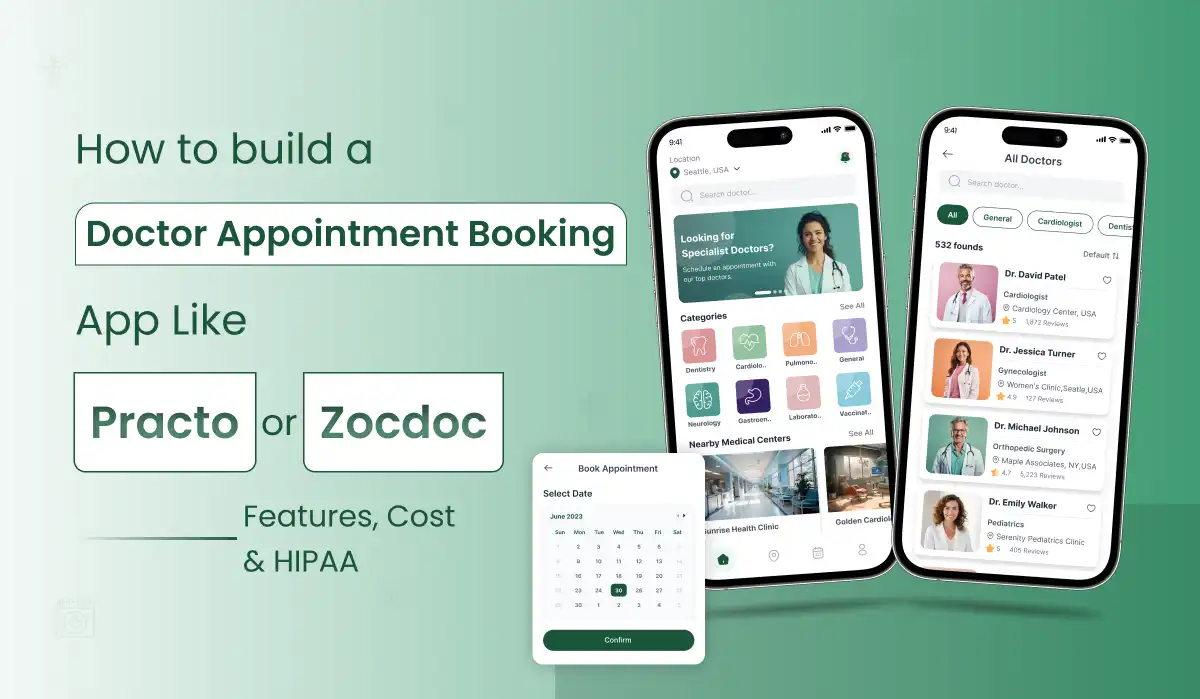
Most guides confuse doctor appointment booking with telemedicine. They’re different products with different engineering challenges. This guide covers the booking side specifically — real-time availability sync, HIPAA compliance as architecture (not a feature), no-show reduction, and why the Practo model and the Zocdoc model are actually different businesses.
The number you came here for
A doctor appointment booking app like Practo or Zocdoc costs $12,000–$30,000 for an MVP (patient registration, doctor search, real-time availability display, appointment booking, SMS/email reminders, payment processing) at India development rates. A mid-tier platform with video telemedicine, EHR integration, and AI scheduling costs $35,000–$80,000. A full super-app with e-pharmacy and lab booking costs $90,000–$180,000+. US agencies quote $50,000–$250,000 for equivalent scope at US hourly rates — zero India-rate options across any competitor article. Critical note: HIPAA compliance adds 20–30% to development scope and must be designed into the data architecture from day one, not bolted on at launch. See our Flutter healthcare app development service →
75% of patients now prefer booking doctor appointments digitally rather than by phone. The phone-tag, hold-music, business-hours-only booking process that still dominates most clinic scheduling is genuinely broken — and the market that fixes it is large. Zocdoc has 14,000+ practices and 6 million monthly patient searches. Practo serves 70 million+ patients across India and Southeast Asia. Both built significant businesses solving the same core problem: making doctor availability visible and bookable online.
Before this guide goes further into features and cost: most articles on this topic blur doctor appointment booking apps with telemedicine apps. They’re different products. Understanding which one you’re actually building changes everything about scope, compliance requirements, and cost. This guide is specifically about the booking side. If you want the telemedicine consultation side — video calls, virtual waiting rooms, e-prescriptions — see our dedicated Teladoc guide instead.
$285B
Global telehealth market 2026
75%
Patients prefer digital booking
$12K
MVP starting cost (India rates)
30%
SMS reminders reduce no-shows
+20–30%
HIPAA adds to development scope
Doctor Appointment App vs Telemedicine App: Key Difference
Every competitor article on this topic mixes these two categories. They’re genuinely different products with different engineering challenges, different compliance requirements at the feature level, and different development costs. You can build just a booking platform (like Zocdoc at launch), just a telemedicine platform (like Teladoc), or combine both (like modern Practo). Start by being clear about which one you’re building.
Doctor Appointment Booking App
Practo, Zocdoc, Doctolib — THIS guide
Core problem Make doctor availability visible and bookable online
Hard problem Real-time availability sync with clinic scheduling systems
HIPAA need PHI storage, encryption, audit logs, BAA with vendors
No video at MVP Core product works without video consultations
Revenue model Doctor subscription, per-booking fee, or promoted listings
MVP cost (India) $12,000–$30,000
Telemedicine App
Teladoc, Doxy.me, Doctor on Demand
Core problem Conduct the medical consultation via secure video
Hard problem HIPAA-compliant WebRTC, virtual waiting rooms, e-prescriptions
HIPAA need All of booking app PLUS HIPAA-compliant video infrastructure
EHR integration Often required — clinical notes, prescriptions
Revenue model Per-consultation fee, subscription, insurance reimbursement
MVP cost (India) $22,000–$55,000
The honest advice: build the booking side first: Zocdoc launched in 2007 with just the booking functionality — no video, no telemedicine, no EHR. The core product was a real-time availability grid: which doctors have slots open today, book in 30 seconds. It grew to 6 million monthly patient searches before adding telemedicine capabilities. Practo followed a similar trajectory. Building both booking and telemedicine simultaneously at MVP stage doubles your compliance scope, your engineering complexity, and your launch cost — before you know whether patients in your target market even want to use telemedicine or just want digital appointment booking. Start with booking. Add telemedicine once booking is validated and generating revenue. Our dedicated Teladoc build guide covers the telemedicine side →
Practo Clone vs Zocdoc Clone: Which Model Fits You?
These look like similar products from the patient side. From the business model and architecture side, a Practo clone and a Zocdoc clone are meaningfully different builds — and your target geography largely determines which model makes sense.
Practo Model
India, SE Asia, Middle East, emerging markets
Who pays Doctors/clinics (monthly subscription + premium listings)
Patient cost Free to patients for booking; fee for paid consultations
Clinic SaaS Practo Ray: clinic management software for scheduling, records
Build complexity Higher — clinic management SaaS is a product in itself
Zocdoc Model
US, UK, Canada, Western Europe
Who pays Providers — per new patient booking ($35–$110 per specialty)
Patient cost Always free for patients
Key differentiator Real-time availability + insurance verification before booking
Insurance focus Filter by in-network providers — critical for US market
Revenue streams Per new patient booking fee + sponsored search placements
Build complexity Medium — real-time availability sync is the hard engineering problem
HIPAA Compliant App Development: What It Requires
HIPAA compliance is the most consistent budget surprise in healthcare app development — not because it’s unexpected, but because teams consistently underestimate what “HIPAA compliant” actually requires in practice. It’s not a checkbox you tick before launch. It’s an architectural requirement that must be designed into your data model, your vendor selection, your access control system, and your logging infrastructure from the very first sprint.
01
Encryption at Rest and in Transit for All PHI
Every piece of Protected Health Information — patient name, appointment time, doctor specialty, health condition — must be encrypted both when stored in your database and when transmitted between your app and your servers. AES-256 at rest, TLS 1.3 in transit. This is the baseline requirement, not a premium feature.
02
Audit Logs for Every Access to Patient Data
HIPAA requires a complete, tamper-evident log of every action taken on patient data — who viewed it, who modified it, when, and from which IP address. This is not optional and cannot be retrofitted easily. Design your data access layer to generate audit logs from the first line of code that touches patient records.
03
Role-Based Access Control — Minimum Necessary Information
HIPAA’s minimum necessary standard means users should only see the patient data they need for their specific role. Clinic reception staff should not see clinical notes. Admin users should not see payment details. This requires designing a granular permission system from day one, not adding it when you notice a compliance gap.
04
Business Associate Agreements with Every PHI-Touching Vendor
Every vendor whose service processes or stores patient data must sign a Business Associate Agreement (BAA) with you. This includes your cloud hosting provider (AWS, GCP — both offer BAAs), your email service (SendGrid, Mailgun — check before committing), your SMS gateway (Twilio offers a BAA), and your payment processor. Using a vendor that won’t sign a BAA is a HIPAA violation regardless of how you use the service.
05
PHI Isolation — Separate from Non-PHI Data
Store Protected Health Information in a separate, access-controlled database schema or service — not mixed with your regular application data. This makes access control, audit logging, and data breach response significantly more manageable, and is the architecture pattern all serious healthcare platforms use.
06
HIPAA Risk Assessment Before Go-Live
A formal HIPAA security risk assessment conducted by a qualified compliance consultant is required before your platform handles real patient data. This typically costs $5,000–$15,000 and takes 3–6 weeks. Budget for it as a line item, not a surprise. Engage the consultant in week two of development so findings can be addressed during build rather than post-launch.
Why “we’ll add HIPAA compliance before launch” is the most expensive sentence in healthcare development The teams that design HIPAA requirements into their data architecture from sprint one spend 20–30% more on the initial build. The teams that build first and retrofit HIPAA compliance before launch spend 60–80% more — because retrofitting encryption, audit logs, PHI isolation, and access control into an existing codebase requires touching every layer that interacts with patient data, often requiring significant re-architecture of the database schema and API layer. The math is straightforward: HIPAA-from-day-one costs more upfront and significantly less in total. Budget for it from the first conversation.
Get Your Doctor Appointment App Cost Estimate
Share your target market and feature list — we’ll reply with a HIPAA-inclusive, fixed-price quote within 24 hours.
The core value of a doctor booking platform is showing patients which appointment slots are genuinely available right now — not which slots were available when the clinic last updated their calendar, not which slots appear available but have already been booked by a patient calling in. This real-time accuracy is what ZocDoc solved that the phone-based booking model couldn’t — and it’s harder to build than it sounds.
3 Ways to Sync Real-Time Doctor Availability
Manual slot entry:
Doctors or clinic staff enter their availability directly in your platform. The simplest implementation, but requires ongoing doctor-side effort to keep updated. Works well for private practitioners and small clinics who don’t use an external scheduling system.
Google Calendar sync:
Pull availability from a doctor’s Google Calendar via the Calendar API, showing only slots where the doctor has no existing events. Medium complexity, works for clinics that use Google Workspace for scheduling.
EHR/clinic management system integration:
The hardest and most valuable integration — connecting to the clinic’s existing scheduling software (Epic, Cerner, Athenahealth, Practo Ray, or dozens of smaller systems) via HL7 FHIR APIs. Shows real-time availability from the clinic’s authoritative scheduling source, eliminates double-booking, and doesn’t require doctors to manage a second calendar. This is what Zocdoc does for large practices, and it’s the integration that drives the highest booking completion rates.
The double-booking problem and why real-time slot locking matters: If two patients view the same available appointment slot simultaneously and both attempt to book it, without real-time slot locking, both bookings confirm, both patients receive confirmation emails, and the clinic receives a conflict they have to resolve manually — which triggers a negative experience for at least one patient. The correct architecture uses an optimistic locking pattern: when a patient clicks a slot to start the booking flow, the slot is soft-locked for 5–10 minutes while they complete the booking. If they abandon the flow, the lock expires and the slot becomes available again. If they complete the booking, the slot is permanently reserved. This is standard e-commerce inventory pattern applied to appointment slots, but surprisingly many early healthcare booking apps launch without it and discover the problem through angry patients.
No-Show Reduction: The Highest-Impact Feature
Healthcare appointment no-show rates average 20–30% across most markets. For a clinic, a no-show is a revenue loss that can’t be recovered — the appointment slot goes empty, the doctor’s time is wasted, and the patient who needed that slot didn’t get it. For a booking platform, high no-show rates damage your reputation with healthcare providers and jeopardize your revenue model if you charge per new patient booking.
The most effective intervention has nothing to do with features: it’s the reminder sequence. Research consistently shows that text message reminders sent at 48 hours, 24 hours, and 2 hours before an appointment reduce no-show rates by 25–30%. This is a relatively simple feature — a scheduled job that sends SMS/email reminders through Twilio or SendGrid at defined intervals before each appointment — that has more impact on platform success than most other features. Build it before building anything else, because it’s also the feature that makes healthcare providers willing to list their availability on your platform.
Medical Appointment Booking App Features
Here are the core medical appointment booking app features to scope for your MVP, plus the Phase 2 additions worth planning for but not building first.
Doctor Search & Discovery
Filter by specialty, location, insurance network, available date, language, gender. Zocdoc’s search is the entire product. Build it with Elasticsearch for text search plus spatial queries for location.
Real-Time Availability Grid
Show open slots in a calendar view — today, this week, next available. Slots update in real time when booked by another patient. The core product value of the entire platform.
Appointment Reminder Sequence
SMS + email reminders at 48 hours, 24 hours, and 2 hours before the appointment. Reduces no-shows by 25–30%. Build this before almost anything else. Use Twilio for SMS.
Doctor Profiles
Specialty, qualifications, photo, clinic location with map, consultation fee, accepted insurance, languages spoken, verified patient reviews. This is the content that builds patient trust.
In-App Payment
Consultation fee payment or deposit at booking. Stripe for US/global. Razorpay for India. No-show deposit that’s refunded on attendance reduces cancellations significantly.
Verified Patient Reviews
Only patients who completed an appointment through your platform can leave a review. This verification is what separates trustworthy healthcare reviews from generic review platforms.
Clinic Dashboard
Doctors and clinic staff manage their availability, view upcoming appointments, see patient notes submitted at booking, and process cancellations. The supply-side product that keeps providers engaged.
AI-Powered Scheduling (Phase 2)
Suggest optimal appointment times based on patient history, reduce scheduling gaps, predict no-shows and over-book strategically. A Stage 2 feature once you have enough booking data to train on.
Niche Strategy to Compete With Practo & Zocdoc
Zocdoc has 14,000+ practices and 6 million monthly patient searches. Practo has 70 million+ registered patients and decades of clinic relationships. Building a general-purpose doctor booking platform competing head-on with either is not a viable new entrant strategy. The platforms winning market share in 2026 are vertical-specific or geography-specific — and they serve their audience significantly better than a horizontal platform ever will.
Mental Health Specialists
Therapy, psychiatry, and counseling booking with asynchronous messaging, recurring appointment scheduling, and insurance verification specific to mental health coverage — a category Zocdoc serves poorly.
→ BetterHelp: $900M+ annual revenue
Specific Specialty
Dermatology, dentistry, orthopedics — a single specialty with deep booking features, specialty-specific patient intake forms, and provider profiles tuned to what matters for that specialization.
A healthcare booking platform for a specific country, state, or linguistic community where Zocdoc and Practo don’t operate — South Africa, Nigeria, Eastern Europe, Arabic-speaking markets.
→ First-mover, local payment rails, local language
Corporate Wellness
B2B employee health booking — employers provide access to a curated provider network for their employees. Per-seat monthly billing, HR-friendly admin dashboard, utilization reporting.
→ B2B contracts, low churn, high LTV per account
Home Visit & On-Demand
Doctor home visits and same-day appointment booking — the Uber model applied to primary care. High demand in Southeast Asia, Middle East, and premium urban markets globally.
→ Premium pricing, growing demand post-COVID
Pediatric Specialists
Children’s health booking where parents are the primary decision-makers and trust signals (pediatric specialization, family-friendly UI, vaccination tracking) drive platform choice over general booking apps.
→ High parental LTV, recurring appointment pattern
Doctor Appointment App Development Cost by Tier
Tier 1
MVP — Booking + Reminders + HIPAA
$12K–$30K
US equiv: $50,000–$120,000
Patient registration + doctor search
Real-time availability grid (manual slots)
Appointment booking + confirmation
SMS/email reminder sequence (48h/24h/2h)
In-app payment (Stripe / Razorpay)
HIPAA-compliant data architecture
Clinic admin dashboard (availability + bookings)
Most CommonTier 2
Full Platform + Video + AI
$35K–$80K
US equiv: $100,000–$200,000
All Tier 1 features
Video telemedicine (HIPAA-compliant WebRTC)
Insurance verification integration
Google Calendar / basic EHR sync
AI-powered scheduling suggestions
Verified patient reviews + ratings
Analytics dashboard for providers
Tier 3
Super-App — Practo-Style
$90K–$180K+
US equiv: $180,000–$350,000+
All Tier 2 features
EHR integration (Epic, Cerner, FHIR R4)
Lab test booking + results
E-pharmacy integration
Clinic management SaaS (Practo Ray equivalent)
Multi-city, multi-language, multi-currency
Enterprise B2B / corporate wellness tier
Healthcare App Development Tech Stack
The tech stack choices below reflect what a HIPAA compliant healthcare app development project actually needs at each layer — not a generic mobile app stack.
Mobile App
Flutter
Backend API
Node.js
Database
PostgreSQL (HIPAA)
Doctor Search
Elasticsearch
SMS Reminders
Twilio (BAA available)
Payments
Stripe / Razorpay
Video (Phase 2)
Daily.co / Twilio Video
Cloud (BAA-signed)
AWS / GCP
Why Elasticsearch matters for doctor search specifically: A patient searching “cardiologist near me who accepts Blue Cross and speaks Spanish and has slots this week” is issuing a multi-attribute query across specialty, location, insurance network, language, and real-time availability simultaneously. A standard SQL query handling all five of these attributes simultaneously with good performance and relevance ranking is painful to build and maintain. Elasticsearch handles complex multi-attribute search with relevance ranking natively, and its geospatial support lets you sort doctors by distance from the patient’s location. Zocdoc uses Elasticsearch for their provider search. For any platform where doctor discovery is a primary product surface, Elasticsearch is worth the operational complexity it adds.
“Zocdoc’s insight was not that doctors needed a website. It was that 30% of appointment slots were going unfilled because patients couldn’t see them, and doctors couldn’t reach patients who needed them. Every feature in a doctor booking app should trace back to that specific supply-demand mismatch — not to what a healthcare app ‘should’ have.”
Primocys · Healthcare App Development
We Build Doctor Booking Apps With HIPAA Designed In From Day One
Primocys builds healthcare booking platforms with HIPAA compliance scoped as foundational architecture rather than a post-launch checklist item — which means our clients spend 20–30% more on the right build instead of 60–80% more retrofitting a broken one. Flutter, Node.js, PostgreSQL, Elasticsearch. Fixed price from $12,000, full source code.
HIPAA from sprint one
Encryption at rest, audit logs, PHI isolation, BAA vendor checklist — designed in, not bolted on.
Real-time availability
Slot locking to prevent double-booking. Manual, Google Calendar, or EHR sync depending on your provider base.
No-show reduction first
We build the reminder sequence before most other features — 25–30% no-show reduction from day one.
Niche-first scoping
We’ll help you define the specialty or market your platform owns — not a generic Practo clone.
Flutter + Node.js
One Flutter codebase for patient + doctor apps. Node.js for real-time slot availability updates.
Fixed price from $12,000
Cost agreed before development starts. HIPAA compliance scope included in the estimate, not hidden.
Conclusion: Building Your Doctor Appointment Booking App
A doctor appointment booking app like Practo or Zocdoc is a realistic, fundable build in 2026 — an MVP starts at $12,000 at India development rates and can be live in 14–20 weeks. The decisions that matter most are getting HIPAA compliant app development right from the first sprint, solving real-time doctor availability sync properly, shipping a strong no-show reduction reminder sequence, and picking a niche instead of competing head-on with Practo or Zocdoc on day one. Get these four right and the rest of the medical appointment booking app features fall into place.
Primocys is a healthcare app development company in India that has shipped 650+ apps, including Practo-style and Zocdoc-style booking platforms with HIPAA designed in from the start. Talk to our team for a free, fixed-price cost estimate →
FAQs: Doctor Appointment Booking App Development
How much does it cost to build a doctor appointment booking app like Practo or Zocdoc in 2026?
Building a doctor appointment booking app like Practo or Zocdoc costs $12,000–$30,000 for an MVP (patient registration, doctor search, real-time availability display, appointment booking, SMS/email reminders, basic payment processing) at India development rates. A mid-tier platform with video telemedicine, EHR integration, and AI scheduling costs $35,000–$80,000. A full super-app with e-pharmacy and lab booking costs $90,000–$180,000+. US agencies quote $50,000–$250,000 for equivalent scope. HIPAA compliance adds 20–30% to development scope and must be designed in from day one — retrofitting it post-launch costs 60–80% more than building it correctly from the start. Get a personalised estimate →
What is the difference between a doctor appointment booking app and a telemedicine app?
A doctor appointment booking app lets patients find doctors, book available slots, receive reminders, and manage appointments. Telemedicine adds secure video consultations, virtual waiting rooms, and e-prescriptions. A booking-only app is a proven MVP—many platforms launched this way before expanding. Adding telemedicine significantly increases development complexity and compliance requirements. See our dedicated Teladoc telemedicine guide →
Is HIPAA compliance required for a doctor appointment booking app?
Yes. If your platform serves US patients or stores Protected Health Information (PHI), HIPAA compliance is required. Your app should encrypt PHI, maintain audit logs, enforce role-based access, and use Business Associate Agreements (BAAs) with vendors handling PHI. Building HIPAA compliance from day one is far more cost-effective than retrofitting it after launch.
Should I build a Practo model or a Zocdoc model for my doctor booking app?
Choose a Zocdoc-style model for the US, UK, Canada, and Western Europe, where patients book in-network doctors with real-time availability and providers pay per new patient. Choose a Practo-style model for India, Southeast Asia, and the Middle East, where subscription-based clinic software, telemedicine, diagnostics, and pharmacy services fit local healthcare needs. Tell us your niche — free scope call →
Build Your Doctor Booking Platform — HIPAA Included, Not Extra
Tell us your specialty focus, target market, and whether telemedicine is in your MVP or Phase 2. We’ll give you a HIPAA-inclusive cost estimate within 24 hours — not a number that surprises you with compliance costs later.
Arpan leads product and engineering at Primocys, a Top-Rated Clutch app development company based in Ahmedabad, India. With over 10+ years of experience, he has successfully delivered real-time communication platforms for 1,200+ clients worldwide.
He is directly involved in overseeing the development of chat and messaging applications, ensuring high performance, scalability, and seamless user experience in every project.
📧 Email: [email protected]
📱 WhatsApp: Chat on WhatsApp
Trusted by Global Businesses for AI, Mobile, SaaS & Custom Software Development. Your Vision, Our Expertise.Trusted by Global Businesses for AI, Mobile, SaaS & Custom Software Development. Your Vision, Our Expertise.Trusted by Global Businesses for AI, Mobile, SaaS & Custom Software Development. Your Vision, Our Expertise.Trusted by Global Businesses for AI, Mobile, SaaS & Custom Software Development. Your Vision, Our Expertise.Trusted by Global Businesses for AI, Mobile, SaaS & Custom Software Development. Your Vision, Our Expertise.Trusted by Global Businesses for AI, Mobile, SaaS & Custom Software Development. Your Vision, Our Expertise.
Hear from our clients and why 1200+ businesses trust Primocys
"Our B2B and B2C platform helps Nigerian manufacturers sell at wholesale
prices and suppliers offer competitive retail pricing, with a strong focus on Made in Africa products
and easy local and international distribution.
The app has received excellent user reviews for its design and unique features. Communication with the
Primocys team was smooth in an agile setup, even beyond office hours when needed. Their mobile app
development expertise is excellent—highly professional and reliable."
Adegbuyi OduguwaCEO & Co-Founder
"The dating app was delivered successfully and approved by both Apple App
Store and Google Play. Our users are highly impressed with the design, UI, and overall functionality.
The project was well planned with clear milestones, and all modules were delivered on time.
The team is talented, patient, and flexible, accommodating multiple scope revisions as requirements
evolved. Their 24/7 development and support availability made the entire process smooth and reliable."
Revanth KExecutive
" We hired Primocys to develop a highly complex and specialized mobile
application, and they delivered outstanding results. The app includes advanced features such as
timeline mixers, classifieds, payments, advertisements, GPS functionality, and more. Their technical
skills, timely delivery, availability, and the personal attention Arpan Sagar brings to each project
truly stand out. The team stays focused and committed from start to finish—an excellent experience
overall."
Gregor Skerl Founder PROHUNTER
" Great team with excellent communication and a strong commitment to on-time
delivery. They developed a fully customized mobile app for both Android and iOS, perfectly matching
our requirements. The entire process was smooth and professional, with clear updates at every stage.
They are reliable, skilled, and very easy to work with. We’re continuing our partnership on more
projects, and choosing them has been one of the best business decisions I’ve made."