

Smart recommendations
Show each buyer the products they are most likely to want, based on browsing and purchase patterns, which can lift basket size and repeat visits.
 DapkeSocial video app with live streaming and PK battles.
 Lika Real EstateProperty discovery platform for listings and leads.
 BurpoutSocial fitness challenges that keep people moving.
 ChatLivoConnected customer communication SaaS workspace.
 EmoTalesAI storytelling adventures designed for children.
 EarnifyTrack Income from Multiple Sources with Analytics & Tax Planning.
What it really costs, which features earn their place, how marketplaces actually make money, and the launch mistakes we’ve watched founders repeat. Written by the team that builds these platforms.
The short answer: Marketplace app development for a multi-vendor platform typically costs $25,000–$45,000 for an MVP and $50,000–$90,000 for a full growth-stage platform, taking 3–7 months. Enterprise builds start around $100,000. Payments, platform count and integrations move the number more than anything else.
MVP cost for a marketplace app
growth platform cost
typical MVP timeline
typical marketplace take rate
If you’re reading this, you’re probably sitting on an idea like “Etsy for X” or “Uber-style bookings for Y,” and you want a straight answer on what it takes to build it. We’ve helped founders with online marketplace app development across retail, services, rentals and B2B, and the conversation almost always starts the same way: “How much, and how fast?”
We’ll answer that properly below. But we’ll also tell you what we wish more founders asked first: how will this marketplace make money, and how will you get the first 30 vendors? The code is the easy part. This guide covers both.
A multi-vendor marketplace is a platform where many independent sellers list products or services, and many buyers purchase from them in one place. You don’t hold the inventory. You run the storefront, handle trust and payments, and take a cut. Amazon, Etsy, Airbnb and Uber are all marketplaces; they just trade different things.
The thing that makes it “multi-vendor” is the architecture. Instead of one store with one catalog, you need three connected experiences that share one database: a buyer app, a seller workspace, and an admin control room. Each vendor has their own catalog, orders, earnings and rules, and your platform sits in the middle splitting money and enforcing quality. That’s why it’s a bigger build than a normal eCommerce app .
| Type | What’s traded | Typical example | Special needs |
|---|---|---|---|
| Product (B2C) | Physical goods | Etsy, eBay-style | Inventory, shipping, returns |
| Service marketplace | Bookings & labor | Urban Company, TaskRabbit-style | Scheduling, geo-matching, live tracking |
| Freelance | Skills & projects | Fiverr, Upwork-style | Milestone payments, proposals, disputes |
| Rental & booking | Stays, vehicles, equipment | Airbnb-style | Calendars, deposits, reviews both ways |
| B2B / wholesale | Bulk orders | Alibaba-style supply hubs | Quotes, tiered pricing, invoicing |
| Food & local | Meals & local delivery | Restaurant aggregators | Real-time orders, riders — see food delivery apps |
Before you spend a rupee or a dollar on development, decide how the platform earns. We’ve seen great-looking apps launch with no revenue plan and quietly die at month eight. Here are the models that work, and when each one fits.
| Model | How it works | Best when |
|---|---|---|
| Commission per sale | You keep a percentage of every order, often 5–20% depending on category and order value | Vendors should only pay when they earn, which makes it the easiest model to sell to new sellers |
| Vendor subscriptions | Monthly or annual plans with tiered features, such as analytics, more listings or priority support | Vendors do steady volume and want better tools; it also gives you predictable recurring revenue |
| Listing fees | A fee per product or per listing period, charged whether or not the item sells | Listings are high-value or slow-moving, such as property, vehicles or B2B equipment |
| Featured placement & ads | Vendors pay to rank higher in search, appear in banners or promote specific products | You already have real buyer traffic and vendors compete for visibility, so it rarely works at launch |
| Payment & fulfilment fees | A margin on payment processing, shipping or delivery that runs through your platform | You control payments, logistics or delivery end to end |
| Lead fees | Vendors pay per enquiry, booking or qualified lead instead of per sale | The sale closes offline, as with home services, consultations or local providers |
What we tell founders on the first call: Start with commission only. It’s the simplest to explain to vendors and the hardest for them to say no to. Add subscriptions and ads once you have traffic worth paying for. Charging vendors upfront before you’ve delivered a single order is the fastest way to get a ghost-town marketplace.
A multi-vendor marketplace is really three products in one. Skip any of the three and the whole thing wobbles. Here’s what each side needs at launch, and what can wait.
This is the heart of your business, and it’s where cheap builds fall apart. A good engine supports a default rate, overrides per category or vendor, promotional zero-commission periods, tax handling and clear statements vendors can reconcile. If a developer tells you “commission is just a percentage field,” ask them how refunds, partial returns and coupons affect payouts. That answer tells you a lot.
MVP tip: Launch with search, checkout, vendor onboarding, order management, payouts and basic admin controls. Hold back live chat, loyalty points, advanced analytics and AI recommendations until real orders tell you what vendors and buyers actually ask for. See our guide to MVP development cost for what a lean first version costs.
Every marketplace founder hits this wall. Vendors won’t join without buyers, and buyers won’t come to an empty store. Technology doesn’t solve it. Sequencing does. Here’s the order that works most often:
“Handmade furniture in Ahmedabad” beats “everything for everyone.” A tight market lets you reach critical mass with far fewer vendors, and keeps delivery and support manageable.
Personally onboard your first 20–30 vendors. Offer zero commission for the first few months, help them upload listings, and treat them like partners, not users.
Ten great listings with strong photos convert better than a hundred thin ones. Set listing standards from day one, so a buyer’s first impression is always a good one.
Use local communities, WhatsApp groups, referral rewards and content. Send traffic only once buyers can find something worth buying.
Your early order experience becomes your reputation. Watch every delivery, answer complaints personally and fix process gaps before you scale.
Payments are where marketplaces get technical and where mistakes cost real money. In a normal store, the customer pays you. Here the customer pays once and the money has to be divided correctly between the vendor, your commission, taxes and fees.
Common mistake: Founders often treat payouts as a “phase two” task and run them manually in a spreadsheet. It works for ten vendors and becomes a nightmare at fifty. Build automated reconciliation into version one, even if the interface is basic.
AI is useful in marketplaces when it solves a real operational problem, not as decoration. These are the ones we see paying for themselves, usually built as Python microservices that your main API calls. Our AI development team can scope any of them. For budgeting, see what AI features cost in a mobile app.
Show each buyer the products they are most likely to want, based on browsing and purchase patterns, which can lift basket size and repeat visits.
Flag suspicious vendors, duplicate listings, abnormal order patterns and review manipulation before they hurt buyers.
Let buyers search by meaning or by photo, so “blue linen shirt for summer” finds the right results even when titles differ.
Generate titles, descriptions and categories from a single product photo, cutting onboarding friction for non-technical vendors.
Suggest competitive prices to vendors based on demand and similar listings. You stay in control; they get guidance.
Answer common order, refund and tracking questions instantly, and escalate the tricky ones to your team.
There’s no single “right” stack, but there is a sensible, proven one. We pick technologies that your future developers can easily hire for and that scale without a rewrite.
| Layer | Technology | Why it fits |
|---|---|---|
| Mobile apps | Flutter or React Native | One codebase for iOS and Android, faster and cheaper to maintain |
| Web storefront & vendor panel | Next.js / React | SEO-friendly product pages and fast dashboards |
| API & real-time | Node.js | Handles orders, chat and notifications with many concurrent users |
| Database & cache | PostgreSQL + Redis | Reliable transactions for money, fast reads for browsing |
| Search | Elasticsearch or similar | Filters, facets and typo-tolerant search at scale |
| Payments | Stripe Connect / Razorpay Route | Built-in split payments and vendor onboarding |
| Hosting & media | AWS (S3, CloudFront) | Fast image delivery and room to scale |
| AI services | Python (FastAPI) | Recommendations, fraud checks and listing assistants |
You do not need every layer on launch day. Most marketplaces start with one mobile codebase, a single database and built-in search, then add Elasticsearch and heavier caching once catalog size and traffic justify the cost. We help you decide what to build now and what can wait.
Now the question everyone scrolled for. These marketplace app development cost ranges reflect Primocys’ India-based delivery and are indicative, since your final number depends on scope. A written estimate after a short discovery call is the only reliable figure. For general pricing, see our mobile app development cost in 2026 guide, or try the app cost calculator.
Your written estimate will spell out exactly what is included, so there are no surprises on hosting, third-party fees or post-launch support.
The fastest way to estimate marketplace app development cost is to find the model your idea most resembles. These ranges are indicative for an India-based team and shift with scope, platforms and payment complexity.
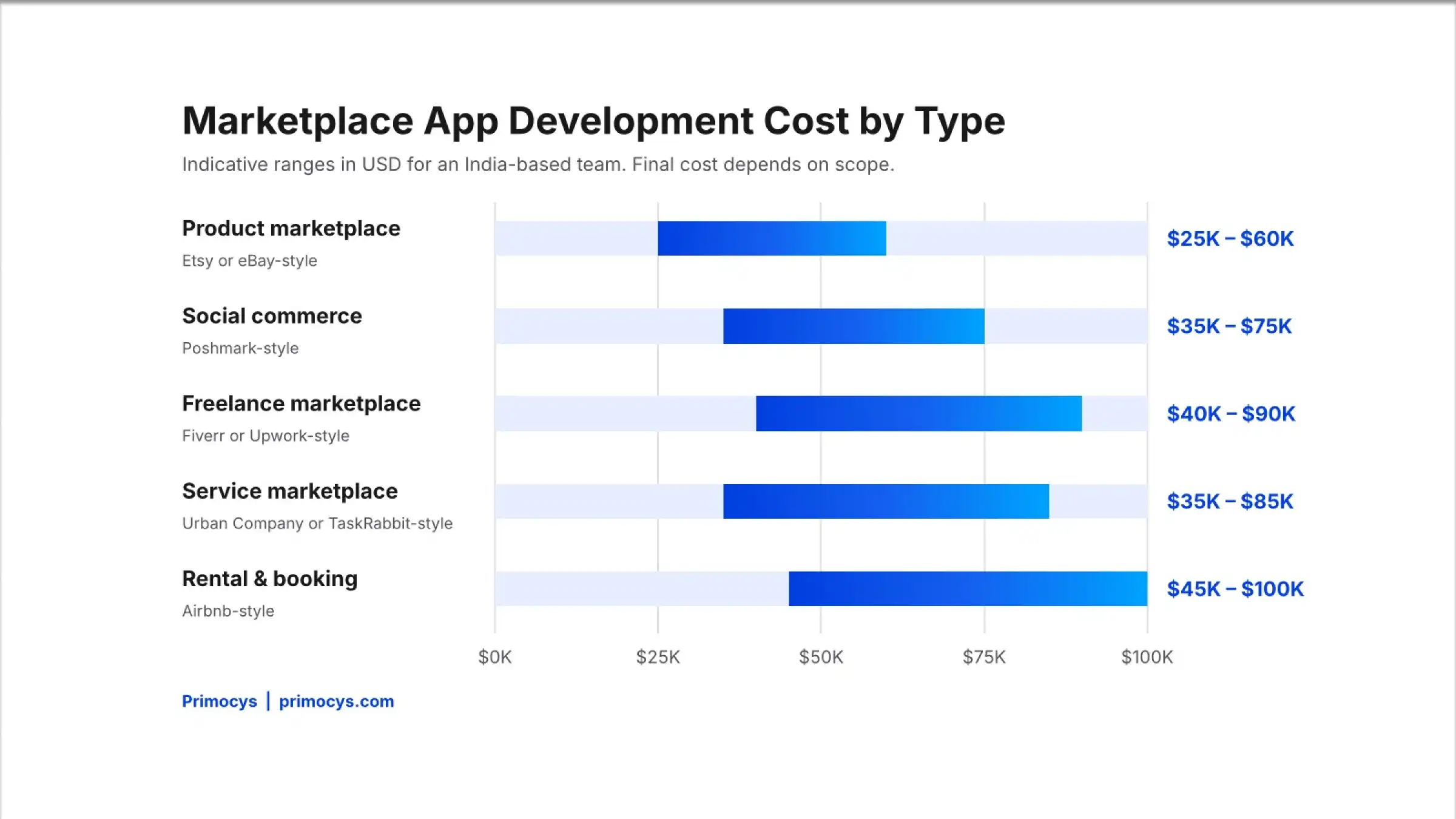
| Marketplace type | Example model | Indicative cost | What drives the cost |
|---|---|---|---|
| Product marketplace | Etsy or eBay-style | $25K – $60K | Simplest flow: listings, cart, shipping and reviews |
| Social commerce | Poshmark-style | $35K – $75K | Feeds, follows and user posts on top of the buy-sell core |
| Freelance marketplace | Fiverr or Upwork-style | $40K – $90K | Milestone payments, proposals, disputes and talent search |
| Service marketplace | Urban Company or TaskRabbit-style | $35K – $85K | Scheduling, provider matching, live tracking and verification |
| Rental & booking | Airbnb-style | $45K – $100K | Calendars, dynamic pricing, deposits and two-way reviews |
| Module | Typical range | What drives it up |
|---|---|---|
| Vendor onboarding & KYC | $3K – $6K | Document verification, approval workflows |
| Catalog, variants & inventory | $4K – $8K | Bulk upload, many attributes |
| Search & filters | $3K – $7K | Faceted search, semantic search |
| Cart, checkout & orders | $5K – $10K | Multi-vendor carts, returns |
| Split payments & payouts | $6K – $14K | Escrow, multi-currency, tax rules |
| Reviews & ratings | $2K – $4K | Moderation, verified purchase |
| Chat | $4K – $8K | Media, read receipts, moderation |
| Admin panel | $6K – $12K | Granular roles, reporting depth |
| AI recommendations | $8K – $18K | Data volume, real-time personalization |
Two marketplaces with the same feature list can still differ by tens of thousands of dollars. These are the five factors that decide where your project lands within the ranges above.
The build number is only the headline. These running costs are the ones first-time founders forget.
Plan a year-one reserve on top of the build cost, so support and growth never stall after launch.
If your model is fairly standard, a customizable base can cut months and a meaningful share of the budget. If your pricing logic, workflow or compliance needs are unusual, custom is safer. A common middle path is starting with a proven foundation and replacing modules as you learn (our build vs buy guide covers the trade-offs). We’re happy to tell you honestly which route suits you, even when it’s the cheaper one. If you’re planning service marketplace app development, see also our on-demand service app and classified app solutions for related models.
| Option | Best for | Upfront cost | Trade-off |
|---|---|---|---|
| No-code / SaaS platform | Testing demand quickly | Lowest (monthly fee) | Limited customization, you rent the platform |
| White-label script | Standard models on a tight budget | Low to medium | Fast launch, hard to bend for unusual workflows |
| Custom development | Unique workflows, payments or scale plans | Medium to high | Full ownership, longer timeline |
| Hybrid | Most funded founders | Medium | Start on a base, replace modules as you learn |
A marketplace budget is rarely lost on one big decision. It leaks through extra scope, avoidable rework and the wrong team. These five habits keep it under control.
Find, pay, receive. Seller approval and disputes can be manual at launch. Payout reconciliation should not be.
Flutter or React Native serves both app stores from one codebase. See Flutter vs React Native vs native for the full comparison.
Stripe Connect or Razorpay Route for split payments instead of building your own.
Every extra feature is built three times, once for each panel.
A team that has shipped split payouts saves more in avoided rework than a cheaper team learning on your budget.
Not sure which of these applies to your idea? A short discovery call turns this list into a scoped, priced plan.
Most marketplace builds follow the five phases below. For a broader view, read how long a mobile app takes to build.
Business model, user journeys, wireframes, architecture and a prioritized feature list.
UI/UX for all three panels, a clickable prototype and feedback from real vendors if possible.
Catalog, orders, payments, commission engine, vendor and admin panels, in short demo-able sprints.
Payment edge cases, load tests, security review and store submission.
Monitor real orders, support vendors, fix friction and add features based on actual behaviour.
Every marketplace is different, and the ranges above only go so far. Tell us a bit about yours and we’ll send a clear, no-obligation estimate within 24 hours. No sales scripts, just a realistic scope and number.
Over the years we’ve watched promising marketplaces stumble over the same handful of problems. Avoid these and you’re already ahead of most.
Your partner shapes your budget more than any single feature. Ask these questions before you sign anything, and read our guide to hiring a mobile app development company for a deeper checklist.
Red flags: A flat quote before they understand your transaction model, no admin panel in the scope, payouts left for “phase two”, or vague code ownership.
We’re a marketplace app development company based in Ahmedabad, India, and we build the way we’d want our own platform built: scope tight, payments right, and no surprises on the invoice. Our marketplace app development services cover discovery, design, build and post-launch support. Browse our portfolio to see the products we have shipped.
We’ll tell you what to cut from version one, even when it makes the quote smaller.
Split settlements, commission logic, refunds and payouts designed in from day one.
Mobile, backend, web and AI under one roof, so nothing gets lost between vendors.
Get a dedicated team started quickly, or hire dedicated developers to extend your own.
Architecture that handles growth without a ground-up rewrite at your first success.
We stay around for the messy first months when real users find real edge cases.
Successful marketplace app development comes down to three decisions: a revenue model vendors accept, a tight MVP scope, and payments built right from day one. Launch in one niche, recruit your first vendors by hand, and budget for the year after launch, not just the build.
Want a realistic scope, timeline and cost for your idea? Share your project and the Primocys team will send a clear estimate within 24 hours.

Hear from our clients and why 1200+ businesses trust Primocys

"Our B2B and B2C platform helps Nigerian manufacturers sell at wholesale prices and suppliers offer competitive retail pricing, with a strong focus on Made in Africa products and easy local and international distribution. The app has received excellent user reviews for its design and unique features. Communication with the Primocys team was smooth in an agile setup, even beyond office hours when needed. Their mobile app development expertise is excellent—highly professional and reliable."

"The dating app was delivered successfully and approved by both Apple App Store and Google Play. Our users are highly impressed with the design, UI, and overall functionality. The project was well planned with clear milestones, and all modules were delivered on time. The team is talented, patient, and flexible, accommodating multiple scope revisions as requirements evolved. Their 24/7 development and support availability made the entire process smooth and reliable."

" We hired Primocys to develop a highly complex and specialized mobile application, and they delivered outstanding results. The app includes advanced features such as timeline mixers, classifieds, payments, advertisements, GPS functionality, and more. Their technical skills, timely delivery, availability, and the personal attention Arpan Sagar brings to each project truly stand out. The team stays focused and committed from start to finish—an excellent experience overall."

" Great team with excellent communication and a strong commitment to on-time delivery. They developed a fully customized mobile app for both Android and iOS, perfectly matching our requirements. The entire process was smooth and professional, with clear updates at every stage. They are reliable, skilled, and very easy to work with. We’re continuing our partnership on more projects, and choosing them has been one of the best business decisions I’ve made."

AWARDS




TRUSTED BY GLOBAL BRANDS