






How much does it cost to develop an app UK businesses should plan for in 2026? Realistic GBP planning ranges, UK versus offshore costs, what agencies include in a quote, and the questions worth asking before you commit.
App development cost UK at a glance
If you have asked three agencies for a mobile app quote and received three very different numbers, that is normal. The cost of app development in the UK varies widely because scope is rarely identical. One team may have priced a prototype. Another may have included backend development, security, testing and launch support. A third may have assumed you already own the designs.
How much does it cost to develop an app in the UK? For planning in 2026, allow around £15,000–£40,000 for a simple app MVP built by a UK agency, £40,000–£100,000 for a medium-complexity product, and £100,000–£250,000+ for complex applications. These are illustrative budget scenarios, not audited UK market averages. Your actual quote depends on what must be delivered.
Important distinction: A clickable prototype, a working MVP, and a launch-ready commercial product are not interchangeable. Always compare like-for-like scope.
Mobile App Development Cost UK by Project Type
Planning an app in the UK? Compare agency budgets from a £5,000 prototype to a £250,000+ platform, plus timelines, then get a free estimate for your idea.
| App scope | Illustrative UK agency budget | Typical scope | Planning timeline | Best for |
|---|---|---|---|---|
| Prototype / proof of concept | £5,000–£15,000 | Clickable flows or limited working feature | 2–6 weeks | Testing an idea before funding a full build |
| Lean MVP | £15,000–£40,000 | Login, core journey, basic admin, limited integrations | 8–14 weeks | Startups launching a first working version |
| Growth-stage app | £40,000–£100,000 | Multiple roles, payments, notifications, analytics, robust backend | 4–7 months | Businesses scaling users and revenue |
| Complex / regulated platform | £100,000–£250,000+ | Advanced workflows, extensive integrations, security and audit requirements | 6–12+ months | Finance, health or enterprise-grade products |
Illustrative planning ranges for UK agencies, excluding VAT, hosting, third-party fees and ongoing maintenance. They are not a Primocys quotation.
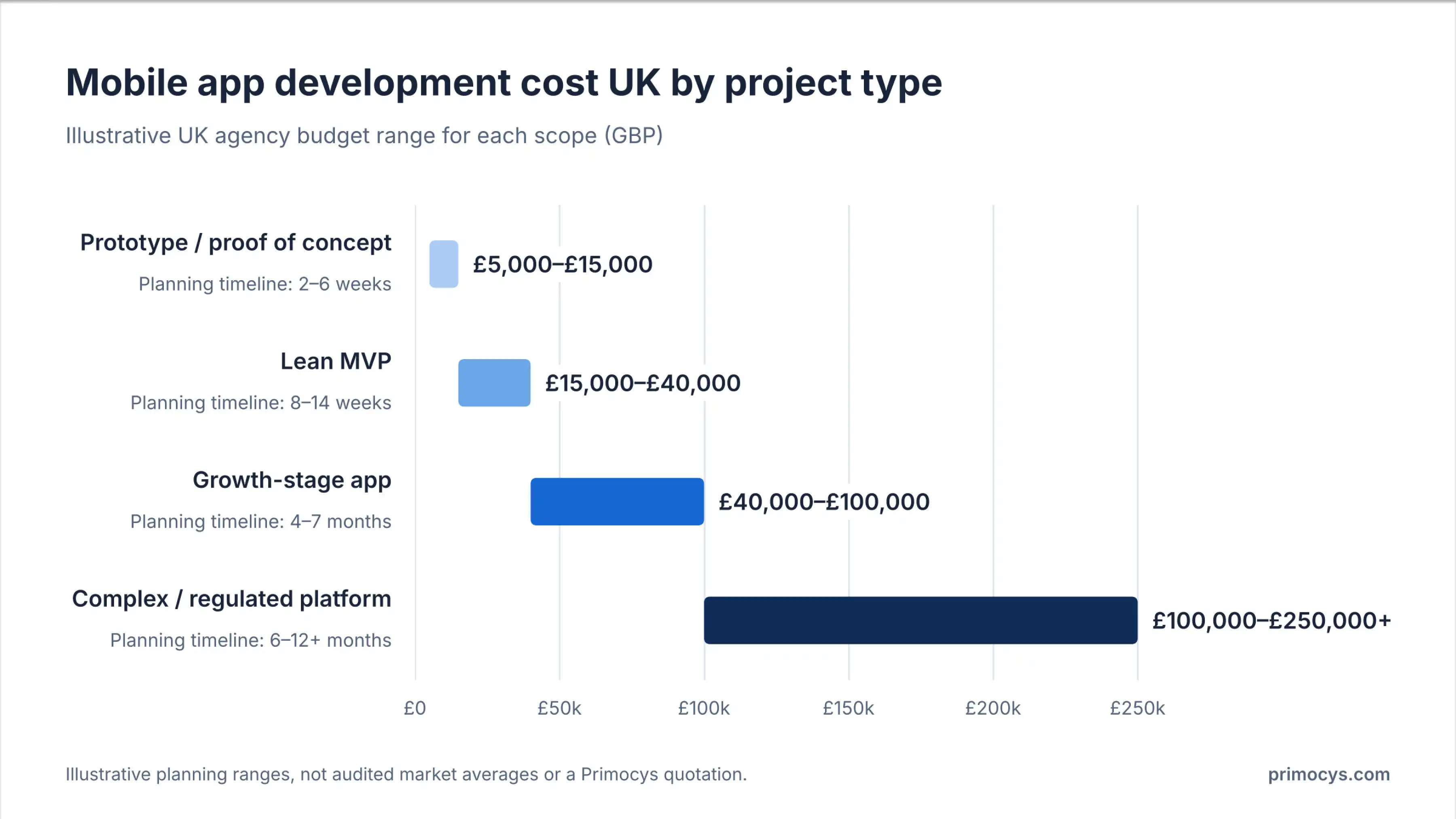
Use this table as a starting point for the cost to build an app UK startups and SMEs typically face, then adjust for platforms, integrations, design depth and compliance needs. If you are validating an idea first, explore our MVP app development service and our guide on how long an app takes to build.
The price is not determined by app category alone. A simple booking app can be cheaper than a sophisticated internal workflow tool; a social platform with live video can be more expensive than a straightforward e-commerce companion app. For platform-specific budgets, see iOS app development cost and Android app development cost.
For a broader global comparison, see our general mobile app development cost guide. This article concentrates on UK procurement and GBP budgets.
App Development Cost in London and Other UK Cities
Comparing app development cost London quotes with regional UK or offshore teams? The same hours of work can cost very different amounts depending on where the team is based. See hourly ranges by location and what drives each gap.
| Where the team is based | Illustrative hourly planning range | What usually drives the difference | Best for |
|---|---|---|---|
| London agency | £90–£140+ | Higher office overheads and strong demand for senior talent | On-site workshops and regulated-sector experience |
| Manchester, Birmingham or Leeds agency | £70–£110 | Strong regional talent pools with lower overheads than London | Balancing senior talent with a lower budget |
| Edinburgh, Glasgow, Cardiff or Bristol agency | £65–£105 | Smaller local markets; specialist skills vary by agency | Local presence at moderate cost |
| Remote or offshore specialist team | £20–£60 equivalent | Lower rates; evaluate communication, contract and support terms | Well-defined scope and tighter budgets |
These are illustrative planning assumptions, not verified city-level market data or a Primocys rate card. To see what the gap means in pounds, take an app estimated at 900 delivery hours. Labour alone would be roughly £81,000–£126,000 with a London agency, £63,000–£99,000 with a Manchester, Birmingham or Leeds agency, and £18,000–£54,000 with an offshore team, before discovery, testing, management and support.
Location changes price mainly through agency overheads and local demand for senior engineers, so compare seniority, delivery process and support, not just the hourly rate. Not sure which location suits your scope? Share your project requirements and we will help you compare realistic options.
Is a London app developer worth the premium?
It can be, when you need on-site workshops, a regulated-sector track record or a team in your time zone. If your scope is well defined and your team is comfortable working remotely, a regional or offshore partner may deliver the same app at a lower total cost. Ask each agency who will actually build the product and how often you will see working builds.
UK Agency vs Offshore App Development Cost
UK agency or offshore team? Compare hourly planning ranges for agencies, independent developers and offshore specialists, and what you get for the total spend.
| Delivery model | Illustrative hourly planning range | Trade-off to consider | Best for |
|---|---|---|---|
| UK app development agency | £70–£140+ | Local workshops and procurement familiarity; often higher delivery cost | On-site workshops and regulated sectors |
| UK independent developer | £40–£100+ | Flexible for narrow work; confirm backup, design and QA coverage | Narrow, short-term tasks |
| Offshore specialist agency | £20–£60 equivalent | Potentially lower cost; evaluate process, communication and contract protections | Well-defined scope and tighter budgets |
These figures are broad illustrative planning assumptions, not independently verified UK salary statistics or a fixed Primocys rate card. A lower hourly rate can still lead to a more expensive project if requirements change repeatedly or the architecture needs to be rebuilt.
UK vs offshore: an example
Imagine an app estimated at 900 delivery hours. At £100 per hour, the labour portion is £90,000. At £35 per hour, it is £31,500. But neither figure is a complete project quote until you include discovery, design, testing, security, management, contingency and support. The point is to understand the cost structure, not to assume equal outcomes from unequal scopes.
Flutter vs Native: How the Approach Affects App Cost
Flutter, native or one platform first? Compare relative cost, best-fit use cases and watch-outs for each approach before you lock in your platform strategy.
| Approach | Relative cost position (illustrative) | Best suited to | Watch-outs |
|---|---|---|---|
| Cross-platform (Flutter) | Often lower than two native builds when features overlap, because one team builds one codebase | MVPs and business apps with shared iOS and Android journeys, such as booking, ordering or account apps | Platform-specific integrations still need budget and testing |
| Native iOS and Android | Typically higher, with two codebases to build and maintain | Apps that rely on advanced device features or platform-specific performance, such as AR or heavy sensor use | Duplicate effort for features, QA and updates |
| Single platform first (iOS or Android) | Lowest initial build cost | Validating an idea with one audience before expanding | The second platform is a later cost; check where your users are |
Quick rule of thumb: If your iOS and Android journeys are mostly the same, start with Flutter. If your product depends on advanced device features, budget for native. If you are still testing demand, launch on one platform first and add the second once users prove the idea.
Your platform strategy is one of the biggest levers on the cost of app development in the UK. In the example £45,000 budget later in this guide, the Flutter mobile app is a single £12,600 line, whereas a native approach would need two separate frontend builds in its place. The saving depends on how much platform-specific functionality you need, so these are illustrative planning positions, not fixed discounts.
Not sure which route fits your product? Our team can compare Flutter app development and cross-platform app development options against your feature list. For a deeper technical comparison, read Flutter vs React Native vs native.
App development cost breakdown: where the budget goes
Many founders budget for screens and forget everything behind them. A user taps “Book now”, but that action might trigger authentication, inventory checks, payment authorisation, scheduling, notifications and an admin update.
| Workstream | Illustrative share of build budget | What you are paying for |
|---|---|---|
| Discovery and product scope | 8% | User journeys, requirements, architecture and acceptance criteria |
| UX and UI design | 15% | Flows, prototypes, visual components and accessibility review |
| Mobile frontend | 28% | Flutter, iOS or Android screens and platform features |
| Backend and integrations | 29% | APIs, database, admin, payments and third-party systems |
| Testing, release and handover | 20% | Device QA, fixes, security checks, deployment and documentation |
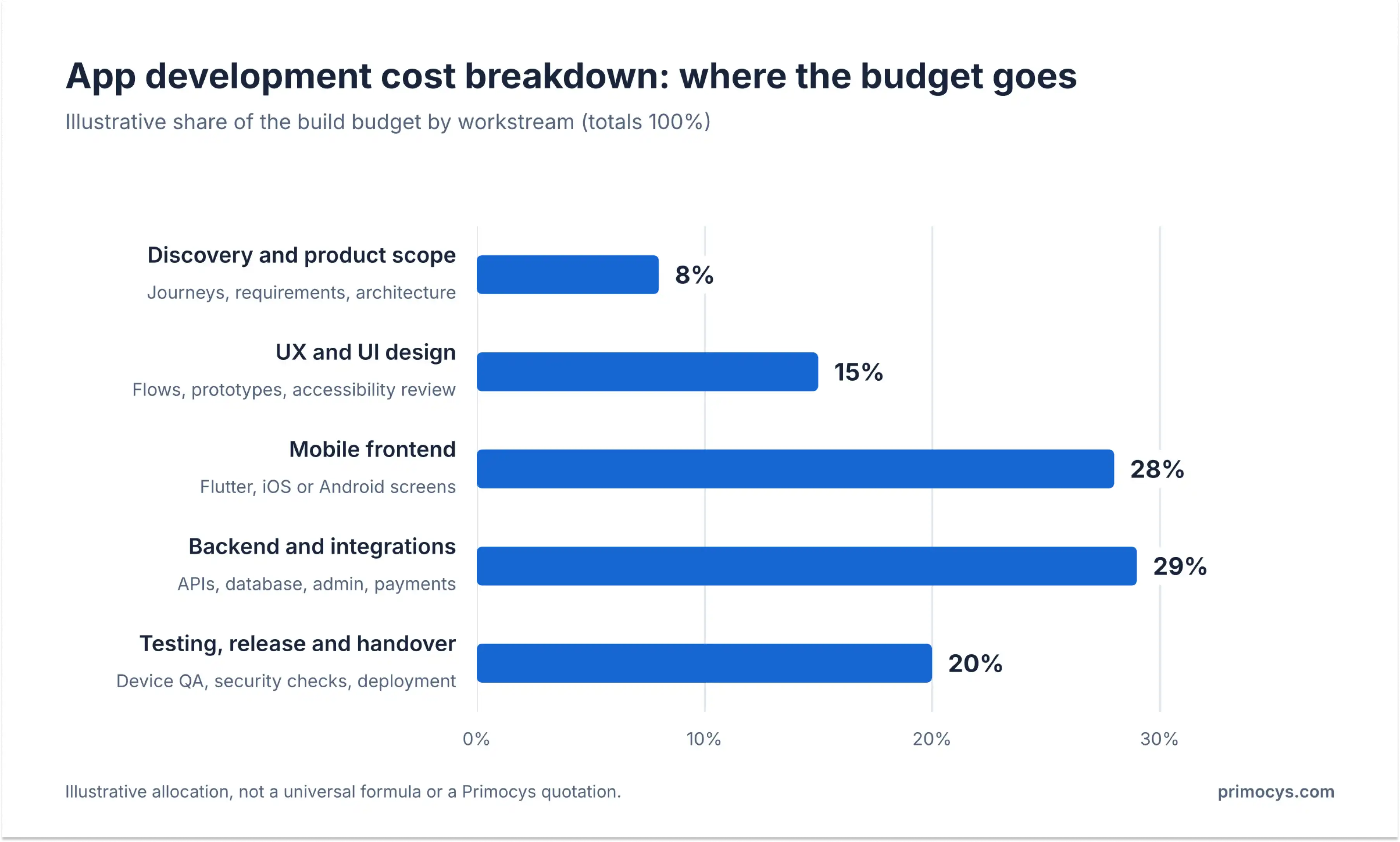
This is an example allocation that sums to 100%, not a universal formula. A data-heavy enterprise app may devote much more to backend integrations; a design-led consumer product may spend more on UX. Need help with the design stage? Explore our mobile app design services.
Features That Raise the Cost of App Development
Two apps with the same number of screens can have very different budgets. The difference usually sits in these six cost drivers, which add the most backend, testing and support work, so scope them early before requesting quotes.
Payment gateways, recurring billing, refunds, receipts and platform purchase rules require careful implementation and testing.
Chat, voice calls and live streaming add state management, network reliability, moderation and infrastructure costs.
Driver tracking, dispatch logic, route updates and geolocation permissions create more complexity than simply displaying a map.
Chatbots, recommendations and AI agents introduce model usage, data handling, evaluation and human fallback requirements. See AI development and the AI app development cost guide.
Staff permissions, reporting, dispute handling, content review and audit logs are often essential but overlooked in early estimates.
Health, finance and children’s products may need deeper privacy review, threat modelling, accessibility and audit controls. Related: healthcare app development and fintech app development.
Not sure which of these apply to your app? Test your own feature list in our app cost calculator before you request quotes.
Hidden Costs of Building an App in the UK
The quote is rarely the full price of a UK app. Plan for VAT, UK GDPR, accessibility and ongoing costs early so your budget still holds after launch.
VAT and invoicing
Ask whether the quote is inclusive or exclusive of VAT and how tax is handled for the actual supplier and transaction. Cross-border services can have different VAT treatment depending on the circumstances; confirm with your accountant rather than assuming offshore invoices are automatically VAT-free.
UK GDPR and data protection
If the app processes personal data, establish the controller/processor roles, hosting region, data retention, access controls, and any international transfer arrangements. The right approach depends on the data and the services involved; this is not a substitute for legal advice.
Accessibility and usability
Accessibility should be designed and tested from the beginning, particularly for public-facing or regulated services. Specify expectations and testing criteria in the statement of work rather than treating accessibility as a late cosmetic fix.
Ongoing costs
Keep a separate annual allowance for cloud services, third-party APIs, monitoring, app-store fees, security patches, OS updates and feature improvements. A common planning starting point is 15–25% of initial build cost annually for support and ongoing changes, but the real figure depends on usage and service levels. See our app maintenance and support services and the guide to submitting to the App Store and Google Play.
Our Product Experience: Booking and Chat Apps
Cost tables are easier to trust when you can see the work behind them. These are two live Primocys products on Google Play, shown as delivery experience rather than independently verified client ROI case studies.
HandyHue: on-demand service booking app
- What buyers need: A service-booking product needs more than attractive customer screens. It must coordinate service discovery, bookings, provider workflows and administrative oversight.
- What the product includes: Multi-role support for admins, service providers, handymen and customers, booking assignment, payment methods, coupons, push notifications, multi-language and RTL support, and an admin panel with dashboard statistics. View HandyHue on Google Play.
- What it means for your budget: Multiple user roles, payments, notifications and an admin dashboard are the features that move a project from lean MVP towards growth-stage pricing, so scope them early.
Whoxa: real-time chat app with calls
- What buyers need: Messaging apps need consistent state across devices, reliable delivery and communication features that behave well on real networks.
- What the product includes: OTP mobile login, single and group chats, attachments such as documents, images, videos and location, message reply and forward, block and report tools, an admin panel, and audio and video calls. View Whoxa on Google Play.
- What it means for your budget: Group chat, media sharing and audio or video calling are the real-time features that add state management, moderation and infrastructure cost, so price them separately from basic screens.
Working with an offshore app partner: what UK buyers should check
Many UK businesses use offshore or hybrid teams to manage the cost to build an app in the UK. The saving is real only when the delivery process is dependable. Before you sign, ask any partner, including Primocys, these questions.
Time-zone overlap
Which hours will the team be available for UK calls, and who is your day-to-day contact?
Code and IP ownership
Will source code, designs and cloud accounts be assigned to your company at handover?
Security and NDA
How is your data protected, who can access repositories, and is an NDA signed before scoping?
Milestone payments
Are payments tied to reviewed milestones and working builds rather than time elapsed?
Demo cadence
How often will you see a tested build, and how are change requests priced?
Post-launch support
Who fixes critical bugs after release, and what do support and updates cost?
Prefer to talk it through? Ask our team these questions before you shortlist vendors. For a wider comparison, read Flutter app development company: India vs USA.
Example: budgeting for a £45,000 UK mobile app
Suppose a small UK service business wants a cross-platform customer app with booking, account management, card payments, notifications and a basic operations dashboard. A hypothetical £45,000 build budget could look like this:
| Workstream | Illustrative allocation |
|---|---|
| Discovery and requirements | £3,600 |
| UX/UI design | £6,750 |
| Flutter mobile app | £12,600 |
| Backend, admin and integrations | £13,050 |
| QA, release and handover | £9,000 |
| Total | £45,000 |
That figure is an example, not a Primocys price promise. It also excludes any separately contracted maintenance, third-party usage charges and applicable tax. For a leaner launch, the business might postpone advanced analytics, loyalty features and complex staff reporting until it has real user feedback.
Reduce App Development Costs Without Rework
The cheapest app is not the one with the lowest quote. It is the one you do not have to rebuild. Use these six habits to keep your budget under control without cutting corners on quality.
6 WAYS TO REDUCE APP DEVELOPMENT COSTS
- Start with one user problem: Define the single core task version one must solve, then track how many users complete it after launch.
- Choose cross-platform when it fits: Flutter can serve shared iOS and Android journeys from one codebase, though native features still need proper integration.
- Reuse proven services: Authentication, notifications and payments rarely need custom builds. Ready-made options cut build time and testing effort.
- Specify admin workflows early: Operations teams need tools too, and dashboards added late are a common source of costly rework.
- Agree acceptance criteria: Describe how each feature will be tested, not just what it is called, so scope disputes do not become paid change requests.
- Separate launch scope from roadmap: Move nice-to-have features into a later phase with their own budget, and fund them after real user feedback.
Fixed Price vs Time and Materials vs Dedicated Team
Your engagement model decides who carries the risk and how predictable your final bill is. No model is automatically cheaper. A clear £55,000 proposal can be better value than a vague £25,000 promise, so the right choice depends on how clear your scope is and how often your priorities may change.
| Model | How it works | Best suited to | Main risk |
|---|---|---|---|
| Fixed price | Agreed scope, timeline and price | Well-defined MVPs with stable requirements, such as a lean MVP in the £15,000–£40,000 planning range | Changes are priced separately, and vague scope leads to disputes |
| Time and materials | You pay for effort used, usually with a sprint or monthly cap | Evolving products where priorities may shift | Needs active product ownership and regular budget tracking |
| Dedicated team | A team works on your roadmap for a monthly fee | Long-term products with continuous releases | Higher ongoing commitment, so it works best after the MVP is validated |
Not sure which model fits? A phased approach is a common way to reduce uncertainty: start with paid discovery, then move to a fixed-scope build. For example, a lean MVP that takes around 8–14 weeks often suits fixed price, while a growing product with changing priorities suits time and materials. If you need ongoing capacity after launch, you can hire dedicated developers once the MVP is validated. Share your scope with us and we will help you choose the model that protects your budget.
How to compare UK mobile app development quotes fairly
Ask each provider to quote against the same brief, then check that every quote states the six points below. A cheaper quote often just leaves some of them out.
6 THINGS EVERY APP QUOTE SHOULD STATE
- Scope included: Discovery, UX, source code, backend and admin dashboard, so nothing is assumed.
- Testing and release: Test devices, security checks and app-store submission.
- Ownership and access: Intellectual-property ownership, plus access to repositories, cloud accounts and third-party services.
- Project management: Who manages the project and how often you will see a working build.
- Change control: What happens, and what it costs, when requirements change.
- Post-launch support: How critical bugs are handled after launch and what support and updates cost.
A clear £55,000 proposal can be better value than a vague £25,000 promise if it prevents months of avoidable rework. For more, read how to hire an app development company.
Primocys supports cross-platform and native mobile app development for international clients. Explore our UK-focused service page for delivery options, or share your project requirements for a scoped estimate.
Conclusion: plan your UK app budget with confidence
The mobile app development cost UK businesses face in 2026 is driven less by the platform and more by scope, integrations, design depth and who builds it. Start with a lean MVP, compare quotes against the same brief, and keep a separate allowance for hosting, support and updates. That keeps the cost of app development UK projects predictable and protects you from expensive rework. You can also explore our UK mobile app development services .
To get a useful estimate quickly, send us:
- Who will use the app and the top three things they need to do
- Target platforms (iOS, Android or both) and any design references
- Integrations such as payments, maps, CRM or messaging
- Compliance or data-protection requirements
- Your launch deadline and indicative budget range
App Development Cost UK: FAQs
How much does it cost to develop an app in the UK?
How much do UK app developers charge per hour?
Is Flutter cheaper than building separate iOS and Android apps?
Is hiring an offshore team a safe way to lower app costs?
Does an app quote include VAT, hosting and maintenance?
How long does it take to build a mobile app?
How can I get an accurate app development quote?
Related Guides & Services

Build your scalable apps today.
Contact UsLeaving Already?
Hear from our clients and why 1200+ businesses trust Primocys

"Our B2B and B2C platform helps Nigerian manufacturers sell at wholesale prices and suppliers offer competitive retail pricing, with a strong focus on Made in Africa products and easy local and international distribution. The app has received excellent user reviews for its design and unique features. Communication with the Primocys team was smooth in an agile setup, even beyond office hours when needed. Their mobile app development expertise is excellent—highly professional and reliable."

"The dating app was delivered successfully and approved by both Apple App Store and Google Play. Our users are highly impressed with the design, UI, and overall functionality. The project was well planned with clear milestones, and all modules were delivered on time. The team is talented, patient, and flexible, accommodating multiple scope revisions as requirements evolved. Their 24/7 development and support availability made the entire process smooth and reliable."

" We hired Primocys to develop a highly complex and specialized mobile application, and they delivered outstanding results. The app includes advanced features such as timeline mixers, classifieds, payments, advertisements, GPS functionality, and more. Their technical skills, timely delivery, availability, and the personal attention Arpan Sagar brings to each project truly stand out. The team stays focused and committed from start to finish—an excellent experience overall."

" Great team with excellent communication and a strong commitment to on-time delivery. They developed a fully customized mobile app for both Android and iOS, perfectly matching our requirements. The entire process was smooth and professional, with clear updates at every stage. They are reliable, skilled, and very easy to work with. We’re continuing our partnership on more projects, and choosing them has been one of the best business decisions I’ve made."

AWARDS



Share Your Requirements
TRUSTED BY GLOBAL BRANDS